Star Wars Episode I: The Phantom Menace (1999)

The Farce Awakens

Star Wars Episode I: The Phantom Menace is a movie I’m apprehensive to review; perhaps more than any other film ever. I only review movies if I feel I have something to interesting and unique to say. What unique viewpoint to do I have to give to the Star Wars prequels? –  possibly the three most heavily critiqued films ever. I decided to watch all three prequels again (and hopefully for the last time) in order to get a fresh perspective on them. I believe I may have some unique points of view to offer; plus I am among the populace who is addicted to discussing every aspect of George Lucas’ pop culture behemoth.

Don’t be too surprised when I tell you I hate the prequels – big shocker, right? However, The Phantom Menace is the prequel I dislike the least. The major aspect I find The Phantom Menace does have going for it over the other two prequels are the aesthetics. It comes the closest to resembling the original trilogy, if still incredibly far off. The Phantom Menace was shot on film and does feature on location filming and even some practical effects here and there, so the whole thing doesn’t come off looking like a video game as Episodes II and III did. There is a lot of eye candy to behold, such as the locations such as the Palace of Caserta in Italy (why do you want to film everything on a green screen when beautiful places like this exist in the world?), while the costume design – not something I would normally comment on – is very pleasing to the eyes. The only two scenes in The Phantom Menace which has a little bit of that excitement that I get watching the original trilogy are the pod race and final lightsaber duel between Obi-Wan, Qui-Gon and Darth Maul; an impressive display of acrobatics and is it’s not choreographed within an inch of its life like the duels in Episodes II and III. But even these few aspects of the film I do enjoy are ultimately superficial as there is no internal conflict nor am I emotionally invested.

What surprised me watching The Phantom Menace for the first time in a decade was just how incredibly frustrated I got. I’ve seen and read more reviews of this film over the years, analysing it to death and mocking every aspect of it. Watching the film again I expected to have reactions of “yeah it sucks, what else is new”, but sitting down and watching the entire thing my brain became so numb from the never-ending monotone exposition. I’m not even that keen on the John Williams score; it’s not bad by any means – far from it – but it feels too dark and moody for a Star Wars movie. As fine a piece of music as Duel of the Fates is, those booming choirs feel out of place for Star Wars. In regards to the most hated fictional character of all time, I don’t think Jar Jar is the absolute worst thing ever, I can at least tolerate him (if there’s any character in the prequel trilogy that bothers me for how ridiculous they are: its General Grievous). Plus at least he’s responsible for the only line from this film I like; “The ability to talk does not you intelligent”.

All three prequels lack the space western elements of the original trilogy, and I recall a comment that George Lucas intended The Phantom Menace to play out like a costume drama. Perhaps it’s own such a direction could have worked if you know, the execution wasn’t total pants. I can see what Lucas was perhaps going for in the story in trying to portray the fall of a democracy; the idea of radicals using political unrest as a means of coming to power – such as the Nazis using the turmoil caused by the great depression to amass power. Perhaps the empire isn’t such a bad thing, it appears under their command the universe became a more interesting place.

As someone who is interested in the relationship people have with popular culture, I find the most interesting aspect of The Phantom Menace is nothing in the film itself but rather its place in history. Think about it, the most anticipated movie of all time and it was a colossal letdown, and this occurring during the early days of the internet. What would the world of geekdom be like if The Phantom Menace actually lived up to expectations? Would an entire generation be less cynical?  Would internet culture be the same as it is today, possibly for the better?
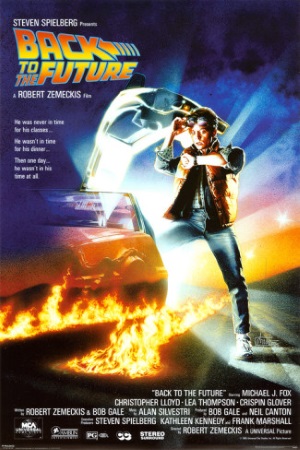
Back to the Future (1985)

Spaceman From Pluto

***This Review Contains Spoilers***

An aura of ‘cool’ permeates everything about Back to the Future. I could imagine seeing this film when it came out in 1985 (of course I wasn’t alive) and watching Marty McFly riding through Hill Valley on his skateboard while holding onto the back of a truck to The Power of Love by Huey Lewis and the News and thinking to myself, “omg, this is just the coolest film ever”. To me Marty McFly is the personification of cool, he rides skateboards, has a hot girlfriend, plays guitar. Yet his life is far from perfect; his dad is a dweb, his mum is an alcoholic and his uncle is in prison. This brings him down to a relatable level, plus he hangs out with a crazy old scientist. Why? I don’t want to know. I like the mystery of not knowing how this unconventional friendship came to be. The technical jargon between Marty and Doc is a never-ending pleasure to listen and even lines which shouldn’t be memorable are somehow highly quotable (“Wait a minute Doc, are you telling me that it’s 8:25…dam I’m late for school!”). Likewise taking the coolest looking, commercially available car and making that the time machine is yet another stroke of genius. Notice the scene in which we see the DeLorean for the first time; it’s impossible for Doc Brown to get inside the DeLorean while it is inside the truck so he would have had to get into the car and drive it into the truck and just wait there until Marty would show up and then drive it out and exit the car. I guess Doc thought he had made a time machine that looked so badass he really had to give it an impressive introduction to Marty. The whole movie has the best uses of product placements I’ve seen in a film; never before have I been happier to see advertisements for Pepsi and Texaco. The pacing of Back to the Future is perfect, the film never lets up; the odds keep stacking up against Marty and the suspense towards the end of the film is crazy.

Even though most of the film takes place in the 1950’s, Back To The Future is the film which defines the 1980’s. The ending in which Marty finds his family has been changed for the better and he gets the 4×4 vehicle he wanted; it’s a wish fulfilment fantasy and very much a capitalist, 80’s ideal. It’s an uplifting ending, providing you ignore the fact that Marty now has to adjust to living with a family he has no previous memory off. It makes sense that Marty goes back to the year 1955, the time period of when adolescence had a voice and began an economic force for the first time in history; plus just take a look at the title of what won Best Picture that year. Marty’s mother being attracted to her son is weirdly funny plus his mother being the opposite of her adult herself; makes you question your own parents claims about their day. I’m always struck by the moment when Marty tell his relatives in 1955 he has two TVs and they think he’s joking yet if you told someone in 1985 that households today own upwards of 6-7 TVs, they would have the same reaction.

Star Wars, Indiana Jones and Back To The Future; to me these are the trilogy of trilogies. The three film sagas I can watch again and again, always notice something new on each viewing, discussing every character to no end, coming up with crazy fan theories and trying to find an explanation to any possible plot hole. I’m sure there are still plenty of subtle gags, use of foreshadowing and who knows what lurked within this film which I still haven’t noticed. Is it possible for a film to be 100% perfect, one which has absolutely nothing wrong with it no matter how minuscule? I can’t think of another film (or series) which has a better use of repeating images and motifs. If I could only bring one DVD to a desert island, it would be my trilogy box set so I could spend my time uncovering every last secret in the trilogy. I love how self-contained the movies are; there are so closely connected to each other and the perfect film trilogy to watch in one go (as I have done several times).

But what is it that makes Back to the Future immensely beloved by such a wide audience? I can tell you why I love it but I have a weird and eccentric film taste. Perhaps it’s due to time travel is something we all fantasize about, as well as the idea of seeing your parents when they were young. The themes the film explores such as family, coming of age, the generation gap and the optimistic message of free will, that our future isn’t written; it’s whatever you make it.

To Be Continued…