
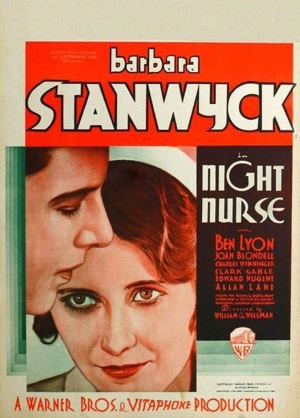
I’m Nick…the Chauffeur!
It doesn’t take long into Night Nurse to see the film isn’t a very positive portrayal of the health care service circa depression-era United States. Dr. Kildare this is not and even makes 1934’s Men In White come off as a more an idealised vision of the health care system in the 1930’s; Night Nurse is anything but. All within the picture’s first ten minutes Lora Hart (Barbara Stanwyck) is turned down for the job as a nurse but then gets it after catching the fancy from another doctor. Likewise one of the interns is a pervert and fellow nurse Maloney (Joan Blondell) recommends tricking patients into thinking you’ve saved their life in order to get money out of them. Blondell’s character, in particular, I really found myself loathing from an actress who normally played such likable characters. She clearly dislikes her profession and even recites the Florence Nightingale pledge while chewing gum – Night Nurse is a movie with a wide range of despicable human beings on display. There is even a scene which appears to show an actual baby in distress and another in which children talk about in graphic terms of the mental and physical abuse they and their dead sister have received – not very comfortable viewing.
Director William Wellman was one of the most interesting filmmakers during the pre-code era, whose film’s go against the conception of movies from the early 1930s being static and lacking camera movement or fluidity. Night Nurse is a perfect example of the kind of pictures Warner Bros produced during the 1930’s; a thought-provoking socially conscious melodrama. Whether or not it’s exaggerated, the plot of hospital corruption and the ineffectiveness of both the hospital and the authorities to prevent child abuse, the movie does succeed in packing a punch. What does it say when the intervention of gangsters, people working outside the law are required to save the lives of two children? Warner Bros was also known for featuring ethnic casts in their movies. At the beginning of the movie a shot focuses on a group of Chinese people sitting around a hospital bed speaking in their native language, helping to set the film’s gritty mood. There is also an emphasises later in the film that the shop which is broken into in order to steal milk for a bath in order to save the lives of malnourished children is from a Kosher delicatessen. Is there a particular reason for this? This was 1931 but history has made of this scene of the delicatessen windows being smashed unintentional creepy.
The other major reason to watch Night Nurse is to see Clark Gable in the pre-stardom role of Nick the Chauffeur in his glorious 5 minutes and 25 seconds (approx) of screen time (yes, I timed it). The film builds up to his reveal with the name of this unscrupulous “Nick” being thrown around. His character’s introduction with the use of a camera zoom and the uttering of “I’m Nick…the chauffeur” gives me chills in one of the most memorable moments in pre-code cinema. Gable is scary enough as a dominating brute who wants to murder children and isn’t afraid to punch women or the elderly but this is multiplied by the fact that he’s dressed like a Nazi. Ok not really, it’s a chauffeur’s uniform but when I first saw him wearing this, my instant reaction was “Why is he dressed like an SS officer?” (likewise, just as equally striking is his costume choice of a black kimono). The role of Nick is an odd duckling in the career of Gable which shown he had the knack for playing terrifying villains – such unrealised potential. As much as the man’s appearance in the background is enough to make you go, “oh s—t!”, and in a big way sister.
 Sat In Your Lap