Double Indemnity (1944)

Flawless Film Making, Baby!

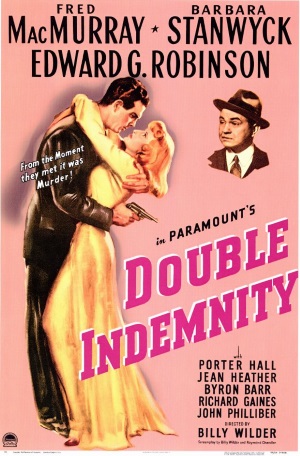
If there is a keyword I would describe Double Indemnity, its dialogue. Exposition is a very tricky line to cross; when done poorly it can come off as immensely frustrating but when done right it can be music to the ears, leaving me dying to hear more like I’m watching an engrossing documentary. Throughout Double Indemnity with the use of narration, Fred MacMurray will explain what’s clearly appearing in the frame but as nobody does narration quite like Billy Wilder. Instead of making Double Indemnity coming off as a movie which feels the need to dumb down and explain everything to the viewer, this expositional narration comes off a poetry, enhancing any scene in the film. Even with hearing noir dialogue parodied countless times, it doesn’t affect my enjoyment of the movie.

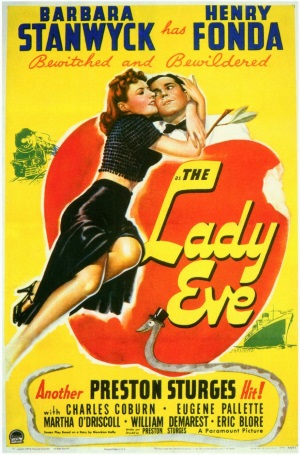
I’ve generally never thought much of Fred MacMurray as an actor; he strikes me as serviceable but never an enigmatic screen presence. His role as Walter Neff in Double Indemnity is the one major exception in his career. This casting against type may be my favourite one-hit wonder performance ever; his uttering of the words “Baby” and “Hello Keyes” never gets old. When I first watched Double Indemnity I assumed MacMurray must have been an icon of film noir, turns out he was anything but. Barbara Stanwyck was a sexual siren in a number of her films, I’m not aware of what Stanwyck’s ideological or moral beliefs where but a number of her films are some of most sexually suggestive old Hollywood films I’ve seen. There is her pre-code work such as Baby Face but in the postcode era, she appeared in the code breakers Ball of Fire, The Lady Eve and yes, Double Indemnity. In her introduction scene as Phyllis Dietrichson, she is dressed in a titillating manner with her legs crossed while wearing a skirt, almost expecting her to pull off a Sharon Stone in Basic Instinct. Culminating this trio of actors at some of their greatest work is Edward G. Robinson as Barton Keyes, the claims expert. When watching his performance I don’t feel like I’m watching someone playing a claims expert, I feel like I’m watching an actual claims expert. Double Indemnity offers an intriguing insight into the profession of the insurance salesman but like being a lawyer, I’m sure this is one job which Hollywood makes out to be more exciting than it actually is.

Like a number of films in the noir genre, the ending is revealed at the beginning of the movie, leaving me not wanting to know how the film ends but rather how the story and characters got to that point and boy, am I dying to know. For an example of one of the film’s suspenseful scenes, take the moment in which Phyllis arrives at Walter’s apartment to discover Keyes is also there. All within a single frame Phyllis is hiding behind the door with Walter trying to prop it open and Keyes in the background. When Keyes walks towards the door and there is a bump in the music score, it’s moments like these which get the blood rushing, yet they look so deceptively simple.

Why do Phyllis and Walter agree that honking a car horn three times a signal when that would easily draw attention? When a plot hole or nonsensical moment (Or Barbara Stanwyck’s wig) doesn’t bother me in the slightest, it’s a testament to how great a movie is: not affecting the movie’s heart racing, tearing the leather of the sofa’s armrest levels of suspense from start to finish. Why are so many people dismissive of old movies? Because they are corny and cheesy? Few other movies pose such an aurora of cool as Double Indemnity, baby!

Anchors Aweigh (1945)

Join the Navy!

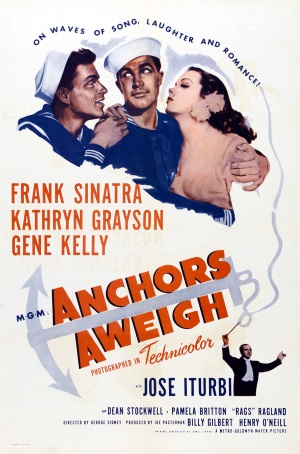
Anchors Aweigh is the first film of the Frank Sinatra-Gene Kelly trilogy, tapping into the odd fascination the classic Hollywood musical had with sailors. It wouldn’t be the last time Kelly or Sinatra would play a sailor and what an underrated comedic duo they are. Gene Kelly is so loveably egocentric, constantly lying about his exploits with dames and rubbing the fact that he got ship leave in his comrades’ faces, so much so that he sings a musical number about it – the interactions he shares with Sinatra are priceless. If the accounts are to be believed, reportedly Kelly was known in real life for being a control freak and getting his own way, so I wonder how much of his personality is reflective in this performance. Frank Sinatra is largely the opposite of Kelly, girl shy and completely gawky, a stark contrast to what he later became; he sure toughened up over time.

Anchors Aweigh came around the beginning of a new era of film musicals, at a time when the genre became almost exclusively one filmed in colour and as the distinctive style of the MGM musical took off, separating them from the likes of the Astaire & Rodgers musicals of the past. Unlike Fred Astaire, Gene Kelly was “off the people”, usually playing commoners on screen. Fred Astaire did play a sailor in Follow the Fleet but no doubt Gene Kelly suits the role better. Perhaps the film’s greatest highlight is Gene Kelly dancing with Jerry of Tom & Jerry fame. It might not be as technically advanced or as smoothly animated as later live-action/animation hybrids but it’s one of the most awe-inspiring (the animators even make note to include Jerry’s reflection on the floor). The studio originally wanted Disney to allow them use of Mickey Mouse for the number, which seems very hard to believe. The film’s inclusion of some very Disney-looking animated creatures, including two which look suspiciously like Bambi and Thumper, suggests the studio was serious about including Mickey.

The other unique aspect of Anchors Aweigh is the documentary-like look at MGM studios circa 1945 during one portion of the film. A peek inside the dream factory itself, with people in costume, props everywhere and what look like studio workers in suits going about their business. It’s unabashed self-promotion but hey, it’s one entertaining commercial. This use of on-location filming including the scenes as the Hollywood Bowl show shades of what was come several years later in On the Town. I do wish they though could have shown some more of 1945 Hollywood but the sets present in Anchors Aweigh are something to marvel at. Even with the odd background which is clearly two painted backdrops placed side by side with a dividing line clearly visible, the sets create a cartoon-like Technicolor world that you wish real life could look like; just look at that set of the Spanish part of town; such artificial beauty.

The only downside to Anchors Aweigh which prevents it from being a greater film is the runtime and much of this is largely due to the amount of which is spent in the house of Kathryn Grayson’s character; I really started to get sick of the sight of it, especially since the movie takes place in Hollywood and there are places so much more interesting they could be. The characters keep returning to the house several times throughout the movie, which wouldn’t be such a problem if it wasn’t for the large chunk of time that was spent there when they first arrived at it – by far the most frustrating aspect of the film. Thankfully the good outweighs the bad and the good isn’t just good, it’s amazingly good. There’s really no dud musical number present, they’re all so very, very beautiful.

All Through the Night (1941)

A Mixture of Action Und Comedy

Bogart: Let’s Get Silly!

Mixing up so many genres into a single movie could potentially be a disaster yet I’ve perhaps never seen a better genre mash-up than All Through the Night. I’m astounded at this movie’s ability to have a bit of everything and pull it off so immaculately; bouncing back and forth between drama, comedy, action, murder mystery and even film noir. All Through the Night is the closest thing to a Hitchcock movie starring Humphrey Bogart in which an ordinary man gets caught up in espionage and becomes a fugitive for a crime he didn’t commit, with moments in the film such as the auction scene or Bogart deliberately getting arrested by police directly reminded me of North by Northwest; likewise the movie even stars Judith Anderson in the Mrs. Danvers hairstyle from Rebecca while Bogart’s exploits against the movie’s Nazi villains gives an urban Indiana Jones edge to the film. Even the movie’s final climatic moment had me on the edge of my seat and thinking to myself “how is he going to get out of this?!”. One top of that the film gets an additional boast with some truly superb use of shadows and lighting; All Through the Night really exemplifies the unique look of Warner Bros. movies of the 30’s and 40’s.

I may sound hyperbolic but the more I think about it, the role of Gloves Donahue may be the greatest performance of Bogart’s career; why you ask, versatility! Just like the tone of the film he is able to continually bounce back between being serious to just downright silly. Bogart has made me laugh during comedic moments in his other movies but I never knew he could make me laugh this side splittingly hard; from subtle moments such as throwing the reserved sign off a table in a nightclub to the more obvious in which he infiltrates and stalls a secret Nazi meeting. At another point he delivers the line “More here than meets the FBI”; I do love me a corny pun but with Bogart delivering it just makes it funnier – All Through the Night makes me wish he had starred in more comedies.

On top of all that, the character he plays is a momma’s boy yet he’s still badass! I find this aspect of his character is hilarious in itself. There’s something adorable about a tough guy who wears dotted bathrobes and loves cheesecake so much; exemplified even more with his mother being played by the ever motherly Jane Darwell. All Through the Night features a large selection of character actors at some of their best work and even features a young Jackie Gleason in one of his earliest film roles; what more secrets does this movie hold? If I was to find any point of contention with All Through the Night I wouldn’t have minded seeing a bit romance between Bogart and Kaaren Verne, but with a film that has this much merit, it’s hard to complain.

All Through the Night is an anti-Nazi propaganda film and an effective one at that. I find the satire here is on par with The Great Dictator and To Be or Not Be as the movie pokes fun at Nazi ideology. The leader of the branch of Nazi spies is portrayed by Conrad Veidt whom there was probably no one better at the time to play evil Nazis. Gloves Donahue is also a minor gangster which reflects the attitude of real-life gangsters of the time who worked with the government to infiltrate Nazi spies. One scene in the film involves Bogart giving a chilling monologue on how the Nazis will take people’s freedoms away in an argument against US isolationism in the ongoing war in Europe; all this however without even mentioning the word Nazi once throughout the film. Another interesting aspect of the film is the mentioning of an actual concentration camp Dachau. Being released in 1941 before the true nature of the camps where discovered, this is one moment I found quite chilling. All Through the Night was released in the US only 5 days before the attack on Pearl Harbor, although Warner Bros. had already long established themselves as an anti-Nazi studio.

By the time I watched All Through the Night I had already seen all of Bogart’s major movies and figured I was largely finished exploring the actor’s filmography, thus it came as such a delight discovering this obscure gem which satisfied me more than many of his more famous movies. This is the type of movie which makes me want to scream out, “Why the hell is this not more well known?!”, but then again its moments like these in which I live to be a cinephile.