Departures [おくりびと/Okuribito] (2008)

To The Faithful Departed

***This Review Contains Spoilers***

Cultures across the globe have different approaches to how they deal with their deceased. In my own Irish culture, it’s normal practice for the body of the deceased to be on open display prior to the closing of the casket, which, to my surprise, isn’t even the case across the sea in Great Britain. However, if there is one thing which is consistent amongst many cultures, it’s the taboo nature of death as a topic of discussion. In the anglosphere, people don’t even like to use blunt language as “dead people”, rather opting for language such as “passed away”, the late…”, “the departed”, “the deceased” or “those no longer with us”. Departures (おくりびと/Okuribito – “one who sends off“) is the only film I’ve ever seen about those who hold the job of handling bodies of the departed, well, at least in a serious manner (Night Shift, Weekend At Bernies).
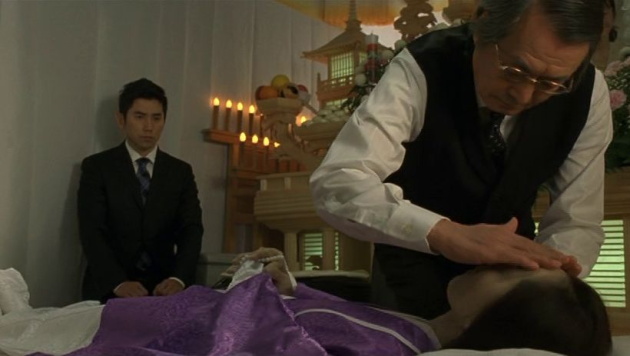
Departures depicts men known as Nōkanshi and details their custom of ‘encoffining’, in which the body is prepared for its so-called departure. This is accomplished through a procedure of cleaning, dressing and applying make-up; there is such a level of dignity, grace and even an artisanal nature to the procedure as it is performed with such intricate precision (even when it involves a man undressing a woman and touching her body). In a way, the procedure brings life back to the body, as the application of makeup returns colour to the face after the blood has been drained from the face.
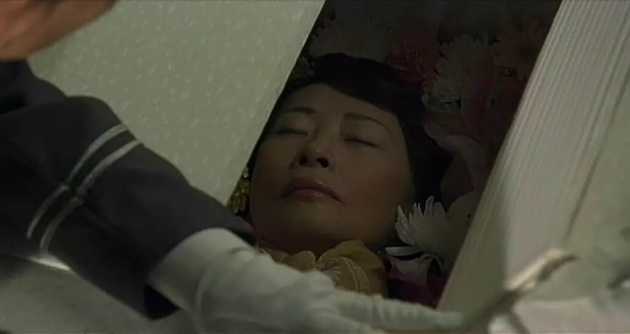
However, despite the importance of death rituals in Japanese culture, the subject is considered “unclean” as everything related to death is thought to be a source of “kegare” (defilement). This is the contradiction at the core of Departures: a job which is so vital and dealing with something so universal, yet those who perform it are scorned upon and discriminated against. Daigo Kobayashi (Masahiro Motoki) is only one of three employees at the encoffining company NK Agent, alongside his world-weary Freudian father-figure boss Ikeui (Tsutomu Yamazaki) and the secretary Yuriko (Kimiko Uemura), whom is herself a social outcast. Daigo is even openly insulted by a patron during an encoffining ceremony, while an old friend, Yamashita (Tetta Sugimoto), highly chastises Daigo upon learning of his profession. Well, that is until his own mother dies and he receives a metaphorical comeuppance. This discriminatory treatment reaches its zenith when Daigo’s Mika (Ryoko Hirosue) wife, temporarily leaves him upon discovering what he does. From an outsider’s cultural perspective, it’s hard not to feel that the reactions Daigo receives are anything but unreasonable (but I understand that I come from a particular perspective).

That being said, Daigo does receive praise from patrons during the course of the film for his work. This ties into the other (albeit positive) irony within Departures, that a man finds meaning in life through death. At the beginning of the film, Daigo is devastated to lose his job as a cello player in a Tokyo orchestra, as few people are attending their performances. This has been a lifelong ambition of Daigo as he has been playing the instrument since kindergarten (“You professional cello player yet?!”). This death of his music career, however, yields a new career, as just like in the real world, life doesn’t always turn out how we planned it (“What I’d always taken as my dream maybe hadn’t been one after all”). With so many people in the world stuck in dead-end (pardon the pun) jobs, Departures really showcases the importance of finding deep meaning and purpose in one’s work, and just what a spiritual privilege that can be.
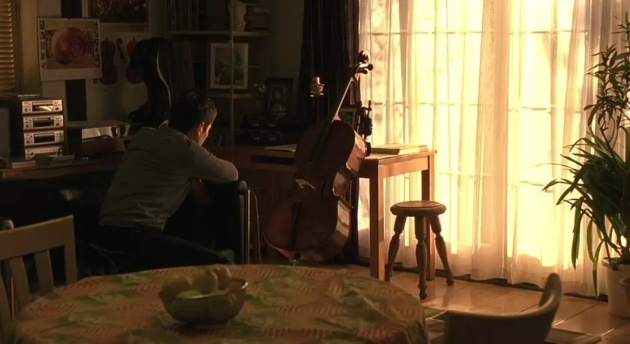
Despite the subject matter, Departures is not a dour film, far from it. In fact, upon watching again, I was surprised to find the film rather funny. From Daigo wearing a giant diaper to film an instructional video, to live octopus antics in the kitchen, Departures injects an appropriate degree of levity, but not in a way to break the mood. Even during the opening scene, Daigo discovers the deceased person in question was actually a gender dysphoric male once he discovers she has “a thing”, leading to a funny exchange between Daigo and his boss (but not in a way which feels inappropriate or out of place). This levity also extends to the film’s montage, in which the complete spectrum of people dealing with grief is displayed. One funeral sees a family laughing with tears of joy and leaving lipstick marks on the face of their deceased patriarch, while another family happily proclaims “bye-bye” and “thank you for everything” to their grandmother while she wears her favourite socks (really putting the fun in funeral). On the other end of the spectrum, the POV shot from the deceased Christian boy as the lid is slid over the coffin into darkness gives me goosebumps. Likewise, the emphasis of the cello in the film’s narrative not only ties in with the Japanese love of European classical music but also influences the music score. Composer Joe Hisaishi emphasises the use of cellos in his score of which he described the challenge of centring a score around the cello as one of the most difficult things he had ever done.

In a classic “would probably never happen in real life” scenario, Departures concludes with Daigo performing an encoffining for his estranged father, who left himself and his mother for a waitress when he was a child. Daigo finds in the hands of his father’s deceased body a rock (a counter piece to a rock his father gave him as a child to symbolise their bond), showing that he never forgot about his son and thus acting as a form of redemption for this deadbeat father. Although I do have to question if this is enough to really redeem his character, should there have been evidence for more active measures by his character in order to achieve redemption? Regardless, as presented in the film, one can view it through either the Eastern notion of forgiveness vs the Western Christian notion of forgiveness.

Forgiveness doesn’t erase karma, but it helps release attachment and hate vs “Forgive us our trespasses as we forgive those who trespass against us”.

The Nostalgia Critic (2007-Present)

“What Happened To You Man? You used to have strong plentiful balls”: Ma-ti – Battlefield Earth Review

Back in 2007, an episode of The Angry Video Game Nerd involved the titular character reviewing the movie Teenage Mutant Ninja Turtles III. This was a change of pace to his regular videos as he would normally only review video games, however, I particularly loved this one video and wish he could have done more like this, or that someone would come around and be The Angry Video Game Nerd of movies. In a number of respects, this was The Nostalgia Critic (portrayed by Doug Walker). This is what first attracted me to the series when I first discovered it in 2009, and after watching a few episodes I was hooked. The series debuted on YouTube in 2007 before moving to Doug Walker’s own site That Guy With the Glasses.com (later re-titled Channel Awesome), a website which showcased of people involved in the increasingly popular genre of satirical reviews.

That Guy With the Glasses wasn’t entertainment being churned out by a corporation or by Hollywood executives, it was entertainment for the people by the people with no concern for financial gain but creating content purely out of passion which could be shared with a mass audience thanks to this thing known as the internet. I had my own aspirations to be on TGWTG, of course, nothing ever materialized, but to even be a follower of the site it felt like being part of something truly special and unique. All the great personalities the site had to offer; Spoony, Angry Joe, Todd in the Shadows, Linkara, Paw, Film Brain – the list goes on. Online videos like these have more heart, soul, and personality than contemporary Hollywood blockbusters or anything currently on TV.

But let’s talk about The Nostalgia Critic. Doug Walker was a natural comedian, he made the art of reviewing while cracking jokes, pop culture references and comedic over reactions look easy. Surf Ninjas is my favourite NC review, I have watched a good 30 times; a masterpiece of sarcasm. I remember I used to stay up on Tuesday nights to see each new video as soon as it was uploaded and I considered Doug Walker to be one of my comedic influences.

Various ex-fans of The Nostalgia Critic have different dates as to when he went downhill, so I can’t speak for everyone, but for me personally, 2011 was the beginning of the end. Right from the start of 2011, the cracks were showing. Sequel month was a lazy idea, just rehashing previous review source material, but I presumed this would just be a minor blip. Despite a few good videos over the following year, the quality had declined. Also while I absolutely adored the two year anniversary special Kickassia, the following anniversary special in 2011 Suburban Knights simply wasn’t funny, not to mention it felt like a very anti-climatic follow up to Kickassia in which they made the special in cooperation with an actual micro-nation. Going from something as large-scale and ambitious as that to a special filmed is suburban neighborhood felt like a bummer. When Star Trek month rolled around in January 2012 I gave up. Now at this point, The Nostalgia Critic’s video wasn’t awful, but more so just really boring.

I was glad when Doug brought the series to an end in August 2012 and began a new project called Demo Reel. Perhaps Demo Reel had potential but what I have watched of it is seriously dull; although at least it was something different and showed Doug didn’t want to be The Critic all his life. However, due to the failure of Demo Reel Doug revived The Nostalgia Critic. I haven’t seen everything he has done since the series revival but what I have is unbelievably awful. For this review, I had to try and watch more recent videos of his which I hadn’t seen, and doing so was the biggest chore, such a contrast to his older work which had such a natural progression and the best of which were consistently funny from beginning to end.

A rundown of the problems with The Nostalgia Critic beginning in 2011 and spiraling out of control in 2012:

Firstly he started going to way of MTV, he’s become The Nostalgia Critic in name only. This problem began in October 2011 when he reviewed Exorcist II: The Heretic and Book of Shadows: Blair Witch 2; two films totally outside of his territory as there’s nothing nostalgic about them to the Critic’s target audience. He once had cut off date of 2000 (aside from the odd exception), however now it’s clear he’s run out of nostalgic movies and TV shows from his time frame and now reviews whatever he wants. He was at his best reviewing stupid and nonsensical Movies and TV shows from the 80’s and 90’s; that was the kind of material that worked best with his brand of humor.

His jokes are now forced beyond belief, an example? In his Top 11 F-Ups Part 3, he makes a joke about how people get the titles of Star Wars: Return of the Jedi and Revenge of the Sith mixed up. Not only is this joke shoehorned in out of nowhere, it’s creating a situation that doesn’t even exist. However it’s bad enough when a joke is unfunny and forced, it’s even worse if it goes on for ages. I don’t mind long jokes if they’re done well as Doug himself has done so in the past such as the dream sequence in the Junior review. For an example of a joke which goes on for an eternity; the “Allen” gag in his Jurassic Park III review. I was in a state of disbelief and non-existent laughter at just how long it lasts. I could make a huge list of the individual jokes in his new videos and why each one doesn’t work.

Other reviews are simply unpleasant, hateful and mean-spirited. In his review of Eight Crazy Nights, he had recurring gag throughout the video making fun of Happy Madison fans as lowest common denominator yokels. Regardless of how terrible Happy Madison films are, I did not start watching this guy’s videos in the first place to see such mean-spirited gags such as this.

The other major source of increasing annoyance is the lack of research he does for his videos. In his Patch Adams review he clearly has no knowledge of film’s subject matter, or in his Jurassic Park review, he criticizes the science present in the film and even has a sketch about it despite having no apparent knowledge of it. This brings me to what annoys me most of what the critic has now become. He’s become a self-righteous know-it-all jerk, and not in an intentional self-aware funny way. His review of Patch Adams is just one huge snob fest, while in his reviews of generally well-liked films (Jurassic Park, Indiana Jones and the Temple of Doom, The Matrix), he parades like his opinion is fact even though his criticisms on these films are just stupid nitpicking. There was once a time when watching a Nostalgia Critic review was simply fun, now it’s about having Doug Walker’s self-righteous, poorly researched, incorrect or simply illogical statements shoved down your throat. The dividing line between Doug and his fictional creation is becoming increasingly blurred; in his Top 11 F-Ups Part 3 he makes a list entry related to videos he made speaking as himself and not the Critic.

Since Demo Reel failed the people Doug has hired to appear in that show are now regulars on the revived series of The Nostalgia Citric, and none of them of any charisma; it makes me miss the days of Ma-ti. His new videos also look too sterile and washed out; what happened to that warm inviting yellow background?

He’s also stopped using creative title cards and instead now uses lazy photoshopped title cards; ironic considering in his Drew Struzan tribute he criticized movie studios for using lazy, uninspired photoshopped movie posters. Also, all these new title cards have an exaggerated facial expression from Doug which is increasingly obnoxious. I’m sure there are many other problems I could mention, but trying to watch his more recent videos for the sake of this review is excruciating with how bad they are.

Then there’s his NC: Editorials. These annoy me for two reasons. Firstly it’s the constant retreading of this mentality that you’re simply blinded by nostalgia if you dislike some aspect of contemporary popular culture. Secondly, they’re pretentious, giving an over important emphasis to questions no one was asking the answers to (Is It Right to Nitpick? Why Do We Love Stupid?), or questions which have obvious answers (Have we gone too deep into CGI?, Why Is Tom & Jerry Genius?).

I can’t comment on the current state of other TGWTG contributors as I gave up on the site as a whole long ago (expect Todd In the Shadows who is the only one I still watch), but I know some of the longtime members such as The Nostalgia Chick, Oancitizen, Phealous, and Obscurus Lupa are no longer there.

When writing this review I was wondering if it was a mistake to undertake as I much prefer to write reviews of stuff I love instead of contributing to an internet full of negativity, but this show used to mean so much to me and bring me such joy, now it does the complete opposite. I have witnessed two things in my life degrade from being something I loved so dearly to becoming one of the worst pieces of so-called “entertainment” I have ever seen – The Simpsons and The Nostalgia Critic. It’s hard to watch his old videos now without thinking about what a joke he is now. Congratulations Doug on destroying your own creation.

Dig Out Your Soul (2008)

Do Believe the Truth!

Alas! A great Oasis album! The best Oasis album since Be Here Now (yes I am a “best since Be Here Now” person, not a “best since Morning Glory” person) one which is great from start to finish, unlike the patchy efforts of Heathen Chemistry and Don’t Believe the Truth.  Dig Out Your Soul is the most ambitious Oasis album since Be Here Now. Their previous three albums missed the large-scale orchestras and choirs present in their 90’s output and instead relied more on the acoustic side of things. Dig Out Your Soul brought it all back, creating the most richly textured Oasis album – one soaked in a trippy, psychedelic, moody, 60s-inspired atmosphere.

The first good sign with Dig Out Your Soul is the album cover – it rocks! I haven’t seen an Oasis album cover that good since The Masterplan but onto the actual songs, the first two tracks are excellent and they’re not singles. The structure of Bag It Up reminds me of Rock ‘n’ Roll Star in how the final portion of the song has no vocals with epic over-the-top instrumentation. This along with The Turning and The Shock of Lightning are the most balls-to-the-wall rockers Oasis has done since the 90’s. Waiting For the Rapture is a good mid-tempo rocker, although I do feel the demo version is more atmospheric. Likewise,  I consider I’m Outta Time to be the best song Liam ever wrote. Oasis isn’t the first band to come to mind when I think of love songs; with several of their songs such as Wonderwall, I’m unsure whether they would be classified as love songs but this is one song which can undeniably be classified as such and such a beauty at that. Falling Down is one of Noel’s finest accomplishments, showcasing Oasis’ vision of the apocalypse. It’s strangely prophetic this dark and brooding song would be Oasis’ final single, as well as with the album as a whole; signalling the final days of a band whose popularity was shrinking. The album still isn’t without its weak songs, coming in the form of Ain’t Got Nothin’ and The Nature of Reality. With the latter, I can tell you a lot of Oasis fans hate this song with a passion: Me? I think it’s more mediocre than terrible.

The other important aspect of Dig Out Your Soul which I’ve not heard anyone else mention is this may be a concept album, or at least that’s the impression I get. The songs tell a story of an impending apocalypse as we are told to “Bag It Up” because we are “Waiting for The Rapture” which occurs with “The Shock of the Lightning”. The use of a John Lennon quote sampled in I’m Outta Time reinforces the apocalyptic theme (“It’s every Englishman’s inalienable right to live where the hell he likes. What’s it going to do, vanish? It’s not going to be there when I get back.”), even more so as Lennon said this shortly before his own untimely death in 1980. The album’s remaining songs deal with the aftermath of the apocalypse such as the alien-sounding (Get Off Your) High Horse Lady and To Be Where There’s Life (I believe the title of that one explains itself). This all culminates in the album’s final song Soldier On, which we will carry onwards, until the very end.

Dig Out Your Soul can proudly sit beside Oasis’ first three albums and partially makes up for the band’s lackluster run during the 2000’s, but hey, we don’t look back in anger, I heard you say.

Oasis:  1991 – 2009


Dig Out Your Soul Era B-Sides and Rarities

In 2005 CD singles were on their last legs, by 2008/9 they had all but gone, becoming designated to collector’s items. With the three singles to come of Dig Out Your Soul, only one B-side was produced. Those Swollen Hand Blues from the Falling Down single – a good trippy, psychedelic number. The box set of Dig Out Your Soul contained a CD of bonus material comprised of alternative versions of songs, remixes and two alum outtakes, Boy With The Blues and I Believe In All. The rarities produced for Dig Out Your Soul won’t give the likes of Live Forever a run for their money but they are with unearthing.