Pirates of the Caribbean: At World’s End (2007)

Bored and Confused

For my money Pirates of the Caribbean: At World’s End represents everything wrong in contemporary blockbuster cinema and anyone who paid money to go and see is contributing to the decline of western civilization; unfortunately that also includes me resulting in the single most boring, confusing and frustrating movie I ever had the misfortune of viewing and in a movie theatre no less! For beginners, the movie’s opening scene which shows people including children being hanged should act as a metaphor for the next 168 minutes of terror.

A $300 million dollar budget, and for what? Huge CGI battle sequences with characters I couldn’t give a monkeys about fighting each other, well actually I take that back because I don’t even know what they’re fighting about. This movie is like the First World War, nobody knows what it’s all about. I enjoyed the first installment of this franchise was disappointed with the sequel due to its incomprehensible plot but At World’s End goes beyond that. I literally don’t have a clue what is going on. Whose side anyone is on? Who’s that guy? Why are they going to this place? What’s that thing? Even reading the movie’s plot on Wikipedia I can’t get my read around it but then again they did start shooting the film before a script was completed.

While I enjoyed Johnny Depp’s performance in the first two movies here he is, no apologies, annoying; very, very annoying. When we are first introduced to Jack Sparrow in this film it isn’t just one Jack Sparrow, there are dozens of Jack Sparrows and they won’t shut up. Too much a good thing, way too much! One scene which particular aggravated me is when a bunch of characters are sitting around a table debating who knows what and it goes on for an eternity. It’s like 12 Angry Men, except it’s not and there’s only one angry man, me, watching the dam thing. I tend to avoid using the word hate unless I really mean it but few other movies have enraged me as much as this “movie”. I know every movie on the IMDB boards has a topic in which some proclaims it as the worst film they’ve ever seen but Pirates of the Caribbean: At World’s End really is one of the absolute worst films I’ve ever seen.

Indiana Jones and the Temple of Doom (1984)

Fortune & Glory

***This Review Contains Spoilers***

Ah, Indiana Jones and the Temple of Doom. One of those films which I thought was beloved for many years until the advent of the internet in which I discovered it actually gets a lot of stick. Well never fear Temple of Doom, as I am here to defend you against waves of undeserved criticism. So hold onto yo potatoes, it’s time for a controversial review of unpopular opinion.

I’ll begin my defense of Temple of Doom by discussing the movie’s two not so beloved supporting characters. First up its Short Round as delightfully played by child actor Jonathan Ke Quan. I love Short round for several reasons with the first being the endearing relationship he shares with Indiana Jones. Unlike Indy’s other companions, Short Round idolizes Indy. The moment in which Indy places Short Round’s cap on his head after freeing him from the Thuggee cult’s spell perfectly sums up their relationship and it gets me every time. Short Round saves Indy’s life on multiple occasions; In fact, sometimes I wonder how he’s even still alive without him. In comparison to a more beloved character in the series, Henry Jones senior, who almost gets Indy killed on a number of occasions thus rendering the criticism of Short Round being a hindrance to Indy invalid. But I hear you say, Short Round has an annoying voice? – Not at all. Short projects a voice of juvenile innocence and adventure. Short Round is like a kid’s fantasy, what’s cooler than getting to be Indiana Jones’ sidekick? Who wouldn’t want to be Short Round? Well, I’d rather be Indy himself, but being Short Round is the next best thing.

But how do I defend Willie Scott?! This bastion of female serotypes! Oh please, quit the feminist double standard. Outrage is none existent when a character exhibits male stereotypes (not that there should be). Shouldn’t true equality between the sexes allow for a female character to be portrayed as incompetent rather than imposing creative limitations on how women can be portrayed in fiction.

For those who call Willie annoying; well let’s agree to disagree. I’ve never found the character of Willie to be annoying and I believe one of the reasons for this is that she is punished for her selfish actions throughout the film. Her character is supposed to be unlikeable and the movie is fully aware of this by making her receive comeuppance. Willie holds some similarities with Marilyn Monroe in Gentlemen Prefer Blondes with her preoccupation with diamonds and her intention to get rich by marrying a particular wealthy gentleman, only to find out they’re a child. Just like Monroe, Capshaw displays a wide range of facial expressions and excels in her comedic timing. During the movie Willie matures, she shows concern for Indy and Short Round during the later portion of the film and even punches bad guys during the mine cart chase, a far cry from her earlier self. I love this trio of characters, so yeah, what are you going to do about it?!

Temple of Doom begins not with the build-up to an action scene but rather a musical number (with the opening shot of the gong is surely a little tribute to the Rank Organisation). I’ve never heard every rendition of Cole Porter’s Anything Goes but surely this has to be the best version of the tune with Kate Capshaw singing it in Mandarin. The superb rendition of the song along with the dance choreography, the costumes and shear sparkling on-screen, this may be the greatest musical number from a non-musical film. It might seem odd to start an Indiana Jones movie with a musical number but as it captures the 1930’s setting and exotic tone of the series so against the odds it works and works magnificently. Temple of Doom even serves as a travelogue for India with its gorgeous landscapes, accompanied by John Williams at his most exotic.

Temple of Doom is a film that doesn’t beat about the bush and gets over the top very quickly. This is another aspect that sets it apart from Raiders and Last Crusade as the action in Temple of Doom is the least plausible from the original three movies; hence why moments such as the trio escaping from the plane via jumping out of it on a rubber raft come under criticism. However, I believe there’s a fine line between action being implausible but not the point in which you can’t suspend your disbelief (yes I’m looking at you Nuke the Fridge) and I feel Temple of Doom achieves this fine line. The second half of Temple of Doom is one huge roller coaster ride with many classic B-movie and adventure serial pitfalls; a room with a descending spiked roof, a conveyor belt with a crushing roller at the end, a scene atop a rope bridge and the best of all, the mine cart chase sequence – an absolute master class of action movie filmmaking. After the trio escape from metaphorical hell, the final kiss between Indy and Willie is one of the most satisfying in all of cinema.

Temple of Doom is too juvenile you say? You’re saying juvenile like it’s a bad thing. I like all the weird creepy stuff; the bugs, the monkey brains, hearts being ripped out of people’s chests. It’s repulsive in the best sense of the word. But Temple of Doom isn’t a stupid film. No one ever seems to mention Indy’s character arc of overcoming his selfish streak. During the first half of the film, he is only concerned with obtaining his “fortune and glory”. Even after visiting the baron village and obtaining the Sankara Stones, his personal gain remains his only objective. It’s not until he sees with his own eyes the children in slave labour that he changes his ways. Likewise, people praise The Empire Strikes Back for being “dark”, why doesn’t this logic of darkness being synonymous with quality not work for Temple of Doom?

But let’s get into the real serious stuff – the film’s portrayal of Hinduism. I don’t claim to be an expert on Hinduism but I’ll attempt to the best of my ability to defend this most controversial aspect of the film. The villains of Temple of Doom, The Thuggee, were a cult who resided in India over several hundred years who would strangle travelers and steal their belongings (hence the origin of the term ‘thug’). The Thuggee were followers of the Hindu Goddess Kali, however, in Hinduism, Kali is not an evil entity, but rather the goddess of time, change and energy. As what The Thuggee believes is not what Kahali stands for, it makes the villains more interesting as they religious extremists, desecrating a faith for their own selfish gain, such as The Westro Baptist Church to Christianity or Isis to Islam. I believe the filmmakers are aware of this, as evident in the scene towards the end of the film on the dangling rope bridge. Just before Indy sends Mola Ram to his death, he utters “You betrayed Kali!”. Raiders and Last Crusade both show that the God of Christianity exists in the Indiana Jones universe. Does the spiritual power to the Shankara Stones lend legitimacy to Hinduism then?

Then you’ve got the usual crowd with their screams of “racism!”. Does the movie have a stereotypical portrayal of Indians? I don’t see Raiders or Last Crusade having such a loving portrayal of the German people but of course, they’re white so it doesn’t count. I’m sick of engaging in this game. When a film is labeled for apparent racism I think to myself, was there malicious intent behind it? Temple of Doom doesn’t give into any pretense of political correctness with its white saviour protagonist, touchy religious subject matter and stereotypical female lead; deal with it.

I consider Temple of Doom to be no less worthy of a film than Raiders or Last Crusade. Like how Temple of Doom dared to be different and the black sheep of the series, I dare not to bow to the will of popular opinion. What are you going to do about it!? For you see my opinion is always correct, except for the times when I am wrong, which is never.
Indiana Jones and the Last Crusade (1989)

Now That’s What I Call Archaeology!

***This Review Contains Spoilers***

Indiana Jones and the Last Crusade takes everything that made Raiders of the Lost Ark great to begin with and builds on top of that. Last Crusade is unquestionably my favourite of the series and the main reason for this being the role of Sean Connery as Indy’s father Henry Jones Sr, which I consider to be one of the greatest casting choices ever made. This casting was largely due to James Bond being one of the inspirations for Indiana Jones although oddly enough despite my love of Indiana Jones I’ve never been keen on the James Bond films. There’s something about father-son stories that I’ve always had a particular affection for and the relationship between Indy and his father is challenging to put into words how thematically in-depth it is. The search for the bond between father and son ends up becoming more important than the search for the grail

Their personalities differ from Henry being more of an academic and Indy being more of an adventurer (at the film’s beginning Indy is struggling to even find the time to grade his student’s papers), yet at heart, they are both giddy schoolboys. Their emotionally distant relationship is beautifully conveyed during their exchange on the airship in which Indy complains to his father about never being there for him. His father replies by asking him what does he want to talk about and Indy struggles to find a conversation point to dwell on. The tone of Henry’s response, “well what are you complaining about?!” sums it up beautifully. At the film’s climax when Henry finally calls his son Indiana rather than Junior, it gives me chills alongside his words of “Let it go” as legitimate advice I apply to many real-life situations (when has a James Bond movie had anything as remotely substantive as this?).

Their scenes together are so melancholic and full of complex emotions that further humanises the character of Indiana Jones. I really do think this may be the greatest pairing of two actors ever and when I contemplate on it. I also feel this is the best performance Harrison Ford ever gave in his career, never has he been able to convey such emotion on-screen (and impersonate and art-loving Scotsman). Ford is one of few actors who can make any normal line of dialogue into something memorable.

The Last Crusade is also a comedy classic in its own right from the North by Northwest type moments (“No ticket!”) to more slapstick-oriented gags. The Hitchcock influence even extends to borrowing a moment from The Lady Vanishes in which young Indy escapes from a train via a magician’s box. Likewise, the Forest Gump type moment in which Indy inadvertently confronts Hitler face to face is brilliant on so many levels. – It works the same way the clothes hanger scene from Raiders did.

The supporting cast of players in the Last Crusade are second to none. Indy, Henry, Sallah (John Rhys-Davies) and Marcus Brody (Denholm Elliot) are simply so much fun to watch together on screen, with the clumsy Marcus going on the adventure (whereas in Raiders he is only seen at the beginning and end of the film) also really gives Last Crusade a big boost. Even his line “The pen is mightier than the sword” always cracks me up with the manner in which he delivers it in an English gentlemanly way, or Indy Sr’s uttering of “Junior!”; music to my ears. Likewise, I’m more than happy to listen to the eloquent and well-spoken Julian Glover as Walter Donavon as himself and Harrison Ford deliver exposition and tell each other “bedtime stories” (and subsequently transform into Doc Brown just before his untimely demise). Ernest Vogel (Michael Byrne) on the other hand is a completely two-dimensional villain in the best way possible with his intimidating presence as one really evil, tall, uniformed Nazi with a powerful music cue to introduce him in any scene. He has also has one of the most comical deaths in any film ever in a bizarrely campy two-second shot on him falling towards the camera. – Even the actor playing the Grail Knight (Robert Eddison) is mesmerizing in his brief part.

If I was the make a list of my favourite action scenes in film, I swear my list would be dominated by scenes from the original Star Wars trilogy and its sister franchise. Sequences such as that on the circus train or in the belly the steel beast make such clever use of props and their surroundings. Last Crusade was one of the last blockbusters to have such extensive use of practical effects, you know, before CGI had to go and ruin everything. Two years later Terminator 2 was released and things would never be the same again. As for the film’s music, the score by John Williams is not only one of his best but one of his most moving, perfectly capturing the melancholic and deep thematic nature of the film. I regularly listen to the movie’s soundtrack in moments of personal reflection, it’s that powerful.

Indiana Jones and the Last Crusade is one of those rare films which gives me everything I could ask for in a motion picture. Like the filmmakers specifically made it just for me, encapsulating everything I love about cinema. The final shot of the four characters riding off into the sunset brings to an end to a decade of filmmaking like no other.

Hot Fuzz (2007)

Proper Action and Sh*t

***This Review Contains Spoilers***

Hot Fuzz is my favourite comedy of the new millennium as well as in my top 5 favourite films of said era. I already thought Shaun of the Dead itself was a perfect film yet Hot Fuzz is even better. There are so many film and pop culture references, inside jokes and foreshadowing ranging from the subtle to the more obvious. Just how long does it take to write a movie this layered? It’s like Bad Boys meets The Vicar of Dibley meets The Wicker Man. British comedy has long been about quality over quantity, just look at the small episode count of British sitcoms or films by Aardman Animations which employee a similar style of humour to Hot Fuzz; there is more comedy in this one film than several Hollywood comedies combined. The pacing and consistency of the jokes in Hot Fuzz are perfect, never is there more than 10 seconds that I’m not laughing. For me, the best laugh was saved until the end when the swan attacks the police officer in the car.

Those moments when Danny (Nick Frost) asks Nicholas Angel (Simon Pegg) about films he has seen; just how many times have I been in this situation in real life when someone names films one by one (usually junk food films) and when you say you haven’t seen one they keep going onto you about it. Angel himself manages to be a likable character despite his overt political correctness but for me, Timothy Dalton steals the show. He really is one of the last of his kind as a Shakespearean trained actor who can play these types of debonair villains; here he just has the smuggest look on his face.

It’s easy for a film to mock bureaucracy but this seems to be one film which speaks in its favour, then again how many films can make the act of filling out paperwork look exciting. The film’s use of fascism and the concept of “The Greater Good” (the greater good!) as a theme surprisingly is highly thought-provoking.

Hot Fuzz satirizes action movies by being grounded in reality and with Danny’s misconceptions between fantasy and reality yet at the same time also celebrates them. Having an action movie with British police officers, set in a small English town and full of Hollywood action movie tropes; the concept works on so many levels – likely because there doesn’t exist a tradition of cop movies in the UK. Plus having the bad guy’s hideout being an outlet for an actual British supermarket chain is another stroke of brilliance. There’s just something refreshing and satisfying watching these Hollywood clichés spoofed in a British manner. Action movies have never been a favourite genre of mine, especially this brand of shaky cam, fast cut action, but the action scenes here are legitimately edge of your seat thrilling. The film’s use of CGI blood is my only complaint but when a film is this amazing I can look past this one flaw. Thank you, Edgar Wright and Simon Pegg for improving the greater good of British cinema (the greater good!).

Captain Blood (1935)

There Will Be Blood

Captain Blood, the one that started it all – the breakthrough roles for Errol Flynn and Olivia de Havilland and the first of their eight films together. The picture which saw the first of eleven films Flynn would make with director Michael Curtiz and the movie which helped establish Erich Wolfgang Korngold as one of Hollywood’s greatest composers. Captain Blood ushered in a new era for the swashbuckler, a genre which was huge in the 1920s but became practically non-existent during the pre-code era.

Talk about a great start for two careers; two unknown actors being cast in a major production at one of Hollywood’s biggest studios. Should Hollywood have taken risks like this more often or was Captain Blood just one freakishly lucky gamble? With his long hair and muscular physique I don’t think Errol Flynn has ever appeared more attractive than he was in Captain Blood; he certainly never looked this beat up than he did in any of his subsequent movies. Reportedly during production scenes had to be reshot as Flynn’s acting had improved so dramatically over time. The man is a far better actor than he’s given credit for and perhaps the only other man in Hollywood who could rival Clark Gable in terms of pure swagger (just look at his ability to manipulate those two foolish doctors into assisting him into escaping from the island). The scenes between Errol Flynn and Olivia de Havilland are pure movie magic. When they’re in isolation it’s like they’re suddenly in a whole world of their own – it’s truly phenomenal chemistry. De Havilland was only 19 during the filming of Captain Blood, and it never ceases to amaze me I watch her in a film and knowing that she is still with us as of writing this review. Likewise, it is worth the 70-minute wait until Basil Rathbone finally enters the picture as the larger-than-life, French playboy Captain Levasseur.

In contrast to MGM’s Mutiny On The Bounty from the same year, Captain Blood does suffer slightly from being a more studio-bound product with no location filming (with the exception of the swordfight between Blood and Levasseur) or the aid of a life-size ship recreation. It’s also odd that the film is quite reliant on inter-titles to progress the plot, a silent-era holdover which still made it to 1935. Regardless, under the direction of Curtiz, the topical, palm tree-laden sets do come to life.

Dr Peter Blood reflects Flynn’s real-life personality if the man’s biographical tales are anything to go by – a free spirit who “has had enough adventure for 6 years to last him 6 lifetimes”. The plot of Captain Blood is a surprisingly empowering tale of defiance against corrupt and unjust authority. Blood is a doctor whom after following his sacred duty as a physician and giving medical aid to a wounded rebel during the Monmouth Rebellion in England circa 1685, is sentenced to slavery in a Caribbean colony and denied even the right to a fair trial. Captain Blood, however, is not your typical pirate picture. Blood and his band of escaped convicts do not bare eye patches, peg legs or utter “shiver me timbers”. They are not bloodthirsty pirates and do uphold moral convictions such as disdain the molestation of women (their articles forbid such action). Blood is not too dissimilar to Robin Hood and his Merry Men, they are not revolutionaries but rather outlaws who want to see the rightful king returned to the throne of England.

The Blues Brothers (1980)

The Ultimate Comedy

To date, The Blues Brothers remains the only instance in which after watching a movie for the first time, I watched it again the very next day. Several viewings later I’ve come to the decision that The Blues Brothers is my favourite film comedy.

The Blues Brothers is some of the most fun you’ll ever have with a motion picture. Just one incredibly fun set piece after another whether a car chase, a musical number or comedic showcase. Choosing a favourite moment? Now that’s difficult. The portion of the film which has me in the most hysterical fit is the sequence at Bob’s Country Bunker. Having a blues band with two lead singers who are as urban as it gets at a redneck bar in which everyone thinks they’re the night’s country music act and everyone is oblivious to this pink elephant in the room has me laughing just thinking about it (not to mention quite a dig at country music), and what country song are they able to play to the crowd? Why the theme song to a TV show of all things. In regards to the film’s musical numbers, let’s just say I bought the two-disc movie soundtrack very soon after watching the film, which gave me a solid twelve months of continuous music listening pleasure.

The brothers Jake and Elwood epitomise coolness with their black suits, sunglasses and stoic nature. Yet despite the film’s protagonists being criminals, The Blues Brothers is a film of strong moral character. The film makes fun of the antiquated nature of Catholicism while still celebrating faith-based virtues which can transcend to the secular viewer. Jake and Elwood have to save the Catholic orphanage they grew up in but are forced to raise the money to do so by honest means and at the end of the day, they do get punished for their bad deeds. Also, I have to ask, do churches as fun as that portrayed in The Blues Brothers actually exist in real life?

What other movie which has more reverence for its location (the only other film which instantly pops into my mind is Rocky with Philadelphia). Right from the opening shots of the industrial landscape, the city of Chicago is gloriously captured. For the best moment in the movie which captures the grit and grime of the city of Chicago is the scene on Maxwell street with John Lee Hooker playing cut to shots of stalls selling music tapes and other artefacts; such a beautiful sequence

Then there’s the film’s final car chase. I haven’t seen every famous movie car chase but I would happily place a wager that there is no other car chase in the history of cinema better than this. I believe a truly great action sequence is one in which there’s a sense of danger that someone can get hurt or even killed. Here I’m not only fearing for the fictional characters but also the real-life cast and crew. The number of cars involved and carnage that ensues is unprecedented; Grand Theft Auto years before Grant Theft Auto existed. With so many action movies featuring gargantuan levels destruction which means nothing and has no impact, they should take note from The Blues Brothers on how to make action sequences in which you can actually feel the weight and heft of everything from the screech of every tire to the sirens of every police car whizzing past the screen.

The lack of logic in The Blues Brothers only adds to its enjoyment. For example, the very obvious plot hole in which The Good Ole Boys arrive hours late at the country bar with no explanation would likely downgrade most movies; here it just enhances the surreal world inhabited by the Blues Brothers. My favourite illogical moment is the Illinois Nazi’s demise on the unfinished freeway; it makes no sense in the most wonderful way. The 80’s was pretty much the decade for epic, large-scale comedies such as The Blues Brothers. Only then could a film like this even get made.

Avatar (2009)

Pandora’s Box of Vacuosity

I went into Avatar with hopes of it being an intelligent science fiction movie, James Cameron has directed two of my favourite movies of all time, Terminator 2 and Titanic, but I remain convinced all he was interested in this movie was the special effects, and not giving second thought to story or characters despite the film being in production for a decade.

One aspect of Avatar which bothers me which I’ve never heard other reviewers comment upon is the fact that Sam Worthington’s character of Jake Sully is paralyzed, being confined to a wheelchair at the beginning of the movie. However when he becomes an avatar and is not only is he able to walk in this new form, he’s running and jumping through the forests of Pandora, so why is there no sense of liberation? Why is this character confined to a wheelchair if the movie never takes advantage of this as a definable characteristic? Am I only person who looked beyond the movie’s special effects and actually noticed this guy is in a wheelchair, even in the movie’s trailer we can see he’s in a wheelchair, and I thought to myself, “Wow, a protagonist in an action movie who is in a wheelchair , that’s something you don’t see every day”, but no, the wheelchair is there for no reason, if he wasn’t paralyzed it would have made no difference to his character, or should I say “character”, since no one in this movie has a personality.

Even more bothersome for me however is Colonel Milies Quaritch (and yes I had to go to Wikipedia to find out his name as the characters in this movie suck), or as I like to call him, Generic Army General Guy. This is one of the absolute worst, most uninspired villains I have ever seen. This villain alone proves that James Cameron spent a decade working on the technology for this movie’s special effects and didn’t give a monkey’s about the story or characters. I was that shocked at how cliché this villain is that I can’t even enjoy him in an ironic sense, instead, I just sat there in bemusement at a villain who belongs in a spoof movie, heck even 80’s action movies have better villains.

Of course, I’m not going to beat the dead horses’ skeleton regarding the movie’s white guilt plot. I know humanity will always have its flaws and perhaps it just the optimist in me would like to imagine that in the year 2154 we would have learned something by then and won’t be colonizing other inhabited planets because of greed, but if the movie at least made some acknowledgement of the actions in the film being a case of history repeating itself and even act as a cautionary tale, I would have been more forgiving.

I don’t like CGI to begin with, it’s one of biggest complaints about modern filmmaking, but I do acknowledge the technology can be put to good use when put in the right hands. The effects in Avatar are impressive, but to quote George Lucas (I’ll presume he said this before he himself completely lost it), “a special effect without a story is a pretty boring thing.”

All Through the Night (1941)

A Mixture of Action Und Comedy

Bogart: Let’s Get Silly!

Mixing up so many genres into a single movie could potentially be a disaster yet I’ve perhaps never seen a better genre mash-up than All Through the Night. I’m astounded at this movie’s ability to have a bit of everything and pull it off so immaculately; bouncing back and forth between drama, comedy, action, murder mystery and even film noir. All Through the Night is the closest thing to a Hitchcock movie starring Humphrey Bogart in which an ordinary man gets caught up in espionage and becomes a fugitive for a crime he didn’t commit, with moments in the film such as the auction scene or Bogart deliberately getting arrested by police directly reminded me of North by Northwest; likewise the movie even stars Judith Anderson in the Mrs. Danvers hairstyle from Rebecca while Bogart’s exploits against the movie’s Nazi villains gives an urban Indiana Jones edge to the film. Even the movie’s final climatic moment had me on the edge of my seat and thinking to myself “how is he going to get out of this?!”. One top of that the film gets an additional boast with some truly superb use of shadows and lighting; All Through the Night really exemplifies the unique look of Warner Bros. movies of the 30’s and 40’s.

I may sound hyperbolic but the more I think about it, the role of Gloves Donahue may be the greatest performance of Bogart’s career; why you ask, versatility! Just like the tone of the film he is able to continually bounce back between being serious to just downright silly. Bogart has made me laugh during comedic moments in his other movies but I never knew he could make me laugh this side splittingly hard; from subtle moments such as throwing the reserved sign off a table in a nightclub to the more obvious in which he infiltrates and stalls a secret Nazi meeting. At another point he delivers the line “More here than meets the FBI”; I do love me a corny pun but with Bogart delivering it just makes it funnier – All Through the Night makes me wish he had starred in more comedies.

On top of all that, the character he plays is a momma’s boy yet he’s still badass! I find this aspect of his character is hilarious in itself. There’s something adorable about a tough guy who wears dotted bathrobes and loves cheesecake so much; exemplified even more with his mother being played by the ever motherly Jane Darwell. All Through the Night features a large selection of character actors at some of their best work and even features a young Jackie Gleason in one of his earliest film roles; what more secrets does this movie hold? If I was to find any point of contention with All Through the Night I wouldn’t have minded seeing a bit romance between Bogart and Kaaren Verne, but with a film that has this much merit, it’s hard to complain.

All Through the Night is an anti-Nazi propaganda film and an effective one at that. I find the satire here is on par with The Great Dictator and To Be or Not Be as the movie pokes fun at Nazi ideology. The leader of the branch of Nazi spies is portrayed by Conrad Veidt whom there was probably no one better at the time to play evil Nazis. Gloves Donahue is also a minor gangster which reflects the attitude of real-life gangsters of the time who worked with the government to infiltrate Nazi spies. One scene in the film involves Bogart giving a chilling monologue on how the Nazis will take people’s freedoms away in an argument against US isolationism in the ongoing war in Europe; all this however without even mentioning the word Nazi once throughout the film. Another interesting aspect of the film is the mentioning of an actual concentration camp Dachau. Being released in 1941 before the true nature of the camps where discovered, this is one moment I found quite chilling. All Through the Night was released in the US only 5 days before the attack on Pearl Harbor, although Warner Bros. had already long established themselves as an anti-Nazi studio.

By the time I watched All Through the Night I had already seen all of Bogart’s major movies and figured I was largely finished exploring the actor’s filmography, thus it came as such a delight discovering this obscure gem which satisfied me more than many of his more famous movies. This is the type of movie which makes me want to scream out, “Why the hell is this not more well known?!”, but then again its moments like these in which I live to be a cinephile.

The Adventures of Robin Hood (1938)

Perfectly Perfected Perfection

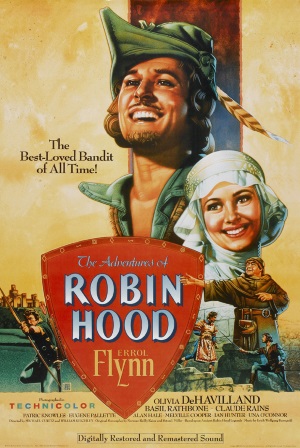
I’ve long considered reviewing this movie before but it’s hard to do it justice. For my money, The Adventures of Robin Hood is just too dam perfect a film, every element fits together to an nth degree; I could put this movie under the microscope and not find a single thing I dislike about it. Errol Flynn, Olivia de Havilland, Basil Rathbone and Claude Raines as the villains, the Technicolor, the sets, the action, the romance, the music, just the sear escapism of it all. It’s the type of film that fuels imaginations and makes you feel like a kid again. This all may sound hyperbolic but the more think about this movie the more I fall in love with it and have even gone as far as contemplating to label it as my favourite movie of all time, maybe not quite but I put it in my top 10. The Adventures of Robin Hood Is just so dam perfect that I am actually envious of it.

Just the first four names billed names in the cast list would make The Adventures of Robin Hood one of the greatest casts ever assembled. Who can play a more ridiculously charming lead hero than Errol Flynn? Who can play more loathsome villains than Basil Rathbone and Claude Raines? Rathbone being unabashedly evil while Raines surely most have helped popularise the trope of the effeminate villain. Likewise, the flawless beauty that is Olivia de Havilland as The Lady Marian isn’t just some useless damsel in distress but a central figure in the plot’s progression, acting as an insider after Robin has red pilled her.

Along with the masterful direction of Michael Curtiz, these talents coming together in the same picture is one in a million. It’s hard to talk about any Michael Curtiz directed film and not praise the film on a technical level. Let’s talk about that eye-watering Technicolor. Where the middle ages really this colourful? Every frame of this movie is oozing in beauty and with sets featuring such an astounding level of detail, those gorgeous matte paintings or the brightly coloured outfits (especially those worn by The Lady Marian); I just love staring at it and can never take my eyes off the screen. Really, The Adventures of Robin Hood is my choice as the most visually arresting movie ever. If you have contemporary film directors who resurrect the use of black & white cinematography, then why isn’t anyone resurrecting the use of Technicolor? There also isn’t a frame in the movie which doesn’t have an eye-pleasing composition with layers of props in the foreground and background.

Every action sequence is unbelievably exciting, with the film’s climactic sword fight being one of the most intense action sequences ever filmed. Also, that shadow effect is just so dam stylistic and cool; no one could implement shadows into the frame better than Curtiz (one of his visual trademarks as a director). Such scenes wouldn’t be as effective though without Erich Wolfgang Korngold’s highly melancholic and at other times adrenalizing score. I do rigorously listen to this soundtrack in it’s entirely on a regular basis; there is no other film score which evokes a greater sense of emotion from me.

On top of that, every time I watch Robin Hood it’s felt like a different experience every time, even as if I was watching the movie for the first time. I swear I’m not making this up but on every viewing, I’ve had with this movie has the weird, uncanny effect of having scenes I have no memory of seeing. Normally when I say I don’t remember a scene that would be a criticism but not in this case. That’s just the magic this movie possesses and the reason it is my number 1 choice of desert island movie.  If you have not viewed its perfection then what are you waiting for? That’s not a recommendation, that’s an order! There will never ever be a better Robin Hood movie…ever!