A Big Hand for the Little Lady (1966)

6 Angry Card Players

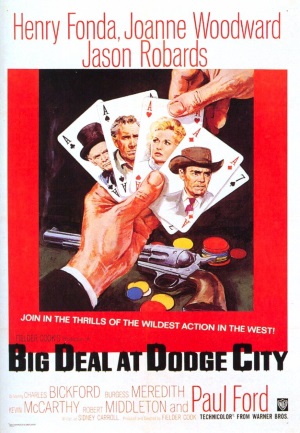
The opening of A Big Hand for the Little Lady has so much frantic build up, the scoping scenery shots as far as the eye can see with a grand western music score and for what? A game of poker; but rightfully so as this may be the best poker movie I’ll ever see. I don’t know how to play poker nor do I have any interest in cards, but it doesn’t stop me from being absorbed in this fascinating and inspired comedy.

Much humour is derived from Henry Fonda’s performance as a gambling addict who attempts to act naive and innocent in order to mask his addiction; resulting in the man becoming a ticking time bomb and the suspense which derives from watching this guy throwing his livelihood away. At one point in the film, however, it stops being entirely comic in which I start feeling sorry for how pathetic Fonda’s character has become; the effective quick switched between comedy and drama is superb. Backed by a cast of charismatic gents as they bicker and tell outlandish stories of what they abandoned in order to attend the game of poker and take the rules of poker so seriously, even when a man’s life is on the line. The only issue I would take with the film is the unnecessary remaining 10 minutes which drag along after the film’s plot has been resolved.

I’d love to see this concept of a poker game going out of control expanded upon and taken to new heights. Not a remake but the same concept in a different setting and perhaps a bit zanier, I would like to see. The sub-genre of the western comedy intrigues me. Westerns as a whole I find hit and miss but when presented in comedic form I have a much easier time caring about what’s happening on screen.

The Band Wagon (1953)

Fred Astaire 1953!

The Band Wagon is the film Fred Astaire’s career was culminating to: his best film in my view. Like Ninotchka with Greta Garbo or A Star Is Born with Judy Garland, this was the role he was born to play; one catered to his on-screen persona. Fred Astaire is Tony Hunter! An ageing hoofer who no longer is the star he once was. The Band Wagon contains little references to Astaire’s past: from Bill Bojangles Robinson to the opening credits feature an image of a top hat and cane, to the mentioning of a fictional movie “Swinging Down to Panama” perhaps a reference to Swing Time and Flying Down to Rio (although I do wish there could have been a little reference to Ginger Rogers herself in there).

The Band Wagon provides Astaire with some of the best musical numbers of his career. However, the film also allows him to showcase other avenues of his talent, such as his outburst scene over his dissatisfaction over rehearsals – a fine example of the acting prowess he possessed. While Ginger Rogers is obviously Astaire’s greatest partner Cyd Charisse is his most accomplished; could there be a more graceful figure?

Was I gullible that when I first watched The Band Wagon that the movie manipulated me into thinking the pretentious and egotistical stage director Jeffrey Cordova’s (Jack Buchanan) idea of a musical inspired by the Faust legend was a good idea? This isn’t the same old backstage musical plot; The Band Wagon is a thinking person’s musical. Likewise, Charisse’s Gabrielle Gerard has a mature subplot of her own involving her trying to deal with her dominating boyfriend and her feeling towards Tony; giving the film that extra mature edge.

Not only is there a great story, but there is also great comedy with a cast gels so well together. Oscar Levant and Nanette Fabray as a bickering couple and their hysterical fanboy reactions to meeting Tony Hunter, to Jack Buchanan’s over the top histrionics and his terrible ideas for a stage musical. My favourite moment in comedy in The Bandwagon is the scene in which Jeffrey Cordova manipulates Gabrielle’s boyfriend from being dead set against allowing her to be cast in his stage production to then begging him to allow her to be in the show. It’s like a Bugs Bunny-Yosemite Sam type moment but on a much more subtle level and made even more impressive by occurring in an uncut shot. Likewise, the sets in The Band Wagon have an astounding level of detail that scenes near the beginning of the film taking place on the street had me wondering where they sets or real-world locations.

Up until The Band Wagon, it was uncommon for a film musical to have a soundtrack entirely composed for it rather than having songs and compositions taken from other sources; which makes it all the more impressive that the entire soundtrack to The Bandwagon is superb. If I was to choose my three favourite musical numbers of all time, in terms of epic scope they would be The Broadway Melody Ballet from Singin’ In the Rain, The Lullaby of Broadway from Gold Diggers of 1935 and The Girl Hunt Ballet from The Band Wagon in all its 13-minute glory. Here noir meets musical, with Astaire at his most badass. His line delivery could be in an actual crime film itself, plus it inspired the music video for Michael Jackson’s Smooth Criminal. There’s also the Shine on Your Shoes number, one which I could watch again and again just to look at all those gizmos in the background and the genuine reactions on people’s faces at seeing Fred Astaire dance; while That’s Entertainment has become a semi-official anthem for Hollywood. Oh and there’s the Triplets number; one of the weirdest musical numbers ever filmed and they’re actually dancing on their knees!

The early to mid-1950’s where a phenomenal period for the musical genre. Hollywood produced some of its finest musicals in these years before television brought this era of film musicals to an end. Films like The Band Wagon elevated the genre to new heights. A Fred Astaire musical which has everything and more!

Back to the Future Part III (1990)

Once Upon a Time In Hill Valley

***This Review Contains Spoilers***

While I loved Back to the Future Part II for how frantic and fast-paced it is, I love Part III for largely the opposite reason; for being more simple and laid back. You need a dark chapter like Part II before you can have something more romantic and light-hearted like Part III. I love the western setting, there’s a certain innocence to it and is classic in every sense of the word. There’s monument valley, cowboys, Indians, a saloon as well as the atypical western music score. It’s also fun to see Marty and Doc in a date much further back in time as well as seeing the images, quotes and motifs from the first film reapplied in the western setting. The film shows us Hill Valley during its early days thus over the course of three films we get the entire history (and near future) of this town, making it a character onto itself even if the western setting does raise the question about Hill Valley’s geographical location.

Part III is the Doc’s movie; it gave his character a whole new dimension as his scientific ethics are challenged by falling in love for the first time. I don’t think many people realise it but Doc Brown is a pretty dark character. He blew his family’s fortune on inventions which don’t work (at least until he invented time travel) and is ostracised from the rest of Hill Valley so it’s about time something finally went right in his life and he finds a love. Plus it’s cute, two geeks falling in love who were previously separated by space and time for that added romantic element.

My only complaint with Part III (really my only complaint with any film in the trilogy) is that the film pulls the liar revealed, one of my most dreaded of movie clichés. We know the Doc and Clara are going to get back together towards the end of the movie, so do really need to have the movie abruptly stop for a period. But I’m more forgiving of it in this instance as their separation does contribute to the suspense during the film’s finale which is one of the highlights of the entire trilogy. The interactions between Marty and Doc, on the other hand, are just as great as ever, even more so that they have to find a way to get the DeLorean up to 88 miles per hour with the technology available to them in 1885. Although I do have to ask is Doc not going against his principles at the end by creating another time machine, oh well, it’s still a great ending. Back to the Future Part III is my least favourite of the series but I still love it. Unlike other film franchises, the trilogy is done and dusted. It’s not polluted with further sequels, prequels, remakes, reboots, re-whatevers, and hopefully, it will stay that way.

The End.

Back To The Future Part II (1989)

It’s a Wonderful Future

***This Review Contains Spoilers***

Back to the Future Part II is one of the most relentless films I’ve ever seen. A one hour and forty minute film yet it feels like only a fraction of that length. As the characters are already introduced to us, the movie immediately gets the ball rolling. I love how frantic and faced paced Part II is; the movie almost never pauses and is one hell of a thrill ride. How many movie sequels return to the events of the first film? I can’t imagine the effort that went into recreating the scenes from the first film from different perspectives, it makes you see the first film in a whole different light. The film’s portrayal of 2015, on the other hand, is the future we all wish we could have, unlike most movies which predict a future of doom and gloom. I still want those self-tying shoelaces and the pizza which can be cooked with a few seconds – its fun watching all those future gizmos. Although they got some things right; the large, flat, wide screen TV with multiple channels or the market for nostalgia with the Cafe 80’s.

Part II takes The Empire Strikes Back route by being darker than the first film; the alternate 1985 is like an even darker version of It’s a Wonderful Life. Part II is Biff’s movie; while he doesn’t have the most complex personality. What makes him such a great character is all the different incarnations he has from different ages, timelines as well as his relatives. Thomas F. Wilson has by far the juiciest role in the film, playing no less than five variations of the same character and even having the young Biff interact with the old Biff. I find it funny that the universe could get destroyed just because this one guy has to be an asshole. Also, I’m not the first person to notice this but it’s dawned on me how much the alternate 1985 Biff looks like Donald Trump. If the first Back to the Future showed the good side of capitalism: this movie shows the bad side of capitalism.

Back to the Future Part II is one of the best examples I’ve seen of single actors playing multiple roles and how they seamlessly have them appear side by side and interact with each other. It still makes me wonder how they did those effects. Today, of course, they would be achieved using CGI but not back then and that’s part of the fun of these effects – on top of being cool to look at – you find yourself asking “how did they do that?” Robert Zemeicks had just directed the technically challenging Who Framed Rodger Rabbit and then directed a film as complex as this followed by directing the third Back to the Future; someone had a busy set of years working. They also got a new actress for the role of Jennifer and even then they manage to make the change in casting appear seamless.

Part II is by far the most and I do mean by far the most complex of the trilogy, these movies seriously screw with your head if you think about them too much. For example, (presuming time travel exists) if you go to the future you can’t actually meet your future self, as you skipped the intervening time period by travelling forward in time, your older self would not exist in that timeline; instead you would find your loved ones mourning over the day you disappeared or how about when old Biff returns to the future after giving his younger self the almanac, should he not have returned the future which he changed? I’ll admit the first time I saw it I found the plot a bit confusing; it took me a number of viewings until I finally figured out why the old Biff is in pain when he returns to 2015. I don’t see these inaccuracies as a bad thing if anything they strengthen our love for these films. Part of the fun of the trilogy is discussing the time travel mechanics and trying to find explanations for any possible inaccuracy. Also one other thing I’ve always wondered, why does Marty make no effort to protect the letter from the rain when his life depends on it? The scene in which Doc tries to explain to Marty that they are in an alternative 1985 must have been similar to the interactions between Robert Zemeckis and Bob Gale when they were writing this film.

To Be Concluded…

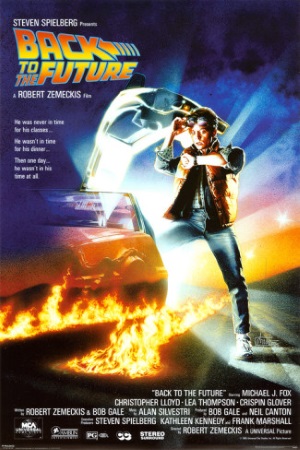
Back to the Future (1985)

Spaceman From Pluto

***This Review Contains Spoilers***

An aura of ‘cool’ permeates everything about Back to the Future. I could imagine seeing this film when it came out in 1985 (of course I wasn’t alive) and watching Marty McFly riding through Hill Valley on his skateboard while holding onto the back of a truck to The Power of Love by Huey Lewis and the News and thinking to myself, “omg, this is just the coolest film ever”. To me Marty McFly is the personification of cool, he rides skateboards, has a hot girlfriend, plays guitar. Yet his life is far from perfect; his dad is a dweb, his mum is an alcoholic and his uncle is in prison. This brings him down to a relatable level, plus he hangs out with a crazy old scientist. Why? I don’t want to know. I like the mystery of not knowing how this unconventional friendship came to be. The technical jargon between Marty and Doc is a never-ending pleasure to listen and even lines which shouldn’t be memorable are somehow highly quotable (“Wait a minute Doc, are you telling me that it’s 8:25…dam I’m late for school!”). Likewise taking the coolest looking, commercially available car and making that the time machine is yet another stroke of genius. Notice the scene in which we see the DeLorean for the first time; it’s impossible for Doc Brown to get inside the DeLorean while it is inside the truck so he would have had to get into the car and drive it into the truck and just wait there until Marty would show up and then drive it out and exit the car. I guess Doc thought he had made a time machine that looked so badass he really had to give it an impressive introduction to Marty. The whole movie has the best uses of product placements I’ve seen in a film; never before have I been happier to see advertisements for Pepsi and Texaco. The pacing of Back to the Future is perfect, the film never lets up; the odds keep stacking up against Marty and the suspense towards the end of the film is crazy.

Even though most of the film takes place in the 1950’s, Back To The Future is the film which defines the 1980’s. The ending in which Marty finds his family has been changed for the better and he gets the 4×4 vehicle he wanted; it’s a wish fulfilment fantasy and very much a capitalist, 80’s ideal. It’s an uplifting ending, providing you ignore the fact that Marty now has to adjust to living with a family he has no previous memory off. It makes sense that Marty goes back to the year 1955, the time period of when adolescence had a voice and began an economic force for the first time in history; plus just take a look at the title of what won Best Picture that year. Marty’s mother being attracted to her son is weirdly funny plus his mother being the opposite of her adult herself; makes you question your own parents claims about their day. I’m always struck by the moment when Marty tell his relatives in 1955 he has two TVs and they think he’s joking yet if you told someone in 1985 that households today own upwards of 6-7 TVs, they would have the same reaction.

Star Wars, Indiana Jones and Back To The Future; to me these are the trilogy of trilogies. The three film sagas I can watch again and again, always notice something new on each viewing, discussing every character to no end, coming up with crazy fan theories and trying to find an explanation to any possible plot hole. I’m sure there are still plenty of subtle gags, use of foreshadowing and who knows what lurked within this film which I still haven’t noticed. Is it possible for a film to be 100% perfect, one which has absolutely nothing wrong with it no matter how minuscule? I can’t think of another film (or series) which has a better use of repeating images and motifs. If I could only bring one DVD to a desert island, it would be my trilogy box set so I could spend my time uncovering every last secret in the trilogy. I love how self-contained the movies are; there are so closely connected to each other and the perfect film trilogy to watch in one go (as I have done several times).

But what is it that makes Back to the Future immensely beloved by such a wide audience? I can tell you why I love it but I have a weird and eccentric film taste. Perhaps it’s due to time travel is something we all fantasize about, as well as the idea of seeing your parents when they were young. The themes the film explores such as family, coming of age, the generation gap and the optimistic message of free will, that our future isn’t written; it’s whatever you make it.

To Be Continued…

Auntie Mame (1958)

Live! Live! Live!

It’s hard for me not to be complete enamoured by a movie and a character like Auntie Mame. Two and half hours of zany histrionics with a central character who is a free-thinking, non-conformist and constantly has a joyous, optimistic outlook on life; oh, and did I mention she is a total screwball. Few other fictional characters seem to lead such an exciting life that I as the viewer am actually is jealous off (“Life is a banquet, and most poor suckers are just starving to death!”). If I ever amass a huge fortune then perhaps I can try to emulate the lifestyle of Mame. Ok even with a huge fortune that probably wouldn’t be possible in this mundane realm that is reality but I can at least try.

Auntie Mame is one of the most liberal movies to come out of the 1950’s. Mame’s carefree, flamboyant, free thinking and non-conformist lifestyle clashes with a decade which is thought of as being the most conformist of the 20th century. It should come as no surprise this movie has a huge gay following as the title character is essentially a drag queen. At the beginning of the movie, we see Mame throwing a party full of bohemians, intellectuals and champagne socialists (“Karl Marx, is he one of the Marx Brothers?”), essentially the predecessors to the modern day hipster. During the first 50 minutes of Auntie Mame the liberals are the ones having fun while the stuffy, puritan conservative Mr Babbock is being driven mad by Mame’s antics and instance that her nephew be sent to a be sent to a progressive school over a conservative prep school, a school with ancient Greek principles, has no uniforms and as the movies implies, teaches sex education in a very odd manner.

However, Auntie Mame isn’t a total demonisation of conservatives. In the middle portion of the movie she does end up getting married to a southern gentleman and an oil tycoon of whom lives on a plantation and goes fox hunting, which does show you that love can overcome ideology. Likewise, when Mame returns to her apartment after the death of her husband, the next few incarnations of her constantly redesigned apartment as well as her outfits are not as camp, possibly suggesting her husband’s influence on her. Well at least until the second last incarnation of her apartment which is very avant-garde.

With the movie’s references to sex and homosexuality among other things, Auntie Mame falls into the category of “how did they get away with that?”. Yet as liberal as the movie is for its time (and in many respects still is), the liberal of today is the conservative of tomorrow. Some of Mame’s actions wouldn’t rub with the modern left such as her desire to settle down with a man and her motherly instincts.

The Kaleidoscope opening credits set the stage for a film which is a feast for the eyes and ears. They really put effort into these early widescreen era title sequences in one of many attempts for a film to compete against television. Likewise, Mame’s lavish apartment is a masterpiece of set design as it evolves throughout the movie, with each incarnation being as impressive as the last. The movie doesn’t lose its stage roots which each act ending with the dimming of the lights with the spotlight on Mame before completely going to dark.

I am a huge Rosalind Russell fan and I know it’s a cliché expression but it usage couldn’t be any more adept here: this is the role she was born to play! How is it possible of a human being to talk at such a voracious rate? I do wonder how long the script for Auntie Mame must have been. There are probably more words in this movie than the Encyclopedia Britannica. Whenever there is a moment free of any dialogue I have little think to myself, “Oh yes, silence, I forgot what that feels like”.  When Roz’s motor mouth isn’t running, she’s pulling at my heartstrings; there are times when I wish I could just go into the screen and hug her. I can’t stress enough my love for the actress, the performance and the fictional character. Auntie Mame is an encapsulation of pure unmitigated joy. When I’m feeling down, I know what movie I’ll be turning to.
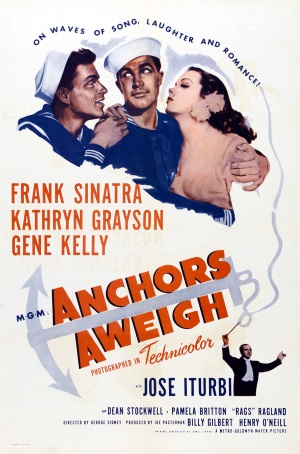
Anchors Aweigh (1945)

Join the Navy!

Anchors Aweigh is the first film of the Frank Sinatra-Gene Kelly trilogy, tapping into the odd fascination the classic Hollywood musical had with sailors. It wouldn’t be the last time Kelly or Sinatra would play a sailor and what an underrated comedic duo they are. Gene Kelly is so loveably egocentric, constantly lying about his exploits with dames and rubbing the fact that he got ship leave in his comrades’ faces, so much so that he sings a musical number about it – the interactions he shares with Sinatra are priceless. If the accounts are to be believed, reportedly Kelly was known in real life for being a control freak and getting his own way, so I wonder how much of his personality is reflective in this performance. Frank Sinatra is largely the opposite of Kelly, girl shy and completely gawky, a stark contrast to what he later became; he sure toughened up over time.

Anchors Aweigh came around the beginning of a new era of film musicals, at a time when the genre became almost exclusively one filmed in colour and as the distinctive style of the MGM musical took off, separating them from the likes of the Astaire & Rodgers musicals of the past. Unlike Fred Astaire, Gene Kelly was “off the people”, usually playing commoners on screen. Fred Astaire did play a sailor in Follow the Fleet but no doubt Gene Kelly suits the role better. Perhaps the film’s greatest highlight is Gene Kelly dancing with Jerry of Tom & Jerry fame. It might not be as technically advanced or as smoothly animated as later live-action/animation hybrids but it’s one of the most awe-inspiring (the animators even make note to include Jerry’s reflection on the floor). The studio originally wanted Disney to allow them use of Mickey Mouse for the number, which seems very hard to believe. The film’s inclusion of some very Disney-looking animated creatures, including two which look suspiciously like Bambi and Thumper, suggests the studio was serious about including Mickey.

The other unique aspect of Anchors Aweigh is the documentary-like look at MGM studios circa 1945 during one portion of the film. A peek inside the dream factory itself, with people in costume, props everywhere and what look like studio workers in suits going about their business. It’s unabashed self-promotion but hey, it’s one entertaining commercial. This use of on-location filming including the scenes as the Hollywood Bowl show shades of what was come several years later in On the Town. I do wish they though could have shown some more of 1945 Hollywood but the sets present in Anchors Aweigh are something to marvel at. Even with the odd background which is clearly two painted backdrops placed side by side with a dividing line clearly visible, the sets create a cartoon-like Technicolor world that you wish real life could look like; just look at that set of the Spanish part of town; such artificial beauty.

The only downside to Anchors Aweigh which prevents it from being a greater film is the runtime and much of this is largely due to the amount of which is spent in the house of Kathryn Grayson’s character; I really started to get sick of the sight of it, especially since the movie takes place in Hollywood and there are places so much more interesting they could be. The characters keep returning to the house several times throughout the movie, which wouldn’t be such a problem if it wasn’t for the large chunk of time that was spent there when they first arrived at it – by far the most frustrating aspect of the film. Thankfully the good outweighs the bad and the good isn’t just good, it’s amazingly good. There’s really no dud musical number present, they’re all so very, very beautiful.

All Through the Night (1941)

A Mixture of Action Und Comedy

Bogart: Let’s Get Silly!

Mixing up so many genres into a single movie could potentially be a disaster yet I’ve perhaps never seen a better genre mash-up than All Through the Night. I’m astounded at this movie’s ability to have a bit of everything and pull it off so immaculately; bouncing back and forth between drama, comedy, action, murder mystery and even film noir. All Through the Night is the closest thing to a Hitchcock movie starring Humphrey Bogart in which an ordinary man gets caught up in espionage and becomes a fugitive for a crime he didn’t commit, with moments in the film such as the auction scene or Bogart deliberately getting arrested by police directly reminded me of North by Northwest; likewise the movie even stars Judith Anderson in the Mrs. Danvers hairstyle from Rebecca while Bogart’s exploits against the movie’s Nazi villains gives an urban Indiana Jones edge to the film. Even the movie’s final climatic moment had me on the edge of my seat and thinking to myself “how is he going to get out of this?!”. One top of that the film gets an additional boast with some truly superb use of shadows and lighting; All Through the Night really exemplifies the unique look of Warner Bros. movies of the 30’s and 40’s.

I may sound hyperbolic but the more I think about it, the role of Gloves Donahue may be the greatest performance of Bogart’s career; why you ask, versatility! Just like the tone of the film he is able to continually bounce back between being serious to just downright silly. Bogart has made me laugh during comedic moments in his other movies but I never knew he could make me laugh this side splittingly hard; from subtle moments such as throwing the reserved sign off a table in a nightclub to the more obvious in which he infiltrates and stalls a secret Nazi meeting. At another point he delivers the line “More here than meets the FBI”; I do love me a corny pun but with Bogart delivering it just makes it funnier – All Through the Night makes me wish he had starred in more comedies.

On top of all that, the character he plays is a momma’s boy yet he’s still badass! I find this aspect of his character is hilarious in itself. There’s something adorable about a tough guy who wears dotted bathrobes and loves cheesecake so much; exemplified even more with his mother being played by the ever motherly Jane Darwell. All Through the Night features a large selection of character actors at some of their best work and even features a young Jackie Gleason in one of his earliest film roles; what more secrets does this movie hold? If I was to find any point of contention with All Through the Night I wouldn’t have minded seeing a bit romance between Bogart and Kaaren Verne, but with a film that has this much merit, it’s hard to complain.

All Through the Night is an anti-Nazi propaganda film and an effective one at that. I find the satire here is on par with The Great Dictator and To Be or Not Be as the movie pokes fun at Nazi ideology. The leader of the branch of Nazi spies is portrayed by Conrad Veidt whom there was probably no one better at the time to play evil Nazis. Gloves Donahue is also a minor gangster which reflects the attitude of real-life gangsters of the time who worked with the government to infiltrate Nazi spies. One scene in the film involves Bogart giving a chilling monologue on how the Nazis will take people’s freedoms away in an argument against US isolationism in the ongoing war in Europe; all this however without even mentioning the word Nazi once throughout the film. Another interesting aspect of the film is the mentioning of an actual concentration camp Dachau. Being released in 1941 before the true nature of the camps where discovered, this is one moment I found quite chilling. All Through the Night was released in the US only 5 days before the attack on Pearl Harbor, although Warner Bros. had already long established themselves as an anti-Nazi studio.

By the time I watched All Through the Night I had already seen all of Bogart’s major movies and figured I was largely finished exploring the actor’s filmography, thus it came as such a delight discovering this obscure gem which satisfied me more than many of his more famous movies. This is the type of movie which makes me want to scream out, “Why the hell is this not more well known?!”, but then again its moments like these in which I live to be a cinephile.

After the Thin Man (1936)

All In The Family

***This Review Contains Spoilers***

After the Thin Man clearly has a much higher budget than the first film so it does loose the grittier, low budget charm of the original but it still works in its own glossier way. I don’t think any of The Thin Man sequels reached the standard of the first film but this was the best of them.

After the Thin Man gives William Powell some of the best comedic moments of his career; the scene in which he has a conversation with the snoring gentlemen I could watch over and over; he manages to maintain composure and still act sarcastic no matter how frustrated he gets. Although my favourite part of the film is just watching Nick and Nora trying to get an important clue from Asta by chasing him through their giant manner of a house. Just how does a retired detective and a woman who doesn’t work manage to afford to live in a palace like this during the great depression anyway? Every movie in the series had a long sequence in which Nick would go sleuthing on his own in the dark with no dialogue or music, and rightfully so, it’s so captivating. The plot is even the easiest in the series and I was actually just barely able to keep up with it.

The film’s most notable contribution to cinema is having James Stewart’s first really notable screen role. This would be the only time in his career in which he would play a villain as the suspiciously motivated David Graham. At the end of the film when he’s revealed to be the murder culprit, he has a breakdown and threatens everyone at gunpoint before being thwarted and then arrested. Jimmy Stewart as a heartless murderer who is sent to prison, what kind of crazy movie is this? It’s disheartening in a way to see this but of course, this was before he became forever enshrined as the everyman. He does pull off the role and displays he was a natural acting talent from the start of his career and shows he could have potentially portrayed convincing villains. Also look out for the Asian bodyguard who throws his hat to get a gun from Jimmy Stewart’s hand, Oddjob anyone?

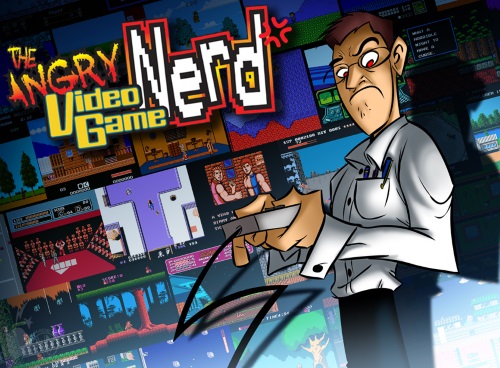
The Angry Video Game Nerd (2004-Present)

This Game Sucks…

The reviewing of poor media products on the internet has become a whole genre of comedy in itself. Movies, video games, anime, comic books, music, etc, all have dedicated reviewers who will pick them apart and criticize all in the good name of entertainment. One of the most famous perpetrators and originators of this genre within the cyberspace of the internet is none other than The Angry Video Game Nerd. The Nerd (James D. Rolfe), is a foul-mouthed, short-tempered retro gamer, destined to review as he would call them, “sh***y f**king games”.

The Nerd’s trademark humor is comprised mostly of strong profanity and over the top comparisons to describe how awful a game is, i.e. “This game is so hard it would actually be easier to outside in a thunderstorm and dodge rain”. It’s an acquired taste but trust me when I say there are few times in my life in which I laughed as hard when I first discovered this guy and watched his Ghostbusters review back in 2007.

This is partially due to many of the games he reviews being so horrific they almost review themselves but also because of James’ charisma as a performer. Let’s face it, almost everyone who goes on the internet and makes videos in which they try to entertain or inform (including top subscribed You Tubers, although I won’t name names) are either dull or are trying to force a personality onto themselves. James, on the other hand, is just a complete natural. He’s always an absolute joy to listen to and makes the art of appearing on camera and reviewing media (whether comically or straight) seem easy. However, James is first and foremost a filmmaker and thanks to this The Angry Video Game Nerd had considerably greater production values than most other internet content. Frankly, the guy is one of my personal heroes.

I still continue to enjoy new episodes of The Angry Video Game Nerd. I’m glad James now only makes several episodes per year, whereas at the height of the series productivity we had two every month. Some of the more recent episodes are among some of the funniest he’s ever done, not bad for something which debuted on YouTube 9 years ago. I just hope he will keep the character in this state of semi-retirement. With The Angry Video Game Nerd, James Rolfe managed to create something totally original. Countless imitators will come and go but the original will never be topped.