Superman III (1983)

Clark v Evil Superman

***This Review Contains Spoilers***

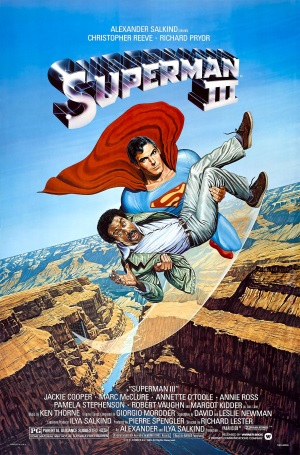
Superman III, often dismissed as “the Richard Pryor Superman movie”, is a film with many highly questionable moments and bizarre decisions on the part of the filmmakers (most notably the far greater emphasis on comedy), but dam if it’s not a movie I have an immensely fun time watching. Even during the film’s pre-opening credits scene I already found myself relating to Richard Pryor’s character of August ‘Gus’ Gorman and I thought to myself “Isn’t this supposed to be a bad movie?” Ah yes, the monotonous and degrading experience of going to a jobs & benefits office and dealing with the employees who don’t want to be there and probably don’t like you as evident from their body language. The down-on-his-luck Gus then complains about his experience being employed at a fast-food restaurant and how “they expect you to learn that stuff in one day” – let’s say I’ve had some similar real-life experiences. This is later followed by another one of Gus’ relatable frustrations – having your pay undercut by taxes (“State tax, federal tax, social security tax”). I wasn’t bothered by Pryor sharing the spotlight with Superman regarding screen time as I very quickly became endeared by this regular Joe who bites off more than he can chew and finds himself in extraordinary circumstances. Gus, you are my spirit animal!
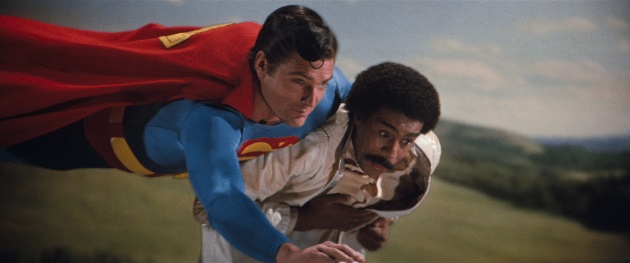
The text for the opening credits of Superman III looks like it was created using Windows Movie Maker (or whatever the equivalent was circa 1983) but I’d be lying if I didn’t say the slapstick comedy in the opening credits amuses me with its classic vaudeville-like elements (including a haphazard blind man, a pie in the face and even a clumsy mime). This opening is very intricately set up and is done by a director who understands and knows how to do physical comedy aided by a delightfully mischievous-sounding score from Ken Throne. Now you might be asking dear reader, “Even if all that is true, what is this sequence doing in a Superman film? This isn’t a Jacques Tati film”, and you would be absolutely correct in that assessment. I could try to post-hoc rationalise its inclusion, arguing that it ties in with the fact that Clark Kent is often a bumbling clutz, plus the series is light-hearted and campy as a whole. However, at the end of the day, all I can say is that it simply entertains me and makes me laugh. So please let me enjoy the one time in history in which the unique and odd combination of the Superhero genre and classic vaudeville comedy came together into one.
Not all of the comedy in Superman III is successful in my eyes. If I was to pick out the weakest scene in the entire film it would be that in which Gus explains Superman’s exploits in Columbia as the Man Of Steel disrupts the villain’s plans for economic manipulation (“But this one miserable, puissant little country, has the gall to think it can dictate the economy of an open market!”). I can understand the writers were trying to give Pryor room to express his comic chops however the scene fails on such a level and rather just comes off as a lengthy and awkward expositional monologue edited to several brief flashbacks of Superman in Columbia – why not create an action scene out of this plot point instead?. Then there’s the gag of the green man and the red man in the traffic lights fighting each other. I find the moment funny in isolation, but when viewed within the context of the film you have to ask yourself, “Did that really just happen?”. Nowadays with smart technology, someone with the know-how could actually programme such a thing to happen, so perhaps the gag was ahead of its time after all.
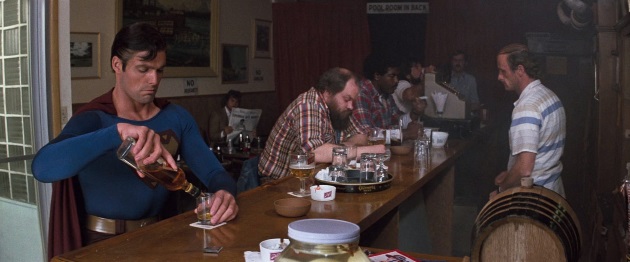
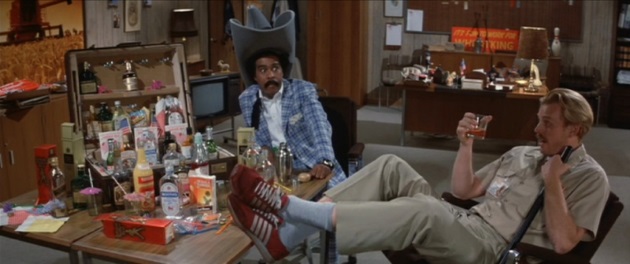
Amongst the comedy which does succeed, I do enjoy the gags which use Superman’s powers for comedic effect such as Evil Superman straightening of the Leaning Tower of Pisa or the blowing out of the Olympic Torch just as it reaches its final destination. However, If I was to pick a comic highlight of the film, it would have to be the sequence in which Gus breaks into the Webscoe offices in Smallville, with all the drunken antics and the improvised use of a passed out inebriated body of a security guard to turn on a computer which requires “both keys at the same time” to activate (a very Mr. Bean-like scenario) – plus the sight of Pryor in a tweed suit and an oversized cowboy hat which keeps bobbing around is a funny image in itself. Corresponding, the film also has its share of more subtle comic moments such as Gus foolishly flaunting his ill-gotten wealth by driving to work in a Ferrari to Jimmy Olsen’s incessant yammering to Clark as they ride on the bus. I also enjoy Pamela Stephenson as the Jean Harlow-like dumb blonde Lorelei who conceals her intelligence (“How can he say that pure categories have no objective meaning and transcendental logic? What about synthetic unity?”). Then there’s the other brand of comic moments in Superman III, those which I can’t quite determine if they were intentionally supposed to be funny or not, such as the bizarre sight of the unshaven Evil Superman in a bar drinking as he flicks peanuts to smash glass bottles. Regardless, moments like this are now a goldmine for internet memes galore.  
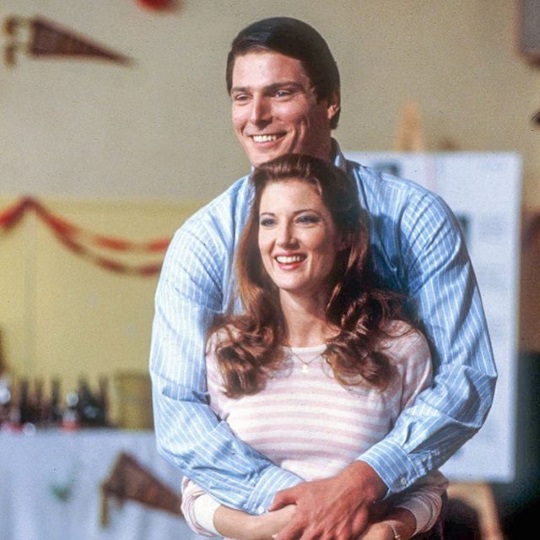
Third time’s the charm and Christopher Reeve finally gets top-billed in his own series. Superman III is Reeve’s finest performance as the Man of Steel as he has the task of portraying three different personalities in one film – Clark Kent, Superman and Evil Superman (which he has been retroactively referred to as the persona is never actually given a name in the movie). While these are all persona variations of the same character, it does show Reeve held the same ability alongside the likes of Peter Sellers or Eddie Murphy to play multiple characters in the same film and even interact with each other in the same scene. How one man can look so vastly different from three versions of the same character? Reeve even showcases his physical acting abilities to be on par with the greatest silent film actors with the level of expression he can convey through body language and facial expressions (just look how tightly the skin is pulled back around Reeve’s neck as he shouts “Come on!” during the junkyard fight). Moreover, as with Superman II, one of the elements of the movie I found myself enjoying most was the character relationships. I was surprised I was engaged with the relationship and dynamic with Clark’s Smallville sweetheart Lana Lang (Annette O’Toole) as much as I did with Lois Lane in the previous film. In one of my favourite moments in Superman III, Clark and Lana are cleaning up the gym together following the class reunion party as she tells him about her ambitions and how she wants to leave Smallville as Clark plays an instrumental rendition of Earth Angel on the piano (in a great combination of diegetic and non-diegetic music). At this point in the movie, I thought to myself how people can dismiss this movie as much as they do when you have brilliant, intimate moments like this which showcase performers with such marvellous chemistry. What really differentiates Clark’s relationship with Lana in contrast to his love interest in Superman II is that Lois is in love with Superman but ignores Clark, whereas Lana is in love with Clark but not so much Superman. Thus Clark is much more confident, suave and debonair with Lana, and not the bumbling clutz he is with Lois. Sadly, the status quo of the Superman universe can’t allow Clark and Lana to become a couple, but what a superb pairing they are. I do have to ask though, why are the class of 1965 having a reunion in an off-year, assuming the film is set in the year it was released (but I digress)? 
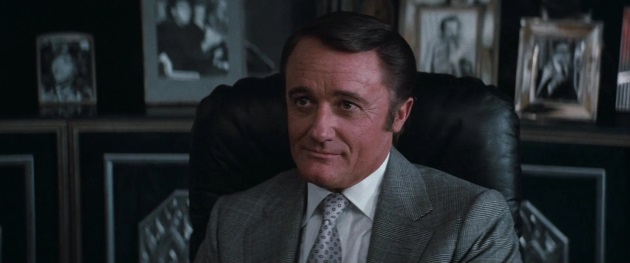
Initially, the big bad of Superman III, Ross Webster (Robert Vaughn) disappointingly came off to me as a lesser Lex Luthor. However, on further viewing, I’ve really come to appreciate the Bond villain-like character and Robert Vaughn’s charismatic and suave performance as well as that of Annie Ross as Webster’s butch, somewhat comical sister Vera. Like Luthor’s underground, abandoned subway layer in the first film, Webster’s own layer is like a character in itself, with his own ski resort atop a Metropolis skyscraper and a memorable, grey, art deco design in his grand office. Additionally, I’m not the first person to point out that the reimagining of Lex Luthor in the comics starting with the Crises Of Infinite Earth series in 1986, portrayed Luthor as not the mad scientist archetype as he had been for decades until that point, but rather as an entrepreneurial head of Lexcorp – not too dissimilar to Ross Webster and his company Websco with both being complete with tall, extravagant skyscraper penthouses as a testament to their larger-than-life egos.
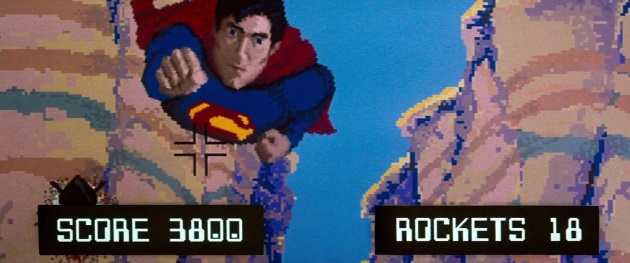
One of the most notable and unique aspects of Superman III is its semi-serious early screen depiction of computers and cyber-terrorism. Gus’s get-rich-quick scheme of writing a computer programme to gather up fractions of a cent remaining from other Webscoe employee’s pay cheques does have its basis in reality in a practice known as salami slicing (with this aspect of Superman III having influenced the movie Office Space as directly referenced in that film itself). However, I do use the term semi-serious as by the film’s climax, the understanding of computers in Superman III goes from having a basis in reality to becoming pure science-fiction with the super-computer designed by Gus. Just how did Gus accumulate the knowledge to design a machine which can feed itself by absorbing power from the electric grid, is able to grab people by using its wiring like a series of tentacles, can levitate people into the air and even turns Vera into a robot (I don’t think even the likes of Bill Gates are capable of creating a computer quite like this). Vera’s robotic transformation (or is she a cyborg as she appears to still have flesh skin albeit painted grey) is particularly frightening as she screams in agony during the process and then proceeds to walk like Boris Karloff in her new robotic form. I’d also be remiss if I didn’t mention, why does the villain’s view of Superman flying through the canyon looks like a video game complete with score points and those infamous Atari Pac-Man sounds? It doesn’t make sense (not to mention they do realise Superman is indestructible so why are they bothering to fire missiles at him?) but it sure is a fun sequence to watch. This entire action climax of the film is ridiculous but makes for very entertaining viewing and is topped with many memorable special effects shots from stop motion to miniatures (bringing the 80’s factor of Superman III up to 11).
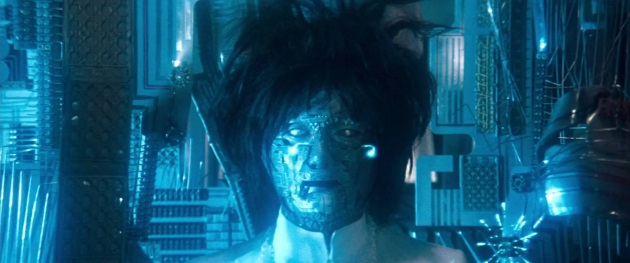
I find Superman III to be the most visually and aesthetically appealing of all four Reeve films, and with Richard Lester being the only director at the helm (unlike Superman II which went through two directors), Superman III is consistent in its visual style with its use of warm, pastel colours and coupled with the picture’s use creative old-school practical effects. These films became more pop art in style as they went along, with another major unique contribution of Superman III to the series being the wholesome, small-town Americana feel with the scenes in Clark’s hometown of Smallville (ironically though filmed in High River, Alberta, Canada). Superman III is full of very comic book-like, very Superman-ey (for lack of a better term) moments such as Clark sneezing to create a bowling ball strike or Superman freezing an entire lake and then carrying it as a huge piece of ice in order to extinguish a chemical plant fire – a joyously simple and effective solution which feels like it’s taken right off the pages of a comic book. Furthermore, the TV version of Superman III contains 18 minutes of extra footage but unlike the TV versions of the first two films, the extra footage is mostly unnecessary padding for existing scenes and contains nothing that I was wishing was included in the theatrical cut. Even the Frank Oz cameo as the surgeon comes off as an awkward and unfunny attempt at shock humour while the clear indication that Evil Superman is definitely getting it on with Lorelei (whereas in the theatrical cut, this is only implied) is pushing it too far for what’s supposed to be a family film. Additionally, the opening credit sequence in this version which goes back to the traditional outer-space credits of the first two films is very dull with the repetitive use of scrolling text. This is one Superman movie in which I will stick with the theatrical version. Or if you would rather have an abridged version of Superman III, watch the infamous trailer which explains the entire main plot in 3 minutes.
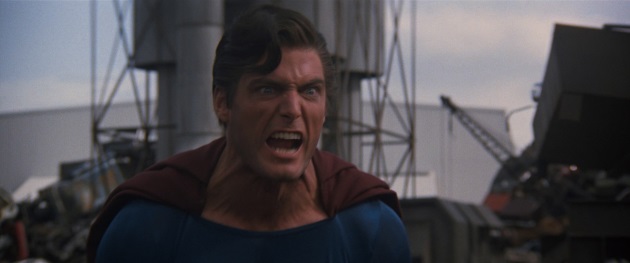
An aspect of Superman III which is not often discussed is the film’s many references to indulgence and substance abuse, with Evil Superman being a potential metaphor for this. When analysing a movie for a deeper meaning like this, you can question if any such messages were intentionally incorporated by the scriptwriters. However, in Superman III, this theme is very on the nose that I can’t see it being something which the writers didn’t knowingly include. Firstly, how did Evil Superman come to be? Well by man-made kryptonite which substituted tar with an unknown substance of 0.57% after Gus Gorman choose the substance after seeing it as an ingredient on the side of a cigarette package. It’s like the film is saying smoking turned Superman evil (then again, didn’t your last movie have product placement for Marlboro Cigarettes?). Reeve plays Evil Superman in a manner in which he appears to always be intoxicated, while in pursuit of hedonistic pleasures (including getting super-laid). In general, Superman III is full of references to addictive substances including alcohol, cigarettes, coffee and fast food from the character of Brad Wilson (Gavin O’Herlihy) being in a state of near-constant inebriation to Ross Webster himself being a coffee mogul. Even Webster’s line “Every time a drunk sobers up, he’ll be drinking Webster coffee” is very on the nose. Gus himself also indulges in his newfound wealth (after previously complaining that he wants his pension money now) causing him to lose sight of his moral compass. On top of that, the film’s co-writer Leslie Newman refers to the Evil Superman as being “under the influence” in the documentary The Making Of Superman III – make of that what you will. During the film Evil Superman never kills anyone nor causes catastrophic damage or destruction (bar the oil tanker incident which is the worst action he performs) as Superman’s own inherit morality would prevent him from doing so – it makes sense that hedonism (and general trolling) would be the worst thing a corrupted Superman would do. When watching the movie through this thematic lens of indulgence and substance abuse it makes the confrontation between Clark and Evil Superman all the more compelling, speaking off…
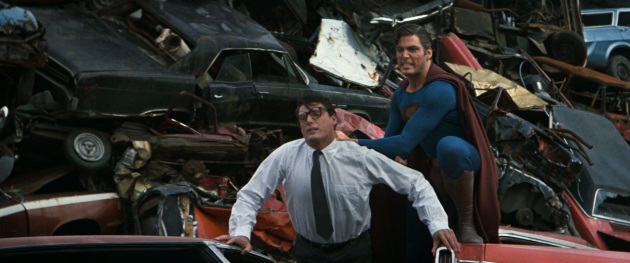
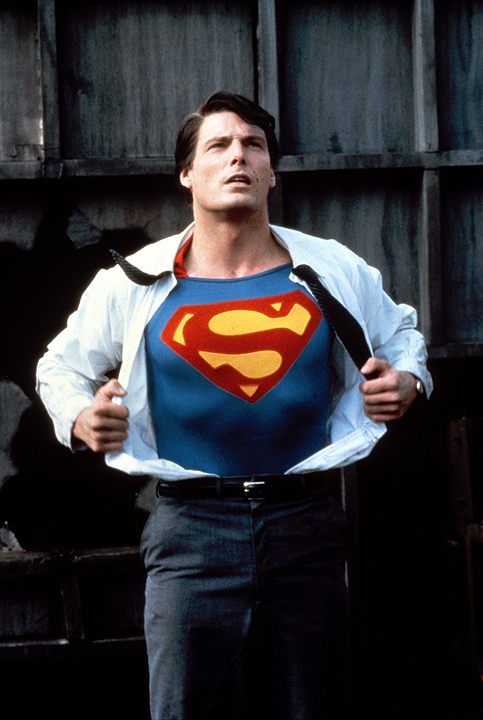
The grand highlight of Superman III has to be the inner conflict of good and evil that is the in-head fight between Evil Superman and Clark Kent in the junkyard – never before has a fight which doesn’t actually happen been so exciting. It’s intriguing to see the Clark persona involved in combat with the juxtaposition of a dorky guy who can give and receive such a brutal beating (“I can give as good as I get”). The use of composite shots and body doubles sells the illusion of two versions of Christopher Reeve fighting each other (pre-dating Back To The Future: Part II by six years), while the junkyard environment is used to great effect with the use of conveyor belts and trash compactors. While none of Ken Throne’s original music reaches anywhere near the heights of John Williams’ work, his music for this fight is a highlight with its eerie use of synthesisers. In addition, I find the moment of Clark being crushed in the trash compactor to be scary stuff. Even though as a viewer I know he will be fine as he is Superman after all, his heavy breathing and the look of horror on his face as he is trying to escape from the machine alongside the pov shot in which he catches his last glimpse of daylight in a scenario of which a normal human would be crushed to death is very unsettling to watch. In the end, the better angels of our nature prevail as Clark defeats Evil Superman, followed by a glorious victory shot in which Clark does the iconic shirt rip and subsequently flies off as regular Superman as the John Williams theme plays is one of those triumphant movie moments that make you want to just cheer on – “Yeah, go Supes!”. I’m not ashamed to proclaim my un-ironic love for the imperfect but joyous cinematic outing that is Superman III (perhaps I can reclaim some cinephile street-cred by reviewing some pretentious, European art-house that everyone pretends to love in order to look cool and artistically enlightened). Will I be able to find any merit in Part IV of the Superman film franchise? Let us embark on the next stage of our quest…a quest for peace?
Star Wars Episode I: The Phantom Menace (1999)

The Farce Awakens

Star Wars Episode I: The Phantom Menace is a movie I’m apprehensive to review; perhaps more than any other film ever. I only review movies if I feel I have something to interesting and unique to say. What unique viewpoint to do I have to give to the Star Wars prequels? –  possibly the three most heavily critiqued films ever. I decided to watch all three prequels again (and hopefully for the last time) in order to get a fresh perspective on them. I believe I may have some unique points of view to offer; plus I am among the populace who is addicted to discussing every aspect of George Lucas’ pop culture behemoth.

Don’t be too surprised when I tell you I hate the prequels – big shocker, right? However, The Phantom Menace is the prequel I dislike the least. The major aspect I find The Phantom Menace does have going for it over the other two prequels are the aesthetics. It comes the closest to resembling the original trilogy, if still incredibly far off. The Phantom Menace was shot on film and does feature on location filming and even some practical effects here and there, so the whole thing doesn’t come off looking like a video game as Episodes II and III did. There is a lot of eye candy to behold, such as the locations such as the Palace of Caserta in Italy (why do you want to film everything on a green screen when beautiful places like this exist in the world?), while the costume design – not something I would normally comment on – is very pleasing to the eyes. The only two scenes in The Phantom Menace which has a little bit of that excitement that I get watching the original trilogy are the pod race and final lightsaber duel between Obi-Wan, Qui-Gon and Darth Maul; an impressive display of acrobatics and is it’s not choreographed within an inch of its life like the duels in Episodes II and III. But even these few aspects of the film I do enjoy are ultimately superficial as there is no internal conflict nor am I emotionally invested.

What surprised me watching The Phantom Menace for the first time in a decade was just how incredibly frustrated I got. I’ve seen and read more reviews of this film over the years, analysing it to death and mocking every aspect of it. Watching the film again I expected to have reactions of “yeah it sucks, what else is new”, but sitting down and watching the entire thing my brain became so numb from the never-ending monotone exposition. I’m not even that keen on the John Williams score; it’s not bad by any means – far from it – but it feels too dark and moody for a Star Wars movie. As fine a piece of music as Duel of the Fates is, those booming choirs feel out of place for Star Wars. In regards to the most hated fictional character of all time, I don’t think Jar Jar is the absolute worst thing ever, I can at least tolerate him (if there’s any character in the prequel trilogy that bothers me for how ridiculous they are: its General Grievous). Plus at least he’s responsible for the only line from this film I like; “The ability to talk does not you intelligent”.

All three prequels lack the space western elements of the original trilogy, and I recall a comment that George Lucas intended The Phantom Menace to play out like a costume drama. Perhaps it’s own such a direction could have worked if you know, the execution wasn’t total pants. I can see what Lucas was perhaps going for in the story in trying to portray the fall of a democracy; the idea of radicals using political unrest as a means of coming to power – such as the Nazis using the turmoil caused by the great depression to amass power. Perhaps the empire isn’t such a bad thing, it appears under their command the universe became a more interesting place.

As someone who is interested in the relationship people have with popular culture, I find the most interesting aspect of The Phantom Menace is nothing in the film itself but rather its place in history. Think about it, the most anticipated movie of all time and it was a colossal letdown, and this occurring during the early days of the internet. What would the world of geekdom be like if The Phantom Menace actually lived up to expectations? Would an entire generation be less cynical?  Would internet culture be the same as it is today, possibly for the better?

Star Wars: Return of the Jedi (1983)

Luke Be a Jedi Tonight!

***This Review Contains Spoilers***

It’s not easy calling Return of the Jedi your favourite Star Wars film. Were as when someone says The Empire Strikes Back is their favourite they get cheers from the crowd. Call Return of the Jedi your favourite you get boos and hisses followed by a rigorous defense of your opinion. Well, it could be worse; those who call the prequels their favourite usually get stoned or hanged by a lynch mob.

I find Return of the Jedi to be the film in the series which satisfies me the most in this swashbuckling space adventure. I like how it combines elements from both A New Hope and The Empire Strikes Back from Hope’s light-hearted nature and the nostalgic return to Tatooine, to Empire’s darker nature with Luke confronting Vader and the Emperor. But when I think Return of the Jedi I think redwood forests. The forest moon of Endor is such a splendour to look at, and once again proves that Planet Earth is the greatest movie set of all.

Let’s talk about everyone’s favourite addition to the Star Wars universe, shall we? I am indeed speaking of the Ewoks. The dismissive statements towards these creatures that the empire was brought down by a bunch of teddy bears I find to be very close-minded. I completely agree with George Lucas that they showcase how it is possible for a primitive race to bring down a technologically advanced superpower such as the empire is inspired by the Viet Cong’s offense against the Americans during the Vietnam War. I like this message as it’s true that the most advanced technology isn’t always the best means; sometimes less is more. I know many say the idea of Ewoks helping bring down the Empire was highly improbable. Well, my answer to that is remember Yoda’s lesson in The Empire Strikes Back, “Judge me by my size do you?”. The cute nature of the Ewoks (along with their whimsy yet epic theme music) provides a counterbalance to the darker scenes in Return of the Jedi. Yet the Ewok’s themselves are not without their own darker side. At one point in the film, they have no remorse when they intend to burn out heroes alive and notice how they use the helmets of dead stormtroopers as musical instruments.

Likewise, Return of the Jedi has too many puppets? I’m used to hearing people complain about movies which use too much CGI but a movie using too many practical effects – that’s a new one. The creature department and their astounding levels of creativity employed for Return of the Jedi hit it out of the park with creations such as the odd-looking yet enamoring fish create that is Admiral Ackbar. It’s just a shame people look at this cynically and say they were just trying to sell toys.

Return of the Jedi does not disappoint in its reveal of Jabba the Hut. The space gangster whose name is mentioned in the previous two movies with no indication as to whether or not he was a human, an alien or something different altogether (at least in the original theatrical versions). In a masterwork of puppetry, Jabba is a wonderfully, horrendous creature design; an extreme, gluttonous version of Sydney Greenstreet. Return of the Jedi also contains the iconic bikini Leia. More than just a sex symbol (insert Tex Avery wolf here), it also gives way to the powerful image of Leia strangler Jabba, her enslaver with the very chains attached to her body.

My favourite action scene in any movie ever is a toss between the final car chase in The Blues Brothers and the escape from Jabba in Return of the Jedi (with the later speeder bike chase not being far behind). Talk about a “How are they going to get out of that?” moment; in which they do in a convincing, heart racing like crazy manner. I love how the escape is one big elaborate plan which all our heroes are in on, not to mention the introduction of Luke’s green lightsaber in a shot that couldn’t look more majestic. Also, I never understood people’s love affair with Boba Fett, so his death didn’t bother me. To the contrary I find his death to be interesting in how unconventional it is; this tough badass who doesn’t go out with a bang, but rather dies in a humiliating fashion. I was more concerned with Lando being on the cusp of death!

The second half of Return of the Jedi is one of the most intense, involving and grand cinematic experiences. Cutting between the assault on the imperial cruisers and the second death star, the assault on Endor and the powerful emotions when Luke is confronting Vader and the senile, scenery chewer that is Emperor Palpatine; it perplexes me that people can put down this movie so much. Having a second Death Star sounds like a lazy idea on paper but I fell they get away with it due to the immaculate execution. I love the incomplete appearance of Death Star II and the film’s final battle involves ships navigating through the tunnels and into the center of the battle station makes for a dogfight even more exciting than that from A New Hope. Likewise, while it’s near impossible to go into these movies for the first time fresh unless you’ve spent your whole life under a rock, but I didn’t have previous knowledge that Luke and Leia are brother and sister; which is one surprise the original Star Wars trilogy had for me.

Science fiction cinema had never seen a finer moment between the final confrontation between Luke, Vader and the Emperor. The optimism of Luke Skywalker to find the good in someone as evil as Darth Vader and bring him away from the dark side is inspiring in this powerful arch of redemption as Vader returns to the light side just at the very end of his life; a life he sacrificed in order to save Luke’s. The unmasking of Vader is enough to make grown men cry, and seeing the ghost of Anakin Skywalker played Sebastian Shaw (sorry Hayden Christensen) appear to next to the ghosts of Obi-wan and Yoda is awe inspiring. Revenge of the Sith, a Shakespearean tragedy? Pfft, please. This is proper storytelling tragedy. I couldn’t ask for a better finale to a better trilogy. Ah, Return of the Jedi, I know people give you flak but to me, you’re perfect the way you are – Ewoks and all.

Star Wars: The Empire Strikes Back (1980)

The Empire Strikes Back, With a Vengeance!

***This Review Contains Spoilers***

The Empire Strikes Back is my least favourite of the original trilogy, I guess I just prefer the more light-hearted nature of A New Hope and Return of the Jedi (plus when has darkness become a measure of quality?), as well as the sense of closure given by those films but calling it my least favourite is like saying this pizza with 19 slices of pepperoni is it not as good as this pizza with 20 slices of pepperoni. It’s appropriate that the second part of the three-act story is the dark entry so the more light-hearted third act can act as a release from the darkness and despair.

Imagine if Star Wars went in the direction of The Planet of the Apes franchise? It’s a miracle the studio had no input into the film, creating the movie sequel all movie sequels aspire to be. What if it was a rushed out sequel titled Star Wars II? If Jaws started the trend of blockbusters and Star Wars cemented it, then The Empire Strikes Back was the final step in the birth of the blockbusters, by cementing the rules behind the art of the movie sequel (and creating the subtitle any movie sequel wishes they had). However, could the film’s quality also due to Lucas not having any input into the writing or directing of the film?

The Empire Strikes Back is a film of more advanced directorial prowess than A New Hope in this ridiculously fast-paced movie. Right from the start, you can tell the characters within The Empire Strikes Back are much deeper than the first film. Han and Leia are simply one of the greatest romances in all of cinema; the classic tale of two who pretend to hate each other but are secretly in love, a trope as old as cinema. Watch as the two engage in the hottest moments of a generally a-sexual franchise. It’s no surprise the two are posed in the manner of Rhett Butler and Scarlet O’Hara on the film’s poster. Yet The Empire Strikes Back introduces the closest thing to rivaling the coolness of Han Solo in the form of Lando Calrissian played by Billy Dee Williams, to inject some smooth blaxploitation vibes into the Star Wars universe (not to mention the beauty of the Cloud City theme).

The planets in Star Wars are like characters themselves from the tundra of Hoth providing a counter to the deserts of Tatooine, to the intimacy and poignancy to the scenes on the swamp planet Dagobah and its one (as far as we know) lowly inhabitant. Yoda really is a perfect creation, like Obi-Wan, you do wonder if everything he says is full of nonsense when you break it down but it doesn’t matter. It’s just a shame the perception of the character has become bastardized because of the prequels. Plus what is it about stop-motion that is just endlessly appealing to look at from the long shots of the Tauntauns to those majestic herds of impending was elephants known of AT-ATs during the Battle of Hoth. The manner in which the stop motion doesn’t have the full fluid motion of live action movement but not to the point that it looks choppy is a visual I never tire off.

Although the darkest, The Empire Strikes Back is the funniest film of the series. C-3PO constantly telling people about the improbability of escaping the situation they’re getting themselves into, to Han’s many sarcastic whips never fails to get a laugh. Plus the movie keeps teasing you that you’re going to get to see that iconic jump to light speed shot from the first film, making it all the more satisfying when you finally do get to see it.

Even Darth Vader is significantly deepened as a character in The Empire Strikes back, thanks in part to him getting his own theme music to strike the fear of impending authoritarianism into your heart, but also thanks to certain plot twist.“I am your Father”, the most well-known piece of pop culture knowledge. Is there anyone in the civilised world who doesn’t know Darth Vader is Luke Skywalker’s father? Should we try and preserve the secrecy of these plot twists so future generations can enjoy the surprise?

The Blues Brothers (1980)

The Ultimate Comedy

To date, The Blues Brothers remains the only instance in which after watching a movie for the first time, I watched it again the very next day. Several viewings later I’ve come to the decision that The Blues Brothers is my favourite film comedy.

The Blues Brothers is some of the most fun you’ll ever have with a motion picture. Just one incredibly fun set piece after another whether a car chase, a musical number or comedic showcase. Choosing a favourite moment? Now that’s difficult. The portion of the film which has me in the most hysterical fit is the sequence at Bob’s Country Bunker. Having a blues band with two lead singers who are as urban as it gets at a redneck bar in which everyone thinks they’re the night’s country music act and everyone is oblivious to this pink elephant in the room has me laughing just thinking about it (not to mention quite a dig at country music), and what country song are they able to play to the crowd? Why the theme song to a TV show of all things. In regards to the film’s musical numbers, let’s just say I bought the two-disc movie soundtrack very soon after watching the film, which gave me a solid twelve months of continuous music listening pleasure.

The brothers Jake and Elwood epitomise coolness with their black suits, sunglasses and stoic nature. Yet despite the film’s protagonists being criminals, The Blues Brothers is a film of strong moral character. The film makes fun of the antiquated nature of Catholicism while still celebrating faith-based virtues which can transcend to the secular viewer. Jake and Elwood have to save the Catholic orphanage they grew up in but are forced to raise the money to do so by honest means and at the end of the day, they do get punished for their bad deeds. Also, I have to ask, do churches as fun as that portrayed in The Blues Brothers actually exist in real life?

What other movie which has more reverence for its location (the only other film which instantly pops into my mind is Rocky with Philadelphia). Right from the opening shots of the industrial landscape, the city of Chicago is gloriously captured. For the best moment in the movie which captures the grit and grime of the city of Chicago is the scene on Maxwell street with John Lee Hooker playing cut to shots of stalls selling music tapes and other artefacts; such a beautiful sequence

Then there’s the film’s final car chase. I haven’t seen every famous movie car chase but I would happily place a wager that there is no other car chase in the history of cinema better than this. I believe a truly great action sequence is one in which there’s a sense of danger that someone can get hurt or even killed. Here I’m not only fearing for the fictional characters but also the real-life cast and crew. The number of cars involved and carnage that ensues is unprecedented; Grand Theft Auto years before Grant Theft Auto existed. With so many action movies featuring gargantuan levels destruction which means nothing and has no impact, they should take note from The Blues Brothers on how to make action sequences in which you can actually feel the weight and heft of everything from the screech of every tire to the sirens of every police car whizzing past the screen.

The lack of logic in The Blues Brothers only adds to its enjoyment. For example, the very obvious plot hole in which The Good Ole Boys arrive hours late at the country bar with no explanation would likely downgrade most movies; here it just enhances the surreal world inhabited by the Blues Brothers. My favourite illogical moment is the Illinois Nazi’s demise on the unfinished freeway; it makes no sense in the most wonderful way. The 80’s was pretty much the decade for epic, large-scale comedies such as The Blues Brothers. Only then could a film like this even get made.