
![Departures [おくりびと/Okuribito] (2008)](https://satinyourlap.com/wp-content/uploads/2025/03/mv5bmtuzotcwota2nv5bml5banbnxkftztcwndczmzczmg4040._v1_fmjpg_ux1000_.jpg?w=300)
To The Faithful Departed
***This Review Contains Spoilers***
Cultures across the globe have different approaches to how they deal with their deceased. In my own Irish culture, it’s normal practice for the body of the deceased to be on open display prior to the closing of the casket, which, to my surprise, isn’t even the case across the sea in Great Britain. However, if there is one thing which is consistent amongst many cultures, it’s the taboo nature of death as a topic of discussion. In the anglosphere, people don’t even like to use blunt language as “dead people”, rather opting for language such as “passed away”, “the late…”, “the departed”, “the deceased” or “those no longer with us”. Departures (おくりびと/Okuribito – “one who sends off“) is the only film I’ve ever seen about those who hold the job of handling bodies of the departed, well, at least in a serious manner (Night Shift, Weekend At Bernies).
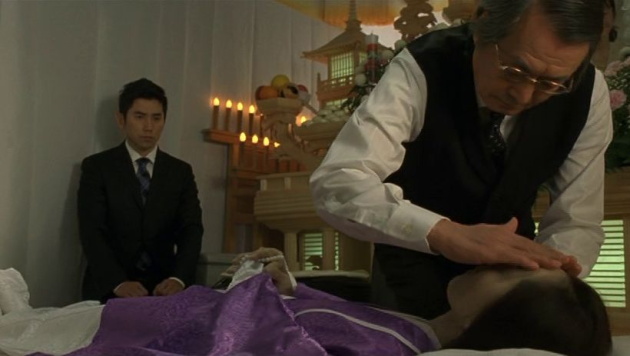
Departures depicts men known as Nōkanshi and details their custom of ‘encoffining’, in which the body is prepared for its so-called departure. This is accomplished through a procedure of cleaning, dressing and applying make-up; there is such a level of dignity, grace and even an artisanal nature to the procedure as it is performed with such intricate precision (even when it involves a man undressing a woman and touching her body). In a way, the procedure brings life back to the body, as the application of makeup returns colour to the face after the blood has been drained from the face.
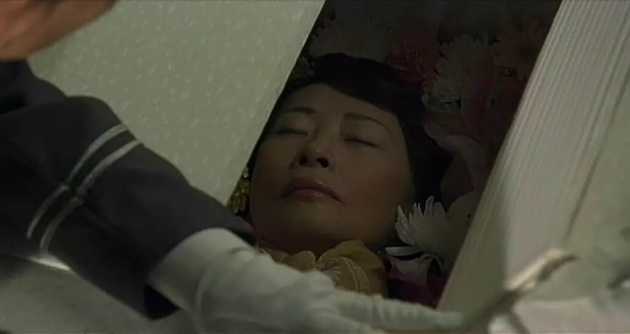
However, despite the importance of death rituals in Japanese culture, the subject is considered “unclean” as everything related to death is thought to be a source of “kegare” (defilement). This is the contradiction at the core of Departures: a job which is so vital and dealing with something so universal, yet those who perform it are scorned upon and discriminated against. Daigo Kobayashi (Masahiro Motoki) is only one of three employees at the encoffining company NK Agent, alongside his world-weary Freudian father-figure boss Ikeui (Tsutomu Yamazaki) and the secretary Yuriko (Kimiko Uemura), whom is herself a social outcast. Daigo is even openly insulted by a patron during an encoffining ceremony, while an old friend, Yamashita (Tetta Sugimoto), highly chastises Daigo upon learning of his profession. Well, that is until his own mother dies and he receives a metaphorical comeuppance. This discriminatory treatment reaches its zenith when Daigo’s Mika (Ryoko Hirosue) wife, temporarily leaves him upon discovering what he does. From an outsider’s cultural perspective, it’s hard not to feel that the reactions Daigo receives are anything but unreasonable (but I understand that I come from a particular perspective).

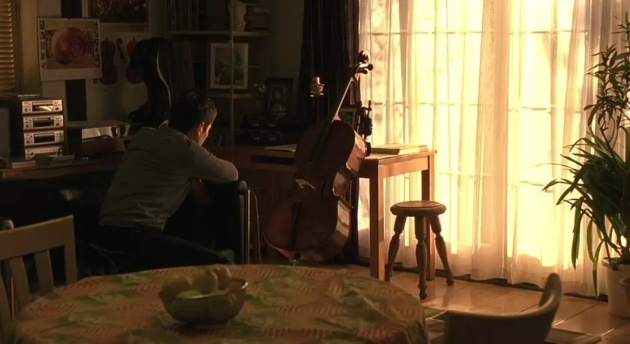
That being said, Daigo does receive praise from patrons during the course of the film for his work. This ties into the other (albeit positive) irony within Departures, that a man finds meaning in life through death. At the beginning of the film, Daigo is devastated to lose his job as a cello player in a Tokyo orchestra, as few people are attending their performances. This has been a lifelong ambition of Daigo as he has been playing the instrument since kindergarten (“You professional cello player yet?!”). This death of his music career, however, yields a new career, as just like in the real world, life doesn’t always turn out how we planned it (“What I’d always taken as my dream maybe hadn’t been one after all”). With so many people in the world stuck in dead-end (pardon the pun) jobs, Departures really showcases the importance of finding deep meaning and purpose in one’s work, and just what a spiritual privilege that can be.
Despite the subject matter, Departures is not a dour film, far from it. In fact, upon watching again, I was surprised to find the film rather funny. From Daigo wearing a giant diaper to film an instructional video, to live octopus antics in the kitchen, Departures injects an appropriate degree of levity, but not in a way to break the mood. Even during the opening scene, Daigo discovers the deceased person in question was actually a gender dysphoric male once he discovers she has “a thing”, leading to a funny exchange between Daigo and his boss (but not in a way which feels inappropriate or out of place). This levity also extends to the film’s montage, in which the complete spectrum of people dealing with grief is displayed. One funeral sees a family laughing with tears of joy and leaving lipstick marks on the face of their deceased patriarch, while another family happily proclaims “bye-bye” and “thank you for everything” to their grandmother while she wears her favourite socks (really putting the fun in funeral). On the other end of the spectrum, the POV shot from the deceased Christian boy as the lid is slid over the coffin into darkness gives me goosebumps. Likewise, the emphasis of the cello in the film’s narrative not only ties in with the Japanese love of European classical music but also influences the music score. Composer Joe Hisaishi emphasises the use of cellos in his score of which he described the challenge of centring a score around the cello as one of the most difficult things he had ever done.

In a classic “would probably never happen in real life” scenario, Departures concludes with Daigo performing an encoffining for his estranged father, who left himself and his mother for a waitress when he was a child. Daigo finds in the hands of his father’s deceased body a rock (a counter piece to a rock his father gave him as a child to symbolise their bond), showing that he never forgot about his son and thus acting as a form of redemption for this deadbeat father. Although I do have to question if this is enough to really redeem his character, should there have been evidence for more active measures by his character in order to achieve redemption? Regardless, as presented in the film, one can view it through either the Eastern notion of forgiveness vs the Western Christian notion of forgiveness.
Forgiveness doesn’t erase karma, but it helps release attachment and hate vs “Forgive us our trespasses as we forgive those who trespass against us”.
 Sat In Your Lap