Clark v Evil Superman
***This Review Contains Spoilers***
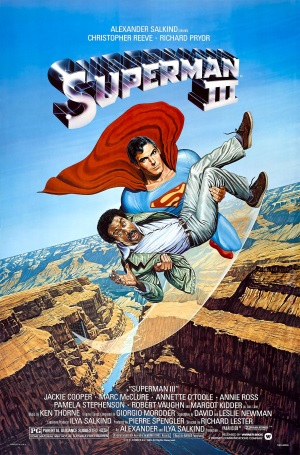
Superman III, often dismissed as “the Richard Pryor Superman movie”, is a film with many highly questionable moments and bizarre decisions on the part of the filmmakers (most notably the far greater emphasis on comedy), but dam if it’s not a movie I have an immensely fun time watching. Even during the film’s pre-opening credits scene I already found myself relating to Richard Pryor’s character of August ‘Gus’ Gorman and I thought to myself “Isn’t this supposed to be a bad movie?” Ah yes, the monotonous and degrading experience of going to a jobs & benefits office and dealing with the employees who don’t want to be there and probably don’t like you as evident from their body language. The down-on-his-luck Gus then complains about his experience being employed at a fast-food restaurant and how “they expect you to learn that stuff in one day” – let’s say I’ve had some similar real-life experiences. This is later followed by another one of Gus’ relatable frustrations – having your pay undercut by taxes (“State tax, federal tax, social security tax”). I wasn’t bothered by Pryor sharing the spotlight with Superman regarding screen time as I very quickly became endeared by this regular Joe who bites off more than he can chew and finds himself in extraordinary circumstances. Gus, you are my spirit animal!
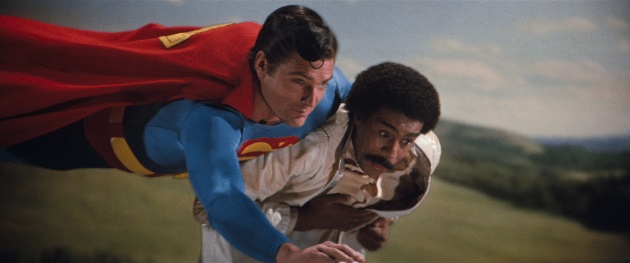
The text for the opening credits of Superman III looks like it was created using Windows Movie Maker (or whatever the equivalent was circa 1983) but I’d be lying if I didn’t say the slapstick comedy in the opening credits amuses me with its classic vaudeville-like elements (including a haphazard blind man, a pie in the face and even a clumsy mime). This opening is very intricately set up and is done by a director who understands and knows how to do physical comedy aided by a delightfully mischievous-sounding score from Ken Throne. Now you might be asking dear reader, “Even if all that is true, what is this sequence doing in a Superman film? This isn’t a Jacques Tati film”, and you would be absolutely correct in that assessment. I could try to post-hoc rationalise its inclusion, arguing that it ties in with the fact that Clark Kent is often a bumbling clutz, plus the series is light-hearted and campy as a whole. However, at the end of the day, all I can say is that it simply entertains me and makes me laugh. So please let me enjoy the one time in history in which the unique and odd combination of the Superhero genre and classic vaudeville comedy came together into one.
Not all of the comedy in Superman III is successful in my eyes. If I was to pick out the weakest scene in the entire film it would be that in which Gus explains Superman’s exploits in Columbia as the Man Of Steel disrupts the villain’s plans for economic manipulation (“But this one miserable, puissant little country, has the gall to think it can dictate the economy of an open market!”). I can understand the writers were trying to give Pryor room to express his comic chops however the scene fails on such a level and rather just comes off as a lengthy and awkward expositional monologue edited to several brief flashbacks of Superman in Columbia – why not create an action scene out of this plot point instead?. Then there’s the gag of the green man and the red man in the traffic lights fighting each other. I find the moment funny in isolation, but when viewed within the context of the film you have to ask yourself, “Did that really just happen?”. Nowadays with smart technology, someone with the know-how could actually programme such a thing to happen, so perhaps the gag was ahead of its time after all.
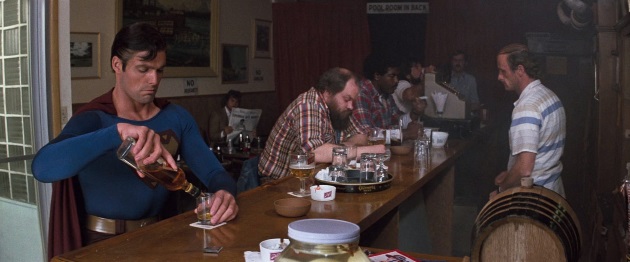
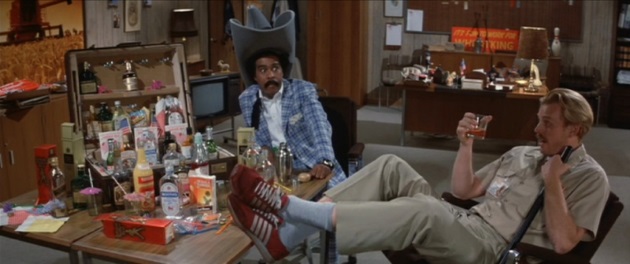
Amongst the comedy which does succeed, I do enjoy the gags which use Superman’s powers for comedic effect such as Evil Superman straightening of the Leaning Tower of Pisa or the blowing out of the Olympic Torch just as it reaches its final destination. However, If I was to pick a comic highlight of the film, it would have to be the sequence in which Gus breaks into the Webscoe offices in Smallville, with all the drunken antics and the improvised use of a passed out inebriated body of a security guard to turn on a computer which requires “both keys at the same time” to activate (a very Mr. Bean-like scenario) – plus the sight of Pryor in a tweed suit and an oversized cowboy hat which keeps bobbing around is a funny image in itself. Corresponding, the film also has its share of more subtle comic moments such as Gus foolishly flaunting his ill-gotten wealth by driving to work in a Ferrari to Jimmy Olsen’s incessant yammering to Clark as they ride on the bus. I also enjoy Pamela Stephenson as the Jean Harlow-like dumb blonde Lorelei who conceals her intelligence (“How can he say that pure categories have no objective meaning and transcendental logic? What about synthetic unity?”). Then there’s the other brand of comic moments in Superman III, those which I can’t quite determine if they were intentionally supposed to be funny or not, such as the bizarre sight of the unshaven Evil Superman in a bar drinking as he flicks peanuts to smash glass bottles. Regardless, moments like this are now a goldmine for internet memes galore.
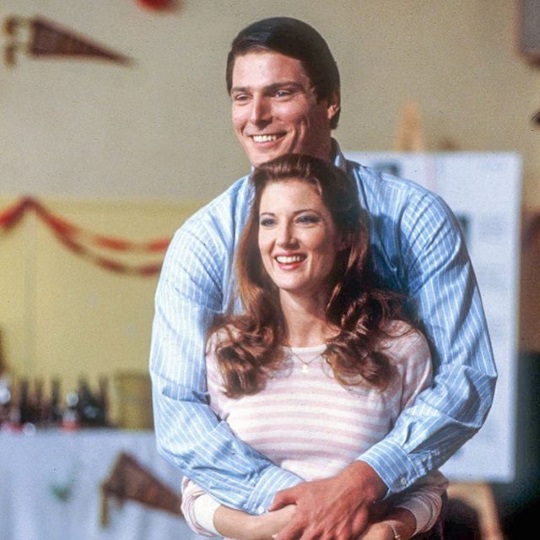
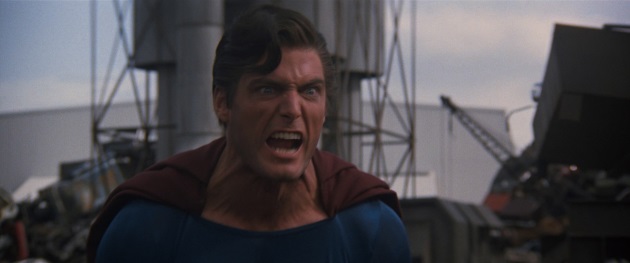
Third time’s the charm and Christopher Reeve finally gets top-billed in his own series. Superman III is Reeve’s finest performance as the Man of Steel as he has the task of portraying three different personalities in one film – Clark Kent, Superman and Evil Superman (which he has been retroactively referred to as the persona is never actually given a name in the movie). While these are all persona variations of the same character, it does show Reeve held the same ability alongside the likes of Peter Sellers or Eddie Murphy to play multiple characters in the same film and even interact with each other in the same scene. How one man can look so vastly different from three versions of the same character? Reeve even showcases his physical acting abilities to be on par with the greatest silent film actors with the level of expression he can convey through body language and facial expressions (just look how tightly the skin is pulled back around Reeve’s neck as he shouts “Come on!” during the junkyard fight). Moreover, as with Superman II, one of the elements of the movie I found myself enjoying most was the character relationships. I was surprised I was engaged with the relationship and dynamic with Clark’s Smallville sweetheart Lana Lang (Annette O’Toole) as much as I did with Lois Lane in the previous film. In one of my favourite moments in Superman III, Clark and Lana are cleaning up the gym together following the class reunion party as she tells him about her ambitions and how she wants to leave Smallville as Clark plays an instrumental rendition of Earth Angel on the piano (in a great combination of diegetic and non-diegetic music). At this point in the movie, I thought to myself how people can dismiss this movie as much as they do when you have brilliant, intimate moments like this which showcase performers with such marvellous chemistry. What really differentiates Clark’s relationship with Lana in contrast to his love interest in Superman II is that Lois is in love with Superman but ignores Clark, whereas Lana is in love with Clark but not so much Superman. Thus Clark is much more confident, suave and debonair with Lana, and not the bumbling clutz he is with Lois. Sadly, the status quo of the Superman universe can’t allow Clark and Lana to become a couple, but what a superb pairing they are. I do have to ask though, why are the class of 1965 having a reunion in an off-year, assuming the film is set in the year it was released (but I digress)?
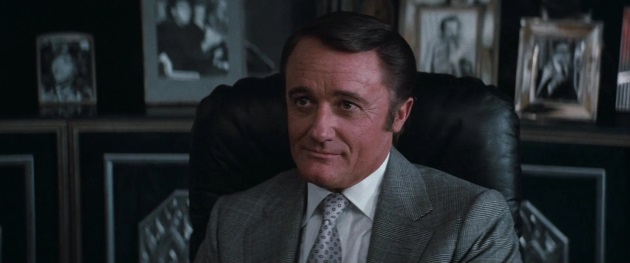
Initially, the big bad of Superman III, Ross Webster (Robert Vaughn) disappointingly came off to me as a lesser Lex Luthor. However, on further viewing, I’ve really come to appreciate the Bond villain-like character and Robert Vaughn’s charismatic and suave performance as well as that of Annie Ross as Webster’s butch, somewhat comical sister Vera. Like Luthor’s underground, abandoned subway layer in the first film, Webster’s own layer is like a character in itself, with his own ski resort atop a Metropolis skyscraper and a memorable, grey, art deco design in his grand office. Additionally, I’m not the first person to point out that the reimagining of Lex Luthor in the comics starting with the Crises Of Infinite Earth series in 1986, portrayed Luthor as not the mad scientist archetype as he had been for decades until that point, but rather as an entrepreneurial head of Lexcorp – not too dissimilar to Ross Webster and his company Websco with both being complete with tall, extravagant skyscraper penthouses as a testament to their larger-than-life egos.
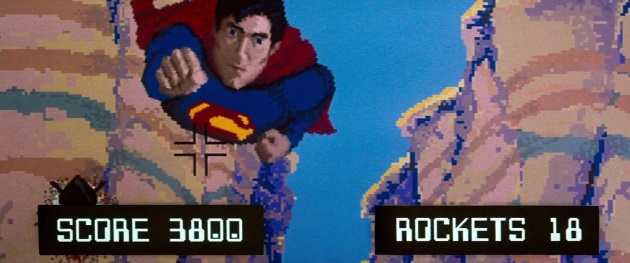
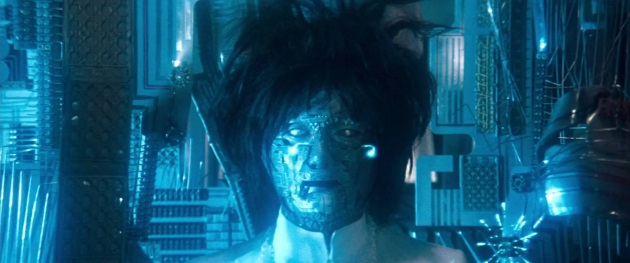
One of the most notable and unique aspects of Superman III is its semi-serious early screen depiction of computers and cyber-terrorism. Gus’s get-rich-quick scheme of writing a computer programme to gather up fractions of a cent remaining from other Webscoe employee’s pay cheques does have its basis in reality in a practice known as salami slicing (with this aspect of Superman III having influenced the movie Office Space as directly referenced in that film itself). However, I do use the term semi-serious as by the film’s climax, the understanding of computers in Superman III goes from having a basis in reality to becoming pure science-fiction with the super-computer designed by Gus. Just how did Gus accumulate the knowledge to design a machine which can feed itself by absorbing power from the electric grid, is able to grab people by using its wiring like a series of tentacles, can levitate people into the air and even turns Vera into a robot (I don’t think even the likes of Bill Gates are capable of creating a computer quite like this). Vera’s robotic transformation (or is she a cyborg as she appears to still have flesh skin albeit painted grey) is particularly frightening as she screams in agony during the process and then proceeds to walk like Boris Karloff in her new robotic form. I’d also be remiss if I didn’t mention, why does the villain’s view of Superman flying through the canyon looks like a video game complete with score points and those infamous Atari Pac-Man sounds? It doesn’t make sense (not to mention they do realise Superman is indestructible so why are they bothering to fire missiles at him?) but it sure is a fun sequence to watch. This entire action climax of the film is ridiculous but makes for very entertaining viewing and is topped with many memorable special effects shots from stop motion to miniatures (bringing the 80’s factor of Superman III up to 11).
I find Superman III to be the most visually and aesthetically appealing of all four Reeve films, and with Richard Lester being the only director at the helm (unlike Superman II which went through two directors), Superman III is consistent in its visual style with its use of warm, pastel colours and coupled with the picture’s use creative old-school practical effects. These films became more pop art in style as they went along, with another major unique contribution of Superman III to the series being the wholesome, small-town Americana feel with the scenes in Clark’s hometown of Smallville (ironically though filmed in High River, Alberta, Canada). Superman III is full of very comic book-like, very Superman-ey (for lack of a better term) moments such as Clark sneezing to create a bowling ball strike or Superman freezing an entire lake and then carrying it as a huge piece of ice in order to extinguish a chemical plant fire – a joyously simple and effective solution which feels like it’s taken right off the pages of a comic book. Furthermore, the TV version of Superman III contains 18 minutes of extra footage but unlike the TV versions of the first two films, the extra footage is mostly unnecessary padding for existing scenes and contains nothing that I was wishing was included in the theatrical cut. Even the Frank Oz cameo as the surgeon comes off as an awkward and unfunny attempt at shock humour while the clear indication that Evil Superman is definitely getting it on with Lorelei (whereas in the theatrical cut, this is only implied) is pushing it too far for what’s supposed to be a family film. Additionally, the opening credit sequence in this version which goes back to the traditional outer-space credits of the first two films is very dull with the repetitive use of scrolling text. This is one Superman movie in which I will stick with the theatrical version. Or if you would rather have an abridged version of Superman III, watch the infamous trailer which explains the entire main plot in 3 minutes.
An aspect of Superman III which is not often discussed is the film’s many references to indulgence and substance abuse, with Evil Superman being a potential metaphor for this. When analysing a movie for a deeper meaning like this, you can question if any such messages were intentionally incorporated by the scriptwriters. However, in Superman III, this theme is very on the nose that I can’t see it being something which the writers didn’t knowingly include. Firstly, how did Evil Superman come to be? Well by man-made kryptonite which substituted tar with an unknown substance of 0.57% after Gus Gorman choose the substance after seeing it as an ingredient on the side of a cigarette package. It’s like the film is saying smoking turned Superman evil (then again, didn’t your last movie have product placement for Marlboro Cigarettes?). Reeve plays Evil Superman in a manner in which he appears to always be intoxicated, while in pursuit of hedonistic pleasures (including getting super-laid). In general, Superman III is full of references to addictive substances including alcohol, cigarettes, coffee and fast food from the character of Brad Wilson (Gavin O’Herlihy) being in a state of near-constant inebriation to Ross Webster himself being a coffee mogul. Even Webster’s line “Every time a drunk sobers up, he’ll be drinking Webster coffee” is very on the nose. Gus himself also indulges in his newfound wealth (after previously complaining that he wants his pension money now) causing him to lose sight of his moral compass. On top of that, the film’s co-writer Leslie Newman refers to the Evil Superman as being “under the influence” in the documentary The Making Of Superman III – make of that what you will. During the film Evil Superman never kills anyone nor causes catastrophic damage or destruction (bar the oil tanker incident which is the worst action he performs) as Superman’s own inherit morality would prevent him from doing so – it makes sense that hedonism (and general trolling) would be the worst thing a corrupted Superman would do. When watching the movie through this thematic lens of indulgence and substance abuse it makes the confrontation between Clark and Evil Superman all the more compelling, speaking off…
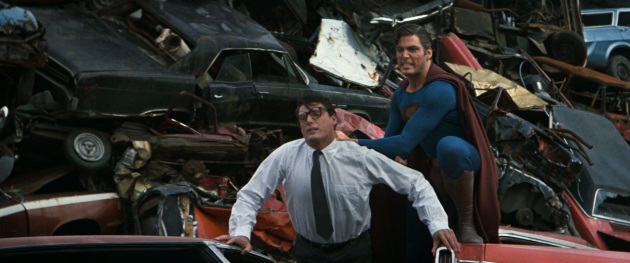
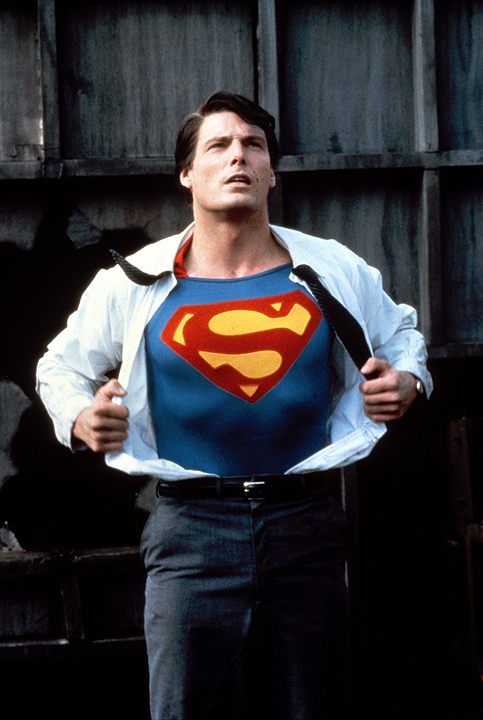
The grand highlight of Superman III has to be the inner conflict of good and evil that is the in-head fight between Evil Superman and Clark Kent in the junkyard – never before has a fight which doesn’t actually happen been so exciting. It’s intriguing to see the Clark persona involved in combat with the juxtaposition of a dorky guy who can give and receive such a brutal beating (“I can give as good as I get”). The use of composite shots and body doubles sells the illusion of two versions of Christopher Reeve fighting each other (pre-dating Back To The Future: Part II by six years), while the junkyard environment is used to great effect with the use of conveyor belts and trash compactors. While none of Ken Throne’s original music reaches anywhere near the heights of John Williams’ work, his music for this fight is a highlight with its eerie use of synthesisers. In addition, I find the moment of Clark being crushed in the trash compactor to be scary stuff. Even though as a viewer I know he will be fine as he is Superman after all, his heavy breathing and the look of horror on his face as he is trying to escape from the machine alongside the pov shot in which he catches his last glimpse of daylight in a scenario of which a normal human would be crushed to death is very unsettling to watch. In the end, the better angels of our nature prevail as Clark defeats Evil Superman, followed by a glorious victory shot in which Clark does the iconic shirt rip and subsequently flies off as regular Superman as the John Williams theme plays is one of those triumphant movie moments that make you want to just cheer on – “Yeah, go Supes!”. I’m not ashamed to proclaim my un-ironic love for the imperfect but joyous cinematic outing that is Superman III (perhaps I can reclaim some cinephile street-cred by reviewing some pretentious, European art-house that everyone pretends to love in order to look cool and artistically enlightened). Will I be able to find any merit in Part IV of the Superman film franchise? Let us embark on the next stage of our quest…a quest for peace?







 Sat In Your Lap