
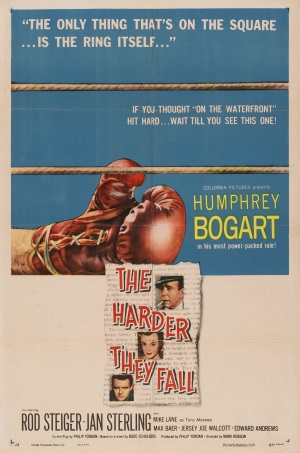
The Harder They Fall (1956)

The Pen Is Mightier Than The Sword

***This Review Contains Spoilers***

It’s unique to see Humphrey Bogart in a more contemporary, neo-realist 1950’s film in the form of The Harder They Fall. From the Saul Bass-inspired opening credits which help set up the plot (rather than just a series of static title cards) to the punchy music score, I imagine if Bogart lived longer and stared in movies for at least a few more years they would have been aesthetically in a similar vein to The Harder They Fall.

The Harder They Fall deals with corruption and fixing in boxing and how promoters exploit athletes regardless of their health or well being, providing an in-depth look at corruption in boxing as to who pulls the strings and how. The fight scenes themselves don’t suffer from the dilemma of old boxing films having dodgy looking bouts with sped-up footage or obviously fake punches, partially due to the fact that the fights within the film are staged and of poor quality fight tactics. Likewise, the grime and sweatiness of boxing arenas and training gyms never fail as effective subjects to capture on film, especially in black and white. Also, what’s the deal with that bus with the cardboard cutouts attached to it? It’s almost like a character in itself.

More so than any other Bogart film do we see such a striking generational clash with Bogart coming from the old school style of theatrical acting and Rod Steiger from the Marlon Brandon, method school style of acting. However, I’ve always found Bogart to be a very adaptable actor and he is able to seamlessly play of Steiger despite their acting styles being worlds apart. Bogart’s role as washed up columnist, Eddie Willis is one of the most interesting heroic performances of his career which combines Bogart’s trademarks of both world-weary cynicism but also, a sense of righteous morality as he deals with his moral and ethical conscience throughout the film. Eddie can draw up fake publicity for the not so talented, big lug Toro Moreno (Mike Lane), writing articles stating he is the heavyweight champion of South America, undefeated in 39 fights and largely get away with it – that’s the pre-internet world for you (“Nobody reads these west coast papers in the east”).

Eddie may take part in the world of boxing corruption but he never fully believes in what he is doing and tries to make the outfit as unscrupulous as possible. Not to mention he is the only person in the racket who genuinely cares about the gargantuan Toro, whereas the rest of the men couldn’t care less about him. Rod Steiger on the other hand as corrupt sports promoter Nick Benko is an impulsive, brash character who has no moral or ethical conscience – you have to ask does he actually believe in what he is doing is justified in his mind. Steiger chews the scenery throughout the film in a very shouty, loud-mouthed performance which has shades of DeNiro or Pacino coming through.

I had a sense of melancholy during the movie’s closing shots knowing this was the last time Bogart appeared on screen. Bogart was in poor health during the film’s production, suffering from lung cancer (although ironically it doesn’t stop him from lighting up during the movie). In the film’s conclusion, The Harder They Fall celebrates the power of writing as a force to fight wrong and enforce positive social change – proving once again the pen is mightier than the sword, or should I say boxing glove. In the powerful final shot, Eddie begins typing an article on boxing corruption and reformation for the sport, an aspiring sight for any budding non-fiction writers.

“The boxing business must rid itself of the evil influence of racketeers and crooked managers, even if it takes an Act of Congress to do it.”
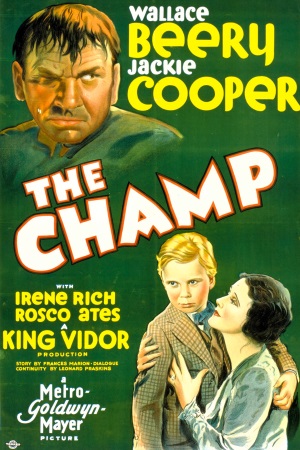
The Champ (1931)

Wallace Beery, Boxing Picture, What Do You Need, A Roadmap?

***This Review Contains Spoilers***

I can say without hesitation, The Champ is one of the most tearjerking stories ever committed to celluloid – a tale so moving in its raw, cinematic transcendence. Little Dink (Jackie Cooper) and his father Andy Purcell, aka The Champ (Wallace Beery), hold one of the most heartfelt and compelling on-screen relationships I’ve ever seen, with their chemistry and interactions showcasing the power of the medium.

Screenwriter Francis Marion wrote The Champ as a starring vehicle for Wallace Beery, with the picture perfectly matching his lovable lug persona. Andy/The Champ is not a two-dimensional stereotype, but rather a figure who is, in one sense, tragic due to his fall from grace after losing a championship boxing fight at an unspecified time in the past (possibly due to his alcoholism, although The Champ himself denies this). Despite his character flaws alongside himself and the fact that he and his son live in near poverty, he still manages to create a life for themselves, staying afloat from ventures in prizefighting and horseracing (and more unfortunately, gambling). Likewise, his failed marriage with society woman (and Dink’s mother) Linda (Irene Rich) showcases that although he is an unsophisticated slob at heart, his previous brush with the high life has had some effect on him, as he is able to maintain somewhat of a dignified aura. It is stated that Andy won the custody of Dink over his mother, which, given the film’s subtle characterisations, is something I can buy into.

However, it’s the ever-adorable Jackie Cooper who steals the show as Little Dink. Every time the little scamp utters the name of The Champ (“Come on Champ, “You betcha, Champ!”) or one of his many memorable lines (“You’re some dame with a lot of jack”), I have myself a little smile of joy. Cooper’s wide-eyed optimism and “aww shucks” persona stand in contrast to his position of being thrust into the role of an adult due to his father’s irresponsibility. Having to stay up at night until his drunken father comes home (and then helping him into bed) to managing a professional racehorse. Dink is even capable of driving a car full of adults (even if the steering wheel movements don’t match those of the car). Dink practically worships his father despite their relationship seeming like a massive contradiction. His father is a washed-up loser who drinks, gambles and often breaks promises he makes to his son. Yet, he still remains The Champ, “the greatest”, and truly loves his son back. At the end of the day, Dink’s devotion isn’t based on logic. It’s based on attachment, unconditional love, hope, and the inability of a child to separate a parent’s moral failings from the emotional bond they share. With these two, I feel like I’m observing real human behaviour, not acting.

The film’s naturalistic and unmanufactured feel extends beyond the performances. The world of The Champ feels real and lived in. It’s run-down and unpolished to the point that it’s hard to distinguish between what is real and what is a Hollywood backlot. The Champ also disproves the misconception of movies from the 1930’s being static. Right from the opening scene, the camera moves alongside Dink and The Champ as they are jogging, or take the sequence in which Champ arises from bed in the morning, with the camera following and zooming in on his movements throughout the room in a lengthy, uncut shot. The Champ belongs to the genre of waif films (such as Charlie Chaplin’s The Kid), about stories of children living in urban settings full of wooden fences and general dilapidation, with The Champ in particular featuring scenes of kids freely roaming the bustling streets, unescorted by adults. This is even reflected in the cinematography during the scene in which Dink and his friends try to find The Champ in a smoke-filled bar; the camera remains at the same eye level of the children. Likewise, the sequence in which Dink waits outside his mother’s large and opulent home really deserves mentioning. The scene has no relevance to the rest of the plot and simply involves Dink singing while he plays on some railings and proceeds to walk and further ascend the tiled roof. The scene is so intriguing to watch as it feels like looking into a slice-of-life time portal of a bygone era.

The Champ is set in Tijuana, Mexico, which makes sense why a character like Andy would choose to live just south of the border. During the era of Prohibition in the United States, Tijuana had become a playground for Americans, with thousands crossing the border every week to drink alcohol, gamble, attend horse races, and watch boxing – activities that were illegal or heavily restricted in the United States. In the film, all the background signage is in English (barring the exception of the police truck), while the only characters of Latin descent or who speak Spanish in the film are The Champ’s opponent, Manuel Quiroga (Frank Hagney) and his trainers. I can’t comment on just how accurate the film’s depiction of an Americanized Tijuana is, but it certainly adds another element of intrigue to the picture.

I initially reacted with dismay when Dink’s mother and her second husband, Tony (Hale Hamilton), try to separate Dink from The Champ, since the stakes of the separation feel real. In a lesser film, Linda and Tony would likely have descended into cliché villainy, but instead they come to accept that the separation of Dink and The Champ ain’t gonna happen and help support Andy rather than become antagonists of the story. They even show up to support Andy on the night of his big comeback fight. Andy wins the fight; however, this redemption comes at a price, as his injuries from the bout prove fatal. The Champ bows out one last time, in front of his son. With Dink’s entire world collapsing before his eyes, everyone in the room, one by one, tries to comfort the inconsolable child as he heartbreakingly yells, “I want The Champ!”. Everyone, however, fails in this task, and only when his mother enters the room, Dink thrusts himself into her arms for comfort. Only in death does the spiritual custody transfer. Watch and let the waterworks roll.