Get Witch or Die Tryin’
***This Review Contains Spoilers***
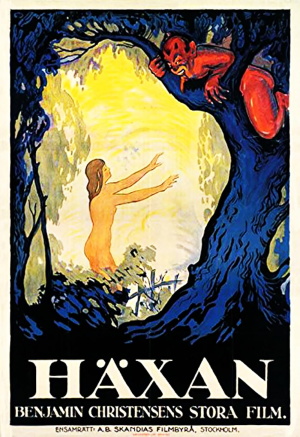
Witchcraft as a subject matter wouldn’t normally be my cup of brew, yet with its unique combination of documentary and scripted drama, Häxan (pronounced as “heck-sun”) presents itself as interesting even to non-adherents. Häxan is a film which on the surface level looks like it would appeal to new age mystics or that one edgy goth kid in every school, however, in contradiction to its arcane visual presentation, Häxan is a film of scientific rationalism as established from the beginning (“The belief in evil spirits and witchcraft is connected with childish perceptions from the world of mysticism”) and one from the God of the Gaps school of thought (“When primitive man is faced with something incomprehensible, the explanation is always the same: witchcraft and evil spirits”).
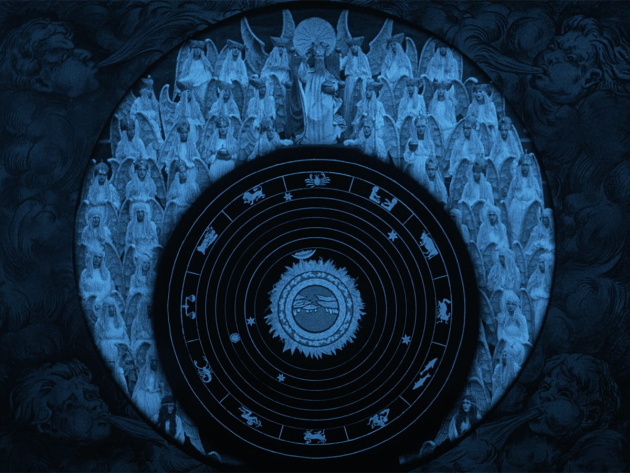
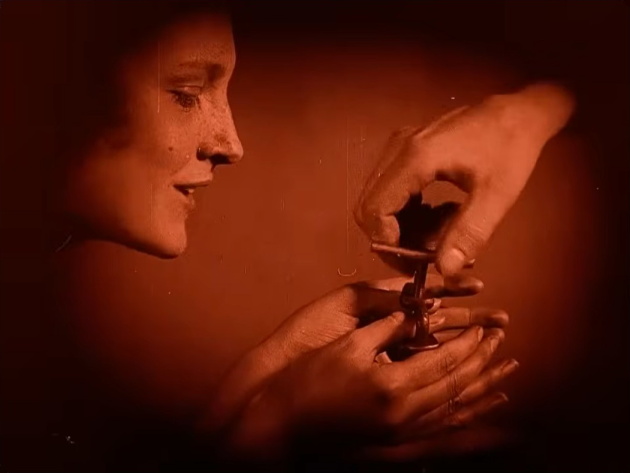
The film’s first of seven chapters provides an overview of witchcraft throughout the ages (primarily the Middle Ages), featuring an array of astronomical diagrams from antiquity, as well as historical depictions of devils and demons. Many of these images are frightening to look at and are presented alongside such gruesome captions as “One devil pours the sulphur-reeking contents of a horn down a man’s throat”, speaking deeply to the fear present in the human condition. One of the film’s later documentary segments features the ever-popular topic of Medieval instruments of torture, with one particularly standout moment involving (as the film claims) one of the actresses volunteering to use a medieval thumb screw, although she is seen laughing on screen when using it (make of that what you will). Many of these displays feature an on-screen pointer being held by someone off-screen, yet they still retain a cinematic quality. As a viewer, you feel like you are being imparted with clandestine, forbidden knowledge rather than feeling like the 1920’s equivalent of a PowerPoint presentation.
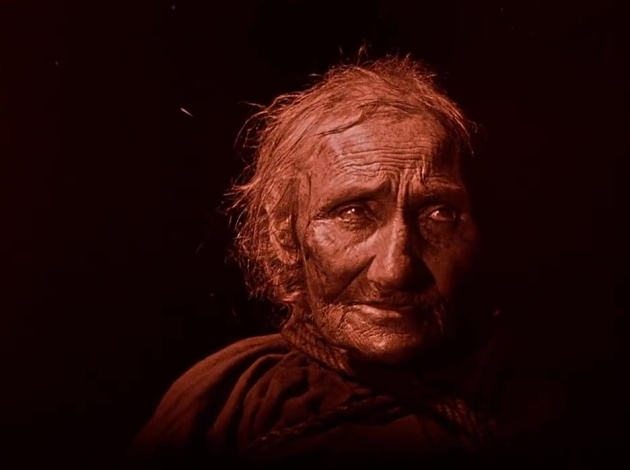
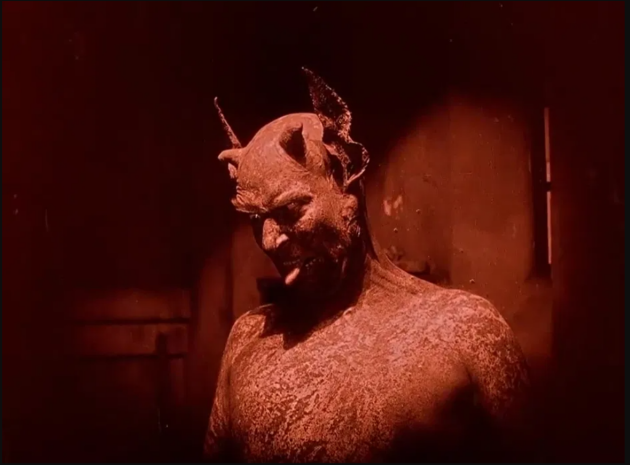
Häxan has all the ingredients you would want from a 100+ year old, arcane, European movie. The sepia tinting, eerie music, haunting choirs, the sight of animal skulls and skeletons in the witch’s dwelling and even the Swedish title cards make it feel all the more unnerving and atmospheric. Likewise, during the trial section of the film (chapters 3 and 4), the close-up shots of the old woman’s face as she is forced to deal with Church inquisitors feel reminiscent of what would later be accomplished in The Passion of Joan of Arc (1928). The lady in question during these scenes, Maren Pedersen (as Maria the Weaver), in her only screen credit, was born in the year 1842. It’s amazing, penetrating close-up into the face of a woman whose birth predates the existence of cinema by decades. Häxan also features scenes with Satan himself (played by the director, Benjamin Christensen), as he gleefully shows off his forked tongue. Over the years, I have kept seeing this as an image of ridicule and parody; thus, my instant reaction when seeing it is to laugh. Likewise, as far as the more immature 12-year-old in me goes, many viewers may also be humoured to see the end credits card.
Witch hunts (whether literal or figurative) have one major paradox, as stated in Häxan: ”those who oppose the arrest of a witch are of course themselves witches”. Or as The Simpsons memorably put it in the episode Treehouse Of Horror VIII, “If you’re innocent, you will fall to an honourable Christian death. If, however, you are the Bride of Satan, you will surely fly your broom to safety. At that point, you will report back here for torture and beheading”. During Häxan, we see a deception of the pious man of the church as a glutton, comically feasting on huge pieces of bread and meat, before chasing his maiden for some hanky-panky. Regardless of whether or not the film has a deliberate anti-clerical or anti-religious angle, it still uses the phraseology in one of its intertitles of “the year of our Lord 1488”.
The final chapter of Häxan circles back to the demystified with a medicalised conclusion, of which the picture presents its central argument that women accused of being witches in the past would be diagnosed with hysteria or other medical conditions in the present day. It is presented in a thought-provoking and articulate manner, although if I were to give one criticism, it would be with the title card stating: “We no longer sit and stare in fright at the devil’s paintings on the church wall”. For starters, it annoys me in a lot of media, the use of pronoun “we” as the media in question thinks it is speaking on behalf of viewers, but additionally, the film contradicts this only moments later by stating “But superstition – doesn’t it still flourish among us?”, as well as with an earlier claim by the director that the actress who plays Maria the Weaver, states that she herself has seen the devil at her own bedside. Häxan presents itself as a work of scientific demystification, yet it cannot resist the same lurid imagery and superstition it claims to transcend. One might say, the devil is in the details.
 Sat In Your Lap