Glen or Glenda (1953)

Misunderstood

Note: This is the earliest film review of mine which I still have. While my other early attempts make me cringe in how amateurish they are, this one I find has an appealing innocence to it, therefore I present it as I originally wrote it back in 2011.


I might sound insane, but I’m giving an Ed Wood movie a positive score from an artistic point of view. Glen or Glenda marked Wood’s first film, which he not only written and directed but also starred in. The film was originally slated to be a biopic on Christine Jorgensen, the propriety of the first publicly known sex change operation (in this case from male to female) Wood, however, took over production and instead turned it into a film about his own transvestism.

Whether you’re conservative or liberal on issue of cross-dressing and trans-sexuality, Glen Or Glenda manages to do something which I’ve seen many sacred cows fail to do, create emotional interest in its main characters, and succeeds to raise question on what it means to be normal, with an issue which is just as relevant today as it was in 1953.

The movie’s production values are surprisingly good for a film of this calibre. The surreal dream-like sequence in the 2nd half of the movie features some impressive filmmaking techniques and manages to engage you in the character’s descent into insanity. Even the film’s acting is decent, certainly better than in the likes of Plan 9 from Outer Space.

Lugosi’s character is widely regarded to be a scientist representing God. At first, I didn’t understand the character’s role in the movie (plus the use of the stock of footage is completely random). However, I was impressed with how his catchphrase which he utters throughout the course of the movie actually finds its way to having relevance with the plot.

I’m not the type of person who over analyzes movies looking for their deeper meaning, but in Glen or Glenda it really came through quite obviously and did leave an impression on me, as well as changing my opinions on Wood as a director. I can defiantly sense Ed Wood put a lot legitimate feeling into this movie, and certainly comes through in the finished product.

Fours a Crowd (1938)

Release the Hounds!

***This Review Contains Spoilers***

Errol Flynn, Olivia de Havilland and Rosalind Russell in a screwball comedy? These are the kinds of cast ensembles which unleash the inner fanboy in me. Errol Flynn rarely got the chance in his career to perform comedy and here he proves he was cable of doing Cary Grant-esque comedy on the same level as well, Cary Grant. Sadly Four’s a Crowd’s lack of box office success prevented Warner Bros from putting him in more comedies

Although The Women is seen as the film which launched Rosalind Russell as a fast-talking comedic actress, Four’s a Crowd is the first film in which she plays such a character and her first turn as the working career woman (or “newspaper man” as she refers to herself here) which became synonymous with shades of Hildy Johnson coming through. She takes full advantage of the role, stealing the show with her impeccable timing which reportedly made Olivia de Havilland envious. De Havilland though is tasked with playing a dim-witted character which she performs without coming off as annoying as such characters can easily be.

Four’s a Crowd owes a certain debt to Libeled Lady featuring some similar plot trends and themes with its slam on the upper classes, the socialite lifestyle and the desperate lengths newspapers will go to in order to get a story and control the narrative. Even the opening title sequence is taken from Libeled Lady in which the cast do the same arm in arm walk but is full of moments of inspired zaniness to distinguish itself. The model train sequence which lasts for 16 minutes had to have come from creative minds; plus what’s funnier in an innocent, cute kind of way than grown men playing with model trains. However, there is one moment in Fours a Crowd which is one of the most bizarre gags I’ve ever seen in a film in which after escaping from a pack of guard dogs to the other side of a gate, he grabs one of the dog’s legs and bites it. I still don’t know how to react to it, whether I should laugh or be horrified or both! The plot gets very confusing very fast but in a good way culminating in a finale in which Errol gets the wrong girl at the end! Although the manner in which this happens is screwball antics at its finest.

Fedora (1978)

When the Pictures Became Small

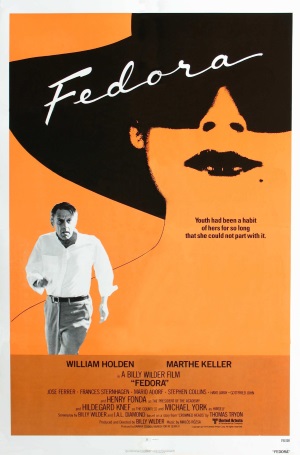
Fedora is one of the most bizarre films I’ve ever seen, to say the least. At points I’m almost laughing at the movie’s plot twist yet the more bizarre and highly improbable the movie became the more I found myself getting engaged in the story, waiting in eager anticipation to find out what will happen next with those oh so joyous “I did not see that coming” moments. The film’s highly implausible plot manages to draw the thin line between being completely absurd but never feeling like a parody.

The character of Fedora herself is a reclusive movie star who goes to extreme lengths in order to stay “on top” and retain her eternal youth to the point which even Norma Desmond would consider crazy. Early during the film, I suspected Greta Garbo to be the likely source of inspiration for the character of Fedora (whom Wilder always had great admiration for) but as the plot progressed I thought to myself “ok even Garbo was never this nuts”.

One of Fedora’s other intriguing aspects is the film’s critique of New Hollywood and how times have changed since Hollywood’s golden era came to pass. Fedora is the only film I’ve seen which displays a harsh attitude towards New Hollywood with lines referring to Hollywood being taken over by kids with beards who don’t need a script, just a handheld camera with a zoom lens as well as the demise of glamorous movie stars of the past. This is one of several aspects of Fedora which makes it similar to what you could call its spiritual cousin Sunset Boulevard; which itself commented upon what was lost when the silent era came to an end. I could go on making comparisons between the two films from William Holden playing a Hollywood hack in both films to Michael York’s role the in film being similar to the role Cecil B. Millie played in Sunset Boulevard.

I imagined by 1978 Wilder was far past his directing prime, not to mention after the 1950’s he seemed to become content with only directing comedies; thus I’m surprised to consider Fedora as one of his greatest films and a return to the roots of his earlier work as a director. As soon as William Holden’s narration begins you can instantly tell this is classic, old-school Billy Wilder.

Fail-Safe (1964)

Fail-Safe or Strangelove? That Is the Question

***This Review Contains Spoilers***

Fail-Safe is largely overshadowed by Stanley Kubrick’s Dr. Strangelove due to both movies being released in the same year. Both films deal with the events leading up to a nuclear strike although Fail-Safe takes a serious approach as opposed to the comedic nature of Dr. Strangelove. I much prefer Fail-Safe which I feel is a considerably more suspenseful film than Dr. Strangelove is a funny film. Fail-Safe examines in step by step detail what could potentially happen if a technical mishap gave pilots on a bomber the order to drop a nuclear bomb, in this case on the city of Moscow. The movie never explains what the technical mishaps was but the rest of the film examines in precise detail the actions which would be carried out if such a thing was too happen; primarily trying to stop the bombers and convincing the Soviets that the oncoming attack is accidental. Although the opening scene at the rodeo seems rather pretentious, Fail-Safe is a no-nonsense, straight to the point wordy drama. Like Sidney Lumet’s 12 Angry Men, Fail-Safe is a film driven by heart-pounding wordy exchanges.

Playing the President of The United States requires an actor with charisma and a commanding screen presence, no surprise that Henry Fonda pulls off the role with the greatest of ease. As a huge Henry Fonda fan, I do delight in seeing him as the most powerful man in the world. Along with James Stewart and Gary Cooper as actors who best embody the everyman, I feel this is one of the best roles of his career, representing the ideal American President (on the surface level at least) I’m sure many wish for (no political party is mentioned) as he tries to remain calm under the most extreme pressure.

Fonda spends almost the entire film in a small room only being accompanied by his Russian language translator Buck (Larry Hagman). This one aspect of the film did have questioning why the President isn’t surrounded by advisers and associates but this one liberty does create a sense of loneliness and claustrophobia with the film’s use of high contrast black and white cinematography also heightens the sense of fear and giving the film a great visual flair in one of the most visually stunning black & white films of the 1960s’s. Hagman’s performance itself is especially impressive as his character translates Russian to English as he listens to it being spoken, talking in a uniquely awkward manner in several sequences throughout the film, the first of which is a single, lengthy uncut shot.

The only other liberty I have to question in Fail-Safe is the failure of the wife of the bomber pilot O’Grady to tell him something only the two of them would know when speaking to him over the radio in an attempted to divert the bomber from destroying Moscow and convince them this isn’t an impression from Soviet spies – Could have at least been worth an attempt in order to avoid World War III.

Comedic actor Walter Matthau shows off his dramatic stripes as the cynical nuclear expert Professor Groeteschele, whom is more concerned with the political and economic aspects of nuclear warfare as opposed to the cost to human life. He is cold hearted and has no sentimental side to him and even gets pleasure making discussions of nuclear war into a piece of sick entertainment as seen at a house party during the beginning of the film. Later he makes very questionable recommendations in an attempt to have communism destroyed when the opportunity arises due to the technical mishap. His final worlds in Fail-Safe are a recommendation to prioritise recovering business records in New York City over the recovery of survivors and the dead as apparently, the economy depends on it. Whether or not this and other actions are justified, Groeteschele is a character who gives off bad vibes throughout the film and appears to enjoy his job a little too much.

The movie contains a disclaimer at the end that the US military has procedures in place to prevent the film’s events from occurring actually occurring but with a character like Matthau’s being a government adviser, I wonder what kind of statement the movie is making. The Congressman Mr. Raskob acts as the audience getaway character, perplexed and terrified of the technology he is being given a tour off at the war room of Strategic Air Command while the military personnel act in a confident manner to the improbability of anything going wrong. I doubt Fail-Safe is going to give any viewers a pro-nuclear mindset and will leave a chill down your spine. I feel nobody does thought-provoking and issue-based films (or issuetainment) as well as Sidney Lumet but none quite as terrifying as Fail-Safe.

Evelyn Prentice (1934)

The Thin Woman

***This Review Contains Spoilers***

Movies like Evelyn Prentice give me one of the greatest satisfactions I get from watching films; discovering an obscurity from an actor’s filmography which I end up considering to be one of their finest films. Myrna Loy superbly carries Evelyn Prentice, dominating the majority of the screen time, with William Powell delivering one of his finest dramatic turns while seeing Rosalind Russell in her screen debut is just a mere bonus. Russell doesn’t have a whole lot to do but she still comes off as a memorable screen presence despite this, although it is a little odd hearing her speak in an English accent and not at a machine gun rate. Loy and Una Merkel make for a fun duo, with Merkel having a very memorable comic sounding voice. Just the deco of Evelyn Prentice itself makes me love this film more, whether it’s a smoke-filled nightclub, the lavish interior of Powell and Loy’s home to even the clothes worn in the film (the costume department really knocks this one out of the park), sucking me into the world of the 1930’s.

Scenes such as the family exercising or the father and daughter playing the piano together help humanize them, making me more fearful that a character played by the sweetheart Myrna Loy could be going to prison, or maybe get the electric chair! The tension builds as the film progresses. The scene in which a witness arrives at the Prentice household while Evelyn is present to describe the women she witnessed leaving the murder scene, this woman, of course, being Evelyn buy nobody else knows that, feels like the type of moment you would get from a Hitchcock movie. In fact, the entire premise of the movie could be given the Hitchcock treatment.

I often feel like Hollywood makes being a lawyer look like the coolest job ever. Even if John Prentice (William Powell) is missing time from his family, his turn during the film’s courtroom climax makes the profession look like a constant flow of hair-raising excitement. The film’s final twenty-minute courtroom sequence had my heart pounding, eating up every minute of its melodramatic glory while screaming in anticipation of how the characters are going to get themselves out of this situation.  At the same time, however, I was tense that the movie would pull the characters out of their intense dilemma in a contrived manner, I’m pleased to say I was not disappointed. The outcome of the case is movie fantasy but it didn’t feel like a cop-out. Throughout this sequence, Powell and Loy do some of the finest acting work of their careers. Myrna Loy is generally not highly regarded as a dramatic actress but I would defy anyone says otherwise as she lays on the tears and the passionate pleas. I must also give credit to Judith Wilson, whole also left an impression during these proceedings. As a fan of Powell & Loy partnership and courtroom dramas, their third film together satisfied more than I could ask for. Manhattan Melodrama, The Thin Man and Evelyn Prentice all in one year, ain’t too stingy.

Double Indemnity (1944)

Flawless Film Making, Baby!

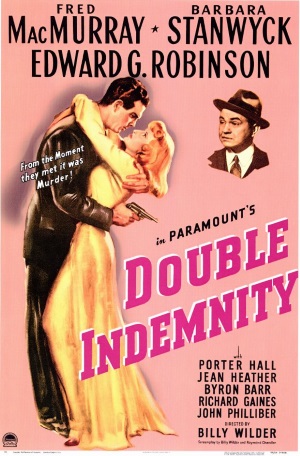
If there is a keyword I would describe Double Indemnity, its dialogue. Exposition is a very tricky line to cross; when done poorly it can come off as immensely frustrating but when done right it can be music to the ears, leaving me dying to hear more like I’m watching an engrossing documentary. Throughout Double Indemnity with the use of narration, Fred MacMurray will explain what’s clearly appearing in the frame but as nobody does narration quite like Billy Wilder. Instead of making Double Indemnity coming off as a movie which feels the need to dumb down and explain everything to the viewer, this expositional narration comes off a poetry, enhancing any scene in the film. Even with hearing noir dialogue parodied countless times, it doesn’t affect my enjoyment of the movie.

I’ve generally never thought much of Fred MacMurray as an actor; he strikes me as serviceable but never an enigmatic screen presence. His role as Walter Neff in Double Indemnity is the one major exception in his career. This casting against type may be my favourite one-hit wonder performance ever; his uttering of the words “Baby” and “Hello Keyes” never gets old. When I first watched Double Indemnity I assumed MacMurray must have been an icon of film noir, turns out he was anything but. Barbara Stanwyck was a sexual siren in a number of her films, I’m not aware of what Stanwyck’s ideological or moral beliefs where but a number of her films are some of most sexually suggestive old Hollywood films I’ve seen. There is her pre-code work such as Baby Face but in the postcode era, she appeared in the code breakers Ball of Fire, The Lady Eve and yes, Double Indemnity. In her introduction scene as Phyllis Dietrichson, she is dressed in a titillating manner with her legs crossed while wearing a skirt, almost expecting her to pull off a Sharon Stone in Basic Instinct. Culminating this trio of actors at some of their greatest work is Edward G. Robinson as Barton Keyes, the claims expert. When watching his performance I don’t feel like I’m watching someone playing a claims expert, I feel like I’m watching an actual claims expert. Double Indemnity offers an intriguing insight into the profession of the insurance salesman but like being a lawyer, I’m sure this is one job which Hollywood makes out to be more exciting than it actually is.

Like a number of films in the noir genre, the ending is revealed at the beginning of the movie, leaving me not wanting to know how the film ends but rather how the story and characters got to that point and boy, am I dying to know. For an example of one of the film’s suspenseful scenes, take the moment in which Phyllis arrives at Walter’s apartment to discover Keyes is also there. All within a single frame Phyllis is hiding behind the door with Walter trying to prop it open and Keyes in the background. When Keyes walks towards the door and there is a bump in the music score, it’s moments like these which get the blood rushing, yet they look so deceptively simple.

Why do Phyllis and Walter agree that honking a car horn three times a signal when that would easily draw attention? When a plot hole or nonsensical moment (Or Barbara Stanwyck’s wig) doesn’t bother me in the slightest, it’s a testament to how great a movie is: not affecting the movie’s heart racing, tearing the leather of the sofa’s armrest levels of suspense from start to finish. Why are so many people dismissive of old movies? Because they are corny and cheesy? Few other movies pose such an aurora of cool as Double Indemnity, baby!

The Divorce of Lady X (1938)

Heathcliff and Cathy’s Other Film

The Divorce of Lady X stands out from other screwball comedies for several reasons. Firstly it’s one of the few screwball comedies filmed in Technicolor which is complemented by the complimented by the luscious set design and brightly coloured ladies costume design. I do love that night club with its dreamlike painted backdrops as well as the miniature work of Trafalgar Square for the film’s opening shots (even if there are a bunch of empty buses driving). Second, it’s the only British screwball comedy I’ve come across to date, putting a British spin on this distinctly American genre. It’s fun watching typical screwball situations with an entirely British cast, set in Britain and with very British lines of dialogue (“You got marmalade all over your newspaper”).

Third and by far most importantly in what has to rank as one of the most bizarre of pre-stardom roles, it stars Laurence Oliver. Yes, the master of Shakespearean tragedy, perhaps the most respected and dignified actor of the 20th century as a stuffy gent who at first is delightedly full of himself but soon gets into all sorts of crazy shenanigans at the mercy of a screwy dame.  Merle Oberon plays one of the most ruthlessly manipulative characters I’ve seen in any film as she is able to weasel her way to get anything out of this man – the type of dame who destroys civilisations. Thus it doesn’t come as a surprise that Oliver goes head over heels for her despite all the anguish she causes him, likewise her previously having four husbands doesn’t help matters (also, that improvised cape made from a bedsheet she wears is such a brilliant touch). The chemistry between the performers works seamlessly and is aided by the sexual tension and undertones.

The first act of The Divorce of Lady X is one big farcical sequence centered around the sexual politics of the time; the fact that an unmarried man and woman sleeping in the same room was considered scandalous, even if there are two separate beds. This ties in nicely with how film critic Andrew Sarris defines the screwball comedy genre, “a sex comedy without the sex”.

Dinner at Eight (1933)

Guess Who’s Coming to Dinner

Ah, the 1930’s. No decade in cinema has since captured such an aurora of class and sophistication from the clothes worn to the way people talk; a world so removed from our own. It feels like there is no other time period in which it was as easy to make a movie about rich people and their rich people problems without it coming off as a metaphorical dick waving display of wealth. There are few better representations of this than Dinner at Eight. With the heavenly, dream-like music from the film’s opening titles; the viewer is transported to a world long, long gone. All of the stories in Dinner at Eight have tragic, to say the least, but Billie Burke as the socialite holding the impending dinner helps bring comic relief to the proceedings with her histrionics as well simply the sound of her voice. Aside from the largely carefree Burke, the rest of the characters don’t have much to look forward to with their impending affairs, bankruptcy, failing careers and illnesses.

John Barrymore’s story is my favourite; the quietly tragic demise of washed-up film star Larry Renault. His tender love scenes with Madge Evans are largely the opposite of the grandiose interaction with Greta Garbo in Grand Hotel; this is far more down to Earth. It’s not apparent when Renault first appears just what a bad state his career is in. As his segment progresses he becomes more and more pathetic as he becomes increasingly drunk and we learn more about his current state that he is only being offered a bit part in a play, he only has seven cents on him and the ultimate blow when his manager tells him he’s been a joke for years and never taken seriously as an actor; he had his good looks but he doesn’t even have that anymore. The subplot is prophetic of Barrymore’s own future as he spent his last few years as a washed-up actor and succumb to alcohol. There are hints in his performance to the egomaniac he would play the following year in Twentieth Century with his hotel room being littered with photographs of his own profile. With its haunting cinematography, Renault’s final outcome had me holding my breath with part of me wishing this could be its own film; a sort of predecessor to the story of Norman Maine in A Star Is Born.

The other storyline which particularly strikes me is Edmund Lowe’s. Once his wife confronts him about his ongoing affair with Jean Harlow, the two have a long serious chat in which she is completely understanding and forgives him. A stark contrast to any modern romantic comedy in which two characters would break up after a lengthy argument of one has betrayed the other, then get back together 20 minutes later. Are modern romantic comedies just so contrived and unreflective of real life, was adultery less frowned on back then or is it just a pre-code thing?

The early 30’s seems to be the one brief period in cinema history in which there was a number of older aged movie stars who box office draws; Wallace Beery, Marie Dressler, John Barrymore, Lionel Barrymore. There has never been another decade like it.

The Country Girl (1954)

Bing on a Binge

It’s good enough when a movie can impress me with an excellent performance delivered from an actor whom I didn’t think had the chops to do so, now multiply that by three and you’ve got The Country Girl.

I had only previously seen Bing Crosby in several musicals and comedies. He’s never struck me as an enigmatic screen presence but serviceable none the less. Thus surprise performance # 1 in The Country Girl. Why didn’t Crosby do more dramatic roles in his career? This is one of most powerful performances I’ve ever seen as a washed-up alcoholic performer who has hit rock bottom. Like Ray Milland in The Lost Weekend and Jack Lemon in Days of Wine and Roses, Crosby’s performance has helped convince me never to start drinking (or at least that would be the case since I’ve never had any intention of starting).

Yet I would still say he’s outdone by William Holden, surprise performance #2. I’ve found Holden to be very hit or miss as an actor, possibly relying on great directors to get a good performance out of him otherwise he comes off to me as forgettable. The jury is still out on his abilities as an actor but never less after watching The Country Girl again, I can say this is my favourite performance I’ve seen him deliver giving so much raw energy as a driven stage producer.

Finally in the triangle of surprise is Grace Kelly. Prior to watching The Country Girl, I was becoming increasingly anti-Grace Kelly, questioning if she was even a very good actress. Here in this dowdy, playing against type role, my opinion of her changed. I have a rule when it comes to reviewing not to talk about Oscars as I see complaining about awards to be futile and cliché. Yet this is one exception in which I’m forced to break it due to the controversy surrounding her win. Judy Garland’s role in A Star Is Born is one of my favourite film performances of all time and should have won her the Oscar that year however if The Country Girl had been released most other years I would have been more than happy to see Grace Kelly get the Oscar.

Without delving into a mindless praise fest I really was left flabbergasted by this trio of performers aided with the help of the film’s unforgettable sense of atmosphere as Grace Kelly puts best herself: “There’s nothing quite so mysterious and silent as a dark theatre, a night without a star.”

Continental Divide (1981)

The Continental

***This Review Contains Spoilers***

Early during Continental Divide as I was gradually enjoying the film more and more and becoming emotionally invested in its two characters (very emotionally invested I might add), storm clouds began forming over me. I came to the realisation that at some point the movie was going to pull of my least favourite movie cliché, the liar revealed. You know, the woman finds out the man isn’t what he claims to be, after a big monologue about how betrayed she feels, they break up, cue the sad montage music but 20 minutes late they forgive each other and live happily ever after, the end.

Thus it was a huge sigh of relief when Blair Brown’s (not the former British government cabinet) Nell Porter discovers John Belushi’s Ernie Souchak (a name which sounds like it’s taken from a 1930’s newspaper comedy) is secretly writing a news piece on her after he agreed not to during this early point in the film. They don’t argue about it, she happily accepts it. How about when Ernie discovers Nell has been meeting a man in the wilderness purely for sexual intercourse and not for a passionate relationship, does he freak out? No, he has no problem with it and that’s the way it should be! That’s one of the things I loved most about Continental Divide, it was like a big middle finger to the inane and contrived clichés which plague modern-day romantic comedies.

Continental Divide is one of my favourite man and woman alone in the wilderness type movies, in this screwball comedy for the 1980’s; which at the time advertised Belushi and Brown as the next Hepburn & Tracy. With the likes of His Girl Friday and Libeled Lady, Continental Divide has the underlying theme that long-term romantic relationships and careers in journalism are an apparent impossibility; only the typewriters are out in favour of computers. Although I do have to ask how many journalists have the levels of a celebrity among the populace as Ernie Souchak has, in which he is constantly recognised in the street. Likewise, Ernie Souchak’s employment of the Chicago Sun-Times is the paper film critic Rodger Ebert writes for, although there is no cameo or mention of him in the film, likely due to a conflict of interest.

Nell Porter is a woman so reclusive she lives in the mountains while attending to her study of Eagles. She has a desire for peace and quiet and I get the impression she is disenfranchised with civilisation, partly due to her dislike of the media. Having a female character like this is one of the reasons I’m so attracted to a love story like this, since weird girls are my thing. Plus speaking of the wilderness, does this movie look good! Filmed atop of actual mountains in Montana and Washington State, It just shows you that Planet Earth is the greatest movie set of all.

It is evident from both Continental Divide and his final film Neighbours that John Belushi was trying to escape typecasting. Continental Divide proves he had what it takes to be a romantic leading man, however, his time left on this world was short at this point but the legend lives on.