Yin & Yang
***This Review Contains Spoilers***
Mulan is one of my favourite films in the Disney animated canon. A movie which is rich in layers and characterisation topped with brilliant songs and great action, there’s barely a single minute that doesn’t leave me enthralled. The titular heroine herself is a unique specimen in the canon of female Disney protagonists. For one she actually has living parents and contrary to the likes of Belle or Ariel, Mulan is not a free spirit. She is a clumsy, unpunctual, clutz, and a bit of a tomboy who doesn’t fit the gender norms society would have expected of her at the time as she tries to find her place in the world. She is also an adult who still possesses some childlike tendencies, perhaps most memorably and heart-warmingly when she unexpectedly hugs the Emperor of China. Mulan is also under the Disney princess brand even though she has no royal lineage? – Money talks.

Mulan is one of many examples throughout history of women disguised as men in combat roles, albeit in the case of Hua Mulan being one of disputed historicity. For many western children, a film like this would be their first introduction to Chinese culture and history beyond what they would see in a Chinese takeaway. I’m not Chinese so I can’t atone for well the film represents the culture. From a historical accuracy perspective, however, the film presents the Huns being a threat during the film’s setting of 600AD (Tang Dynasty) when they were actually active several centuries prior to that. Likewise, fireworks and gun powder wouldn’t come along until the 9th century (also Mulan’s family owns a pet dog?). – Embrace it in a charmingly inaccurate Cecil B. DeMille way.
Mulan is a classic heroes’ journey as she begins the film within the familiarity of her village but soon has a call to adventure into the unknown, only to eventually return to her village, a transformed individual. Disney films often being at the ire of snooty left-wing academics due to their highly archetypal nature rooted in the conventions of storytelling which are often dismissed as passé and cliché formulas of storytelling in favour of the deconstruction of myths. Thus I have no desire to see a live-action remake of Mulan in the age of woke Hollywood. In relation to the dreaded “F” word of feminism, I’ll reference an unlikely source in the form of Knuckles the Echidna:
“You know Amy, any time someone brings attention to the breaking of gender roles, it ultimately undermines the concept of gender equality by implying that this is an exception and not the status quo.”

Ok, Mulan is a film which is guilty of this itself with irony-laden songs such as Honour To Us All and A Girl Worth Fighting For which would normally lead one to groan with their intentionally un-pc lyrics and little visual accompaniments such as Mulan unintentionally wielding the umbrella like a sword during Honour To us All, but I’m never left with the impression the film is propagating an agenda. Mulan’s journey was never some feminist quest to prove a woman can do anything a man can do and stick it to the patriarchy – rather it was to preserve her father’s and by extension her family’s honour. Mulan doesn’t want to change how her society works, but rather just cheat its conformist rules.
Hollywood has a modern tendency to portray female characters whom are just women acting like aggressive men who can beat up hordes of bad guys and lack any sense of femininity. Mulan is not like that and film demonstrates her lack of physical strength and demonstrates how she has to rely on her mental capabilities to survive. Mulan figures out how to climb the pole and retrieve the arrow with the stone slabs of strength and discipline not with physical strength but with ingenuity, by wrapping the ropes attached to the slabs around the pole as an aid to climb it. Some suspension of disbelief is required that no one in the boot camp isn’t more suspicious that Mulan’s alias Ping is not a man, even as an effeminate one at that (one way the animators got around this is by having Mulan’s face shape change when she is dressed as Ping). To use a symbol of ancient Chinese philosophy, Mulan’s balancing of masculine and feminine is akin to the balancing of the yin and yang.
From the opening shot of The Great Wall, Mulan captures an epic scope on par with some of the best live-action epics. The colour scheme throughout the film is a thing of beauty complete with many a fantastic shot or creative transition. Mulan was the first time a Disney movie dealt with warfare with the sequence involving the soldiers discovering the village following a genocide (after such a joyous upbeat song) being one of the darkest Disney moments. Likewise, the beginning of the battle sequence on the mountain as Shan-Yu and his men appear over the hill is reminiscent to the film Zulu (that avalanche sequence breaks many laws of physics but no less exciting). The film’s scope reaches a peak with the film’s climactic money shot of Mulan jumping of the palace roof in the Forbidden City with fireworks behind her. The only criticism I have for the animation is the repetition of very similar character models in the Chinese and Hun armies as well as in the Forbidden City. Although the appearance of these models on screen is very limited it’s a bit odd whenever I took notice of it.
Jerry Goldsmith’s East Asian influenced score is among the strongest of his career. The track titled Haircut is a piece of synth to die for! How does a piece of music from 1998 sound like it was recorded for a movie made in 1985? None of the musical numbers in Mulan fail in their grand, sweeping nature. The film’s classic Disney “I desire more” ballad in the form of Reflection (how did she wipe away all that makeup with on rub of her sleeve?) helps to signify Mulan’s vulnerability. Yet Mulan’s greatest musical accomplishment is the hair raising I’ll Make a Man Out of You, the militaristic training montage ballad with its larger than life lyrics and memorable one-liners from the supporting characters – it can proudly stand among the likes of the Rocky IV soundtrack as motivational music to get you out of any rut.

The other area where Mulan surprisingly exceeds is the comedy as one of the funnier Disney animated films, managing to balance the laughs with the high stakes drama. Eddie Murphy as Mushu doesn’t surpass Robin Williams in Aladdin but his antics and many memorable quotes give him one of his best career roles. However I find the film’s funniest moments come from Mulan’s attempts to act manly – it’s not a body swap comedy without a scene in which the character’s cover is almost blown when they are out of costume (underwear with hearts on it, anachronism much?). The only tonal criticism I would levy at the film is the end credits song True To Your Heart, an upbeat pop song which comes out of left field after Mulan’s heartfelt reunion with her father and family. A good Stevie Wonder jam but it feels out of place.
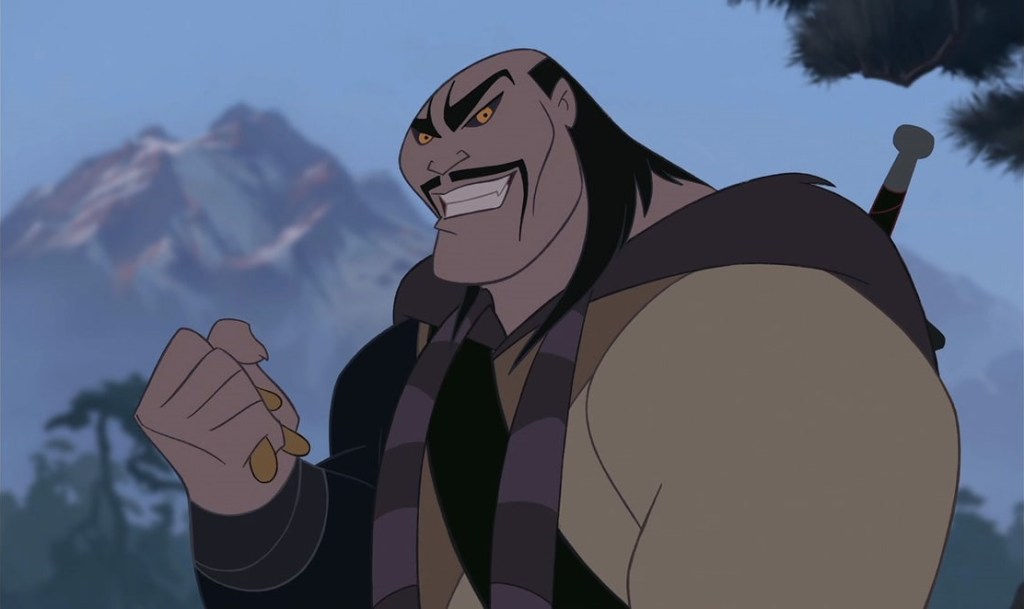
The film’s villain Shan-Yu is a two-dimensional bad guy but is still quite entertaining from how overtly evil he and his falcon companion are, with Shan-Yu himself being complete with fangs and muted colours. I also love how his scenes end with him delivering a spine chilling message (“How many men does it take to deliver a message?” – oh, badass!). He’s not the main source of conflict in the film so his two-dimensional personality doesn’t interfere with the film. However, he does display one revealing character moment during the film’s climax in which upon discovering Mulan was the solider from the battlefield who took out his army, in an ironic twist he is the only character in the film who does not belittle Mulan for being a woman.
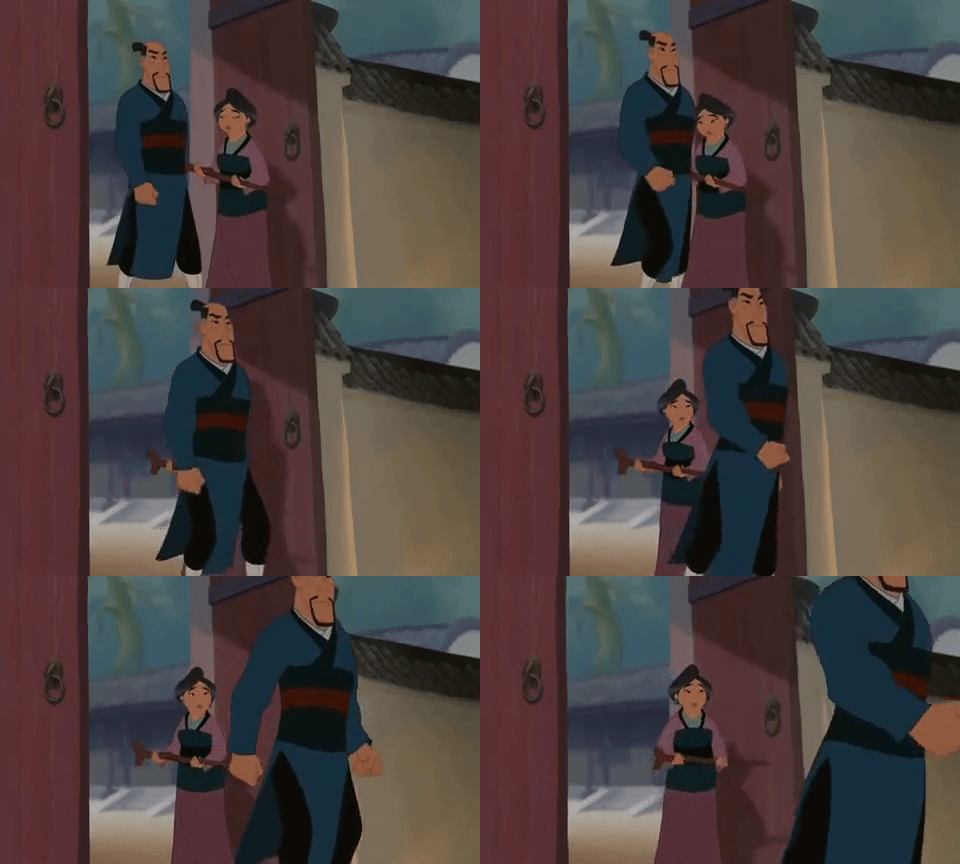
Mulan’s world is populated with many great characters from the badass, no-nonsense general and love interest to Mulan, Li Shang (those abs are body goals) of whom it turns out is a bit socially awkward when it comes to women. Mulan’s dignified father Fa Zhou on the other hand is best summed up in the powerful shot of his attempt to walk without his aid and disguise his limp to accept his conscription assignment. Although absent for most of the film, he is at the film’s heart as the instigator of Mulan’s journey (“I know my place! It is time you learned yours!”). The question does have to be raised if the military would actually have this old, physically weak man on the battlefield but rather to act as a general due to the fact that he appears to be a well-known figure at the boot camp and thus likely respected and held in high esteem. I do also adore the trio of soldiers – the fiery voiced Yao (thank you Harvey Feinstein), the childlike Ling and the pacifist Chein with their camaraderie and failure to act like tough guys and lady killers. Then there is the slimy pencil pusher Chi-Fu, the film’s love to hate character. I like how he is given some humanising moments like his picture with the Emperor on his desk and his claim that he apparently has “a girl back home who’s not like any other”. Even The Emperor of China himself is full of wisdom and memorable quotations worthy of Confucius himself.

“The flower that blooms in adversity is the most rare and beautiful of all”

