
No Longer Believing A Man Can Fly
***This Review Contains Spoilers***
Superman IV: The Quest for Peace, one of the most fascinating disasters in film history. There are bad movies which are straight-up boring, others are cringe-worthy and/or unpleasant to watch, while others fall into the category of being so bad they’re good. For this infamous production made at the madhouse that was Cannon Films, where does Christopher Reeve’s final outing as the Man Of Steel fit in among the pantheon of notorious cinematic failures?

So what is the explosive, hot-button main theme in the fourth instalment of the Superman film franchise? Well no need to fallout as you try to guess, it’s the nuclear arms race! So bear in mind this isn’t just Superman IV, no this is Superman IV: The Quest For Peace. A motion picture dealing with a topic so important that the powers at be gave the film a subtitle, whereas the previous films in the series had been given no such ovation. When listening to the DVD audio commentary for Superman IV by one of the film’s two writers, Mark Rosenthal (which I do highly recommend listening to), Rosenthal states that the plot of Superman IV stems from the idea that if God is an all-benevolent and all-powerful then why does he let bad things happen? Thus, if Superman is all-powerful, why does he allow bad things to happen? However, when thinking about this for more than a few seconds it quickly becomes apparent this notion is nonsensical as Superman is not equivalent to God. He is powerful but not all-powerful, he can’t be everywhere all at once. This shows that while one might argue Superman IV had good intentions behind it, these good intentions were seriously misguided. So why does Superman IV: The Quest For The Remaining Pieces Of Christopher Reeve’s Career choose the nuclear arms race as its main theme? Well, it’s because of Christopher Reeve himself. One of his demands when agreeing to reprise his most famous role was to have creative control over the story. When watching promotional materials for the four Reeve Superman movies, it’s clear the man did take great pride in the role of Superman and cared about the quality of the franchise. Unfortunately, the Film Actor’s Guild from Team America: World Police was in full swing back during the 80’s too, and lefty liberal Christopher Reeve made a Superman movie to act as a platform for his own politics.

The general plot of Superman IV: The Quest For The Remaining Cinematic Integrity Of The Superman Film Franchise sees the Soviet Union overtake the US in the arms race and as a response, a concerned young school boy named Jeremy (Damian McLawhorn in his only on-screen role) writes a letter to the Man Of Steel asking him to rid the world of nuclear arms “because only he can do it”. Ok, number 1, why are you taking moral guidance and advice on geopolitics from a child? Number 2, you do realise if all nuclear weapons were to suddenly disappear then the geopolitical landscape would become highly destabilised? But Number 3, how are you going to get the cooperation of the world’s governments to voluntarily give up their nuclear arsenals? It’s not like Superman is just going to walk into the United Nations and announce he going to rid the world of all nuclear weapons and have the representatives of the Earth’s nations give a huge round of applause and voice no objection whatsoever. Oh wait, that’s exactly what happens. Thus the world’s governments cooperate with Superman as they help him in this process of nuclear disarmament as Supes gathers all of the world’s nuclear missiles, places them into a giant net and then throws said net into the sun. Just how did Superman get a hold of such a net or did he make it himself? Additionally, he does realise throwing hundreds of nukes into the sun doesn’t sound like a very smart or safe idea. The first three Superman movies are full of ridiculous moments but you could gleefully suspend your disbelief at them. Superman IV: The Quest For A Plausible Premise on the other hand is so illogically constructed that it foregoes any such privilege with its moon moving, humans breathing in space, kindergarten levels of science-breaking shenanigans.

Superman IV: The Quest For A Competent Script takes no advantage of its theme of nuclear arms. There’s no political insight or analyses, no thought-provoking debate is brought up as to whether Mutually Assured Destruction is the reason why we have never had World War III. Just a simple “nukes suck” and everyone in the film’s universe agrees so why did we even have them in the first place? I have heard it argued before that Superman IV is a terrible film but it had a good message. No, Superman IV has a terrible message and the one aspect of the film which legitimately enrages me. What Superman is doing is deeply sinister as he is overriding the actions of democratically elected governments yet the film presents it as something oh-so wonderful. One of the many deleted scenes for Superman IV does feature Superman addressing this very point when he tells Jeremy “I’m going to pass the letter onto the leaders of the world, see they’re the ones, not I, who represent the people of the world”. However, the inclusion of this scene in the film would have made it less sensical as Superman just goes on to betray this principle. Betrayed! Betrayed! Betrayed! BETRAYED!

So how do you end this cinematic embodiment of what Thomas Sowell refers to as the unconstrained vision, well with one of the worst lines in film history as Superman proudly and sincerely says in a speech “There will be peace when the people of the world, want it so badly, that their governments will have no choice but to give it to them”. Oh Superman, if only life were that simple. But, it could be even worse! In the film’s deleted, extended ending, Superman once again returns to our young idealistic whip snapper Jeremy and flies him above the Earth (what is it with this movie and humans being able to survive in the vacuum of space?). Once there, he asks Jeremy what he sees so he can tell the people of Earth, to which he gives a response which sounds like a lost verse of John Lennon’s Imagine – “I can’t tell where one country begins and another one ends, there’s no borders, it’ just one world”.

Under the direction of Sidney J. Furie, for the most part, Superman IV: The Quest For A Sustainable Budget is a very bland film for one’s viewing displeasure. Scenes look very flat, the blocking is uninspired and the lighting is often poor. As one of the film’s many, many, many cost-cutting measures, Superman IV was primarily shot in Milton Keynes, a city in Buckinghamshire, England, one of many planned settlements built in the post-war era. With these architecturally contemporaneous developments often looking more like American cities than traditional British towns, Superman IV does convincingly turn merry old England into downtown USA (and humorously so by simply throwing a lone fire hydrant prop here and a hot dog wagon there) but still not in a way that does anything the elevate the bland nature of the film’s visual aesthetic. Superman IV appears to take place in an almost corporate post-apocalyptic world of sterile conference centres. The sets and locations feel very condensed and repetitive and even the offices of The Daily Planet look very generic. You can’t just throw several decals of the newspaper’s logo onto a few windows and expect that to do the job. Additionally, the film’s set design is also subject to much anatopism from subway advertising using the name New York and not the fictional Metropolis to a Daily Planet newsstand using the British-English spelling of “Favourite” over the American “Favorite”. Likewise, the film’s low-budget recreation of the United Nations has the delegate for the United Kingdom whom has a sign on his desk which reads “England”. Oh, you silly Yanks. England is not a country within itself, it is a constituent nation within The United Kingdom Of Great Britain And Northern Ireland. There is no such title as the King/Queen of England or Prime Minister of England. Stop referring to the UK as England. We understand? Ok? Comprende? Capeesh? Regardless, the use of Milton Keynes as a location in Superman IV does appear to be a bit of a claim to fame for the city, with scenes from Superman IV being recreated by various fans and locals at their original locations for the film’s 30th anniversary in 2017. The Milton Keynes Superman IV location-tour anyone?

It takes only a matter of seconds until it is apparent this production is in deep trouble as Superman IV: The Quest For A Decent SFX Team has some of the cheapest-looking opening credits for a major motion picture. At least the title screen has the classic Superman comic book typography if that’s any consolation (these movies did become more pop art as they went along and even the film’s poster is superbly drawn just like a comic book cover).To create a list of all the SFX failures of Superman IV would be a gargantuan task – repeating that same shot of Superman flying towards the screen many times, the lame small-scale recreation of The Fortress of Solitude, the obvious wireframes, the use of the famous image The Blue Marble to represent the Earth or the subway scene in which they resort to using gimmicky edits to create an action scene. Although my favourite special effects failure would have to be the shot of The Statue Of Liberty flying at a 90-degree angle through the Metropolis skyline, I can’t help but chuckle.

Superman IV: The Quest To Occupy 90 Minutes Of Run Time can also lay claim to having the most pointless scene in the history of the art form that is the motion picture. In this scene, Lois visits Clark in his apartment to which Clark says he needs to go outside and get some fresh air. The two walk onto his balcony and Clark pretends he is going to commit suicide by walking off the ledge and taking Lois with him only to then turn into Superman and recreate the romantic flying sequence from the first movie but with the ugliest rear projection you’ve ever seen. Once they return to the apartment, Superman/Clark uses the memory-erasing kiss from Superman II on Lois as if the whole thing never happened. What on under God’s green Earth was the point of that sequence? What was Clark’s motivation for doing this? Was he just bored one day and wanted to use his Superman powers to screw around with Lois for a good laugh? More significantly, why did the filmmakers decide to recreate a bastardised version of one the most magical scenes from the first film and what relevance does this scene have on the rest of the film’s plot? In the words of every wannabe late-2000’s angry YouTube movie critic, “What were they thinking?!”.

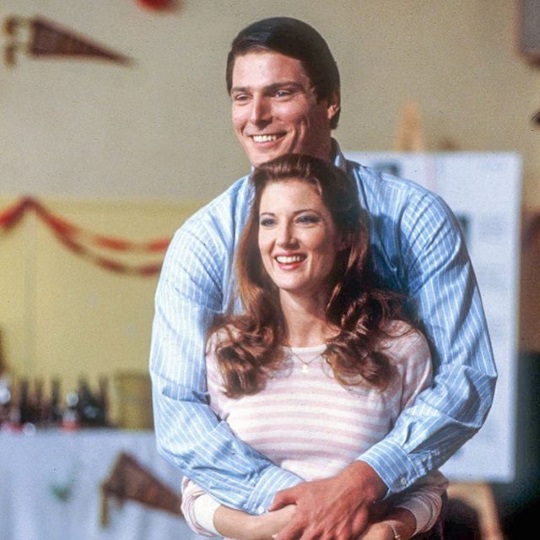
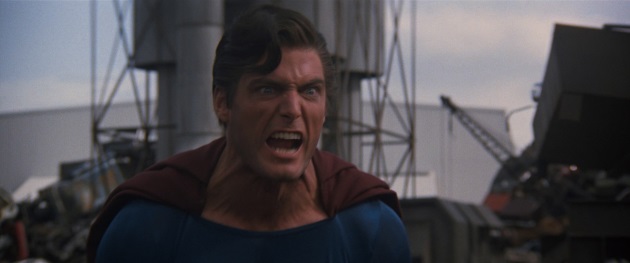
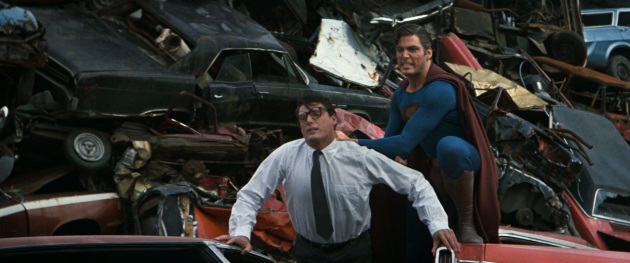
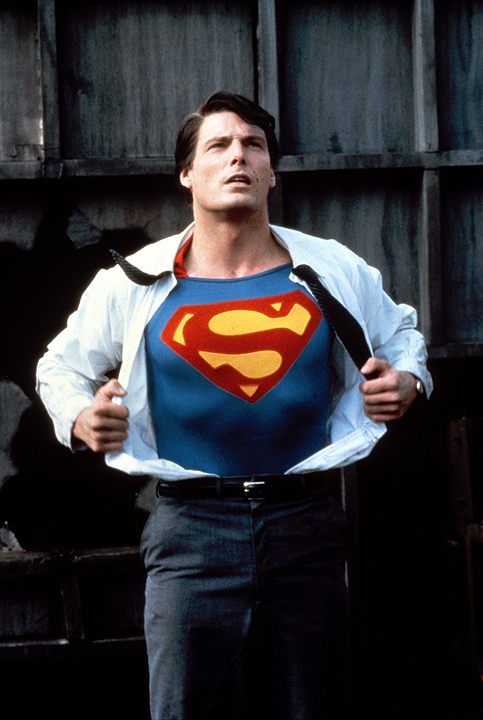
But enough negativity! In what ways does Superman IV succeed in a legitimate, unironic way? There are some brief flashes of greatness and interesting ideas within Superman IV which show a movie which could have been. For starters, the legacy cast is as great as ever. Christopher Reeve puts his all into the role of Superman with the same level of sincerity as before (“Stop! Don’t do it, the people!”), not to mention Reeve hasn’t aged a day since the first film back in 1978. The chemistry with the employees at The Daily Planet is as always a joy to watch with that old-school screwball comedy vibe (even if Marc McClure is too old at this point to be playing Jimmy Olsen). While Reeve looks amazing, sadly the same can’t be said for Margot Kidder who is looking very rough this time around. Reportedly the woman has battled many mental health issues throughout the years and sadly the effects of this do show themselves on screen. Regardless, Reeve and Kidder still have that on-screen magic, with the scene in which Lois visits Clark in his apartment while he is suffering from a terrible case of flu being the most touching in the film (interestingly, this is also the first time in the series in which we actually see Clark’s Metropolis residence).

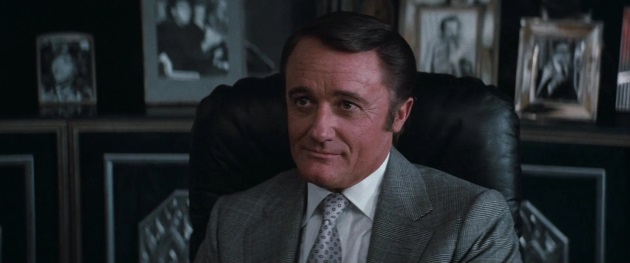
As for new faces, Mariel Hemingway is a welcome addition to the cast and showcases her gifts as a comic actress in the role of Lacy Warfield. The relationship between Lacy and Clark has no real development although Reeve and Hemingway do share a good chemistry making their attraction believable as the bad girl meets the boy scout. I do enjoy their quintessentially 80s scene as the two slide into their lycra and do some aerobics, while the double date screwball comedy sequence is amusing but does feel a bit comically stale (should have had the Benny Hill theme thrown in for good measure). A scene was also filmed in which Clark and Lacy go to a disco of which production photos do exist but sadly it remains unknown if the footage has survived. In the role of Lacy’s father is Sam Wanamaker as the media mogul and obvious Rupert Murdoch stand-in David Warfield. Wanamaker makes Warfield an entertaining caricature with his booming voice while his takeover of The Daily Planet and his attempts to turn the paper into a sleazy, irresponsible tabloid (“We can double our circulation with a good international crises”) is one piece of social commentary which Superman IV performs in a less ham-fisted manner. This plot thread is also visualised through the character of Lacy as she gradually comes to understand the power of journalism with this transformation being illustrated by having Hemingway wear suits with successively smaller shoulder pads. Sadly, this subplot in Superman IV has a very lazy, deus ex-machina conclusion in which Perry White simply announces he has secured a loan to buy a controlling interest in the newspaper thus taking it out of the hands of Warfield. There is no set-up and pay-off leading to this conclusion, rather it just lazily comes out of left field.

Likewise, another subplot which is raised (and this one doesn’t even receive a conclusion), is Clark’s adamant desire to sell the Kent farm to an actual farmer and not to a company looking to build a shopping mall (which does foreshadow The Daily Planet’s corporate takeover). The scene on the Kent farm near the beginning of the film is one of the better and more emotional moments in the film in which they surprisingly do make the English countryside where it was filmed look like rural USA. It has a real sense of reflection for times long gone as the place is no longer used or lived in (plus the baby crib with the broken wood at the foot’s end is a nice touch). Unfortunately, the fate of the farm never comes up again during the rest of the film. Correspondingly, a scene was filmed involving Clark visiting the grave of his adoptive parents in what sounds like could have been a real emotional highlight (Mark Rosenthal does speak highly of it in the audio commentary). Production photos of this scene do exist but sadly the footage has never seen the light of day.

The other major returning cast member in Superman IV: The Quest To Make Superman III Look Decent By Comparison (Well That Is If You’re A Hater of Superman III, I’m A Fan Of It Myself Personally But Whatever) is Gene Hackman as Superman’s most famed nemesis Lex Luthor. Hackman is as enjoyably hammy and charismatic as he was in the first two Superman films and Superman IV even allows him the opportunity to portray Luthor as a Dr Frankenstein-like figure in a scene that feels like it’s straight out of a Universal monster film. Luthor’s layer is even the most dynamic in the film with its art deco design in which he spends his time dancing with a woman dressed as Marie Antoinette (you know, like you do). Luthor’s sidekick this time around is his nephew Lenny Luthor (another original character not from the comics), portrayed by Jon Cryer. Lenny himself increases the movie’s 80’s factor to the most extreme, far out, tubular heights with his New Wave band fashion choices and California surfer dude speak. I get this character annoys many viewers but I get some laughs out of this male equivalent of a valley girl.

Aside from taking out Supes, Luthor wants to reignite the nuclear arms industry but like most aspects of Superman IV, this plot point (you guessed it!) doesn’t make any sense. The movie has already established that the entire world is in unanimous agreement with Superman in regards to him getting rid of the planet’s nuclear arsenal and the world’s governments even aided him in doing this. Thus just how is Lex Baby supposed to reintroduce nuclear arms? We can see him attempting to do so in a deleted scene in which Luthor speaks to the government of the USSR and convinces them that world peace is a capitalistic plot and then subsequently appears before the US government to claim that world peace is a communist plot. I can only speculate as to why this scene was not included in the film as it is fun to watch in isolation but in the wider context of the film it does make the people who inhabit this universe incredibly vulnerable to being easily swayed and manipulated. It’s like that scene in The Simpsons in which Skinner and Krabappel are each trying to convince the children’s parents on what’s more important, their children’s future or tax increases. What is included in the film is Luthor’s honest stated aim, “Nobody wants war. I just want to keep the threat alive”. Well, at least the movie has one pertinent quote concerning the military-industrial complex.

Now let’s get to the real fun part and talk about my boy, Nuclear Man! The poorly thought out and unintentionally hilarious villain in Superman IV, portrayed by Dolph Lundgren lookalike Mark Pillow in his only screen role (an actor with three IMDB acting credits and no Wikipedia page). I’m not going to lie, I love Nuclear Man. Everything about the character screams 1980s with his dripped out black and gold spandex outfit, the lightning animations that travel over his figure, the Southern California hairdo and the most tubular animation of his birth from foetus to a fully blown Adonis. Like Ivan Drago in Rocky IV, every one of his lines is memorable (“If you do not tell me, I will hurt people”, “Destroy Superman!”, “First, I have fun!”), with his booming voice (roars and all) provided by Gene Hackman himself. Due to the sheer enjoyment I get from watching this bombastic bad guy, I can forgive the fact that power-wise, Nuclear Man’s one major weakness is so easily exploitable since he loses his power when he is not in direct sunlight. Likewise, Nuclear Man also has the most glaring non-motivation in the entire film. Due to the sheer amount of material from Superman IV that ended up on the cutting room floor, in the final cut of the film Nuclear Man just randomly looks at a copy of The Daily Planet and sees a picture of Lacy (whom he has no established knowledge off) and thinks “yeah, I want some of that!” and proceeds to kidnap her. Superman tries to stop Nuclear Man and tells him “Give it up, you’ll never find her” in response to Nuclear Man asking “Where is the woman?”. How does Superman know the woman Nuclear Man is talking about? His motivation for kidnapping Lacy is explained in the film’s deleted scenes but it appears someone or something must have thought,” Let’s just skip all the character motivation mumbo jumbo and just get straight to the action scenes!”. Speaking off…

Not the crossover event I was expecting.
Superman IV offers viewers two fights between Supes and Nuclear Man, with both being very slow and mundane. The first is a world-spanning bash of unintentional hilarity as Superman essentially follows Nuclear Man, repairing all the damage he creates from plugging up a volcano in Italy with a giant rock to using his laser vision to repair The Great Wall of China (a random power that came out of nowhere but the stop-motion special effect of the repairing wall looks cool). Likewise, various international cuts of Superman IV also include a sequence in which Nuclear Man creates a tornado which Superman must eliminate, in which the special effects are actually not too shabby. The fight nonetheless concludes in the most pathetic manner, as Nuclear Man uses his fabulous, long, manicured nails to take out Supes. But never fear, as Supes gets his revenge in round 2 as they fight on the Moon in agonising slow motion- It’s so tedious to watch! The two barely even fight, they more so just push against each other – it’s like watching two geriatrics go at it. Regardless, decades on Mark Pillow himself has no embarrassment regarding the character, as evidenced by his entertaining Instagram profile in which he celebrates the bizarre cinematic creation that is Nuclear Man. However, when delving into the treasure trove of deleted scenes for Superman IV: The Quest For What Didn’t Make Into The Final Cut, arguably the most prominent aspect which didn’t make it into the final cut was another Nuclear Man (portrayed by Clive Mantle) originally created Lex Luthor (and subsequently defeated by Superman). I have no love for this Nuclear Man and I fail to see why having two, very different versions of Luthor’s creation was necessary. On top of that, the design of the character is just very unpleasant, looking like an ugly version of Billy Idol and whom bizarrely is born with a metal plate attached to his crouch (an image I’d rather burn from my mind).

The music for Superman IV is actually the one aspect in which the film entirely exceeds…well almost. The rendition of the Superman theme during the opening credits is a very weak, low-energy version, however, the rest of the score features the best original work since the first film alongside some top-notch reworking of previous music. The reason that the new material is so good, is that while he is not credited, it is written by none other than John Williams himself in his first involvement in the series since the first film (with Alexander Courage composing the score). The first of these is Lacy’s Theme (aka Someone Like You), a delightfully cheesy saxophone piece which is accompanied by some lush orchestrations which would easily fit in with a Fred Astaire dance number (the full score also includes a great variation titled the Disco Version). Likewise, Jeremy’s Theme is suitably innocent and childlike but it’s the Nuclear Man Theme which absolutely slaps with its cartoonish villainy (alongside the more epic, drawn-out rendition which is played during the first fight). It goes without saying Williams is the GOAT of film composing but Courage does a fine job reappropriating William’s earlier compositions and the film does feature some relaxing and breezy variations of the iconic Superman theme. Although If I were to pick one original highlight from Courage it would have to be the piece United Nations which is suitably grandiose (just a shame it’s used for such a ridiculous scene).

Superman IV: The Quest For the Non-Existent Box Office would be the last time Christopher Reeve would dawn the red cape and blue spandex of Superman (Superman V: The Quest For Embryonic Stem Cell Research would never see the light of day). Yet despite everything that is wrong with the film, I can’t bring myself to call Superman IV a film I hate. It does remain at the end of the day, a fascinating demonstration of how not to make a motion picture (why else would I have just written a 4,100-word review analysing it within an inch of its life). Superman IV can stand alongside the bad movie greats such as Batman & Robin, The Room and Troll II for its moments of unintentional hilarity and sheer quotability. Honestly, if I were given the choice between watching Superman IV and some Ikea furniture-style assembly superhero movie that Hollywood regurgitates these days, give me the former. With all said and done as I complete my journey extensively reviewing all four Christopher Reeve Superman movies, I can still find some love in my heart for Superman IV: The Quest For Peace.

 Sat In Your Lap