Superman IV: The Quest For Peace (1987)

No Longer Believing A Man Can Fly

***This Review Contains Spoilers***

Superman IV: The Quest for Peace, one of the most fascinating disasters in film history. There are bad movies which are straight-up boring, others are cringe-worthy and/or unpleasant to watch, while others fall into the category of being so bad they’re good. For this infamous production made at the madhouse that was Cannon Films, where does Christopher Reeve’s final outing as the Man Of Steel fit in among the pantheon of notorious cinematic failures?

So what is the explosive, hot-button main theme in the fourth instalment of the Superman film franchise? Well no need to fallout as you try to guess, it’s the nuclear arms race! So bear in mind this isn’t just Superman IV, no this is Superman IV: The Quest For Peace. A motion picture dealing with a topic so important that the powers at be gave the film a subtitle, whereas the previous films in the series had been given no such ovation. When listening to the DVD audio commentary for Superman IV by one of the film’s two writers, Mark Rosenthal (which I do highly recommend listening to), Rosenthal states that the plot of Superman IV stems from the idea that if God is an all-benevolent and all-powerful then why does he let bad things happen? Thus, if Superman is all-powerful, why does he allow bad things to happen? However, when thinking about this for more than a few seconds it quickly becomes apparent this notion is nonsensical as Superman is not equivalent to God. He is powerful but not all-powerful, he can’t be everywhere all at once. This shows that while one might argue Superman IV had good intentions behind it, these good intentions were seriously misguided. So why does Superman IV: The Quest For The Remaining Pieces Of Christopher Reeve’s Career choose the nuclear arms race as its main theme? Well, it’s because of Christopher Reeve himself. One of his demands when agreeing to reprise his most famous role was to have creative control over the story. When watching promotional materials for the four Reeve Superman movies, it’s clear the man did take great pride in the role of Superman and cared about the quality of the franchise. Unfortunately, the Film Actor’s Guild from Team America: World Police was in full swing back during the 80’s too, and lefty liberal Christopher Reeve made a Superman movie to act as a platform for his own politics. 

The general plot of Superman IV: The Quest For The Remaining Cinematic Integrity Of The Superman Film Franchise sees the Soviet Union overtake the US in the arms race and as a response, a concerned young school boy named Jeremy (Damian McLawhorn in his only on-screen role) writes a letter to the Man Of Steel asking him to rid the world of nuclear arms “because only he can do it”. Ok, number 1, why are you taking moral guidance and advice on geopolitics from a child? Number 2, you do realise if all nuclear weapons were to suddenly disappear then the geopolitical landscape would become highly destabilised? But Number 3, how are you going to get the cooperation of the world’s governments to voluntarily give up their nuclear arsenals? It’s not like Superman is just going to walk into the United Nations and announce he going to rid the world of all nuclear weapons and have the representatives of the Earth’s nations give a huge round of applause and voice no objection whatsoever. Oh wait, that’s exactly what happens. Thus the world’s governments cooperate with Superman as they help him in this process of nuclear disarmament as Supes gathers all of the world’s nuclear missiles, places them into a giant net and then throws said net into the sun. Just how did Superman get a hold of such a net or did he make it himself? Additionally, he does realise throwing hundreds of nukes into the sun doesn’t sound like a very smart or safe idea. The first three Superman movies are full of ridiculous moments but you could gleefully suspend your disbelief at them. Superman IV: The Quest For A Plausible Premise on the other hand is so illogically constructed that it foregoes any such privilege with its moon moving, humans breathing in space, kindergarten levels of science-breaking shenanigans. 

Superman IV: The Quest For A Competent Script takes no advantage of its theme of nuclear arms. There’s no political insight or analyses, no thought-provoking debate is brought up as to whether Mutually Assured Destruction is the reason why we have never had World War III. Just a simple “nukes suck” and everyone in the film’s universe agrees so why did we even have them in the first place? I have heard it argued before that Superman IV is a terrible film but it had a good message. No, Superman IV has a terrible message and the one aspect of the film which legitimately enrages me. What Superman is doing is deeply sinister as he is overriding the actions of democratically elected governments yet the film presents it as something oh-so wonderful. One of the many deleted scenes for Superman IV does feature Superman addressing this very point when he tells Jeremy “I’m going to pass the letter onto the leaders of the world, see they’re the ones, not I, who represent the people of the world”. However, the inclusion of this scene in the film would have made it less sensical as Superman just goes on to betray this principle. Betrayed! Betrayed! Betrayed! BETRAYED! 

So how do you end this cinematic embodiment of what Thomas Sowell refers to as the unconstrained vision, well with one of the worst lines in film history as Superman proudly and sincerely says in a speech “There will be peace when the people of the world, want it so badly, that their governments will have no choice but to give it to them”. Oh Superman, if only life were that simple. But, it could be even worse! In the film’s deleted, extended ending, Superman once again returns to our young idealistic whip snapper Jeremy and flies him above the Earth (what is it with this movie and humans being able to survive in the vacuum of space?). Once there, he asks Jeremy what he sees so he can tell the people of Earth, to which he gives a response which sounds like a lost verse of John Lennon’s Imagine – “I can’t tell where one country begins and another one ends, there’s no borders, it’ just one world”.

Under the direction of Sidney J. Furie, for the most part, Superman IV: The Quest For A Sustainable Budget is a very bland film for one’s viewing displeasure. Scenes look very flat, the blocking is uninspired and the lighting is often poor. As one of the film’s many, many, many cost-cutting measures, Superman IV was primarily shot in Milton Keynes, a city in Buckinghamshire, England, one of many planned settlements built in the post-war era. With these architecturally contemporaneous developments often looking more like American cities than traditional British towns, Superman IV does convincingly turn merry old England into downtown USA (and humorously so by simply throwing a lone fire hydrant prop here and a hot dog wagon there) but still not in a way that does anything the elevate the bland nature of the film’s visual aesthetic. Superman IV appears to take place in an almost corporate post-apocalyptic world of sterile conference centres. The sets and locations feel very condensed and repetitive and even the offices of The Daily Planet look very generic. You can’t just throw several decals of the newspaper’s logo onto a few windows and expect that to do the job. Additionally, the film’s set design is also subject to much anatopism from subway advertising using the name New York and not the fictional Metropolis to a Daily Planet newsstand using the British-English spelling of “Favourite” over the American “Favorite”. Likewise, the film’s low-budget recreation of the United Nations has the delegate for the United Kingdom whom has a sign on his desk which reads “England”. Oh, you silly Yanks. England is not a country within itself, it is a constituent nation within The United Kingdom Of Great Britain And Northern Ireland. There is no such title as the King/Queen of England or Prime Minister of England. Stop referring to the UK as England. We understand? Ok? Comprende? Capeesh? Regardless, the use of Milton Keynes as a location in Superman IV does appear to be a bit of a claim to fame for the city, with scenes from Superman IV being recreated by various fans and locals at their original locations for the film’s 30th anniversary in 2017. The Milton Keynes Superman IV location-tour anyone? 

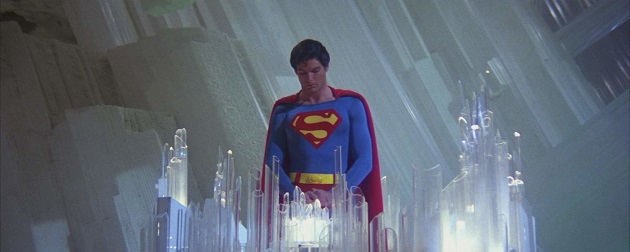
It takes only a matter of seconds until it is apparent this production is in deep trouble as Superman IV: The Quest For A Decent SFX Team has some of the cheapest-looking opening credits for a major motion picture. At least the title screen has the classic Superman comic book typography if that’s any consolation (these movies did become more pop art as they went along and even the film’s poster is superbly drawn just like a comic book cover).To create a list of all the SFX failures of Superman IV would be a gargantuan task – repeating that same shot of Superman flying towards the screen many times, the lame small-scale recreation of The Fortress of Solitude, the obvious wireframes, the use of the famous image The Blue Marble to represent the Earth or the subway scene in which they resort to using gimmicky edits to create an action scene. Although my favourite special effects failure would have to be the shot of The Statue Of Liberty flying at a 90-degree angle through the Metropolis skyline, I can’t help but chuckle.

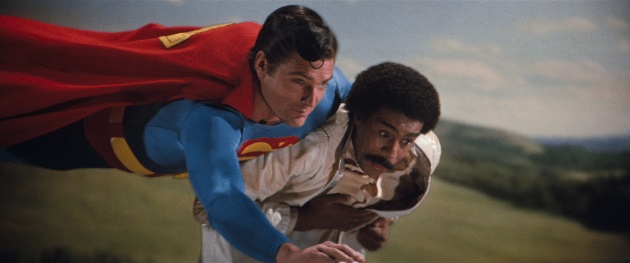
Superman IV: The Quest To Occupy 90 Minutes Of Run Time can also lay claim to having the most pointless scene in the history of the art form that is the motion picture. In this scene, Lois visits Clark in his apartment to which Clark says he needs to go outside and get some fresh air. The two walk onto his balcony and Clark pretends he is going to commit suicide by walking off the ledge and taking Lois with him only to then turn into Superman and recreate the romantic flying sequence from the first movie but with the ugliest rear projection you’ve ever seen. Once they return to the apartment, Superman/Clark uses the memory-erasing kiss from Superman II on Lois as if the whole thing never happened. What on under God’s green Earth was the point of that sequence?  What was Clark’s motivation for doing this? Was he just bored one day and wanted to use his Superman powers to screw around with Lois for a good laugh? More significantly, why did the filmmakers decide to recreate a bastardised version of one the most magical scenes from the first film and what relevance does this scene have on the rest of the film’s plot? In the words of every wannabe late-2000’s angry YouTube movie critic, “What were they thinking?!”.

But enough negativity! In what ways does Superman IV succeed in a legitimate, unironic way? There are some brief flashes of greatness and interesting ideas within Superman IV which show a movie which could have been. For starters, the legacy cast is as great as ever. Christopher Reeve puts his all into the role of Superman with the same level of sincerity as before (“Stop! Don’t do it, the people!”), not to mention Reeve hasn’t aged a day since the first film back in 1978. The chemistry with the employees at The Daily Planet is as always a joy to watch with that old-school screwball comedy vibe (even if Marc McClure is too old at this point to be playing Jimmy Olsen). While Reeve looks amazing, sadly the same can’t be said for Margot Kidder who is looking very rough this time around. Reportedly the woman has battled many mental health issues throughout the years and sadly the effects of this do show themselves on screen. Regardless, Reeve and Kidder still have that on-screen magic, with the scene in which Lois visits Clark in his apartment while he is suffering from a terrible case of flu being the most touching in the film (interestingly, this is also the first time in the series in which we actually see Clark’s Metropolis residence).

As for new faces, Mariel Hemingway is a welcome addition to the cast and showcases her gifts as a comic actress in the role of Lacy Warfield. The relationship between Lacy and Clark has no real development although Reeve and Hemingway do share a good chemistry making their attraction believable as the bad girl meets the boy scout. I do enjoy their quintessentially 80s scene as the two slide into their lycra and do some aerobics, while the double date screwball comedy sequence is amusing but does feel a bit comically stale (should have had the Benny Hill theme thrown in for good measure). A scene was also filmed in which Clark and Lacy go to a disco of which production photos do exist but sadly it remains unknown if the footage has survived. In the role of Lacy’s father is Sam Wanamaker as the media mogul and obvious Rupert Murdoch stand-in David Warfield. Wanamaker makes Warfield an entertaining caricature with his booming voice while his takeover of The Daily Planet and his attempts to turn the paper into a sleazy, irresponsible tabloid (“We can double our circulation with a good international crises”) is one piece of social commentary which Superman IV performs in a less ham-fisted manner. This plot thread is also visualised through the character of Lacy as she gradually comes to understand the power of journalism with this transformation being illustrated by having Hemingway wear suits with successively smaller shoulder pads. Sadly, this subplot in Superman IV has a very lazy, deus ex-machina conclusion in which Perry White simply announces he has secured a loan to buy a controlling interest in the newspaper thus taking it out of the hands of Warfield. There is no set-up and pay-off leading to this conclusion, rather it just lazily comes out of left field. 

Likewise, another subplot which is raised (and this one doesn’t even receive a conclusion), is Clark’s adamant desire to sell the Kent farm to an actual farmer and not to a company looking to build a shopping mall (which does foreshadow The Daily Planet’s corporate takeover). The scene on the Kent farm near the beginning of the film is one of the better and more emotional moments in the film in which they surprisingly do make the English countryside where it was filmed look like rural USA. It has a real sense of reflection for times long gone as the place is no longer used or lived in (plus the baby crib with the broken wood at the foot’s end is a nice touch). Unfortunately, the fate of the farm never comes up again during the rest of the film. Correspondingly, a scene was filmed involving Clark visiting the grave of his adoptive parents in what sounds like could have been a real emotional highlight (Mark Rosenthal does speak highly of it in the audio commentary). Production photos of this scene do exist but sadly the footage has never seen the light of day.

The other major returning cast member in Superman IV: The Quest To Make Superman III Look Decent By Comparison (Well That Is If You’re A Hater of Superman III, I’m A Fan Of It Myself Personally But Whatever) is Gene Hackman as Superman’s most famed nemesis Lex Luthor. Hackman is as enjoyably hammy and charismatic as he was in the first two Superman films and Superman IV even allows him the opportunity to portray Luthor as a Dr Frankenstein-like figure in a scene that feels like it’s straight out of a Universal monster film. Luthor’s layer is even the most dynamic in the film with its art deco design in which he spends his time dancing with a woman dressed as Marie Antoinette (you know, like you do). Luthor’s sidekick this time around is his nephew Lenny Luthor (another original character not from the comics), portrayed by Jon Cryer. Lenny himself increases the movie’s 80’s factor to the most extreme, far out, tubular heights with his New Wave band fashion choices and California surfer dude speak. I get this character annoys many viewers but I get some laughs out of this male equivalent of a valley girl.

Aside from taking out Supes, Luthor wants to reignite the nuclear arms industry but like most aspects of Superman IV, this plot point (you guessed it!) doesn’t make any sense. The movie has already established that the entire world is in unanimous agreement with Superman in regards to him getting rid of the planet’s nuclear arsenal and the world’s governments even aided him in doing this. Thus just how is Lex Baby supposed to reintroduce nuclear arms? We can see him attempting to do so in a deleted scene in which Luthor speaks to the government of the USSR and convinces them that world peace is a capitalistic plot and then subsequently appears before the US government to claim that world peace is a communist plot. I can only speculate as to why this scene was not included in the film as it is fun to watch in isolation but in the wider context of the film it does make the people who inhabit this universe incredibly vulnerable to being easily swayed and manipulated. It’s like that scene in The Simpsons in which Skinner and Krabappel are each trying to convince the children’s parents on what’s more important, their children’s future or tax increases. What is included in the film is Luthor’s honest stated aim, “Nobody wants war. I just want to keep the threat alive”. Well, at least the movie has one pertinent quote concerning the military-industrial complex.

Now let’s get to the real fun part and talk about my boy, Nuclear Man! The poorly thought out and unintentionally hilarious villain in Superman IV, portrayed by Dolph Lundgren lookalike Mark Pillow in his only screen role (an actor with three IMDB acting credits and no Wikipedia page). I’m not going to lie, I love Nuclear Man. Everything about the character screams 1980s with his dripped out black and gold spandex outfit, the lightning animations that travel over his figure, the Southern California hairdo and the most tubular animation of his birth from foetus to a fully blown Adonis. Like Ivan Drago in Rocky IV, every one of his lines is memorable (“If you do not tell me, I will hurt people”, “Destroy Superman!”, “First, I have fun!”), with his booming voice (roars and all) provided by Gene Hackman himself. Due to the sheer enjoyment I get from watching this bombastic bad guy, I can forgive the fact that power-wise, Nuclear Man’s one major weakness is so easily exploitable since he loses his power when he is not in direct sunlight. Likewise, Nuclear Man also has the most glaring non-motivation in the entire film. Due to the sheer amount of material from Superman IV that ended up on the cutting room floor, in the final cut of the film Nuclear Man just randomly looks at a copy of The Daily Planet and sees a picture of Lacy (whom he has no established knowledge off) and thinks “yeah, I want some of that!” and proceeds to kidnap her. Superman tries to stop Nuclear Man and tells him “Give it up, you’ll never find her” in response to Nuclear Man asking “Where is the woman?”. How does Superman know the woman Nuclear Man is talking about? His motivation for kidnapping Lacy is explained in the film’s deleted scenes but it appears someone or something must have thought,” Let’s just skip all the character motivation mumbo jumbo and just get straight to the action scenes!”. Speaking off…

Not the crossover event I was expecting.

Superman IV offers viewers two fights between Supes and Nuclear Man, with both being very slow and mundane. The first is a world-spanning bash of unintentional hilarity as Superman essentially follows Nuclear Man, repairing all the damage he creates from plugging up a volcano in Italy with a giant rock to using his laser vision to repair The Great Wall of China (a random power that came out of nowhere but the stop-motion special effect of the repairing wall looks cool). Likewise, various international cuts of Superman IV also include a sequence in which Nuclear Man creates a tornado which Superman must eliminate, in which the special effects are actually not too shabby. The fight nonetheless concludes in the most pathetic manner, as Nuclear Man uses his fabulous, long, manicured nails to take out Supes. But never fear, as Supes gets his revenge in round 2 as they fight on the Moon in agonising slow motion- It’s so tedious to watch! The two barely even fight, they more so just push against each other – it’s like watching two geriatrics go at it. Regardless, decades on Mark Pillow himself has no embarrassment regarding the character, as evidenced by his entertaining Instagram profile in which he celebrates the bizarre cinematic creation that is Nuclear Man. However, when delving into the treasure trove of deleted scenes for Superman IV: The Quest For What Didn’t Make Into The Final Cut, arguably the most prominent aspect which didn’t make it into the final cut was another Nuclear Man (portrayed by Clive Mantle) originally created Lex Luthor (and subsequently defeated by Superman). I have no love for this Nuclear Man and I fail to see why having two, very different versions of Luthor’s creation was necessary. On top of that, the design of the character is just very unpleasant, looking like an ugly version of Billy Idol and whom bizarrely is born with a metal plate attached to his crouch (an image I’d rather burn from my mind).

The music for Superman IV is actually the one aspect in which the film entirely exceeds…well almost. The rendition of the Superman theme during the opening credits is a very weak, low-energy version, however, the rest of the score features the best original work since the first film alongside some top-notch reworking of previous music. The reason that the new material is so good, is that while he is not credited, it is written by none other than John Williams himself in his first involvement in the series since the first film (with Alexander Courage composing the score). The first of these is Lacy’s Theme (aka Someone Like You), a delightfully cheesy saxophone piece which is accompanied by some lush orchestrations which would easily fit in with a Fred Astaire dance number (the full score also includes a great variation titled the Disco Version). Likewise, Jeremy’s Theme is suitably innocent and childlike but it’s the Nuclear Man Theme which absolutely slaps with its cartoonish villainy (alongside the more epic, drawn-out rendition which is played during the first fight). It goes without saying Williams is the GOAT of film composing but Courage does a fine job reappropriating William’s earlier compositions and the film does feature some relaxing and breezy variations of the iconic Superman theme. Although If I were to pick one original highlight from Courage it would have to be the piece United Nations which is suitably grandiose (just a shame it’s used for such a ridiculous scene).

Superman IV: The Quest For the Non-Existent Box Office would be the last time Christopher Reeve would dawn the red cape and blue spandex of Superman (Superman V: The Quest For Embryonic Stem Cell Research would never see the light of day). Yet despite everything that is wrong with the film, I can’t bring myself to call Superman IV a film I hate. It does remain at the end of the day, a fascinating demonstration of how not to make a motion picture (why else would I have just written a 4,100-word review analysing it within an inch of its life). Superman IV can stand alongside the bad movie greats such as Batman & Robin, The Room and Troll II for its moments of unintentional hilarity and sheer quotability. Honestly, if I were given the choice between watching Superman IV and some Ikea furniture-style assembly superhero movie that Hollywood regurgitates these days, give me the former. With all said and done as I complete my journey extensively reviewing all four Christopher Reeve Superman movies, I can still find some love in my heart for Superman IV: The Quest For Peace.
Superman III (1983)

Clark v Evil Superman

***This Review Contains Spoilers***

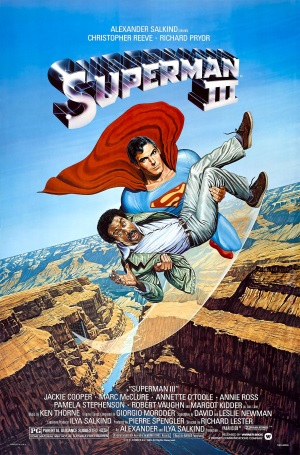
Superman III, often dismissed as “the Richard Pryor Superman movie”, is a film with many highly questionable moments and bizarre decisions on the part of the filmmakers (most notably the far greater emphasis on comedy), but dam if it’s not a movie I have an immensely fun time watching. Even during the film’s pre-opening credits scene I already found myself relating to Richard Pryor’s character of August ‘Gus’ Gorman and I thought to myself “Isn’t this supposed to be a bad movie?” Ah yes, the monotonous and degrading experience of going to a jobs & benefits office and dealing with the employees who don’t want to be there and probably don’t like you as evident from their body language. The down-on-his-luck Gus then complains about his experience being employed at a fast-food restaurant and how “they expect you to learn that stuff in one day” – let’s say I’ve had some similar real-life experiences. This is later followed by another one of Gus’ relatable frustrations – having your pay undercut by taxes (“State tax, federal tax, social security tax”). I wasn’t bothered by Pryor sharing the spotlight with Superman regarding screen time as I very quickly became endeared by this regular Joe who bites off more than he can chew and finds himself in extraordinary circumstances. Gus, you are my spirit animal!

The text for the opening credits of Superman III looks like it was created using Windows Movie Maker (or whatever the equivalent was circa 1983) but I’d be lying if I didn’t say the slapstick comedy in the opening credits amuses me with its classic vaudeville-like elements (including a haphazard blind man, a pie in the face and even a clumsy mime). This opening is very intricately set up and is done by a director who understands and knows how to do physical comedy aided by a delightfully mischievous-sounding score from Ken Throne. Now you might be asking dear reader, “Even if all that is true, what is this sequence doing in a Superman film? This isn’t a Jacques Tati film”, and you would be absolutely correct in that assessment. I could try to post-hoc rationalise its inclusion, arguing that it ties in with the fact that Clark Kent is often a bumbling clutz, plus the series is light-hearted and campy as a whole. However, at the end of the day, all I can say is that it simply entertains me and makes me laugh. So please let me enjoy the one time in history in which the unique and odd combination of the Superhero genre and classic vaudeville comedy came together into one.

Not all of the comedy in Superman III is successful in my eyes. If I was to pick out the weakest scene in the entire film it would be that in which Gus explains Superman’s exploits in Columbia as the Man Of Steel disrupts the villain’s plans for economic manipulation (“But this one miserable, puissant little country, has the gall to think it can dictate the economy of an open market!”). I can understand the writers were trying to give Pryor room to express his comic chops however the scene fails on such a level and rather just comes off as a lengthy and awkward expositional monologue edited to several brief flashbacks of Superman in Columbia – why not create an action scene out of this plot point instead?. Then there’s the gag of the green man and the red man in the traffic lights fighting each other. I find the moment funny in isolation, but when viewed within the context of the film you have to ask yourself, “Did that really just happen?”. Nowadays with smart technology, someone with the know-how could actually programme such a thing to happen, so perhaps the gag was ahead of its time after all.

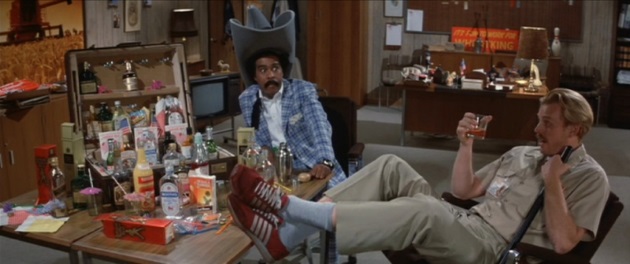
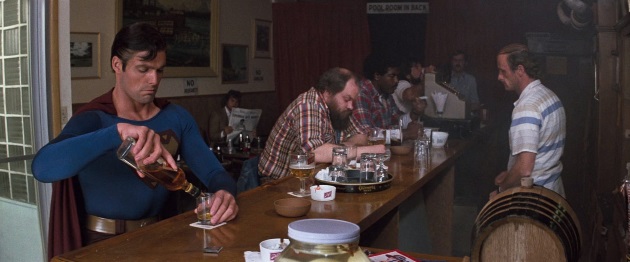
Amongst the comedy which does succeed, I do enjoy the gags which use Superman’s powers for comedic effect such as Evil Superman straightening of the Leaning Tower of Pisa or the blowing out of the Olympic Torch just as it reaches its final destination. However, If I was to pick a comic highlight of the film, it would have to be the sequence in which Gus breaks into the Webscoe offices in Smallville, with all the drunken antics and the improvised use of a passed out inebriated body of a security guard to turn on a computer which requires “both keys at the same time” to activate (a very Mr. Bean-like scenario) – plus the sight of Pryor in a tweed suit and an oversized cowboy hat which keeps bobbing around is a funny image in itself. Corresponding, the film also has its share of more subtle comic moments such as Gus foolishly flaunting his ill-gotten wealth by driving to work in a Ferrari to Jimmy Olsen’s incessant yammering to Clark as they ride on the bus. I also enjoy Pamela Stephenson as the Jean Harlow-like dumb blonde Lorelei who conceals her intelligence (“How can he say that pure categories have no objective meaning and transcendental logic? What about synthetic unity?”). Then there’s the other brand of comic moments in Superman III, those which I can’t quite determine if they were intentionally supposed to be funny or not, such as the bizarre sight of the unshaven Evil Superman in a bar drinking as he flicks peanuts to smash glass bottles. Regardless, moments like this are now a goldmine for internet memes galore.  

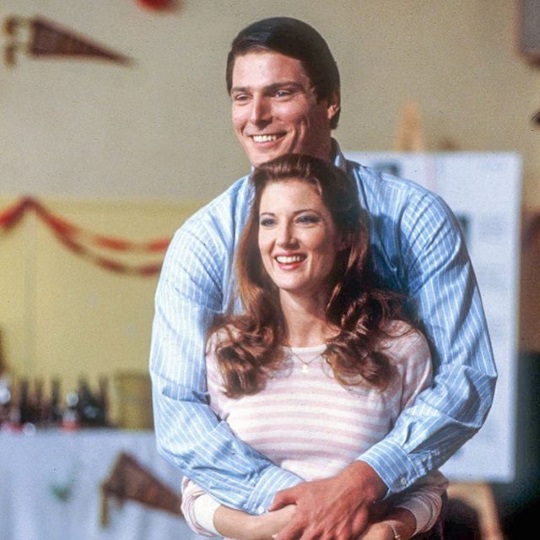
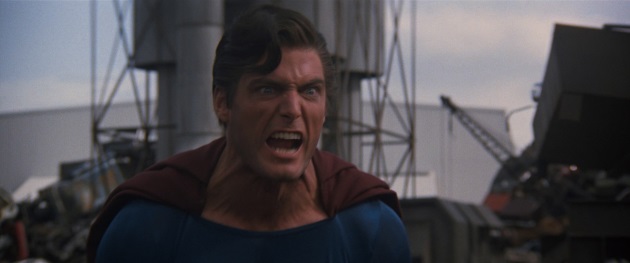
Third time’s the charm and Christopher Reeve finally gets top-billed in his own series. Superman III is Reeve’s finest performance as the Man of Steel as he has the task of portraying three different personalities in one film – Clark Kent, Superman and Evil Superman (which he has been retroactively referred to as the persona is never actually given a name in the movie). While these are all persona variations of the same character, it does show Reeve held the same ability alongside the likes of Peter Sellers or Eddie Murphy to play multiple characters in the same film and even interact with each other in the same scene. How one man can look so vastly different from three versions of the same character? Reeve even showcases his physical acting abilities to be on par with the greatest silent film actors with the level of expression he can convey through body language and facial expressions (just look how tightly the skin is pulled back around Reeve’s neck as he shouts “Come on!” during the junkyard fight). Moreover, as with Superman II, one of the elements of the movie I found myself enjoying most was the character relationships. I was surprised I was engaged with the relationship and dynamic with Clark’s Smallville sweetheart Lana Lang (Annette O’Toole) as much as I did with Lois Lane in the previous film. In one of my favourite moments in Superman III, Clark and Lana are cleaning up the gym together following the class reunion party as she tells him about her ambitions and how she wants to leave Smallville as Clark plays an instrumental rendition of Earth Angel on the piano (in a great combination of diegetic and non-diegetic music). At this point in the movie, I thought to myself how people can dismiss this movie as much as they do when you have brilliant, intimate moments like this which showcase performers with such marvellous chemistry. What really differentiates Clark’s relationship with Lana in contrast to his love interest in Superman II is that Lois is in love with Superman but ignores Clark, whereas Lana is in love with Clark but not so much Superman. Thus Clark is much more confident, suave and debonair with Lana, and not the bumbling clutz he is with Lois. Sadly, the status quo of the Superman universe can’t allow Clark and Lana to become a couple, but what a superb pairing they are. I do have to ask though, why are the class of 1965 having a reunion in an off-year, assuming the film is set in the year it was released (but I digress)? 

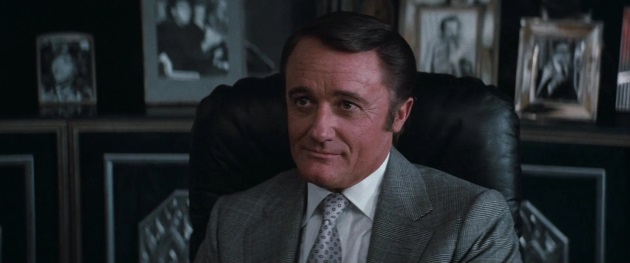
Initially, the big bad of Superman III, Ross Webster (Robert Vaughn) disappointingly came off to me as a lesser Lex Luthor. However, on further viewing, I’ve really come to appreciate the Bond villain-like character and Robert Vaughn’s charismatic and suave performance as well as that of Annie Ross as Webster’s butch, somewhat comical sister Vera. Like Luthor’s underground, abandoned subway layer in the first film, Webster’s own layer is like a character in itself, with his own ski resort atop a Metropolis skyscraper and a memorable, grey, art deco design in his grand office. Additionally, I’m not the first person to point out that the reimagining of Lex Luthor in the comics starting with the Crises Of Infinite Earth series in 1986, portrayed Luthor as not the mad scientist archetype as he had been for decades until that point, but rather as an entrepreneurial head of Lexcorp – not too dissimilar to Ross Webster and his company Websco with both being complete with tall, extravagant skyscraper penthouses as a testament to their larger-than-life egos.

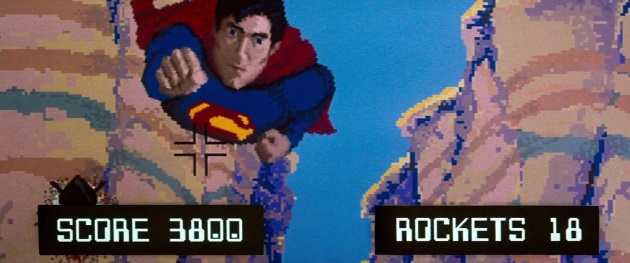
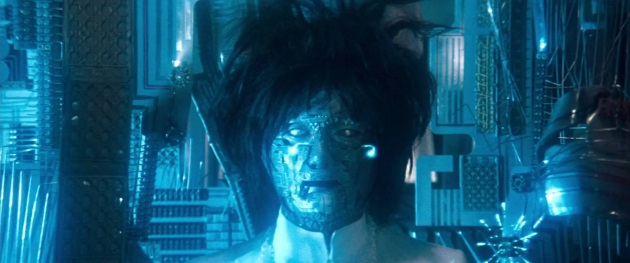
One of the most notable and unique aspects of Superman III is its semi-serious early screen depiction of computers and cyber-terrorism. Gus’s get-rich-quick scheme of writing a computer programme to gather up fractions of a cent remaining from other Webscoe employee’s pay cheques does have its basis in reality in a practice known as salami slicing (with this aspect of Superman III having influenced the movie Office Space as directly referenced in that film itself). However, I do use the term semi-serious as by the film’s climax, the understanding of computers in Superman III goes from having a basis in reality to becoming pure science-fiction with the super-computer designed by Gus. Just how did Gus accumulate the knowledge to design a machine which can feed itself by absorbing power from the electric grid, is able to grab people by using its wiring like a series of tentacles, can levitate people into the air and even turns Vera into a robot (I don’t think even the likes of Bill Gates are capable of creating a computer quite like this). Vera’s robotic transformation (or is she a cyborg as she appears to still have flesh skin albeit painted grey) is particularly frightening as she screams in agony during the process and then proceeds to walk like Boris Karloff in her new robotic form. I’d also be remiss if I didn’t mention, why does the villain’s view of Superman flying through the canyon looks like a video game complete with score points and those infamous Atari Pac-Man sounds? It doesn’t make sense (not to mention they do realise Superman is indestructible so why are they bothering to fire missiles at him?) but it sure is a fun sequence to watch. This entire action climax of the film is ridiculous but makes for very entertaining viewing and is topped with many memorable special effects shots from stop motion to miniatures (bringing the 80’s factor of Superman III up to 11).

I find Superman III to be the most visually and aesthetically appealing of all four Reeve films, and with Richard Lester being the only director at the helm (unlike Superman II which went through two directors), Superman III is consistent in its visual style with its use of warm, pastel colours and coupled with the picture’s use creative old-school practical effects. These films became more pop art in style as they went along, with another major unique contribution of Superman III to the series being the wholesome, small-town Americana feel with the scenes in Clark’s hometown of Smallville (ironically though filmed in High River, Alberta, Canada). Superman III is full of very comic book-like, very Superman-ey (for lack of a better term) moments such as Clark sneezing to create a bowling ball strike or Superman freezing an entire lake and then carrying it as a huge piece of ice in order to extinguish a chemical plant fire – a joyously simple and effective solution which feels like it’s taken right off the pages of a comic book. Furthermore, the TV version of Superman III contains 18 minutes of extra footage but unlike the TV versions of the first two films, the extra footage is mostly unnecessary padding for existing scenes and contains nothing that I was wishing was included in the theatrical cut. Even the Frank Oz cameo as the surgeon comes off as an awkward and unfunny attempt at shock humour while the clear indication that Evil Superman is definitely getting it on with Lorelei (whereas in the theatrical cut, this is only implied) is pushing it too far for what’s supposed to be a family film. Additionally, the opening credit sequence in this version which goes back to the traditional outer-space credits of the first two films is very dull with the repetitive use of scrolling text. This is one Superman movie in which I will stick with the theatrical version. Or if you would rather have an abridged version of Superman III, watch the infamous trailer which explains the entire main plot in 3 minutes.

An aspect of Superman III which is not often discussed is the film’s many references to indulgence and substance abuse, with Evil Superman being a potential metaphor for this. When analysing a movie for a deeper meaning like this, you can question if any such messages were intentionally incorporated by the scriptwriters. However, in Superman III, this theme is very on the nose that I can’t see it being something which the writers didn’t knowingly include. Firstly, how did Evil Superman come to be? Well by man-made kryptonite which substituted tar with an unknown substance of 0.57% after Gus Gorman choose the substance after seeing it as an ingredient on the side of a cigarette package. It’s like the film is saying smoking turned Superman evil (then again, didn’t your last movie have product placement for Marlboro Cigarettes?). Reeve plays Evil Superman in a manner in which he appears to always be intoxicated, while in pursuit of hedonistic pleasures (including getting super-laid). In general, Superman III is full of references to addictive substances including alcohol, cigarettes, coffee and fast food from the character of Brad Wilson (Gavin O’Herlihy) being in a state of near-constant inebriation to Ross Webster himself being a coffee mogul. Even Webster’s line “Every time a drunk sobers up, he’ll be drinking Webster coffee” is very on the nose. Gus himself also indulges in his newfound wealth (after previously complaining that he wants his pension money now) causing him to lose sight of his moral compass. On top of that, the film’s co-writer Leslie Newman refers to the Evil Superman as being “under the influence” in the documentary The Making Of Superman III – make of that what you will. During the film Evil Superman never kills anyone nor causes catastrophic damage or destruction (bar the oil tanker incident which is the worst action he performs) as Superman’s own inherit morality would prevent him from doing so – it makes sense that hedonism (and general trolling) would be the worst thing a corrupted Superman would do. When watching the movie through this thematic lens of indulgence and substance abuse it makes the confrontation between Clark and Evil Superman all the more compelling, speaking off…

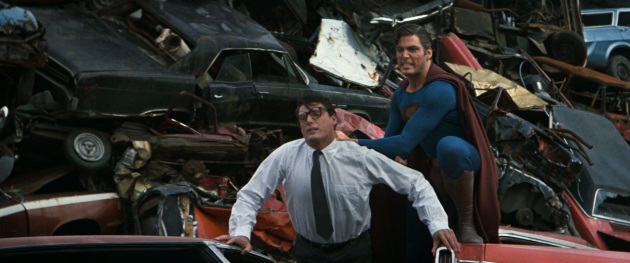
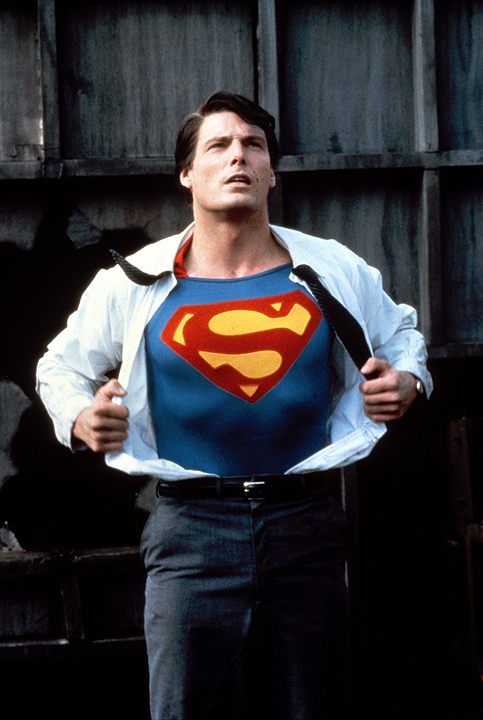
The grand highlight of Superman III has to be the inner conflict of good and evil that is the in-head fight between Evil Superman and Clark Kent in the junkyard – never before has a fight which doesn’t actually happen been so exciting. It’s intriguing to see the Clark persona involved in combat with the juxtaposition of a dorky guy who can give and receive such a brutal beating (“I can give as good as I get”). The use of composite shots and body doubles sells the illusion of two versions of Christopher Reeve fighting each other (pre-dating Back To The Future: Part II by six years), while the junkyard environment is used to great effect with the use of conveyor belts and trash compactors. While none of Ken Throne’s original music reaches anywhere near the heights of John Williams’ work, his music for this fight is a highlight with its eerie use of synthesisers. In addition, I find the moment of Clark being crushed in the trash compactor to be scary stuff. Even though as a viewer I know he will be fine as he is Superman after all, his heavy breathing and the look of horror on his face as he is trying to escape from the machine alongside the pov shot in which he catches his last glimpse of daylight in a scenario of which a normal human would be crushed to death is very unsettling to watch. In the end, the better angels of our nature prevail as Clark defeats Evil Superman, followed by a glorious victory shot in which Clark does the iconic shirt rip and subsequently flies off as regular Superman as the John Williams theme plays is one of those triumphant movie moments that make you want to just cheer on – “Yeah, go Supes!”. I’m not ashamed to proclaim my un-ironic love for the imperfect but joyous cinematic outing that is Superman III (perhaps I can reclaim some cinephile street-cred by reviewing some pretentious, European art-house that everyone pretends to love in order to look cool and artistically enlightened). Will I be able to find any merit in Part IV of the Superman film franchise? Let us embark on the next stage of our quest…a quest for peace?

Superman: The Movie (1978)

It’s Free Real Estate

***This Review Contains Spoilers***

During the opening credits of Superman: The Movie, in gigantic blue neon letters which dramatically zoom out towards the screen is the name of screen legend Marlon Brando, whereas the name of the man who actually plays Superman doesn’t appear until after the main title. Brando is only in the movie for less than 20 minutes in the theatrical cut (more in the extended cut and TV version). This foreshadows the imperfect and flawed nature of the Christopher Reeve Superman films however I think of them along the lines of the Japanese concept of Wabi-sabi – beauty within imperfection. With the internal disagreements that occurred with the making of these films behind the scenes, this saga ended up becoming a “choose your own adventure” anthology. Regardless, it all goes back to the year zero of 1978 and Superman: The Movie.

Christopher Reeve will forever be the GOAT live-action representation of the all-American icon that is Superman. But Superman is a boring, overpowered superhero I hear a bunch of edgy, Zack Synder-worshipping 12-year-olds say – nonsense! Superman is a tragic figure, one who saves the lives of others but is unable to enjoy his own life or be with the woman he loves. In Superman: The Movie this tragedy is showcased right off the bat as the young Clark Kent in Smallville is forced to be a lowly waterboy rather than an all-star college athlete as he is upstaged by a group of jocks and denied his childhood sweetheart Lana Lang. Unlike the creatives of today in both film and print who are embarrassed by the Superman of the past, this is the Superman who unashamedly represents truth, justice and the American way. The aspirational hero, the loveable dork, the pure-of-heart-do-gooder who saves a cat from a tree, will pull back his shirt to reveal the iconic S and dawns the bright, popping, contrasting colours of the famous suit (complete with the trunks) and all conveyed with such un-ironic sincerity (I just wish they could have held off on the Cheerios product placement during such a poignant moment). With the lighthearted nature of these films and their lack of irony, they can get away with a certain degree with their suspension of disbelief, hence on Superman’s first night, he just happens to save Lois Lane and none other than The President Of The United States from near-certain death. You know, like you do in a normal night’s work.

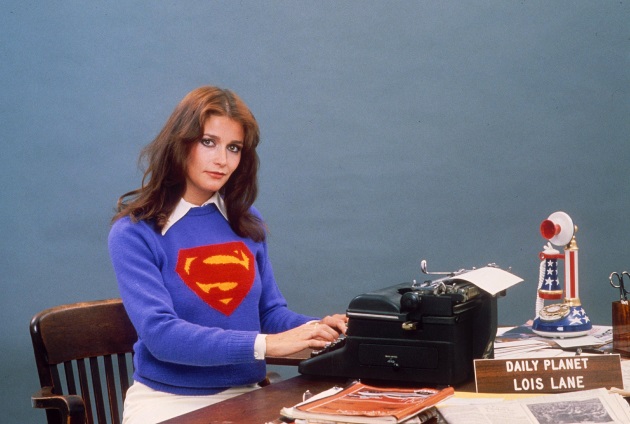
The transformation between Superman and his alter-ego Clark Kent really showcases just what a superb actor the late Christopher Reeve was. The infamous glasses Clark uses as a disguise which no one is able to see through is easy fodder for satirists, but there is so much more to the illusion from his complete change in attitude, posture, voice and mannerisms. Clark wears tailored baggy clothes, parts his hair to a different side, looks frail, slouches, talks in a higher octave, acts clumsy and submissive (while pretending he has no street smarts). Likewise, assuming the film is set in its contemporary period of the 1970s, this Cary Grant-like Clark still dresses as if it is 1938. It is a fantastic sight to observe Reeve playing both personas in the same uncut shot inside Lois’ apartment in which he removes the glasses and speaks in a different voice, as right in front of the viewer’s very eyes, he turns into an entirely different man. Just as impressive is the chemistry Reeve shares with a very quirky and in many ways clumsy Lois Lane played by Margot Kidder, in which the two of them turn the lengthy flying scene with Superman and Lois into pure cinema magic. The sequence and the dreamlike music by John Williams has the beauty and sensuality of an Astaire-Rodgers dance number as it perfectly capturing the intimacy between mortal and immortal (I’m sure with this scene alone the film bagged the female demographic).

Gene Hackman as real-estate madman Lex Luthor provides much of the film’s comic relief with his many flattering comments about himself (“Doesn’t it give you kind of a shudder of electricity through you to be in the same room with me?”) as well as his witty insults against the comic foil that is Otis (even Luthor’s underground layer of an abandoned subway acts like a character in itself). The film’s other great source of comedy is the scenes in The Daily Planet which have that screwball comedy, His Girl Friday vibe. There is a specific electric energy that comes from that click-clack of typewriters and phones ringing (the age before PCs and laptops) to the fast and snappy dialogue from actors who share exceptional chemistry as they walk and talk (“Remember my expose on the sex and drug orgies in the senior citizens home”). Clark himself provides an entertaining contrast as the avatar of Middle America who uses phrases like “swell” against the backdrop of his city slicker urbanites. As far as the film’s other callbacks to vintage Americana, the film plays into the 50’s nostalgia craze of the ’70s (alongside American Graffiti, Happy Days, Grease and The Lords Of The Flatbush) but the film still remains a product of the 1970s (“Say Jim, that’s a bad OUTFIT!”) tapping into the 70’s disaster movie craze with the destruction of the Hollywood sign and the inclusion of several obvious but charming miniatures (complete with scores of tiny boulders). Even the film’s iconic tagline “You’ll Believe A Man Can Fly”, speaks to its era as nothing special effects-wise had ever been accomplished in prior ages. 

In the 1978 TV special on the making of Superman: The Movie, behind-the-scenes footage shows Marlon Brando reading off cue cards when filming as well as reading from the script when he is not on screen. It’s a rather sad and sorry sight (this was into the era when Brando had lost his marbles), but in the finished product, Brando delivers the goods as Superman’s/Kal-El’s father Jor-El. Brando commands the scenes on Superman’s home planet Krypton with his every word and line being delivered with such commitment and integrity. Brando proves to be a comforting presence during the scenes in the Fortress Of Solitude as well as amid his narration throughout the sequence in which the audience is treated to an assortment of galactic images. With its Shakespearean tone and grand opening fanfare music, the scenes on Krypton really provide Superman: The Movie the aura of a Hollywood epic. Well, that and one of the greatest opening credits sequences in cinema, as each member of the cast and crew has their name appear in the form of those aforementioned giant blue neon letters in space accompanied by a hair-raising “swoosh” sound effect as their credit come across the screen (even with director Richard Donner’s name at the very end, the audio gets that extra oomph). Just how did they achieve that effect without the aid of CGI, tell you what, I’m happy not knowing. Above all, what completes the opening credits is none other than the music by cinema’s greatest composer, John Williams. For the first time in the character’s history, Superman has a musical representation, in which such hope and optimism are conveyed in musical form and a theme in which the main three-note musical motif actually speaks the name of the titular superhero.

The opening scenes on Krypton also set up the big bad for the sequel Superman II, General Zod (Terrence Stamp) and his two accomplices, Non (Jack O’Halloran) and Ursa (Sarah Douglas). This opening offers a taster of the greatness which is offered in the sequel with Terrence Stamp’s legendary, scenery-chewing performance as the Kryptonian traitor (“You will bow down before me! Both you, and then one day, your heirs!”). The giant faces in the high court and their pronouncements of “guilty!” as well as that floating square known as The Phantom Zone (often spoofed in pop culture) makes for unforgettable imagery. So what exactly are the trio being tried for? It’s not explained in any depth, but the film states Zod was attempting to start a revolution on Krypton to form a new order with himself as leader. Was there any justification for their goal? Krypton does appear to be a stale, conformist, authoritarian dystopia in which everyone dresses the same and Jor-El is even instructed not to leave Krypton with his family when he believes the planet will imminently self-destruct (hmmm, #ZodWasRight).

For a film series which is full of silly, bizarre or just downright dumb moments, it’s surprising that it’s the first and most grounded of these films which contains the most controversial moment in the entire Superman film franchise. I am indeed speaking of the infamous climax of Superman: The Movie in which Supes turns back time by altering the rotation of the Earth in order to prevent the death of Lois Lane (after he was only able to stop one of the two missiles Lex Luthor had rerouted), or at least this is what is commonly perceived. Is Superman actually flying faster than the speed of light to go back in time thus the reversed rotation of the Earth is a result of Superman going back in time rather than being the method of which he goes back in time? Superman is also subsequently shown to fly in the direction of the Earth’s rotation as if he is re-correcting the direction in which the planet should rotate, or did he simply overshoot by going too far into the past and had to go slightly correct himself time-wise? But then again, how does flying anti-clockwise make him go into the past and clockwise go into the future? Putting the obvious implications of real-world science to one side, the Back To The Future: Part II levels of paradox will not only make your head spin, the movie ultimately fails to make clear what Superman is actually doing. 

Other questions raised by this deus ex-machina climax include:

-Why hasn’t he used this power before or since? If Superman can use time travel to fix any problem, then it makes any conflicts in subsequent movies irrelevant.

-If he can fly that fast then why couldn’t he stop both of the missiles?

-If he went to get the other missile and then save Lois after turning back time, that means there’s another Superman somewhere stopping the one other missile from before.

-If Superman is knowingly breaking Jor-El’s command that he doesn’t interfere with human history (“It is forbidden for you to interfere with human history”) and instead taking his Earth father’s advice (“One thing I know, son, and that is you are here for a reason”), then I can understand that this is a sign that he has chosen Earth over Krypton, why does he continue to consult the elders of Krypton in subsequent movies?

That said, I by no means dislike this ending as it’s not only fun discussing the merits of such a conclusion, it still works on an emotional level as you can feel Superman’s anger, heartache and pain over his failure to save Lois as he lets out a mighty scream and ascends towards a billow of storm clouds as the booming voice of Jor-El instructs him not to interfere with human history.

The 3-hour TV version of Superman: The Movie (first broadcast in 1982 on ABC) contains an extra 37 minutes than the extended cut, which was released by Warner Bros for the first time on home video and in the film’s original aspect ratio for the film’s 40th anniversary in 2018. I did have some scepticism going into this version suspecting it would make the film too long and bloated, however, I am pleased to report this version is my definitive cut of Superman: The Movie. Please forgive me Mr. Donner that I keep preferring the unapproved versions of your Superman films (the Blu-ray contains an opening prologue stating this version does not represent the director’s vision).

So what goodies does this 3-hour long cut offer? Firstly, it offers another moment with the Phantom Zone as it whizzes past baby Superman’s pod. A nice reminder that these guys from the start of the film will come back later not to mention, any more footage of Terrence Stamp as Zod is much appreciated. In this cut, it is also revealed the little girl on the train who saw Clark running in Smallville was none-other than Lois Lane herself, to which I had the reaction of “say what?!”. The scene itself is nonsensical as since when do parents refer to their children by their full name in casual conversation? It is also a bit of a cheap shot to illicit a reaction from the audience but it did work on me so I’ll let them away with this one. It would however have been a more clever move to imply the character was Lois rather than outright stating it, creating a bit of mystery for the viewer. One fantastic addition however is that of Superman speaking to Jor-El in the Fortress Of Solitude after his first night of crime-fighting and speaking of his guilty feelings for having enjoyed the experience (“do not punish yourself you your feelings of vanity, simply learn to control them”). This scene further highlights Superman’s vulnerability and makes this characterization more human – powerful stuff!

Correspondingly, the sequence in which Superman attempts to enter Luthor’s layer but has to make his way through hoards of gun bullets and sub-zero temperatures doesn’t make sense as Luthor is aware that kryptonite is his only weakness but does prove to be a fun sequence despite this obvious plot hole. However speaking of extra scenes involving Lex, my favourite addition to the TV version would have to be that of Luthor’s babies, a collection of big cats which are never seen on screen but only heard with an amalgamation of various big cat growls. These cats strike fear into the heart of Otis as Luthor in a very sinister manner asks him “Otis, did you feed the babies?”. This scene makes Lex all the more sinister and explores the mad-scientist aspect of his character, as well as tying into an additional scene at the film’s end in which we actually discover the fate of Luthor’s accomplice Miss Teschmacher. My only complaint with this version of Superman: The Movie is the dial downed sound effects in the audio mix for the opening credits. That said, I am now waiting for restored versions TV versions of Superman II and III (and an extended cut of IV). Come on Warner Bros, chop chop!

I get that people are very sentimental towards director Richard Donner although I’ve never been a huge fan of his work. Lethal Weapon was never my scene and I don’t like The Goonies. I also really dislike The Richard Donner cut of Superman II (but more on that for another day). Regardless, personally for me Superman: The Movie is by far his best film in my estimation. However, my biggest complaint with Superman: The Movie (as solid as it is) is Superman II. The sequel does everything the first movie did but better. One thing which is lacking from the first movie is an adversary for Superman to engage in combat with (which Superman II has in plentiful supply) not to mention the sequel has much more internal character-driven conflict. With that said, the adventure continues…