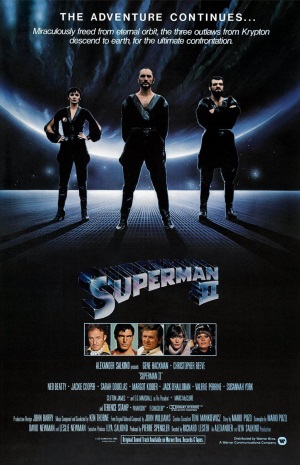
Superman II (1980)

What Is The Story With That Cellophane S?

***This Review Contains Spoilers***

Due to the complex and troubled production behind Superman II it seems likely it would have been destined to become a disaster of a film with the switching of directors from Richard Donner to Richard Lester during the principal photography process. However, instead of turning into a Frankensteinian mess of two director’s visions stitched together into one, I consider Superman II to be the perfect Superman film. A film which improves on the original in so many ways and delivers a more emotionally satisfying film and offering two hours of pure escapist bliss. A rare instance of the perfect combination of cast and crew coming together to create something wonderful. I will also take this opportunity to say: Lester cut > Donner cut (yes, this is a hill I am willing to die on). After watching Superman II: The Richard Donner Cut I thought to myself “Thank God Donner was fired from this production and replaced with Richard Lester”. Within the Donner cut, the romance between Lois and Clark is very forced and underdeveloped; there is a lack of humour, and no exaggeration, one of the absolute worst endings I’ve ever seen – but that’s for another review.

Lester’s style for Superman II forsakes the more epic scope Richard Donner employed for the first film, instead opting for scenes in the film to more resemble the frames of a comic book – Superman II does have more of a comic book/pop-art vibe. Lester brought on cinematographer Robert Paynter for the film to evoke the colour scheme of the comics however the contrast between Lester’s new footage and that shot by Donner which still made it into the film (i.e. all of Gene Hackman’s scenes) isn’t great enough to become distracting.  Superman II has a much more brisk pace than the first film, as evident by the opening scene which re-edits the Kryptonian council’s trial of Zod, Ursa and Non to that of a more frantic pace. It does create a continuity issue with the first film as Marlon Brando has been completely removed from the scene (and is absent for the entire film), however, I am able to look past this as the opening is just so darn exciting and perfectly establishes the tone for the rest of the film. With all the setting up done in the first film, Superman II is able to get straight into the thick of it with the action sequence involving terrorists at the Eiffel Tower, and creating high stakes right off the bat. Correspondingly, another individual who doesn’t return for Superman II is that of composer John Williams and thus is lacking the sounds of The London Symphony Orchestra. Rather the film is scored with a smaller orchestra led by composer Ken Throne, however, I actually don’t mind the stripped-down approach to the music and find it does work in its own way. John Williams may have written the iconic Superman theme, but I find Ken Throne’s faster rendition for the opening credits of Superman II to be the best version of the famous theme with its quicker tempo. Likewise, someone in the production must have been fond of the Average White Band song Pick Up The Pieces as not only does it appear in the film, there is a neat orchestral version of it during the second dinner scene.

While their appearance in Superman: The Movie was fleeting, Superman II finally gives us General Zod (Terrence Stamp) and his two accomplices Ursa (Sarah Douglas) and Non (Jack O’Halloran) in all their glory. Terrence Stamp as Zod is one of those performances which bring me eternal levels of respect for an actor. Every one of his beautiful hammed-up, menacing lines I could listen to all day (a posh English accent makes any on-screen villain all the more evil). Alongside Stamp’s scenery-chewing, part of what makes the trio so intriguing is the innocence of their evil. The three don’t actually seem to be unaware of the immorality of their actions, with Ursa, in particular, taking great joy in her evil misdeeds (one of the many international TV cuts of Superman II does feature a scene in which Non kills a child off-screen, although I prefer this scene’s non-inclusion in the theatrical cut as it is too dark in tone with the rest of the film). Likewise, I greatly enjoy the trio’s genuine curiosity during their time on Earth, such as when Zod is genuinely baffled by Lex Luthor’s impudence (“Why do you say this to me when you know I will kill you for it?”). Much humour is devised from this 3rd Rock From the Sun-type humour such when the trio mistake Earth’s name as planet Houston, nor would any comical/semi-comical act be complete without the dumb one, as even the Kryptonian Council denounces Non for his lack of intelligence (ouch!).

As Zod, Ursa and Non have the same strength as Superman when on Earth, their characters do harken back to the original predecessor story to Superman, Jerry Siegel and Joe Shuster’s short story The Reign Of The Superman from 1933, in which an indestructible “superman” imposes tyranny on the world rather than using his powers for good. However, once Zod becomes supreme leader of Earth in Superman II, he doesn’t actually do anything. He, Ursa and Non just lounge around the Oval Office and don’t do anything while the rest of the world continues as normal. As I argued in my review of Superman: The Movie, Zod was correct to stand up to the authoritarian dystopia that was Krypton, and on Earth, he is the libertarian hero we need. I for one welcome our new Kryptonian overlords (#ZodWasRight). It is also worth noting that in the TV cut of Superman II, during the invasion of The White House, Zod takes particular umbrage at a portrait of Richard Nixon and starts frantically shooting it even though he should have no knowledge of who this man is, I guess it just rubbed him the wrong way.

Although I may put my defence of Zod on hold in favour of the film’s grand action set-piece as the son of Jor-El takes on the Kryptonian trio in a climatic fight which spawns the city of Metropolis. As combat with a villain was absent in the first film, this fight more than satisfies that desire (”Man, this is gonna be good”), with all those wonderfully kitschy special effects on display just getting better with age. The fight also includes multiple humorous uses of product placement as Superman gets thrown onto a Marlboro Cigarettes truck followed by Zod being flung into a Coca-Cola sign only a few seconds later to my great amusement. The inclusion of product placement for Marlboro Cigarettes is odd though considering early in the film there is some very subtle humour coming from Lois Lane speaking about how she is trying to stay healthy her via her intake of orange juice, all while she continues to chain smoke.

As with the first film, the scenes in The Daily Planet have that screwball comedy vibe, however, I feel the dialogue in Superman II is even wittier this time around. The recurring players in all the Christopher Reeve-era Superman films have such a great dynamic together that even in a movie as poor as Superman IV I can still enjoy their interactions. The major cast member absence of Superman II is Marlon Brando, however Susannah York as Superman/Kal-El’s mother does an effective job filling Brando’s shoes as she is commanding and stoic and like Brando, is a comforting presence in The Fortress Of Solitude. Moreover, Superman II offers further insights into the character of Lex Luthor with his desire just to be the ruler of Australia (and then later Cuba). He may be an egomaniac, but at least knows his limits; he can’t have the world but can happily make do with a continent. The TV cut of Superman II also interestingly features an interaction between Luthor and Jimmy Olson (Marc McClure), two characters that otherwise never encounter nor interact with each other at any other point in the series. I also adore how Superman refuses to look Luthor in the eye when speaking to him as he is that unamused by Luthor’s antics (probably in part since Hackman still got billed above Reeve in the opening credits). Other memorable characters from Superman II include Rocky (aka Mr Wonderful), the perfectly executed love-to-hate character, not to mention that kid from the redneck town who for some bizarre reason sounds like he’s from Victorian-era London.

The other aspect which makes Superman II so great is the romance between Lois and Clark. I was left so badly wanted to see these two get together, two down-to-earth souls who are too perfect a match for each other. Their interactions at the beginning of the film are so endearing as Lois almost mothers the clumsy and meek Clark, not to mention you can really feel the pain as Clark gets friend-zoned big time. Following Lois’ discovery that Clark is indeed Superman, Clark surrenders his powers as Superman to live as a mortal in order to be with Lois. This is followed by the two of them going all the way which I assume Clark would be unable to do as Superman as his superhuman strength would literally kill her (so am I to assume Superman gave up his powers just because he was that thirsty?). The crescendo to the Lois & Clark romance comes to ahead with easily the most emotionally powerful moment in the series, as following the restoration of Superman’s powers, the two try to comprehend continuing to professionally work together in the same vicinity despite their feelings for each other. Margot Kidder’s voice is so emotive and she has that Margaret Sullavan-like quality to her (at the film’s most intense romantic moments her tearful pleas kill me). This conflict is resolved by Clark giving Lois a memory-erasing kiss (another addition to the list of bizarre powers Superman uses once and never again alongside going back in time, repairing the Great Wall Of China with his laser eyes and the infamous cellophane S from earlier in the film). A conclusion like this could easily have come off as a cop-out but I will argue in its favour. Firstly, the manner in which he erases Lois’s mind is via the romantic gesture of a kiss is tonally consistent with the scene, and secondly, the sacrifice that is endured on the part of Clark. Lois can have her mind erased to forget the pain, but Clark is not offered that privilege, he must continue to remain stoic to carry the heartache. That said, with the status quo returned, another Superman adventure beckons, to which the beginning of the end credits to Superman II offers the viewer a tease:

Coming soon

“Superman III”

The Caine Mutiny (1954)

Fred MacMurray 2

The Great Strawberry Case of ‘44

***This Review Contains Spoilers***

1954, what a year for film! Rear Window, Dial M for Murder, A Star Is Born, On the Waterfront, Seven Samurai – to name a few. Among this year of outstanding films was The Caine Mutiny; a picture which has all the hallmarks of an event movie – based on a hit novel, an ensemble cast of big names, extremely lush production values. Aside from the high-end Hollywood spectacle on offer, The Caine Mutiny is one of the most thought-provoking films I’ve had the joy of watching. I appreciate these message pictures which came from producer and later director Stanley Kramer which show that people and life itself is complicated and can’t always be simplified to basic narratives. There is never a dull moment during the two hour run time of The Caine Mutiny, although director Edward Dmytryk wanted the film to be three and a half to four hours long and with the film being as layered as it is in its current form, it probably could work drawn out to a much longer length.

There’s little which would make the production values of The Caine Mutiny better. The film likes to show-off those US Navy ships and their docks in the glorious new widescreen format. The only minor criticism would be the implemented stock footage which does stick out although considering such shots would have been near impossible to film then it’s an understandable compromise. Likewise, the typhoon sequence has some very impressive model work, convincingly making a pool (presumably) in the Columbia backlot look like the Pacific Ocean during a great storm. The music score is also one among one of composer Max Steiner’s best; romantic, exciting and even has a swashbuckling tone to it.

Actor Robert Francis is not a hugely charismatic presence with or without the other big-name stars but it’s fitting to cast an unknown and rather plain actor as the POV of the viewer. Ensign Willis Seward “Willie” Keith is a character the average moviegoer can project onto as the average Joe entering the naval world for the first time. The romance subplot involving his love interest May Wynn (played by an actress who chose her stage name after this fictional character she played) is the one inclusion in The Caine Mutiny which is questionable; in other words, it has nothing to do with the main story and feels out of place. That said despite this I do enjoy these romance scenes as I am a sucker for this kind of 1950’s fluff such as the portion of the film in which they go out to Yosemite National Park – just about the most romantic location imaginable. Full of waterfalls, mountains, horse riding, an orchestrated version of the song “I Can’t Believe That You’re In Love With Me”, and no sign that there is a war going on (not to mention May Wynn is not bad on the eyes).

The cast and performances in The Caine Mutiny are exceptional. I never felt like I was watching actors but rather actual naval personal (we even get a pre-fame Lee Marvin in a small part offering some comic relief). I do find their military etiquette makes for very pleasurable listening with there never being a moment when anyone sounds rude. Van Johnson, the boy next door himself is surprisingly commanding in the role of Lieutenant Steve Maryk. Even the scars on his face which he obtained from an accident when filming A Guy Named Joe (1943) are not hidden with makeup, helping to aid his performance. Fred MacMurray, on the other hand, is an actor I find far more interesting when he is cast against type as is the case in the role of Lieutenant Tom Keefer; an elitist snob who thinks the Navy is beneath him and is much more interested in writing his novel. The character is very much the opposite of Van Johnson’s. For example, his thing of playing an amateur psychiatrist was just a little game to him until it later dawns on him the seriousness of the situation. However MacMurray’s performance is very subtle, you barely catch onto these traits unless paying close attention to his performance, another aspect which really gives The Caine Mutiny such re-watch value.

However, let’s talk about the main star of the show – Queeg; a name as infamous as Bligh. The role of Lieutenant Commander Philip Francis Queeg is one of the finest performances of Humphrey Bogart’s career (and the inspiration for one of my favourite Red Dwarf episodes). Humphrey Bogart, James Cagney and Edward G. Robinson all played tyrannical ship captains in what I view as the Tough Guy, Tyrannical Ship Captain Trilogy (The Sea Wolf, The Caine Mutiny and Mister Roberts). Queeg is one complex character whom alone makes the movie worth watching multiple times in order to fully dissect him. There is a subtle, pathetic streak to Queeg (even his posture is rather bent at times); he fails to bond with his crew even though he earnestly tries. During the first meeting with his crew, he brings out a pair of clacking metal balls upon viewing a crew member with an un-tucked shirt; metal balls which just make things feel awkward and uneasy (he probably would have a fidget spinner if the movie were made today). From day one it’s not hard to see why the crew did not warm up to him. While it could be argued Bogart is too old for the role of Queeg (it is stated in the film he was an ensign only 8 years earlier), this can more than easily be looked over as Bogart is so good and synonymous with the role. Even a moment in which Queeg talks with such confidence in relation to the missing quart of strawberries while simultaneously buttering crackers is very entertaining to watch.

The question does have to be raised if the crew had it too easy before Queeg came on board? Like the vessel in Mister Roberts, The Caine is a slack, dead-end ship. Regardless Queeg plays by the book to an obsessive degree and he overreacts to the breaking of rules which are trivial in the grand scheme of things as seen in the famous missing strawberries scene. His obsessive pre-occupation with the rules also puts the ship in danger such as during the minesweeping sequence. Likewise, during the typhoon in which the actual mutiny on board the Caine occurs, Queeg is clearly terrified and becomes paralysed with this fear. Yet Queeg is not the villain of The Caine Mutiny, he does not act in malice and it’s easy to empathise and feel sorry for him. – “A captain’s job is a lonely one. He’s easily misunderstood”.

The final third of The Caine Mutiny is comprised of a court-martial and oh is it gloriously fascinating as I am glued to the screen and eating up every word of it. Unlike many other Hollywood courtroom dramas there are no over the top hysterics but rather the actors remain subdued. That doesn’t make it any less intense though, thanks in part to the powerhouse acting presences of Jose Ferrer and E.G. Marshall as Lieutenant Barney Greenwald and the prosecutor Lieutenant Commander John Challee respectively.

It’s surprising the United States Navy would be involved in a film which portrayed a mentally unbalanced man as a captain as well as involving a mutiny (albeit a legalistic mutiny and not a violent one). The word “Mutiny” is even in the title of the film although I’m sure they would rather have played play linguistic semantics and called it an “Incident”. The film even opens with the disclaimer “There has never been a mutiny in a ship of the United States Navy” – itself a disputable historical fact. Mayrk initially has difficulty obtaining a lawyer to defend him as the Navy’s lawyers refuse to be in the position of having to testify against a commanding officer. While a film like this can be interrupted in many different ways, I’m left feeling it doesn’t paint a great picture of the navy establishment due to the ignorance on display with the dismissing of the crew’s actions based on a preliminary investigation. As Greenwald puts it bluntly, “I think that what you’ve done stinks”.

I remember during my first time watching court marital, the moment which really stuck with me was the point brought up by the prosecutor asking Maryk how he was able to diagnose a mental illness without having the qualifications to do so. This struck me as an incredibly thought-provoking point although watching the movie years later it’s become apparent to me the prosecutor’s use of sophistry when questioning those at the stand. In relation to the aforementioned point, the prosecutor asks Maryk if he has had training in psychiatry or medicine to which Mayrk answers “none”. He also asks Mayrk to define the terms “schizophrenia“, “manic-depressive” and define the difference between “paranoid” and “paranoia”, all of which he fails to do. Isn’t it obvious to determine if someone is mentally unwell even with little knowledge of the subject matter?

Mayrk clearly does not have the ability to effectively defend himself on the stand and looks weak as a result. He is also asked immaterial questions about his school grades which his lawyer Greenwald raises no objection to (nor does he object to anything during the trial). Due to his unpreparedness, Mayrk reluctantly accepts the prosecutor’s narrative that himself and not Captain Queeg is in the wrong (“Isn’t it possible that, under pressure, you became erratic and couldn’t understand the captain’s sound decision?”). We also see the prosecutor put words in the mouth of the Lee Marvin character after he referred to the Captain’s actions as “strange”. The prosecutor then proceeds to straw-man him before he has a chance to defend himself which he clearly doesn’t the intellect to do so and accepts the mischaracterisation of what he may have been attempting to say.

Similar lines of questioning are used when the prosecutor asks Keith “Have you ever been in a ship that foundered?” followed by asking who is better qualified to judge if a ship is foundering; an ensign who has spent little over a year abroad a ship or an experienced captain of eight years? Isn’t such a question irrelevant when the sight of a foundering ship is obvious? Keith does deal nicely with the lines of questioning he receives such as when the prosecutor asks condescending questions such as “did the captain rave and make insane gestures?” while waving his hands about, to the prosecutor’s sarcastic response of “Thank you for your expert opinion” in relation to Keith’s response about the captain’s state. At one point Keith is asked “Are you aware that the captain has been pronounced completely rational by three qualified psychiatrists?”, to which he responds “They weren’t on the board the Caine during the typhoon sir”. – Oh! #ThugLife.

Greenwald does a far more honourable job at questioning and is much more of a class act, not taking part in fallacies. He also knows how to play the game when it comes to the delicate matter of questioning a Naval officer of whom to disrespect would be a punishable offence. He states: “It’s not the defence’s contention that Lieutenant Commander Queeg is a coward. Quite the contrary. The defence assumes that no man who rises to command a United States naval ship can possibly be a coward. And that, therefore, if he commits questionable acts under fire, the explanation must be elsewhere”.  That said I’m not a legal expert so I’m happy to be corrected or challenged on these observations.

When Queeg does take to the stand, Bogart’s acting is the stuff of legend. A confident and cocky Queeg gradually lets himself go and of course, he brings out the clacking metal balls. When you use a term like “geometric logic” to describe how you intended to prove the theft of strawberries then you know you’ve just dug your own grave. The culmination of this breakdown is filmed in a single, uncut, close up shot and is one of the most riveting pieces of acting I’ve ever witnessed. We are never actually told what Queeg’s verdict is but the crew of the ship celebrate the outcome at a party afterwards. Greenwald joins the procession only to give a monologue on how the crew where at least some degree complicit in the situation, pointing to the time when Queeg came to them for help and they “turned him down”. Needless to say, Greenwald is successful in changing their feelings over the situation and killing the mood of the party. This monologue is successful in being immensely thought-provoking and raising many of questions of any similar situation. Who is the victim? Who is the guilty one? Who disrespected who first? The one issue I would take with this monologue though is that it absolves Queeg of any personal responsibility.

Many people will say that movies are a mean of escaping reality; The Caine Mutiny shows how movies can be a means of understanding reality. Grab your ice cream and strawberries and enjoy!

12 Angry Men (1957)

…and Justice for All

***This Review Contains Spoilers***

I don’t think I can bestow a higher statement of praise on a film than to call it a life-changing experience. 12 Angry Men influenced me not to believe everything I hear, instead to question things and ultimately turning me into a more skeptical person; there is more to life than meets the eye (or ear). It’s one of few films which helped shape who I am as a person.  When watching it I constantly visualise the details in my head of the events and locations of the murder case being described. At the beginning of the film, all the jurors bar one believe the boy in question is guilty of murdering his father. By the end of the film, they all change their vote to not guilty. How is this possible? Why just the most incredible 90-minute exhibition of human psychology and argumentation. I enjoy never knowing what really happened; did the kid commit murder or not? – It’s up for the viewer to decide. 12 Angry Men is a movie that is hard to write a review for; I wouldn’t be surprised if I come back to add more since I find myself watching 12 Angry Men at least once a year. With layer upon layer upon layer, this is a movie I could talk about hours, and always finding new aspects to discuss on each viewing. As the exposition reveals more details of the case I am left saying in the words of Milhouse Van Houten, “Tell me more!”. – Ah the pure joy of an engrossing, wordy, civil debate.

On every viewing of 12 Angry Men I find myself focusing on a different character. I’d have to watch the 12 times in order to fully explore every character, all representative of personalities we’re likely to encounter in real life’; I’m sure I’ve encountered each one at some point in my life. This is a movie that needed a cast comprised of character actors (aside from Henry Fonda) in order to create such distinct personalities – the characters are believable without being two-dimensional stereotypes. Not all of them leave prejudice at the door; it’s more obvious with some than others. Not all of them really take much interest in the case or have much pride being part of a jury and even treating it as a bit of a joke at times; even the judge at the beginning doesn’t to be very enthusiastic about the case at hand. They even display different levels of confidence and surety in their opinions – when every juror announces they have changed their mind you can see on their faces how difficult that admission is.

12 Angry Men provides possibly the best cinematic insight into group conflict and argumentation. Like with a jury or a classroom full of people, this large variety of personalities are unlikely to converge elsewhere in a small space for a period of time in which they have to communicate with each other, such as what John Hughes would explore with his teen detention drama in 1985 with The Breakfast Club. You really get a sense of who likes who and who doesn’t as the heat beats down in that claustrophobic space. Director Sidney Lumet made the cast spend time with each other before filming and it certainly helped. I don’t feel like I’m watching actors, I feel like I’m watching a group of everyday people in a jury. As not all US states at the time opened their doors to having womenpresent within juires; the film is not 12 Angry Men and Women. I imagine the feminine point of few would have influenced the examination of the proceedings; just think of Grace Kelly’s female instincts from Rear Window.

The cast:

Juror #1 (Martin Balsam):

The Jury Foreman. He doesn’t express any opinion or reasons for changing his vote, taking a neutral stance and moderates the proceedings.

Juror #2 (John Fiedler):

Nerdy and socially awkward; reminds me of Rick Moranis. I find it interesting that he is placed sitting beside Lee J. Cobb’s Juror #3 as the two are polar opposites. He finds it difficult to articulate an opinion at first but grows confidence and later stands up to the other jurors.

Juror #3 (Lee J. Cobb):

Lee J. Cobb is my favourite of the cast, in my view being the most interesting and complex character with the biggest ark as the opinionated and brash antagonist, Juror #3; ultimately stealing the show. He seems fair and rational at first until we gradually discover he wants to boy on trial found guilty for personal reasons. He is by far the most confrontational juror as he contests every single rebuttal thrown his way and never concedes a good point. This is a strategy that even leads him to shoot himself in the foot when he destroys his own argument by frantically stating “he was an old man, half the time he was confused, how could be positive about anything?” Juror #3’s breakdown at the end is a highlight in a film full of awe-inspiring performances. His angry outburst to Fonda that he’ll kill him followed by Fonda’s response of “You don’t really mean you’ll kill me, do you?”, is surely one of the greatest zingers in cinema history.

Juror #4 (E. G. Marshall):

A cold-hearted individual which is reflected by his wearing of a jacket throughout the whole 90 minutes despite the heat. He is a metaphorical representation of cold, hard facts. He is arguably the most competent and restrained debater and also a bit of a ‘know it all’ which makes it all the more interesting and satisfying when he changes his vote. Likewise, the movies and stars mentioned during his cross-examination by Juror #8 are not real (yes I looked them up)

Juror #5 (Jack Klugman):

Comes from a slum background although his appearance doesn’t suggest this. He even votes guilty on two occasions despite the boy on trail coming from his same background. His decision to change his vote could have been influenced by the accusation from Juror #3 (both still being a member of the guilty party at this point) that he had changed his vote due to sharing the same background the boy on trial, when in fact he hadn’t changed his vote.

Juror #6 (Edward Binns):

The most normal juror, doesn’t stand out – a very regular John Doe. He even states he’s not a “supposing man” and that his boss does all the supposing. He doesn’t have anything to add when asked for his opinion, just repeating points that have already been made in an unsure manner.

Juror #7 (Jack Warden):

Clearly doesn’t want to be there, doesn’t care about the case and even bullies and tries to intimidate other jurors. He has no respect for the grounds with his gum-chewing and litter throwing and although he never outright says he wants to leave and go to the ball game which he has tickets for, it’s painfully obvious from the beginning what his true intent is.

Juror #8/Davis (Henry Fonda):

The film’s protagonist and the outsider of the jury. A soft-spoken and rarely confrontational man who is brave enough to stand up to the collective and going against popular opinion, even when the rest of them get frustrated with him. Fonda like in many of his movies is a beacon of truth and justice here, but he doesn’t come off as unbelievable saintly – even with his wearing of a white suit. The scene in which he puts his knife in the table is a gasping moment if there ever was one.

Juror #9/McCardle (Joseph Sweeney):

The most elderly member of the jury. Juror #1 states he should be respected because of that, and I believe this is deserved because of his knowledge as well as his confidence in Juror #8.

Juror #10 (Ed Begley):

The most obviously bigoted member of the jury and thus ultimately doesn’t prove to be a huge help to the proceedings with talking out of turn multiple tie, his prejudiced rants or his hypocrisy in defending the woman’s statement despite her also being “one of them too”. At one point he even suggests telling a funny story he heard rather than discussing the case and eventually gets expelled from the table when his bigotry is denied an audience

Juror #11 (George Voskovec):

An Eastern European immigrant (possibly from behind the Iron Curtain) who takes more pride in the American justice system as well as democracy than any of the American members of the Jury, even defending it such as when Juror #10 demands that Juror #5 reveals his voting choice. Likewise, I love his statement to Juror #2 in response to what side he is on: “I don’t believe I have to be loyal to one side or the other, I’m simply asking questions”. Juror #11 is a watchmaker who regularly points out the time. Ah, I see what you did there movie!

Juror #12 (Robert Webber):

A huckster in the advertising business which makes sense as he himself has a very manufactured look. I get the impression he represents 1950’s conformity with his appearance, looking like a character from a Rock Hudson/Doris Day comedy with his very 50’s glasses and hair. He goes along with the crowd, even changing his vote more than once.

Is Jury Duty really this incredible in the real world? At the end of 12 Angry Men I wonder if the jurors are aware that they’ve just experienced probably the most incredible 90 minutes of their lives.