
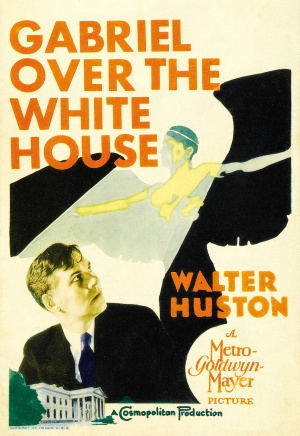
Gabriel Over the White House (1933)

I Love Democracy…

***This Review Contains Spoilers***

I do love the efficiency and streamlined nature of pre-code films. Within two minutes, the opening credits roll, followed by a montage of stock footage, and the story of Gabriel Over The White House is underway (unlike films today with a parade of 10 studio logos and a title screen that doesn’t appear until 40 minutes in).
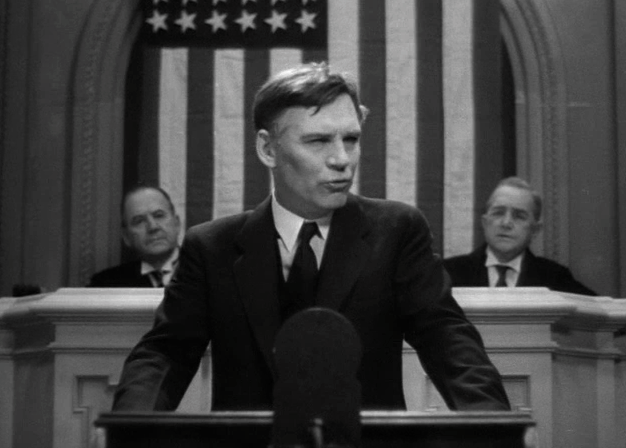
The newly elected President of the United States, Judson Hammond (Walter Huston), is sworn into office, yet behind closed doors, he and his inner circle treat the presidency as a joke. They engage in smarmy chatter and look down upon the populace (“When I think of all the promises I made to the people to get elected…by the time they realise you’re not going to keep them, your term will be over”). Hammond even takes the pen that Lincoln freed the slaves with and remarks, “Well, here it goes for Puerto Rican garbage”. To play up this disregard to an even greater degree, in a very unusual scene featuring a rare use of overlapping dialogue, the President and his nephew play a treasure hunt game in the Oval Office while the radio plays an activist speech. The audio from the dialogue between the President and his nephew becomes drawn out by that of the radio, as Hammond does not have a care in the world for what’s happening in the country. The only loyalty displayed by Hammond is towards what is simply referred to as “The Party” (“The party has a plan, I am just a member of the party”). Walter Huston has the look you would expect from a president from the early 20th century (not too dissimilar looking to Warren G. Harding or a clean-shaven William Howard Taft), while his sheer gravitas not only makes the hairs on your skin stand up, but he also prevents Hammond from coming off as just a caricature. Interestingly, however, he is a President without a First Lady, which would make him and James Buchanan the only unmarried presidents. 

Following a racing accident, Hammond goes into a coma. However, upon his reawakening, Hammond is no longer the man he once was; rather, a populist figure is born. “God might have sent the angel Gabriel to do for Jud Hammond what he did for Daniel”, states the President’s secretary, Pendie Molloy (Karen Morley), as the film makes no secret of indicating that Hammond will be enacting the will of God himself. Many scenes from this point onwards have a softer, more dreamlike look, with a higher contrast between black and white. In one moment shortly after Hudson’s awakening, he stares up in awe at a bright heavenly light shining upon his face, or as Pendie describes it, “the presence of a third being in the room”. Many a beautiful shot populates the film, from the dramatic zoom shot on Hammond (even if it does go in and out of focus) to some stunning set design with the art deco set of the film’s court martial scene.

The new Judson Hammond wastes no time getting things done with his newfound heavenly, populist political will. Right off the bat, he stops calling his staff nicknames and stands up to the members of his own party.

“Now, be careful. I might resign on you.”

“Your resignation is accepted.”

“Oh, well now, wait a minute, Jud, I was only suggesting…”

Hammond asks Congress to declare a state of national emergency to adjourn itself until normal conditions are restored, and during this period, he will assume full responsibility for the government. With the country under martial law, Hammond proceeds to tackle the issues of unemployment, mob rule, forcing over nations to pay their debts the US and by the film’s climax, literally enshrining world peace into a document signed by most nations in the world. Upon lending his own signature to the document, Hammond himself collapses and quickly passes away, lending further credence that he is enacting the will of God.
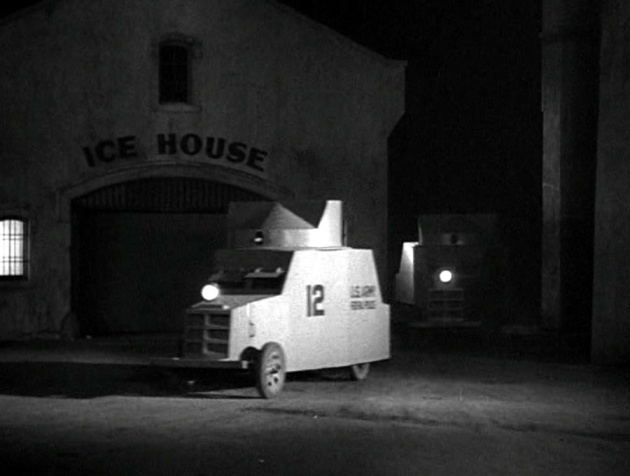
The subplot of Hammond’s efforts to eliminate the mob is particularly interesting. He praises gangster Nick Diamond (of course, he has a scar on his face) directly for “getting rid of most of his own kind”, relating to the theory in criminology that allowing one single crime syndicate to operate results in an overall reduction of crime. Hammond proceeds to create a federal police force to eliminate the mob, leading to two of the oddest scenes in the film, the first in which the mob attempts to assassinate Hammond on the grounds of The White House itself (was this more plausible in 1933?). The latter is a sequence which I can best describe as resembling the climax of every episode of Takeshi’s Castle. Following the arrest of Nick Diamond and his men, they are executed by way of an old school firing shot with the Statue of Liberty in the background (I’ll let you decide what is the intended symbolism, if any, of such a shot).

Is there a name for this kind of populist wish-fulfilment picture? The film which has the most striking similarities to Gabriel Over The White House is Ivan Reitman’s Dave (1993), in which an ineffective, uncaring president is replaced by a populist doppelganger who gets things done. Likewise, multiple sources online speak of an alternative European cut with 17 extra minutes, although such a cut has never been released on home video. Much is made of the fact that film was financed by media conglomerate William Randolph Hearst, although regardless of the agenda those behind the production may or may not have had (although it is worth noting that director Gregory LaCava would go on to direct the anti-New Deal May Man Godfrey in 1936), Gabriel Over The White House, whether by design or not, presents one central dilemma; should a nation be led by one all-powerful leader who can get things done, or have a system of checks and balances, which may be slow and inefficient? When watching Gabriel Over The White House, it’s easy to feel seduced by the temptation of having an all-powerful leader, a benevolent dictator, a king. Or once a crisis has abated, can we ever trust that a leader will lay down the powers given to him? History would say no, but Gabriel Over The White House allows the viewer to indulge in such a fantasy.

Mutiny on the Bounty (1935)

Ship Happens

***This Review Contains Spoilers***

Few other cinematic experiences are as immensely satisfying as MGM’s 1935 production of Mutiny on the Bounty. Loosely based on the mutiny on board the HMS Bounty in the South Pacific on April 28th, 1789 (although at the end of the day how can any of us really know what happened on board that vessel over 200 years ago), the actual build-up to the seizing of the ship is just gloriously immense.

Charles Laughton is an absolute beast as Captain William Bligh, a cruel sadist, and a tyrant with no reverence for the convicts and low lives in his crew. With his arrogant stance, a face like a dead fish and his bushy eyebrows, it’s hard to stress just how much I love this performance; shivers go down my back at any of his many outbursts (“Miiiister Chriiiiiistian!”). For me, this is the ultimate love to hate character that when he finally gets his comeuppance after subjecting his crew to overworking, lashings and other mistreatments (which even go as far as leading to the death of some shipmen), it’s one of the most satisfying movie moments ever. Just like the crew, you grow to hate the Napoleon-complexed bully with a passion. On a personal level, I can see many of my old school teachers in Bligh. Ok, they weren’t that sadist but his harsh nature gives me déjà vu of my school days. There’s just something about angry, tyrannical ship captains which make for such memorable storytelling trope (Captain Ahab, Captain Queeg, James Cagney in Mister Roberts, Edward G. Robinson in The Sea Wolf).

Laughton’s performance as Bligh is not merely a caricature, however. Bligh is shown to have a human side which is expressively shown with the friendship he shares with the King of Thatti, Hitihiti (Bill Bambridge) – the only person who can convince Bligh to be less harsh with his crew and take a more liberal attitude. We don’t know why Bligh is the way is he, but it’s clear he’s very selective with whom he shows his respect and loyalties too. Whenever Bligh is on the lifeboat away from the convicts and lower dregs of society following the mutiny and only surrounded by his most loyal officers, suddenly he’s a great morale booster and a competent captain.

Second billed after Laughton is The King of Hollywood himself: Clark Gable as Fletcher Christian – A figure you would be glad to have as a captain, stern but fair and a man you would happily salute and shout “yes sir!”. He’s the humanitarian saving grace for a crew ravaged at the hands of Captain Bligh. Like Laughton, the hairs on my back rise at any of his outbursts throughout the film (“I call ship’s company to bare witness, you killed him!”). Supposedly the two actors intensely disliked each other possibly due in part to Gable winning the Oscar for Best Actor the year before for It Happened One Night over Laughton’s performance in The Barretts of Wimpole Street. This makes the seething hatred between the two characters feels more real making Mutiny on the Bounty a movie of two powerhouse performances fighting for dominance of the screen. This was Gable’s first role in a historical film and he fits well into the period even with his apparel of knee breeches probably being the most effete thing he’s ever worn on screen and his lack of an English accent (but ultimately this never gets in the way). It’s just a shame Gable would never again do an adventure role in the vein of Mutiny on the Bounty.

The complexity of Fletcher Christian comes from whether the character can be classified as a hero or a coward for his enacting of a mutiny. Christian could have tried to keep the crew’s lives as bearable as possible until they returned to England. On the other hand Bligh, on top of being tyrannical and corrupt, is responsible for the death of crew members. Was Christian justified in his action? It’s a question which the movie has no clear answer for (”From now on, they’ll spell mutiny with my name. I regret that, but not the taking of the ship. Every time think of Bligh, well I’d do it again”). When the mutineers celebrate the taking of the ship, Christian doesn’t part take in their exuberance and has a look of confliction on his face. For the mutineers they had noting waiting for them back in England, Christian, on the other hand, is throwing away his navel career, became a criminal and betrayed the crown in the process.

This question of whether a mutiny can be justified is also notably examined in Herman’s Wouk’s novel and subsequent film adaptation The Caine Mutiny, and there are quite a few plot threads connecting these two films together. In Mutiny on the Bounty Midshipman Byam sees a tall ship and asks if it is the Bounty, only to be disappointed when he’s directed to a much smaller ship; likewise Ensign Keith in The Caine Mutiny spots a new vessel and asks if it is the Caine, only to be directed to a rusty old minesweeper. In Mutiny on the Bounty, Bligh obsesses over two wheels of missing cheese, in The Caine Mutiny, Captain Queeg turns his ship upside down over a quart of missing strawberries. On top of this, both Bligh and Queeg are highly untrusting of their crews, even going as far as to draw up conspiracy theories based on half-heard and innocent conversations. I have to ask if Herman Wouk took inspiration from Mutiny on the Bounty when writing his own novel.

Rounding out the crew of The Bounty is a fine cast of players. I’ve never thought much of Franchot Tone as an actor (or at the very least didn’t get many meaty roles) but he’s superb as Midshipman Roger Byam, an idealist seaman who has to make difficult decisions between his loyalty to the navy and tyranny of Captain Bligh with his final monologue being one of the movie’s many acting highlights. Other character actor highlights include the drunken Dudley Diggs, the easily frightened Herbert Mundin as well as Eddie Quillan and Donald Crisp, who have small but very memorable and striking parts.

The scenes on the island of Tahiti are a major contribution to the pure escapism in Mutiny on the Bounty. Filmed on location on the real-life island itself, this portion of the film is as romantic as it gets. Tahati seems like a world too good to be true; a tropical drug shop of feast, song, and sleep; a seemingly carefree society in which the inhabitants don’t even know about the concept of money. It’s such a release after the tyranny experienced onboard The Bounty, well until we have to return to the ship that is – no wonder a mutiny takes place. Even with the production code in effect, the scenes on the island are still very exotic (even with the women’s navels being covered up with makeup) and it’s defiantly implied that intercourse has taken place. Shirtless Clark Gable, beautiful exotic women, tropical island paradise, what more do you want?

Mutiny on the Bounty also pushes forth a positive representation of the much-vilified British Empire with its patriotic overtones and the portrayal of the Empire having exceedingly good relations with a Polynesian tribe. Even with the appearance of a tyrannical and corrupt ship captain and his associates, the film indicates Bligh is an exception to the British Navy rather than the norm. Likewise, the film states in the opening prologue that the mutiny brought about reform to Britain’s navy:

“But this mutiny, famous in history and legend, helped bring about a new discipline, based upon mutual respect between officers and men, by which Britain’s sea power is maintained as security for all who pass upon the sea.”

The life-size recreation of The Bounty pushes the boundaries of set design at the time. From a visual standpoint, the movie excels in the realism department especially considering the lack of back-projection shooting. Likewise, the rousing musical score by Herbert Stothart unleashes the imagination of your inner schoolboy. Oh, and did I mention James Cagney is in this film; yep he’s in there for a brief second (just when I thought this movie couldn’t get any better). I find the tale of The Bounty is a story of great fascination and one which really sparks the imagination and the yearning for adventure. Mutiny on the Bounty is the seafaring movie all seafaring movies are measured against.