Mister Roberts (1955)

No One Can Succeed Like Mister Roberts

***This Review Contains Spoilers***

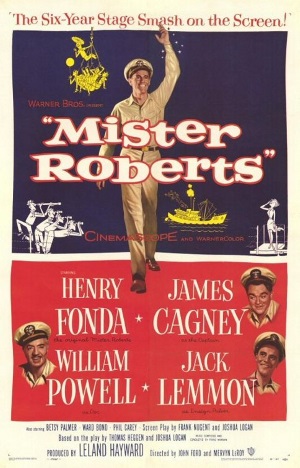
Fonda, Cagney, Powell, Lemon. What more could you ask for? Being a huge fan of all four actors, for me personally, Mister Roberts may be the greatest accumulation of actors ever; thus I will try my best to contain my inner fanboy. Not only do all four play interesting characters but they all share such interesting relationships between each other. Fonda and Cagney share a Bugs Bunny/ Yosemite Sam-like dynamic with Cagney being a frustrated old captain (possibly with a Napoleon complex) in a position of power but with no control over the taller Fonda stepping over everything he does.

Jack Lemon’s Ensign Pulver, on the other hand, hates the Captain but out of total shock, the captain likes the Ensign. I find this dynamic particular funny as I can relate to that situation of being admired by someone you dislike. However, I also relate to the character of Mister Roberts himself in his predicament of being stuck in a rut of which he is desperate to escape from; wanting to leave the navy cargo boat and be right in the action of the Second World War. The entire film effortlessly combines tragedy and comedy with no better example of this being the final scene itself in which the film transitions from the tragedy upon the characters discovering that Mr. Roberts has been killed in action to one more final pay off from a recurring gag; one of my favourite movie endings ever.

The claustrophobic intimacy of the ship, as well as the simply superb dialogue and performances, makes the dialogue-heavy scenes so engaging. Even with two directors on the project which could have spelled disaster, the film manages to come out perfectly fine rather than ending up like a Frankensteinian stitch up. The other scene which always stuck out to me was at the beginning of the film when the men are attempting to get a glimpse of women in a shower and going crazy as hell over it. Would men have the same reaction today because of the internet? Was the prospect of seeing a naked woman more thrilling back then?

Mister Roberts would be William Powell’s final film although one of Jack Lemon’s first, so I see the film as a passing of the torch between two generations of comedic actors. Originally Powell retired after appearing in How to Marry a Millionaire but decided to appear in Mister Roberts after reading the script. A much, much better choice of final film in which he shows that even in this stage of his career the man was still a master of words.

The Lady Eve (1941)

So Close, Yet So Far

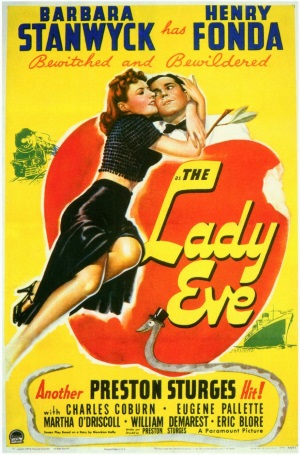
The Lady Eve is a conflicting film. The first hour is some of the most perfect romantic comedy I’ve ever seen, however, it falls apart around the one hour mark. However, what is it that makes the first hour so perfect? Firstly it didn’t take too long for me to realise that Henry Fonda and Barbara Stanwyck are one of the most flawless screen pairings ever, the perfect combination of sexy meets innocent. Watching these two I get the impression they must have been head over heels for each other. I’ve read that apparently Henry Fonda would later tell his wife he was still in love with Barbara Stanwyck, dam! But then again, after having your hair caressed by Stanwyck for 3 minutes and 51 seconds, who wouldn’t be?!

The Lady Eve is a prime example of a “How did they get away with that?!” movie. I’m not aware of what Stanwyck’s ideological or moral beliefs were but a number of her films are some of most sexually suggestive old Hollywood films I’ve seen. There’s her pre-code work such as Baby Face but in the postcode era, we have Ball of Fire, Double Indemnity and of course, The Lady Eve. Call me old-fashioned but movies were sexier when the actors kept their clothes on. Vilma Banky did more with one raised eyebrow than an entire (Warning! Problem in Sector 7G).

So where does it all go wrong, well about 50 minutes into The Lady Eve, the movie pulls my least favourite movie cliché of all time, “the liar revealed”. You know, when a character is exposed as a fraud causing a relationship to end, even though you know they’re going to get back together again by the end of the movie. Having this cliché is bad enough, however, I thought it was only a contrived modern invention but here it is in 1941. At least they don’t drag it out like any rubbish modern-day romantic comedy would.

I’ve found Preston Sturges’ films to be indiscipline, his films all have their moments of greatness but at times they delve into over the top absurdity, even by screwball comedy standards. During the later part of The Lady Eve it’s hard to buy into Stanwyck disguising herself as another woman who doesn’t look massively different from her previous self in order to win back Henry Fonda. Oh, and he buys into the charade, the dope! Part of me wished the entire movie could have just been the two of them on the boat and it would have been a perfect film, however the final third still has some hilarious moments, such as Eugene Pallette frantically banging the table demanding his breakfast, or Fonda getting his suit destroyed three times at a party, a perfectly timed slapstick gag if I’ve ever seen one.

On a second viewing of The Lady Eve, I still have the same reaction to the first hour but I did find myself more forgiving of the last third. With my love of screwball comedies and the pairing of Stanwyck and Fonda, perhaps with additional future viewings, I may become completely forgiving of the last half hour. The first hour is just that perfect.

Fedora (1978)

When the Pictures Became Small

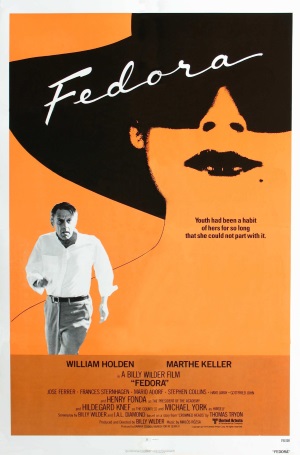
Fedora is one of the most bizarre films I’ve ever seen, to say the least. At points I’m almost laughing at the movie’s plot twist yet the more bizarre and highly improbable the movie became the more I found myself getting engaged in the story, waiting in eager anticipation to find out what will happen next with those oh so joyous “I did not see that coming” moments. The film’s highly implausible plot manages to draw the thin line between being completely absurd but never feeling like a parody.

The character of Fedora herself is a reclusive movie star who goes to extreme lengths in order to stay “on top” and retain her eternal youth to the point which even Norma Desmond would consider crazy. Early during the film, I suspected Greta Garbo to be the likely source of inspiration for the character of Fedora (whom Wilder always had great admiration for) but as the plot progressed I thought to myself “ok even Garbo was never this nuts”.

One of Fedora’s other intriguing aspects is the film’s critique of New Hollywood and how times have changed since Hollywood’s golden era came to pass. Fedora is the only film I’ve seen which displays a harsh attitude towards New Hollywood with lines referring to Hollywood being taken over by kids with beards who don’t need a script, just a handheld camera with a zoom lens as well as the demise of glamorous movie stars of the past. This is one of several aspects of Fedora which makes it similar to what you could call its spiritual cousin Sunset Boulevard; which itself commented upon what was lost when the silent era came to an end. I could go on making comparisons between the two films from William Holden playing a Hollywood hack in both films to Michael York’s role the in film being similar to the role Cecil B. Millie played in Sunset Boulevard.

I imagined by 1978 Wilder was far past his directing prime, not to mention after the 1950’s he seemed to become content with only directing comedies; thus I’m surprised to consider Fedora as one of his greatest films and a return to the roots of his earlier work as a director. As soon as William Holden’s narration begins you can instantly tell this is classic, old-school Billy Wilder.

Fail-Safe (1964)

Fail-Safe or Strangelove? That Is the Question

***This Review Contains Spoilers***

Fail-Safe is largely overshadowed by Stanley Kubrick’s Dr. Strangelove due to both movies being released in the same year. Both films deal with the events leading up to a nuclear strike although Fail-Safe takes a serious approach as opposed to the comedic nature of Dr. Strangelove. I much prefer Fail-Safe which I feel is a considerably more suspenseful film than Dr. Strangelove is a funny film. Fail-Safe examines in step by step detail what could potentially happen if a technical mishap gave pilots on a bomber the order to drop a nuclear bomb, in this case on the city of Moscow. The movie never explains what the technical mishaps was but the rest of the film examines in precise detail the actions which would be carried out if such a thing was too happen; primarily trying to stop the bombers and convincing the Soviets that the oncoming attack is accidental. Although the opening scene at the rodeo seems rather pretentious, Fail-Safe is a no-nonsense, straight to the point wordy drama. Like Sidney Lumet’s 12 Angry Men, Fail-Safe is a film driven by heart-pounding wordy exchanges.

Playing the President of The United States requires an actor with charisma and a commanding screen presence, no surprise that Henry Fonda pulls off the role with the greatest of ease. As a huge Henry Fonda fan, I do delight in seeing him as the most powerful man in the world. Along with James Stewart and Gary Cooper as actors who best embody the everyman, I feel this is one of the best roles of his career, representing the ideal American President (on the surface level at least) I’m sure many wish for (no political party is mentioned) as he tries to remain calm under the most extreme pressure.

Fonda spends almost the entire film in a small room only being accompanied by his Russian language translator Buck (Larry Hagman). This one aspect of the film did have questioning why the President isn’t surrounded by advisers and associates but this one liberty does create a sense of loneliness and claustrophobia with the film’s use of high contrast black and white cinematography also heightens the sense of fear and giving the film a great visual flair in one of the most visually stunning black & white films of the 1960s’s. Hagman’s performance itself is especially impressive as his character translates Russian to English as he listens to it being spoken, talking in a uniquely awkward manner in several sequences throughout the film, the first of which is a single, lengthy uncut shot.

The only other liberty I have to question in Fail-Safe is the failure of the wife of the bomber pilot O’Grady to tell him something only the two of them would know when speaking to him over the radio in an attempted to divert the bomber from destroying Moscow and convince them this isn’t an impression from Soviet spies – Could have at least been worth an attempt in order to avoid World War III.

Comedic actor Walter Matthau shows off his dramatic stripes as the cynical nuclear expert Professor Groeteschele, whom is more concerned with the political and economic aspects of nuclear warfare as opposed to the cost to human life. He is cold hearted and has no sentimental side to him and even gets pleasure making discussions of nuclear war into a piece of sick entertainment as seen at a house party during the beginning of the film. Later he makes very questionable recommendations in an attempt to have communism destroyed when the opportunity arises due to the technical mishap. His final worlds in Fail-Safe are a recommendation to prioritise recovering business records in New York City over the recovery of survivors and the dead as apparently, the economy depends on it. Whether or not this and other actions are justified, Groeteschele is a character who gives off bad vibes throughout the film and appears to enjoy his job a little too much.

The movie contains a disclaimer at the end that the US military has procedures in place to prevent the film’s events from occurring actually occurring but with a character like Matthau’s being a government adviser, I wonder what kind of statement the movie is making. The Congressman Mr. Raskob acts as the audience getaway character, perplexed and terrified of the technology he is being given a tour off at the war room of Strategic Air Command while the military personnel act in a confident manner to the improbability of anything going wrong. I doubt Fail-Safe is going to give any viewers a pro-nuclear mindset and will leave a chill down your spine. I feel nobody does thought-provoking and issue-based films (or issuetainment) as well as Sidney Lumet but none quite as terrifying as Fail-Safe.

The Cheyenne Social Club (1970)

Quit Badmouthing the House!

The Cheyenne Social Club sounds like a bad idea on a number of levels. For beginners it stars two elderly actors towards the end of their careers in a comedy about prostitution, not to mention Gene Kelly would be one of the last people I would expect to be directing a western. For a long time it remained a movie I doubt I would ever watch yet much to my surprise the film turned out not only to be perfectly dignified but also very funny and surprising endearing. The idea of Jimmy Stewart being the owner of a brothel and becoming a sugar daddy sounds wrong on paper yet somehow it manages to work. The Cheyenne Social Club paints an idealized version of a whore house in which the women are proud of their profession and worship their boss. The movie doesn’t shun prostitution and while propaganda might be a strong word I certainly got the impression the movie was voicing its support for the legalisation of prostitution.

Henry Fonda is by far the funniest thing in the film; a child in an adult’s body living out a completely carefree existence with Stewart being the straight man and the grown-up one of the two. Even as soon as the film begins Fonda babbles through the entire opening credits which according to the movie lasts for literally over a thousand miles which helps distract from how ordinarily plain the test in the opening credits are. The relationship between the two is incredibly endearing with one of my favourite moments of the film is the two of them innocently sleeping in the same bed together. It is also very amusing as Fonda just follows Stewart wherever he goes as he has nothing else to do with his time but also because he just likes his company. It’s evident through their own screen chemistry that the two where lifelong friends. The film’s other major highlight is Stewart and Fonda’s discussing of politics (Stewart being a Republican and Fonda a Democrat) mirroring their real-life personas and bringing to mind an occasion when their friendship was almost brought to an end when they got engaged in a fist fight over politics in 1947 (“I don’t like to dispute you John but didn’t you always vote democratic?, Well…that was when I didn’t know any better”) .

The Cheyenne Social Club is the third of three films James Stewart and Henry Fonda starred in together. The first two of which are among the weakest films I’ve seen from ether actor. Thankfully the third time was the charm; it took 35 years to get these two legendary actors in a great film together but it was worth the wait.

A Big Hand for the Little Lady (1966)

6 Angry Card Players

The opening of A Big Hand for the Little Lady has so much frantic build up, the scoping scenery shots as far as the eye can see with a grand western music score and for what? A game of poker; but rightfully so as this may be the best poker movie I’ll ever see. I don’t know how to play poker nor do I have any interest in cards, but it doesn’t stop me from being absorbed in this fascinating and inspired comedy.

Much humour is derived from Henry Fonda’s performance as a gambling addict who attempts to act naive and innocent in order to mask his addiction; resulting in the man becoming a ticking time bomb and the suspense which derives from watching this guy throwing his livelihood away. At one point in the film, however, it stops being entirely comic in which I start feeling sorry for how pathetic Fonda’s character has become; the effective quick switched between comedy and drama is superb. Backed by a cast of charismatic gents as they bicker and tell outlandish stories of what they abandoned in order to attend the game of poker and take the rules of poker so seriously, even when a man’s life is on the line. The only issue I would take with the film is the unnecessary remaining 10 minutes which drag along after the film’s plot has been resolved.

I’d love to see this concept of a poker game going out of control expanded upon and taken to new heights. Not a remake but the same concept in a different setting and perhaps a bit zanier, I would like to see. The sub-genre of the western comedy intrigues me. Westerns as a whole I find hit and miss but when presented in comedic form I have a much easier time caring about what’s happening on screen.

12 Angry Men (1957)

…and Justice for All

***This Review Contains Spoilers***

I don’t think I can bestow a higher statement of praise on a film than to call it a life-changing experience. 12 Angry Men influenced me not to believe everything I hear, instead to question things and ultimately turning me into a more skeptical person; there is more to life than meets the eye (or ear). It’s one of few films which helped shape who I am as a person.  When watching it I constantly visualise the details in my head of the events and locations of the murder case being described. At the beginning of the film, all the jurors bar one believe the boy in question is guilty of murdering his father. By the end of the film, they all change their vote to not guilty. How is this possible? Why just the most incredible 90-minute exhibition of human psychology and argumentation. I enjoy never knowing what really happened; did the kid commit murder or not? – It’s up for the viewer to decide. 12 Angry Men is a movie that is hard to write a review for; I wouldn’t be surprised if I come back to add more since I find myself watching 12 Angry Men at least once a year. With layer upon layer upon layer, this is a movie I could talk about hours, and always finding new aspects to discuss on each viewing. As the exposition reveals more details of the case I am left saying in the words of Milhouse Van Houten, “Tell me more!”. – Ah the pure joy of an engrossing, wordy, civil debate.

On every viewing of 12 Angry Men I find myself focusing on a different character. I’d have to watch the 12 times in order to fully explore every character, all representative of personalities we’re likely to encounter in real life’; I’m sure I’ve encountered each one at some point in my life. This is a movie that needed a cast comprised of character actors (aside from Henry Fonda) in order to create such distinct personalities – the characters are believable without being two-dimensional stereotypes. Not all of them leave prejudice at the door; it’s more obvious with some than others. Not all of them really take much interest in the case or have much pride being part of a jury and even treating it as a bit of a joke at times; even the judge at the beginning doesn’t to be very enthusiastic about the case at hand. They even display different levels of confidence and surety in their opinions – when every juror announces they have changed their mind you can see on their faces how difficult that admission is.

12 Angry Men provides possibly the best cinematic insight into group conflict and argumentation. Like with a jury or a classroom full of people, this large variety of personalities are unlikely to converge elsewhere in a small space for a period of time in which they have to communicate with each other, such as what John Hughes would explore with his teen detention drama in 1985 with The Breakfast Club. You really get a sense of who likes who and who doesn’t as the heat beats down in that claustrophobic space. Director Sidney Lumet made the cast spend time with each other before filming and it certainly helped. I don’t feel like I’m watching actors, I feel like I’m watching a group of everyday people in a jury. As not all US states at the time opened their doors to having womenpresent within juires; the film is not 12 Angry Men and Women. I imagine the feminine point of few would have influenced the examination of the proceedings; just think of Grace Kelly’s female instincts from Rear Window.

The cast:

Juror #1 (Martin Balsam):

The Jury Foreman. He doesn’t express any opinion or reasons for changing his vote, taking a neutral stance and moderates the proceedings.

Juror #2 (John Fiedler):

Nerdy and socially awkward; reminds me of Rick Moranis. I find it interesting that he is placed sitting beside Lee J. Cobb’s Juror #3 as the two are polar opposites. He finds it difficult to articulate an opinion at first but grows confidence and later stands up to the other jurors.

Juror #3 (Lee J. Cobb):

Lee J. Cobb is my favourite of the cast, in my view being the most interesting and complex character with the biggest ark as the opinionated and brash antagonist, Juror #3; ultimately stealing the show. He seems fair and rational at first until we gradually discover he wants to boy on trial found guilty for personal reasons. He is by far the most confrontational juror as he contests every single rebuttal thrown his way and never concedes a good point. This is a strategy that even leads him to shoot himself in the foot when he destroys his own argument by frantically stating “he was an old man, half the time he was confused, how could be positive about anything?” Juror #3’s breakdown at the end is a highlight in a film full of awe-inspiring performances. His angry outburst to Fonda that he’ll kill him followed by Fonda’s response of “You don’t really mean you’ll kill me, do you?”, is surely one of the greatest zingers in cinema history.

Juror #4 (E. G. Marshall):

A cold-hearted individual which is reflected by his wearing of a jacket throughout the whole 90 minutes despite the heat. He is a metaphorical representation of cold, hard facts. He is arguably the most competent and restrained debater and also a bit of a ‘know it all’ which makes it all the more interesting and satisfying when he changes his vote. Likewise, the movies and stars mentioned during his cross-examination by Juror #8 are not real (yes I looked them up)

Juror #5 (Jack Klugman):

Comes from a slum background although his appearance doesn’t suggest this. He even votes guilty on two occasions despite the boy on trail coming from his same background. His decision to change his vote could have been influenced by the accusation from Juror #3 (both still being a member of the guilty party at this point) that he had changed his vote due to sharing the same background the boy on trial, when in fact he hadn’t changed his vote.

Juror #6 (Edward Binns):

The most normal juror, doesn’t stand out – a very regular John Doe. He even states he’s not a “supposing man” and that his boss does all the supposing. He doesn’t have anything to add when asked for his opinion, just repeating points that have already been made in an unsure manner.

Juror #7 (Jack Warden):

Clearly doesn’t want to be there, doesn’t care about the case and even bullies and tries to intimidate other jurors. He has no respect for the grounds with his gum-chewing and litter throwing and although he never outright says he wants to leave and go to the ball game which he has tickets for, it’s painfully obvious from the beginning what his true intent is.

Juror #8/Davis (Henry Fonda):

The film’s protagonist and the outsider of the jury. A soft-spoken and rarely confrontational man who is brave enough to stand up to the collective and going against popular opinion, even when the rest of them get frustrated with him. Fonda like in many of his movies is a beacon of truth and justice here, but he doesn’t come off as unbelievable saintly – even with his wearing of a white suit. The scene in which he puts his knife in the table is a gasping moment if there ever was one.

Juror #9/McCardle (Joseph Sweeney):

The most elderly member of the jury. Juror #1 states he should be respected because of that, and I believe this is deserved because of his knowledge as well as his confidence in Juror #8.

Juror #10 (Ed Begley):

The most obviously bigoted member of the jury and thus ultimately doesn’t prove to be a huge help to the proceedings with talking out of turn multiple tie, his prejudiced rants or his hypocrisy in defending the woman’s statement despite her also being “one of them too”. At one point he even suggests telling a funny story he heard rather than discussing the case and eventually gets expelled from the table when his bigotry is denied an audience

Juror #11 (George Voskovec):

An Eastern European immigrant (possibly from behind the Iron Curtain) who takes more pride in the American justice system as well as democracy than any of the American members of the Jury, even defending it such as when Juror #10 demands that Juror #5 reveals his voting choice. Likewise, I love his statement to Juror #2 in response to what side he is on: “I don’t believe I have to be loyal to one side or the other, I’m simply asking questions”. Juror #11 is a watchmaker who regularly points out the time. Ah, I see what you did there movie!

Juror #12 (Robert Webber):

A huckster in the advertising business which makes sense as he himself has a very manufactured look. I get the impression he represents 1950’s conformity with his appearance, looking like a character from a Rock Hudson/Doris Day comedy with his very 50’s glasses and hair. He goes along with the crowd, even changing his vote more than once.

Is Jury Duty really this incredible in the real world? At the end of 12 Angry Men I wonder if the jurors are aware that they’ve just experienced probably the most incredible 90 minutes of their lives.