Singin’ in the Rain (1952)

That’s Entertainment!

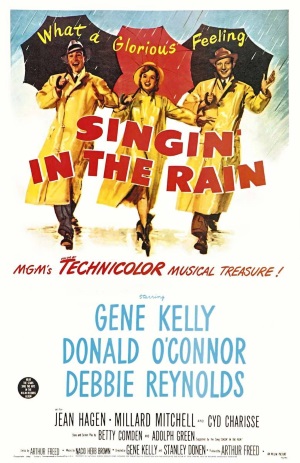
What is about Singin’ in the Rain that even the film elite hold it in such high regard and has even appeared on a previous Sight & Sound poll as one of the ten greatest films of all time, ranking among traditional highbrow films? Singin’ in the Rain is not just a great musical but also a film with a great story. It is not as harsh a critique on Hollywood as Sunset Boulevard but who would have still believed the content of fan magazines to be genuine after this film. Singin’ in the Rain has a cynical side as it pulls apart the Hollywood myth; beginning with Don Lockwood’s back-story as to how he rose to fame, which the movie comically shows us is full of crap. “Dignity, always dignity” but not if you want to make it to the top but at the end of the day  Singin’ in the Rain is a movie for movie lovers which celebrates Hollywood as much as it makes fun of it.

The film is set in 1927 albeit a very colourful 1927. In 1952 Technicolor films were in their final years of production and would soon become a thing of the past. The movie is a tribute to MGM producer and songwriter Arthur Freed – head of the MGM Freed unit – the producers of some of the greatest film musicals of all time. Although the days of the studio system where coming to an end in the early 1950’s as films from different studios started becoming homogenous and not containing unique aesthetics to each studio, the MGM musical still remained its own unique beast that no other studio could replicate. Likewise, the film studio in Singin’ in the Rain is a fictional studio and not MGM itself, I guess that would have been too much of a self-endorsement.

The soundtrack itself has entered the pop culture lexicon for good reason. I’ve had no shortage of listening to my CD soundtrack; glorious corn and camp topped with beautiful orchestrations, all of which never leaves your head and contributing to making Singin’ in the Rain one of the go-to anti-depressant films. Few other songs can lift my mood more than Moses Supposes or the film’s title number: could there be a greater expression of joy? After all, it is in the title; he is singing in the rain; turning the dreary rain into carefree joy, finding joy in despair. As for Make ‘em Laugh, even though it is a plagiarism of Cole Porter’s Be a Clown from The Pirate (1948), I considering Make ‘em Laugh is a superior rendition. There is also that disorienting fashion parade sequence which could be removed and have no effect on the plot but I do love me some 50’s fluff. But they do save the best for last in the form of the Broadway Melody Ballet. A number of MGM musicals had a lengthy ballet sequence, and to say they outdid themselves here would be an understatement as Gene Kelly dressed as Harold Lloyd with the go-getter attitude of the 1920’s celebrates a simple notion, “gotta dance!”. The visually asserting array of bright colours and impressionistic backgrounds is aided by Cyd Charisse; what a talent, what a figure!

Singin’ in the Rain presents a light-hearted and comical look at what actors and studios went through during the transition to sound. Few other scenes in cinema are as entertaining as Lina Lomant’s failure to understand sound recording technology. This scene not only showcases the problems with the technology in its early days by picking up unwanted sounds (complete also with the classic angry movie director) but it perfectly captures the relatable frustration that comes with filmmaking. I can tell you there is nothing more frustrating than out-of-sync sound. Likewise, the star’s difficulty in adapting to talkies and being laughed at by audiences parallel the legend of audiences being in howls of laughter as actor John Gilbert’s attempts to deliver dialogue on screen. Jean Hagan playing the dumb broad Lina Loment does a comedy act similar to Judy Holiday but in my view better than Holiday ever did. Donald O’Connor on the other hand surely isn’t human with his vaudeville-style act his facial and body movements and ability to walk up walls. Just name me a film with a more astounding display of talent. Here’s to you Singin’ In the Rain, I bow humbly to your cinematic and musical perfection.
Silk Stockings (1957)

In Soviet Russia, Stockings Wear You!

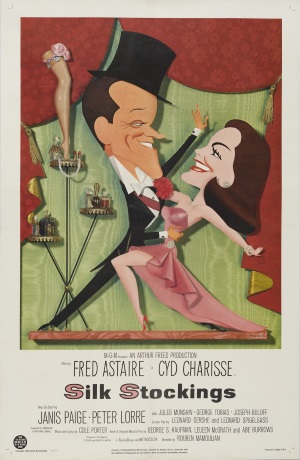
I’m rather disappointed with the latter era MGM musicals. High Society, Les Girls, Gigi; as one of the numbers in Gigi sums it up: “It’s a bore!” Silk Stockings is one of the better ones, not perfect but it shows this now increasingly outdated style of musical could still be glorious, despite their lack of economic viability from the rise of television. Whereas High Society came off to me as an unneeded remake of The Philadelphia Story, Silk Stockings manages to hold its own and not come off as a cheap remake Ninotchka, which was released prior to the cold war in 1939 (and not doing much good for American-Soviet relations). Silk Stockings was made right during the cold war and towards the end of the McCarthy years. It’s interesting seeing the story of love overcoming ideology retold from the cold war perspective in this critique of communism just like Ninotchka before it favours the gayety and decadence of the west to the rigid and gray world of the Soviet Union. While Silk Stockings may be moving denouncing communism it does paint a positive picture of Russian arts. The movie, however, is self-aware its propaganda, with the film being made within the film described as “The iron curtain dissolved by music” and Astaire gleefully proclaiming the film within a film as “what propaganda!”

The influence of the director Rouben Mamoulian is one of the aspects which helps elevate Silk Stockings. Mamoulian was one of the most innovative directors of the 1930’s, whose credits include the ground-breaking musicals Applause and Love Me Tonight. Although this was 1957 and his final film, he was an innovator of the genre and his handsome direction is apparent throughout the film. The musical numbers take full advantage of the Cinemascope frame, such as the number ‘We Can’t Go Back to Russia’ which features multiple people dancing at once in a long, unbroken shot. While Fred Astaire is dancing, Peter Lorre might be doing something amusing in the background. The dancing on display in the film is not Astaire’s most accomplished but is entertaining none the less. Mamoulian never worked with Ninotchka director Ernst Lubitsch, although Love Me Tonight did feature Lubitsch elements, as well as regular Lubitsch stars Maurice Chevalier and Jeanette MacDonald. Elements of the famous Lubitsch Touch are present throughout Silk Stockings; for example, when the Soviet commissar has just finished his first encounter with Ninotchka and is surprised to discover she is a woman, his secretary then bursts into the room to tell him this very fact, very much a Lubitsch inspired gag.

Cyd Charisse succeeds in holding her own, not merely doing an imitation of Greta Garbo; showing that she was an underrated actress as well as a great dancer. Plus it simply a pleasure seeing Fred Astaire and Cyd Charisse reunited again after The Band Wagon. Astaire could have conceivably played Melvyn Douglas’ role back in 1939 (I often wish the man could have done more non-musical comedic roles) so his casting does work; plus I’ve always championed Astaire’s for his unsung comic abilities. The casting of Peter Lorre as one of the three operatives is a brilliant decision, while Janis Page is also very entertaining as the uncultured actress Peggy Dayton.

The film’s selection of songs written by Cole Porter are very good. ‘Stereophonic Sound’ is a satire on the habits of moviegoers more concerned with a film’s technical aspects over the content of the film itself, while Cyd Charrise’s solo dance number captures the decadence of capitalism in the form of dance. The ‘Ritz Roll n’ Rock’ reflects the changing musical landscape from jazz to rock n’roll and appropriately so as this marked Astaire’s retirement from musicals, in the final number of the film dressed in his trademark top hat, white tie, and tails; what a send-off! Although my favourite number in the film is Astaire and Charisse dancing on a film set in ‘All You Dance’, simply beautiful. The big flaw I have with Silk Stockings, however, is the length; at the two hours the movie is too long and some trimming could have gone a long way. With thirty minutes chopped out, Silk Stockings could go from a good movie to a great one.

The Gay Divorcee (1934)

The Old English Definition of Gay

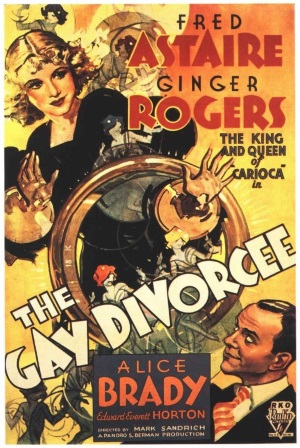
I had a period in which I was infatuated with the greatness that is Fred Astaire & Ginger Rodgers. Prior to this I often heard of them but I was occupied with later film musical of the 50’s. When I checked them out for myself I got it, oh boy did I get it. When together dancing or not, Fred and Ginger are in a world of their own and everyone else ceases to exist. Just look as Night & Day (my favourite Astaire and Rodger’s number), what could be more spellbinding? The Gay Divorcee is my favourite Astaire & Rodgers picture. This was their first film together as leads and yet a feel it gets everything right and I consider it a much better film than Top Hat which itself I find overrated.

I find the humour of The Gay Divorcee is more creative than that of Top Hat. Take the sequence in which Astaire finds Rodger in London by near impossible luck, then the two engage in a car chase into the countryside (how often do you get a car chase in a 30’s musical), and then in a wacky races type moment he goes ahead or Rodgers and gets road closed sign out of nowhere in order to stop her. Astaire’s stalker attitude could come off as creepy but he is charming enough to get away with it, making these moments morbidly funny. This whole sequence is so surreal and plays like a live-action cartoon as if the filmmakers are making fun of the film’s own highly improbably mistaken identity plot. This is much more clever than the handling of the mistaken identity plot in Top Hat. I don’t mean to completely undo Top Hat, I think it’s a good movie, just whatever Top Hat did I can’t help but feel The Gay Divorcee did much better. I’ve always championed Astaire’s unsung abilities as a comedian. His timing and line delivery is easily on par with the likes of Cary Grant; I wish he could have appeared in some non-musical comedies. Ginger Rodgers usually had a female companion throughout the series and I think Alice Brady is the best of them all with her histrionics; the sound of her voice alone cracks me up.

The Gay Divorcee may have slipped through the recently instated production code. If not then it certainly feels like a pre-code film, with sexual tension throughout and an air of scandalousness to the whole thing.

Fred and Ginger, they were gods!

It’s Always Fair Weather (1955)

Stormy Weather Ahead

It’s Always Fair Weather will go down in history as the film musical which “could have been”. Had it been made a few years earlier it could have been in the same leagues as Singin’ In the Rain and On the Town but several shortcomings, some determined by the period the film was made prevent it from being so. Even the studio had that little faith in it they dumped it as a second feature alongside Bad Day At Black Rock.

It’s Always Fair Weather differs from other musicals of its time in its sombre tone with the tale of three war buddies who are reunited ten years later to find out they can’t stand each other upon discovering one is a hick, a snob and a goon. This is juxtaposed to a world of beautiful, bright colours and welcome artificiality with urban sets to die for. It’s Always Fair Weather was originally conceived as a sequel to On the Town, reuniting Gene Kelly with co-stars Frank Sinatra and Jules Munshin. However, by 1955, Munshin no longer had box office credibility while Sinatra was too big a star that the studio was unwilling to work with him. In their place, we get Dan Dailey and Michael Kidd, both of whom get the job done but lack the same electric chemistry Kelly’s On the Town co-stars possessed. Frank Sinatra in particular I find is sorely missed as I loved his three-picture partnership with Kelly in which they made an excellent comedic duo. None the less the roaster does get a big boost with the casting of the great Cyd Charisse, whom like Ann Miller in On the Town, plays a glamorous woman with contradictory personality and an encyclopedic knowledge of well, pretty much any topic.

However, I find It’s Always Fair Weather’s biggest drawback are the sections of the film which are uneventful and doesn’t have the lightning-fast pace of On The Town or Singin’ In The Rain. The film could definitely benefit from the trimming or removal of whole scenes; there is a faster-paced, snappier film in here. The film does help make up for this though in its musical numbers. It’s Always Fair Weather does showcase some of the best moments of any MGM musical with the soundtrack being one of the best in the MGM catalogue. The musical numbers and compositions are fantastic and all written for the film itself by the great Betty Comden and Adolph Green, while the majority of MGM musicals took their songs from their back catalogue as well as other stage musicals.

The five-minute Gershwin like dance number “The Binge” showcases the then-new cinemascope format by having three dancers occupy their own third of the screen as they dance and create percussion with trash can lids on their feet as they work together in great physical tandem of drunken joy. Once Upon a Time, on the other hand, is a heart aching number if there was one as the three men sing about their broken dreams while Music is Better Than Words couldn’t be more enchanting if you asked for it. The centrepiece of the film, however, is Gene Kelly’s number ‘I Like Myself’, featuring him tap dancing on roller skates, no trickery! Like Singin’ In the Rain, the number is an encapsulation of pure happiness (just look at the faces of the onlooking extras). This is of my favourite musical numbers of all time and is an unbelievable display of talent if I ever saw it. The film’s only crime in the song and dance department is the lack of a dance number between Gene Kelly and Cyd Charisse, despite one actually being filmed.

I feel widescreen technology came too late the MGM musicals which could have used it to great advantage but by 1955 musicals had already lost most of their economic viability due to the rise of television. It’s Always Fair Weather is Hollywood coming to terms with the existence of its rival television but relishes the opportunity to satirize the format as superficial and ridden with advertising.

Carefree (1938)

Freud & Ginger

On my first viewing of Carefree, I experienced something I never thought I would with Fred and Ginger, boredom. Initially I was expecting another spectacular musical showcase, however, the film is on a smaller scale (their shortest at only 80 minutes) than their previous outings and only contains a mere four musical numbers; making it more of a comedy with some singing and dancing than a full-fledged musical. With several movies behind them following a similar formula, if they were going to make another then they had to do something different or things would have become stale. I wished though that Fred Astaire could have done straight comedies during his career; Carefree is the closest thing to that.

None of the musical numbers in Carefree stand out as being among the best in the series. Fred Astaire’s number in which he plays golf while tap dancing sounds better on paper than it does in execution. I’m sure what he’s doing is no easy task yet it doesn’t look all that impressive to watch. The Yam, on the other hand, is a pretty standard number, but heck, it’s still Fred and Ginger dancing. I find the film’s most interest musical number is ‘I Used to be Color Blind’, the most experimental in the film, shot in slow motion and allowing the viewer to see Fred and Ginger’s grace in every detail.

For the only time in the series, Astaire plays a character who is not a dancer by profession, but rather a psychiatrist (although they do make sure to mention he once had aspirations of becoming a dancer). I don’t completely buy Astaire as a psychiatrist, but realism is not what these movies are about. Plus I’m sure the psychology on display here is of the “you are getting sleepy” variety as seen in movies. He doesn’t break his professional ethics though by pursuing his patient like his stalkerish attitude towards Ginger in other films in the series, instead, she wants him.

Carefree belongs to Ginger, playing a character whom has been put under hypnosis, giving her the opportunity to completely goof around in a childlike manner with big wide eyes, and it’s pretty funny stuff. How many movies do you get to see Ginger Rogers wielding a shotgun? Everyone needs at least one movie where they get to act stupid. The comedic assets of Ralph Bellamy and Jack Carson are big benefits to the film’s witty dialogue, where much of the film’s strength lies. Even if the dance numbers don’t fully exceed, as a screwball comedy, Carefree grows on me, of course, I am a sucker for these movies and the Astaire/Rodgers name, so good enough for me!

The Blues Brothers (1980)

The Ultimate Comedy

To date, The Blues Brothers remains the only instance in which after watching a movie for the first time, I watched it again the very next day. Several viewings later I’ve come to the decision that The Blues Brothers is my favourite film comedy.

The Blues Brothers is some of the most fun you’ll ever have with a motion picture. Just one incredibly fun set piece after another whether a car chase, a musical number or comedic showcase. Choosing a favourite moment? Now that’s difficult. The portion of the film which has me in the most hysterical fit is the sequence at Bob’s Country Bunker. Having a blues band with two lead singers who are as urban as it gets at a redneck bar in which everyone thinks they’re the night’s country music act and everyone is oblivious to this pink elephant in the room has me laughing just thinking about it (not to mention quite a dig at country music), and what country song are they able to play to the crowd? Why the theme song to a TV show of all things. In regards to the film’s musical numbers, let’s just say I bought the two-disc movie soundtrack very soon after watching the film, which gave me a solid twelve months of continuous music listening pleasure.

The brothers Jake and Elwood epitomise coolness with their black suits, sunglasses and stoic nature. Yet despite the film’s protagonists being criminals, The Blues Brothers is a film of strong moral character. The film makes fun of the antiquated nature of Catholicism while still celebrating faith-based virtues which can transcend to the secular viewer. Jake and Elwood have to save the Catholic orphanage they grew up in but are forced to raise the money to do so by honest means and at the end of the day, they do get punished for their bad deeds. Also, I have to ask, do churches as fun as that portrayed in The Blues Brothers actually exist in real life?

What other movie which has more reverence for its location (the only other film which instantly pops into my mind is Rocky with Philadelphia). Right from the opening shots of the industrial landscape, the city of Chicago is gloriously captured. For the best moment in the movie which captures the grit and grime of the city of Chicago is the scene on Maxwell street with John Lee Hooker playing cut to shots of stalls selling music tapes and other artefacts; such a beautiful sequence

Then there’s the film’s final car chase. I haven’t seen every famous movie car chase but I would happily place a wager that there is no other car chase in the history of cinema better than this. I believe a truly great action sequence is one in which there’s a sense of danger that someone can get hurt or even killed. Here I’m not only fearing for the fictional characters but also the real-life cast and crew. The number of cars involved and carnage that ensues is unprecedented; Grand Theft Auto years before Grant Theft Auto existed. With so many action movies featuring gargantuan levels destruction which means nothing and has no impact, they should take note from The Blues Brothers on how to make action sequences in which you can actually feel the weight and heft of everything from the screech of every tire to the sirens of every police car whizzing past the screen.

The lack of logic in The Blues Brothers only adds to its enjoyment. For example, the very obvious plot hole in which The Good Ole Boys arrive hours late at the country bar with no explanation would likely downgrade most movies; here it just enhances the surreal world inhabited by the Blues Brothers. My favourite illogical moment is the Illinois Nazi’s demise on the unfinished freeway; it makes no sense in the most wonderful way. The 80’s was pretty much the decade for epic, large-scale comedies such as The Blues Brothers. Only then could a film like this even get made.

The Band Wagon (1953)

Fred Astaire 1953!

The Band Wagon is the film Fred Astaire’s career was culminating to: his best film in my view. Like Ninotchka with Greta Garbo or A Star Is Born with Judy Garland, this was the role he was born to play; one catered to his on-screen persona. Fred Astaire is Tony Hunter! An ageing hoofer who no longer is the star he once was. The Band Wagon contains little references to Astaire’s past: from Bill Bojangles Robinson to the opening credits feature an image of a top hat and cane, to the mentioning of a fictional movie “Swinging Down to Panama” perhaps a reference to Swing Time and Flying Down to Rio (although I do wish there could have been a little reference to Ginger Rogers herself in there).

The Band Wagon provides Astaire with some of the best musical numbers of his career. However, the film also allows him to showcase other avenues of his talent, such as his outburst scene over his dissatisfaction over rehearsals – a fine example of the acting prowess he possessed. While Ginger Rogers is obviously Astaire’s greatest partner Cyd Charisse is his most accomplished; could there be a more graceful figure?

Was I gullible that when I first watched The Band Wagon that the movie manipulated me into thinking the pretentious and egotistical stage director Jeffrey Cordova’s (Jack Buchanan) idea of a musical inspired by the Faust legend was a good idea? This isn’t the same old backstage musical plot; The Band Wagon is a thinking person’s musical. Likewise, Charisse’s Gabrielle Gerard has a mature subplot of her own involving her trying to deal with her dominating boyfriend and her feeling towards Tony; giving the film that extra mature edge.

Not only is there a great story, but there is also great comedy with a cast gels so well together. Oscar Levant and Nanette Fabray as a bickering couple and their hysterical fanboy reactions to meeting Tony Hunter, to Jack Buchanan’s over the top histrionics and his terrible ideas for a stage musical. My favourite moment in comedy in The Bandwagon is the scene in which Jeffrey Cordova manipulates Gabrielle’s boyfriend from being dead set against allowing her to be cast in his stage production to then begging him to allow her to be in the show. It’s like a Bugs Bunny-Yosemite Sam type moment but on a much more subtle level and made even more impressive by occurring in an uncut shot. Likewise, the sets in The Band Wagon have an astounding level of detail that scenes near the beginning of the film taking place on the street had me wondering where they sets or real-world locations.

Up until The Band Wagon, it was uncommon for a film musical to have a soundtrack entirely composed for it rather than having songs and compositions taken from other sources; which makes it all the more impressive that the entire soundtrack to The Bandwagon is superb. If I was to choose my three favourite musical numbers of all time, in terms of epic scope they would be The Broadway Melody Ballet from Singin’ In the Rain, The Lullaby of Broadway from Gold Diggers of 1935 and The Girl Hunt Ballet from The Band Wagon in all its 13-minute glory. Here noir meets musical, with Astaire at his most badass. His line delivery could be in an actual crime film itself, plus it inspired the music video for Michael Jackson’s Smooth Criminal. There’s also the Shine on Your Shoes number, one which I could watch again and again just to look at all those gizmos in the background and the genuine reactions on people’s faces at seeing Fred Astaire dance; while That’s Entertainment has become a semi-official anthem for Hollywood. Oh and there’s the Triplets number; one of the weirdest musical numbers ever filmed and they’re actually dancing on their knees!

The early to mid-1950’s where a phenomenal period for the musical genre. Hollywood produced some of its finest musicals in these years before television brought this era of film musicals to an end. Films like The Band Wagon elevated the genre to new heights. A Fred Astaire musical which has everything and more!

Anchors Aweigh (1945)

Join the Navy!

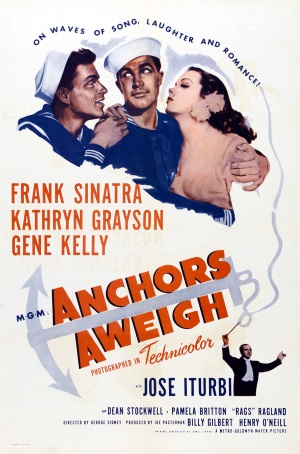
Anchors Aweigh is the first film of the Frank Sinatra-Gene Kelly trilogy, tapping into the odd fascination the classic Hollywood musical had with sailors. It wouldn’t be the last time Kelly or Sinatra would play a sailor and what an underrated comedic duo they are. Gene Kelly is so loveably egocentric, constantly lying about his exploits with dames and rubbing the fact that he got ship leave in his comrades’ faces, so much so that he sings a musical number about it – the interactions he shares with Sinatra are priceless. If the accounts are to be believed, reportedly Kelly was known in real life for being a control freak and getting his own way, so I wonder how much of his personality is reflective in this performance. Frank Sinatra is largely the opposite of Kelly, girl shy and completely gawky, a stark contrast to what he later became; he sure toughened up over time.

Anchors Aweigh came around the beginning of a new era of film musicals, at a time when the genre became almost exclusively one filmed in colour and as the distinctive style of the MGM musical took off, separating them from the likes of the Astaire & Rodgers musicals of the past. Unlike Fred Astaire, Gene Kelly was “off the people”, usually playing commoners on screen. Fred Astaire did play a sailor in Follow the Fleet but no doubt Gene Kelly suits the role better. Perhaps the film’s greatest highlight is Gene Kelly dancing with Jerry of Tom & Jerry fame. It might not be as technically advanced or as smoothly animated as later live-action/animation hybrids but it’s one of the most awe-inspiring (the animators even make note to include Jerry’s reflection on the floor). The studio originally wanted Disney to allow them use of Mickey Mouse for the number, which seems very hard to believe. The film’s inclusion of some very Disney-looking animated creatures, including two which look suspiciously like Bambi and Thumper, suggests the studio was serious about including Mickey.

The other unique aspect of Anchors Aweigh is the documentary-like look at MGM studios circa 1945 during one portion of the film. A peek inside the dream factory itself, with people in costume, props everywhere and what look like studio workers in suits going about their business. It’s unabashed self-promotion but hey, it’s one entertaining commercial. This use of on-location filming including the scenes as the Hollywood Bowl show shades of what was come several years later in On the Town. I do wish they though could have shown some more of 1945 Hollywood but the sets present in Anchors Aweigh are something to marvel at. Even with the odd background which is clearly two painted backdrops placed side by side with a dividing line clearly visible, the sets create a cartoon-like Technicolor world that you wish real life could look like; just look at that set of the Spanish part of town; such artificial beauty.

The only downside to Anchors Aweigh which prevents it from being a greater film is the runtime and much of this is largely due to the amount of which is spent in the house of Kathryn Grayson’s character; I really started to get sick of the sight of it, especially since the movie takes place in Hollywood and there are places so much more interesting they could be. The characters keep returning to the house several times throughout the movie, which wouldn’t be such a problem if it wasn’t for the large chunk of time that was spent there when they first arrived at it – by far the most frustrating aspect of the film. Thankfully the good outweighs the bad and the good isn’t just good, it’s amazingly good. There’s really no dud musical number present, they’re all so very, very beautiful.