Hot Jungle Sex
***This Review Contains Spoilers***
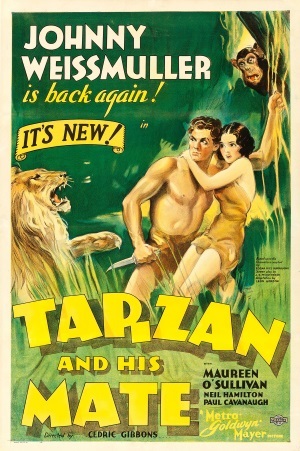
Tarzan and His Mate more than compensates for the shortcomings of the first Johnny Weissmuller Tarzan film of which the production values where a mixed bag. Tarzan and His Mate has less reliance on stock footage and rear projection with its use of matte paintings and a large amount of animals on set to recreate deepest darkest Africa in the only film directed by Cedric Gibbons, otherwise famous as an art designer for MGM. I just wish we could do without the men in not so convincing gorilla outfits, especially since the cast appears on screen with real apes (Planet Of The Apes was still 34 years off).

Pre-code cinema doesn’t get any sexier or revealing than Tarzan and His Mate, notably with its use of full-frontal nudity despite having a modern-day PG rating in the UK. During the early portion of the film, topless African natives can be seen in the background but in one of the film’s most memorable scenes, Tarzan and Jane going for a swim in which Jane goes full commando. The underwater scene was filmed in three different versions to comply with the individual censorship laws of different US states. Maureen O’Sullivan does not appear as Jane during the swimming sequence, rather she is doubled by Josephine McKim, a member of the 1928 and 1932 U.S. Women’s Olympic Swim Teams. O’Sullivan does nonetheless wear one of the screen’s most revealing costumes of the time, a halter-top and a loincloth that left her thighs and hips exposed. Needless to say, this two-piece costume did not make its way to the post-code Tarzan films. Jane sleeps in the nude and is constantly touched by Tarzan, even just watching the two of them interact while alone, there is such sexual tension portrayed on screen (we are even treated to the Austin Powers style silhouette in the tent of a woman getting undressed).

Tarzan and Jane do refer to themselves as a married couple in Tarzan and His Mate (“Never forget, I love you.” “Love who?” Jane prompts…”Love my wife”), however at this point in their relationship it is unlikely Jane and Tarzan are technically married in the eyes of the law since a justice of the peace isn’t likely to be found in the jungle. Rather you could say Jane considers Tarzan her husband because they have lived together and slept together for a long time by now, married virtually, synonymously and spiritually – a true marriage in the law of love and the jungle. Likewise, the scene at Jane’s father’s burial site, Jane takes the chain of his timepiece and puts it around Tarzan’s wrist and says “always” in which Tarzan repeats “always”. The morning after they repeat this vow, which one could interpret as a short and sweet jungle wedding – therefore monocles can remain firmly in place over the prospect of an unmarried couple living and sleeping together.

The mighty figure of a man that is Johnny Weissmuller – he is Tarzan! His short lines of limited, broken English are highly quotable (“Martin My Friend”), while he also provides moments of humour as the feral man reacts with bemusement at the ways of the civilized world such as curiously inspecting a record player like a cat, as well as inspecting Jane’s dress and stockings from Paris. It’s Jane who has to do the talking on behalf of the couple (and even performs the famous Tarzan yell herself). The pure romantic escapism of Tarzan And His Mate comes from watching these two being deeply in love and having the time of their lives in the wilderness of the jungle. The character of Jane is brilliantly summarized in a single line – “A woman who’s learned the abandon of a savage, yet she’d be at home in Mayfair”.

It’s easy to feel sympathy for Jane’s old friend (and not so secret lover) Harry (Neil Hamilton) over his love for Jane as he nostalgically reminisces with her about old times back in England (“Those June nights in England, Murray’s Club in Maidenhead, moonlight on the Thames”). Alternatively, Paul Cavanagh as the villainous, womanising Martin Arlington has a touch of Basil Rathbone to him (expecting him at any point to literally twirl his moustache) while Nathan Curry is a striking screen presence as Saidi, the only native whose life is not expendable and even gets to go out in a moment of heroism. That can’t be said for the rest of the safari runners including one who is shot for his cowardice. Yet, its attacks from uncivilized tribes which prove to be their biggest threat, making Tarzan And His Mate one of the more graphic films of the pre-code era (including one particularly gruesome shot of a man having been impaled in the forehead).

I find it difficult to determine if Tarzan And His Mate is an early example of a film with an environmental/conservationist message? The film shows Tarzan has an almost supernatural connection to the non-predatory/ non-carnivorous animals of the jungle, whereas he fights predators such as lions and crocodiles throughout the picture. In particular, Tarzan has the ability to rally up herds of elephants in order to prevent the safari hunters from removing ivory from an elephant graveyard (there is no such thing as an elephant graveyard but the appearance of one in the film with its litany of skeletons is no less eerie). Is the film trying to promote a message or is it just a reflection of Tarzan’s personal feelings over the elephant graveyard being a sacred ground for the creatures and not to be disturbed or violated? Likewise, Tarzan and His Mate was reportedly banned in Germany by the National Socialist Party on the grounds that it showed a nordic man in primitive surroundings, which I do find odd since I could imagine them using Tarzan as a promotion of Aryan supremacy. Then again perhaps part of their motivation to ban the movie was based on the fact that Tarzan is played by a man whose surname is Weissmuller.

