It’s a Wonderful World (1939)

It’s a Wonderful Life…I Mean World

The first 10 minutes of It’s a Wonderful World is just rather dull set up for an incomprehensible murder mystery, but when Stewart becomes a fugitive on the run trying to prove his innocence and Claudette Colbert enters the picture it’s all smooth sailing even with the largely impossible to understand plot.

James Stewart is Guy Johnson, a hardboiled detective who often has a cigarette hanging at the end of his mouth like he’s Phillip Marlow. The role is a very different change of pace for Stewart but he pulls it off showing he could have easily slipped into a noir/detective thriller. Stewart even channels Clark Gable at times; with even the way he talks to a dog shouting at it to go away is very Gable-like. On top of that, at one point he admits to Colbert’s character that he thinks “all dames are dumb and all men ain’t” and how she has changed his philosophy on women; don’t tell the feminists. I also have to ask does this movie contain Stewart’s only ever blackface moment in a film? So yes, the on-screen personification of a boy scout is now literally poking fun at boy scouts and even tying them up. Claudette Colbert, on the other hand, plays an overly trusting eccentric poet who states throughout the film, “I swear by my eyes”. What does that even mean?

It’s a Wonderful World offers a genre mix of screwball comedy, murder mystery and even some elements of Hitchcock with the plot of a fugitive on the run to prove his innocence. Likewise, many of the solutions’ the character’s use throughout the film feel like they could be used in a Hitchcock movie such as Colbert lighting the newspaper on fire to escape from the car. No surprise that the film’s co-writer Ben Hecht would be a future Hitchcock writer.

Libeled Lady (1936)

The Front Page

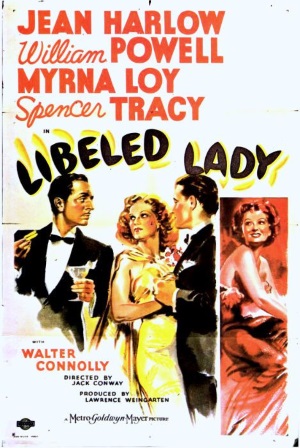
The opening credits of Libeled Lady are not your typical list of screen names, instead we get footage of the four main stars walking arm in arm very happily as their names come on screen one by one. Four heavyweights in roles which play to their strengths, giving some of the best dialogue the screwball comedy has to offer. Libeled Lady is my favourite newspaper comedy, a world in which journalistic ethics are nonexistent and people struggle to make relationships and careers in journalism mix. Warren Haggerty (Spencer Tracy) is so preoccupied with his job as the managing editor of a paper he has missed his own wedding several times, so no surprise Jean Harlow gives a very comically angry performance throughout most of the film.

William Powell’s Bill Chandler has such cool and confidence, he even draws his own contract which will bring him back to the paper he was sacked from as he knows Warren Haggerty will come looking for him following a scandal. Powell gets the chance to show the full range of his comic abilities, not only as a master of words but also gets showcase slapstick comedy similar in vain to Buster Keaton or Charlie Chaplin during the film’s fishing scene. The subplot of Bill Chandler learning to fish would be the basis of Howard Hawk’s comedy Mans’ Favorite Sport?. Despite how incredibly fast he picks up the ability to fish like an expert it doesn’t feel contrived.

A portion of the story is spent trying to find William Powell with telephone, telegraph, and radio as their means of communication. Outdated aspects like in old movies always intrigues me and makes me ponder if stories like this could be told today. With the internet and other modern communication devices, they could have been able to recall those newspapers at the start of the film. Likewise, publications today are no less obsessed with covering the escapades of socialites and people famous for being famous; but Connie Allenbury (Myrna Loy) is not a typical socialite. She is down to Earth, has an image distorted by the media and can even outwit the paper. It’s appropriate this role would be played by Myrna Loy; the so-called only good girl in Hollywood.

The Philadelphia Story (1940)

Another Philadelphia Experiment

***This Review Contains Spoilers***

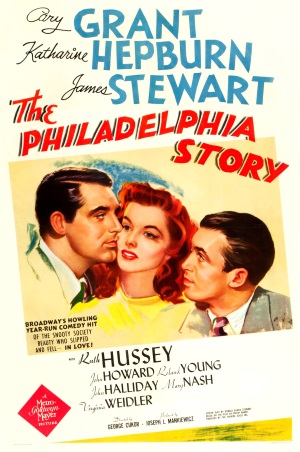
At the beginning of The Philadelphia Story, Cary Grant pushes Katharine Hepburn to the ground by putting his hand in her face. With any other actor this would be a vile act against a woman but because it’s Cary Grant, it works and thus showing the power of these three acting titans, Hepburn, Grant and Stewart. The Philadelphia Story gives an insight into the lives of the rich and famous, something which would be harder to pull off in later decades not to come off as a metaphorical dick waving display of wealth. I do find myself trying to figure out why this is? Could it be the incredibly high standards of writing and filmmaking craft on display here and the love of these performers; even more so when compared to the poor standard of romantic comedies today?

Tracy Lord (Katharine Hepburn) is not a ditzy socialite. In this role written for Hepburn it’s clear that she is a symbol of first wave feminism; wearing pants and an emasculating suit and being an influence on her younger tomboy sister but more importantly, it’s not to be undermined the complex characterisation of Tracy Lord. Like in Holiday, Grant and Hepburn share some very poignant and hard to decipher dialogue in which he tells her about her standing as a goddess and her lack of human frailty. Despite her ego, she claims in a sincere manner “I don’t want to be worshipped, I want to be loved”. Under the surface of the usual Cary Grant charm and elegance, C.K. Dexter Haven is one the darker characters Grant ever played. Apparently he “socked” Tracy on occasions, destroyed the cameras of multiple photographers on a boat and is a recovering alcoholic. This is Cary Grant at his most conniving with no remorse and enjoying it, displaying the darkly comic side of The Philadelphia Story.

However, this is Stewart and Hepburn’s film. Macaulay Connor is the moral, do-gooder James Stewart is known for (at least at the beginning that is); objecting to having been given the assignment of snooping in on the wedding of a Philadelphia socialite, as opposed to something with more journalistic integrity. He is appalled by the rich and their lifestyle but unlike Jefferson Smith he throws this out the window when he falls in love with Tracy; a piece of subtle cynicism on the movie’s part? I also really appreciate the relationship he shares with his work partner Liz Imbrie (Ruth Hussey). Her character is very cynical throughout most of the film but later reveals her more idealist side. She shares a platonic friendship with Macaulay but there are hints they have deeper feelings for each other. Virginia Weidler, on the other hand, is a real scene stealer. Just look at her speaking French in an overdramatic manner then singing Lydia the Tattooed Lady by the piano; a pointless scene but funny.

I can’t call The Philadelphia Story a predictable movie as I couldn’t see where the story was going at the end. I could have sworn she would end up with Jimmy but at the last minute and totally out of nowhere she goes with Cary and with it coming off as contrived. Likewise, a drunken Stewart carrying Hepburn in his arms while singing Somewhere Over the Rainbow is surely one of the greatest things ever caught on celluloid.

Sex and the Single Girl (1964)

Natalie & Tony & Henry & Lauren

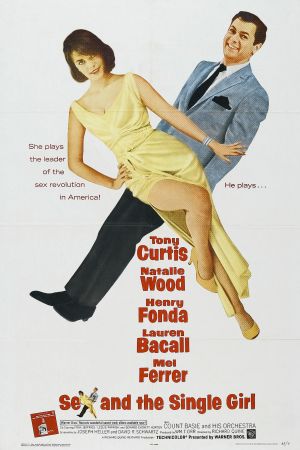
A mainstream movie with sex in the title, even pre-code didn’t do that. I could only find two films which precede Sex and the Single Girl; Sex (1920) and The Opposite Sex (1956). Although I imagine after this a movie having with “Sex” in a movie’s title wasn’t such a big deal but here they sure take advantage of it with the animated opening which puts a lot of emphasis on the word ‘SEX’ in big capital letters. Perhaps the movie may have something interesting to say on its subject with Natalie Wood playing a psychologist who is a 23 old virgin (which characters in the film viewed as a compliment) or something about sleazy journalism but the movie becomes too dull to bother deciphering.

From what I’ve seen I get the impression that Richard Quine is a lousy director. He’s done a number of movies with great casts and interesting premises but are let down by flat, uninspired direction. The opening scene of Sex and the Single Girl is a gem with 1930’s comedy actor Edward Everett Horton giving a speech on how proud he is of his publication becoming “the filthy rag it is today”. Sadly it goes downhill from there. Even with the movie’s madcap finale, it is hard to care what’s going on.

Henry Fonda was ashamed of this movie stating in an interview that he agreed to star in the film as a comprise to do a box office picture so he could indulge in doing movies which interested him such as 12 Angry Men and The Ox-Bow Incident. There are worse movies you can do but why did he hate it so much? I doubt he would have an issue with appearing in a sex comedy as he himself starred in the sexually charged comedy The Lady Eve years earlier or is it because of the movie’s sleaze factor? Who knows…

Although I would be lying if I didn’t say I still got some superficial enjoyment out of the film. I am a sucker for the 60’s aesthetic with the bright, colourful sets (the stocking factory is very amusing) and the cool, breezy music by Neal Hefti. Likewise, I do like the contrast between two generations present between Tony Curtis & Natalie Wood and Henry Fonda & Lauren Bacall. Sex and the Single Girl could have been a neo-screwball gem. In the end, it’s a movie which looks appealing from the outside but is hollow on the inside.

Man’s Favorite Sport? (1964)

Can You Smell What the Rock Is Cooking?

Man’s Favorite Sport? would have to be my favourite neo-screwball comedy (does such a term already exist or can I claim to have invented it?), and perhaps the last screwball directed by one of the original masters of the genre, Howard Hawks.

The factor which by far most surprised me in Man’s Favorite Sport? was Rock Hudson. My previous encounters with the actor left me unimpressed, leaving me to classify him as one of classic Hollywood’s duller leading men. However, the fact that I not only enjoyed his performance in this film but found him hysterically funny was such a shock that I was demanding answers. Did Hudson acting abilities improve by 1964? Is he better than comedy than drama or had he just grown on me? It just goes to show that there are very few classic Hollywood stars who can’t impress me in at least some small way or another, even if my previous impression of them were not very good. Paula Prentiss is also entering my books as a one-hit wonder actress; I’ve yet to see her in another film in which she is as joyous and energetic as this with that comically imposing voice of hers. Being a semi-remake of Hawk’s Bringing Up Baby, the two leads could have just done impressions of Cary Grant and Katharine Hepburn but the avoid doing so and make the roles their own but like Grant and Hepburn their chemistry is on fire.

This movie exemplifies in the early to mid-1960’s aesthetic with its fashion, the cars and overall appearance showcasing the final days of old Hollywood glamour. I want to know who the set designer in this film was; the revolving bar alone has to be one of the most unabashedly 60’s sets ever. Even the less “out there” sets such an office, or a fishing shop, have a certain beauty to them. The film’s colorful visuals help give it the appearance of a live action cartoon, partly due to the fact that many of the outdoor scenes take place on obviously fake sets but then again isn’t a live-action cartoon one of the definitions of screwball comedy. I also don’t normally go for those cheesy opening credit songs from the 50’s and 60’s often sang by the likes of Doris Day but this one is dam catchy.

Unlike the manic intensity of its sister film Bringing Up Baby, Man’s Favorite Sport? is surprising a very relaxing film to watch, aided by lakeside resort setting and Henry Mancini’s music score, which is so mellow. I just love the juvenile innocence of the gags present in this film, such as a bear riding on a motorcycle to many variations of William Powell’s fishing scene from Libeled Lady. Likewise, the common screwball comedy theme of crises of masculinity permeates the film. Hudson’s Rodger Willoughby (a name which feels straight from a 1930’s comedy) is an icon of masculinity from writing books about fishing, yet he is secretly a phony who has never fished in his life and completely fails at his attempts at his attempts at outdoor living while being made the foil of two hyperactive women. Man’s Favorite Sport? shows by the 60’s it was still possible to make these kinds of movies with the same velocity they had back in the 30’s.

The Devil and Miss Jones (1941)

Me and Miss Jones

The Devil and Miss Jones may be the best Frank Capra film he didn’t make and one of the last depression era comedies making it one of the last of its kind – a screwball comedy dealing with the conflict between social classes. The film presents a fascinating and shocking look at the treatment of workers in a department store during the final days of the depression, themes which would become obsolete with the US entry to the war.

The owner of the department store is J.P. Merrick (Charles Coburn). With this character, the movie shows the rich aren’t all bad people at heart. They’re just cut off from common people and their reality, unaware of the common man’s struggle and surround by advisors who think they know what’s best. Heck, J.P. doesn’t even remember what stores he owns! He brings himself down to his employee’s level by going undercover as a store worker in order to identify those who are trying to form a union. J.P. has the advantage that no one in the public knows what he looks like as his picture hasn’t appeared in a newspaper for 20 years, also no internet in 1941 would also be an advantage.

I don’t how if the treatment of the workers is realistic or exaggerated; just how relevant is this movie today? In one scene a store supervisor criticises a new worker (unaware it’s the store’s owner going undercover) in a bullying nature for their poor intelligence level test score. In another scene the department store addresses their workers at the end of the day as they stand in unison like a military dictatorship, threatening to fire anyone and preventing them from working in any department store in the city if they speak out against the company or associate with anyone who does. Next to many of the workers have a secret union meeting on top of a building, like a band of rebels coming together to take down an oppressive regime. The leader of the cause played by Robert Cummings states the company is letting employees go after 15 years when their salary is higher than a new employee and that they expect a quarter lifetime of loyalty to the one employer. At one point Jean Arthur even speaks during one emotionally rousing speech about how working “25 years for only two employers” as unacceptable –  I know those days have certainly passed us. The art deco department store itself is a beauty and offers a nostalgic look at the days before automation, when people had to be employed to do every task without the aid of computers.

Robert Cumming’s character is an activist rallying against the establishment; the type of person who would protect his country against its government. The type of character you don’t see often in classic films and likely would have been labelled a communist during the McCarthy era. In one pivotal scene at a police station he takes on abusive, power hungry cops and escaping charges by reciting the Constitution and then the Declaration of Independence at lightning fast speed to remind the officers of their rights; a real badass. A scene like this just goes to show you how people are unaware of their rights.

Jean Arthur and Charles Coburn are a superb and unconventional pairing. Yet you get two great romance plots for the price of one – old love and young love; Charles Coburn & Spring Byington and Jean Arthur and Robert Cummings. Like Frank Capra’s works, The Devil and Miss Jones is full of incredibly intimate, powerfully sentimental moments as two characters talk to each other as the rest of the world ceases to exist, such as the beach scene with Arthur and Cummings or the moment on the train with Coburn and Byington are all incredibly moving. Yet the intimate moment which strikes me the most is Arthur and Coburn’s discussion on love. Jean Arthur’s monologue on love feels so true; stating that two people can look at each other and see something way deep inside that no one else can see and distances her love from that seen in movies of love songs. She doesn’t think herself or her boyfriend are the greatest people in the world, yet doesn’t know if she’d care to live or die if she would never see him again. When this moment begins the sound effects of people talking in the background becomes increasingly faint and then loud again as other people enter the scene – it’s perfect. In terms of just pure comedy, just look the scene in which Jean Arthur dives across the table; an explosion screwball comedy in its purest form.

The More The Merrier (1943)

Three’s a Crowd

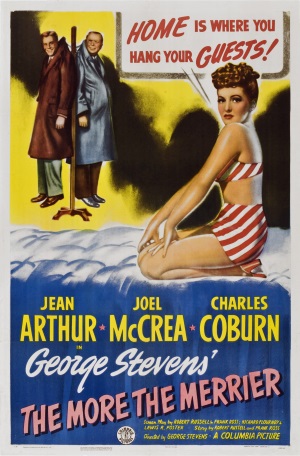
The More The Merrier represents the screwball genre adapting for the war years however this was at the end of the genre’s original run. I wonder why there were not more screwball comedies made during the war period? Did people become more cynical with the war or perhaps the genre was simply made for the depression era. Instead of taking on the establishment like the genre screwball did during the depression, The More The Merrier is supporting it. It is refreshing to see a propaganda film from the war years which is less gloomy and shows how common folk got on with their daily lives during the war.

My main flaw with The More The Merrier is Joel McCrea. He’s fine but that’s the problem, he’s only just fine; a serviceable actor who doesn’t leave a great impression. He’s the weak spot of a trio of characters who could have been much stronger with a more charismatic actor. Granted this was during the war and most of Hollywood’s big male leads were off in Europe kicking Hitler’s ass. Could Cary Grant have played the role instead, but perhaps a big star like that couldn’t play a role in he doesn’t show up until half an hour in. The trio of characters still manages to be fun with Jean Arthur playing the straight man and Charles Coburn as an immature and conniving old man who still seems like a kid at heart; while the romance between Arthur and MrCrea is still believable and handled very well as they spend the final third of the film quietly denying their feelings for each other.

Jean Arthur and Charles Coburn are one of the more unconventional screen pairings in Hollywood starring in three films together, just look at the morning schedule scene; comic choreographed brilliance and by far my favourite part of the film. When McCrea enters the picture though I feel it is never as strong. Also after you watch this movie you may find yourself saying “dam the torpedoes, full speed ahead!”, a lot.

The Gay Divorcee (1934)

The Old English Definition of Gay

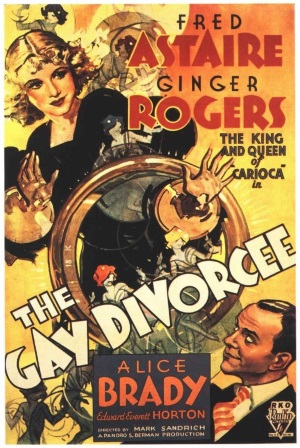
I had a period in which I was infatuated with the greatness that is Fred Astaire & Ginger Rodgers. Prior to this I often heard of them but I was occupied with later film musical of the 50’s. When I checked them out for myself I got it, oh boy did I get it. When together dancing or not, Fred and Ginger are in a world of their own and everyone else ceases to exist. Just look as Night & Day (my favourite Astaire and Rodger’s number), what could be more spellbinding? The Gay Divorcee is my favourite Astaire & Rodgers picture. This was their first film together as leads and yet a feel it gets everything right and I consider it a much better film than Top Hat which itself I find overrated.

I find the humour of The Gay Divorcee is more creative than that of Top Hat. Take the sequence in which Astaire finds Rodger in London by near impossible luck, then the two engage in a car chase into the countryside (how often do you get a car chase in a 30’s musical), and then in a wacky races type moment he goes ahead or Rodgers and gets road closed sign out of nowhere in order to stop her. Astaire’s stalker attitude could come off as creepy but he is charming enough to get away with it, making these moments morbidly funny. This whole sequence is so surreal and plays like a live-action cartoon as if the filmmakers are making fun of the film’s own highly improbably mistaken identity plot. This is much more clever than the handling of the mistaken identity plot in Top Hat. I don’t mean to completely undo Top Hat, I think it’s a good movie, just whatever Top Hat did I can’t help but feel The Gay Divorcee did much better. I’ve always championed Astaire’s unsung abilities as a comedian. His timing and line delivery is easily on par with the likes of Cary Grant; I wish he could have appeared in some non-musical comedies. Ginger Rodgers usually had a female companion throughout the series and I think Alice Brady is the best of them all with her histrionics; the sound of her voice alone cracks me up.

The Gay Divorcee may have slipped through the recently instated production code. If not then it certainly feels like a pre-code film, with sexual tension throughout and an air of scandalousness to the whole thing.

Fred and Ginger, they were gods!

Larceny Inc. (1942)

Under Pressure

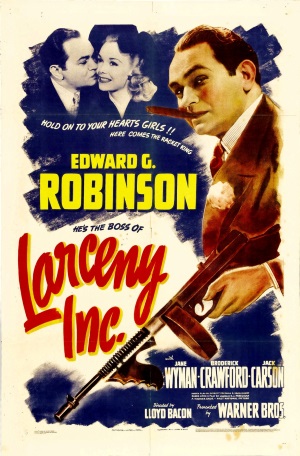
How can you resist a film like Larceny Inc once you’ve heard the plot? It’s one of those quirky film concepts I just love. A cocky criminal and his two buffoons buy a luggage store so they can dig their way into the bank next door. Perhaps the film’s greatest strength is how it plays out like a live action cartoon. Nothing ever goes beyond the scene in the moment; for example in one scene a set of oil pipes are burst during the digging process and the basement from which they are digging from is drenched in oil and yet this is never mentioned again. Even as one character who is not involved in the ban heist comes across the two drenched in the oil he bizarrely does not comment on their appearance; that’s the twisted cartoon world Larceny Inc incorporates. I’ve always thought actors from the 1930’s resembled cartoon characters with their exaggerated facial features and distinctive accents; very true with this cast including Edward G. Robinson, Jack Carson, and even a young Jackie Gleason; all live action caricatures.  Actors who emerged after the war generally didn’t have this and instead were actually more lifelike. You really get a sense of the world the movie takes place in with a street populated with such memorable and mostly ethnic characters giving the movie that Shop Around the Corner edge to it.

Maxwell aka Pressure’s gift wrapping has to be the comedic highlight of Robinson’s career; a comedy moment which couldn’t be timed more perfectly. His uttering of “$9:75”  is funny enough as it is but his pathetic attempt at gifting wrapping which follows had me in stitches. I also love Jack Carson’s attempt at hitting on Jane Wyman. This scene has nothing to do with the rest of the movie but has got to be the ultimate “skipping the pleasantries” monologue I’ve ever heard.

There are so many layers within Larceny Inc. Is the movie a celebration or an indictment on capitalism? The gangsters’ involvement in legitimate business is what makes them renounce their past ways but only after they’ve essentially been seduced and consumed by the capitalist system. Larceny Inc was released in 1942 just months after the US got involved in the war but the film’s production began prior to that with its themes of business and consumerism are completely counterproductive to the war effort, something I’ve noticed with many films released in 1942. There is also the irony that the gangster is the one who brings the community together and the authority figures in the movie are played as fools.

Larceny Inc can also join films like Rocky IV and Die Hard as Christmas movies which aren’t about Christmas, and Edward G Robinson dressed as Santa Claus? Sold!

You Can’t Take It With You (1938)

It’s Truly a Wonderful Life

***This Review Contains Spoilers***

You Can’t Take It With You follows the Sycamore/Vandrerhof household; the ultimate eccentric family. In fact eccentric probably isn’t the right word, they’re complete nuts. They live a counter-cultural lifestyle of not working or paying taxes (and somehow getting away with it) and doing whatever makes them happy without a care in the world; people who aren’t afraid to live. There are like cartoon characters who can twist their way out of any situation with people more in tune with reality, such as when Grandpa Vanderhof (Lionel Barrymore) manages to convince the timid Mr. Poppins (Donald Meek) to stop throwing his life away working as a bureaucrat and start having fun. The Sycamores/Vanderhofs are families we probably can’t be in real life but wish we could.

Even with a large ensemble cast, Lionel Barrymore is the actor at the heart of the film in a role which is the polar opposite of his part of Henry F. Potter in Frank Capra’s It’s a Wonderful Life. The scene in which Vanderhof is confronted by a government official played by the always miserable looking Charles Lane feels like a dig at big government. When Grandpa asks the official what the government gives him for his money he is given the response of “The government gives you everything”, emphases on the word everything, followed by Vanderhof’s humorous but thought-provoking rebuttals. The family’s refusal to pay taxes may be ethically questionable but it’s a movie fantasy and could never happen in real life. Don’t you wish you could deal with bureaucracies as easily as Grandpa Vanderhof?

One of Grandpa Vanderhof’s other fascinating moments is his monologue on “ismmania” although I’m quite sure what to make of it (“when things go a little bad nowadays you go out and get yourself an ‘ism’ and you’re in business”). The message feels similar to a 1948 animated short “Make Mine Freedom” in how the danger of isms can cripple the people. All we need is our Americanism as Vanderhof proclaims, which itself is an ism but I digress. Regardless his line which following this, “Lincoln said, with malice toward none, with charity to all – Nowadays they say think the way I do or I’ll bomb the daylights out of you”; that gives me chill every time.

One the sweetest, most heartwarming scenes in any film ever is when Grandpa Vanderhof tells Alice Sycamore (Jean Arthur) about his love for his deceased wife and how the room still smells of her perfume. Ugh, it just kills my poor little soul; a perfect display of Capra’s gift for directing very intimate, emotional scenes in which the rest of the world ceases to exist. Likewise, there doesn’t seem to be any actress whom James Stewart didn’t share a great dynamic together. James Stewart and Jean Arthur share a perfect chemistry together, pairing the embodiment of the everyman and the embodiment of the everywoman.

Non-conformity is the name of the game in You Can’t Take It With You. Grandpa Vanderhof understands the preciousness of life as he pursues his own interests and his own forms of fulfillment. He encourages others to follow their dreams and not submit to the will of others. In one scene Alice speaks of Grandpa’s thoughts on how “most people are run by fear, the fear of what they eat, fear of what they drink, fear of their jobs, their future, their health, scared to save money and to spend it. People who commercialise on fear scare you to death to sell you something you don’t need”. Amen sister! – The only thing to fear is fear itself.

You Can’t Take It With You promotes what we would now refer to as a libertarian mindset, live and let live as long as you’re not hurting anyone. As Tony Kirby (James Stewart) tells his father Antony P. Kirby (Edward Arnold) towards the end of the film, “I think this business is great. It’s good for you because you like it. I don’t, and I never will”. In many ways the Sycamore/Vandrerhof family is the embodiment of the American Dream. They own their property, each member pursues their individual dreams and they are above all happy. They live their life without inference from the government or other such bodies: Life, liberty and the pursuit of happiness.

One of the other messages derived from You Can’t Take It With You is the same as that to come from the ending of It’s a Wonderful Life in which the townspeople come to George Bailey’s aid, giving him money so he won’t have to do jail time followed by the final message from the angel Clarence; “No man is a failure who has friends”. A very similar incident occurs in YCTIWY in which friends and neighbors of the Sycamores pay for their fine in night court so they won’t be locked up. Likewise, the family’s arrest for being mistakenly identified as communists feels like a foreshadowing to McCarthyism. Then again they should have thought that a fireworks show based on the Russian Revolution as well as advertising it perhaps isn’t the greatest idea; it stinks!

There are those who will hear the name Frank Capra and have a reaction along the lines of “Oh Frank Capra, sentimental, saccharine, manipulative rubbish”. I don’t make apologies when I say that dismissing a film for being sentimental is the nonsense film criticism to end all nonsense criticisms; it stinks! Newsflash, stories have been manipulating people’s emotions since the dawn of time. Pulling of effective sentimentality is a skill and I have not come across a single good reason as to why it is a problem. You Can’t Take It With You is Capra at his most sentimental, manipulative, saccharine and all those other dirty words and I love it for that. So if that’s the crime of the century, then lock me up for life. Capra-corn and proud of it!