
Four Reasons Why You Shouldn’t Apologise To A Cleaner For “Walking Over Their Clean Floor”

For several years of my life, I was employed as a cleaner, first in a factory and later in a care home. The latter of which labelled my job as a “Domestic Assistant”, essentially the cleaning equivalent of calling a Garbage Man a “Sanitation Officer”. Regardless, there is zero shame in being a cleaner. As a cleaner, you are providing an invaluable service in keeping the world a tidier and more pristine place.

Being a neat freak myself, I enjoy cleaning; it’s therapeutic, and it’s always satisfying to look over a freshly cleaned room or area. Since then, I have moved on to other things in my life. However, if there is one thing I look back upon my cleaning days with PTSD levels of horror, it’s those dreaded words (in a Northern Irish accent), “Oh gee, sorry lad. I’m walking all over your good clean floor”. Thus, I will provide 4 reasons why apologising to a cleaner for walking over the floorspace that they have cleaned or are in the process of cleaning is not only very annoying (as much as it might be a well-intentioned natural human reflex) but also lacks any basis in logic.

1. It’s Annoying

        When an individual says those infamous words or some variation of “sorry for walking over your clean floor”, it is usually said in a confident tone of voice as if the person in question has thought up of a really witty joke and can’t wait to tell their friends. In reality, to the cleaner, this is not a smart and witty piece of self-deprecating humour because they (without exaggeration) hear this multiple times every single day. You may potentially be the 7th person to have said this to the cleaner during the morning shift alone.

        2. The Action Itself Doesn’t Actually Cause Any Inconvenience

        Walking over a floor which is being cleaned or has just been cleaned doesn’t actually cause any uncleanliness to form. Unless someone is walking over the floor with dirt hanging off their footwear, now that’s different. However, the average sole of a shoe which has just come in after walking on a normal street, will not cause create any such mess.

        3. The Apology Is Directed At The Wrong Person

        The phrase “your floor” is illogical in itself, as the cleaner doesn’t actually own the floor in question; usually, it will belong to a company. Even if it were the case that walking over the floor caused uncleanliness, then apologising to the cleaner is a futile gesture. Rather, your apology should be directed at the owner of the establishment or if it’s a residential setting (care home, house share, etc), towards the residents.

        4. Not Walking Over A Clean Floor Would Cause Mass Disruption

        If every motor vehicle on the road were to reduce its speed by 10mph, it would save lives in terms of road accidents. However, as a society, we choose not to do that due to the economic damage and sheer inconvenience that would cause. The same logic applies to walking over a clean floor. Imagine how disruptive it would be if everyone had to wait for a floor to dry before walking over it. “Hey Bill, do you mind giving me a hand with this? Sure, John, in 5 minutes, when the floor between us has dried”.

        They often say “the road to hell is often paved with good intentions”; well, in this case, the road to hell is often cleaned with good intentions. Next time to see a hard-working man or woman ensuring the world is a tidier and more pleasant place to inhabit, give them a friendly smile and a “hello”, but for the love of God, do not apologise for walking over “their” clean floor.

        Departures [おくりびと/Okuribito] (2008)

        To The Faithful Departed

        ***This Review Contains Spoilers***

        Cultures across the globe have different approaches to how they deal with their deceased. In my own Irish culture, it’s normal practice for the body of the deceased to be on open display prior to the closing of the casket, which, to my surprise, isn’t even the case across the sea in Great Britain. However, if there is one thing which is consistent amongst many cultures, it’s the taboo nature of death as a topic of discussion. In the anglosphere, people don’t even like to use blunt language as “dead people”, rather opting for language such as “passed away”, the late…”, “the departed”, “the deceased” or “those no longer with us”. Departures (おくりびと/Okuribito – “one who sends off“) is the only film I’ve ever seen about those who hold the job of handling bodies of the departed, well, at least in a serious manner (Night Shift, Weekend At Bernies).

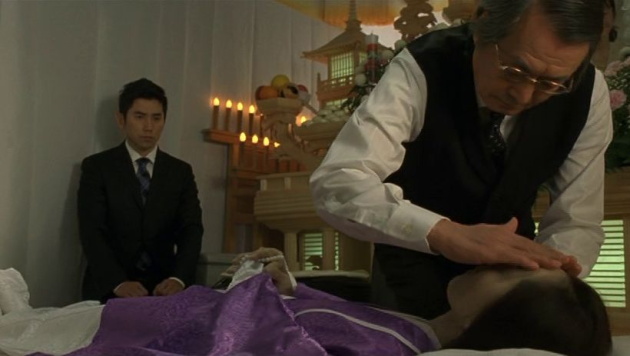
        Departures depicts men known as Nōkanshi and details their custom of ‘encoffining’, in which the body is prepared for its so-called departure. This is accomplished through a procedure of cleaning, dressing and applying make-up; there is such a level of dignity, grace and even an artisanal nature to the procedure as it is performed with such intricate precision (even when it involves a man undressing a woman and touching her body). In a way, the procedure brings life back to the body, as the application of makeup returns colour to the face after the blood has been drained from the face.

        However, despite the importance of death rituals in Japanese culture, the subject is considered “unclean” as everything related to death is thought to be a source of “kegare” (defilement). This is the contradiction at the core of Departures: a job which is so vital and dealing with something so universal, yet those who perform it are scorned upon and discriminated against. Daigo Kobayashi (Masahiro Motoki) is only one of three employees at the encoffining company NK Agent, alongside his world-weary Freudian father-figure boss Ikeui (Tsutomu Yamazaki) and the secretary Yuriko (Kimiko Uemura), whom is herself a social outcast. Daigo is even openly insulted by a patron during an encoffining ceremony, while an old friend, Yamashita (Tetta Sugimoto), highly chastises Daigo upon learning of his profession. Well, that is until his own mother dies and he receives a metaphorical comeuppance. This discriminatory treatment reaches its zenith when Daigo’s Mika (Ryoko Hirosue) wife, temporarily leaves him upon discovering what he does. From an outsider’s cultural perspective, it’s hard not to feel that the reactions Daigo receives are anything but unreasonable (but I understand that I come from a particular perspective).

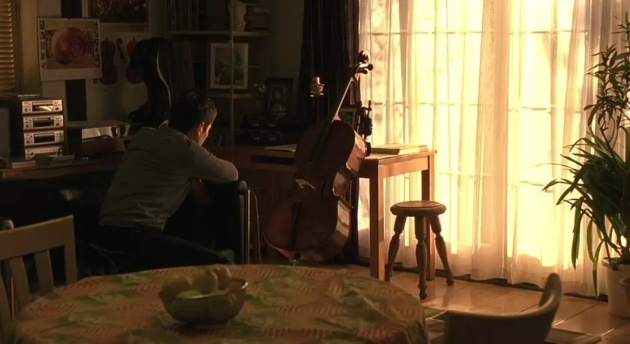
        That being said, Daigo does receive praise from patrons during the course of the film for his work. This ties into the other (albeit positive) irony within Departures, that a man finds meaning in life through death. At the beginning of the film, Daigo is devastated to lose his job as a cello player in a Tokyo orchestra, as few people are attending their performances. This has been a lifelong ambition of Daigo as he has been playing the instrument since kindergarten (“You professional cello player yet?!”). This death of his music career, however, yields a new career, as just like in the real world, life doesn’t always turn out how we planned it (“What I’d always taken as my dream maybe hadn’t been one after all”). With so many people in the world stuck in dead-end (pardon the pun) jobs, Departures really showcases the importance of finding deep meaning and purpose in one’s work, and just what a spiritual privilege that can be.

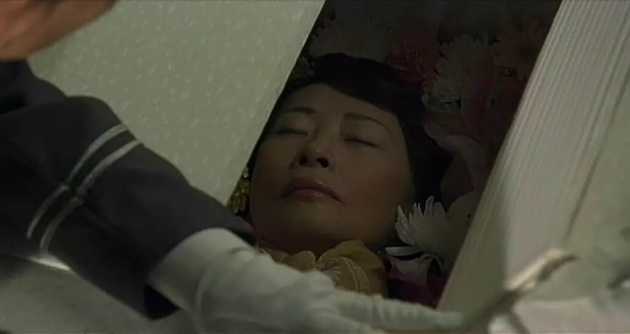
        Despite the subject matter, Departures is not a dour film, far from it. In fact, upon watching again, I was surprised to find the film rather funny. From Daigo wearing a giant diaper to film an instructional video, to live octopus antics in the kitchen, Departures injects an appropriate degree of levity, but not in a way to break the mood. Even during the opening scene, Daigo discovers the deceased person in question was actually a gender dysphoric male once he discovers she has “a thing”, leading to a funny exchange between Daigo and his boss (but not in a way which feels inappropriate or out of place). This levity also extends to the film’s montage, in which the complete spectrum of people dealing with grief is displayed. One funeral sees a family laughing with tears of joy and leaving lipstick marks on the face of their deceased patriarch, while another family happily proclaims “bye-bye” and “thank you for everything” to their grandmother while she wears her favourite socks (really putting the fun in funeral). On the other end of the spectrum, the POV shot from the deceased Christian boy as the lid is slid over the coffin into darkness gives me goosebumps. Likewise, the emphasis of the cello in the film’s narrative not only ties in with the Japanese love of European classical music but also influences the music score. Composer Joe Hisaishi emphasises the use of cellos in his score of which he described the challenge of centring a score around the cello as one of the most difficult things he had ever done.

        In a classic “would probably never happen in real life” scenario, Departures concludes with Daigo performing an encoffining for his estranged father, who left himself and his mother for a waitress when he was a child. Daigo finds in the hands of his father’s deceased body a rock (a counter piece to a rock his father gave him as a child to symbolise their bond), showing that he never forgot about his son and thus acting as a form of redemption for this deadbeat father. Although I do have to question if this is enough to really redeem his character, should there have been evidence for more active measures by his character in order to achieve redemption? Regardless, as presented in the film, one can view it through either the Eastern notion of forgiveness vs the Western Christian notion of forgiveness.

        Forgiveness doesn’t erase karma, but it helps release attachment and hate vs “Forgive us our trespasses as we forgive those who trespass against us”.

        Whisper Of The Heart [耳をすませば/Mimi o Sumaseba] (1995)

        I Don’t Think There’s Any Artist Of Any Value Who Doesn’t Doubt What They Are Doing

        ***This Review Contains Spoilers***

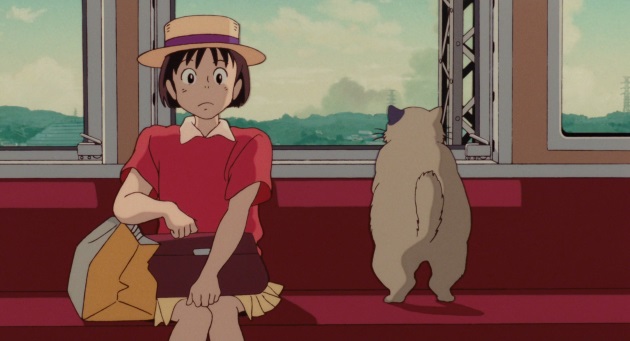
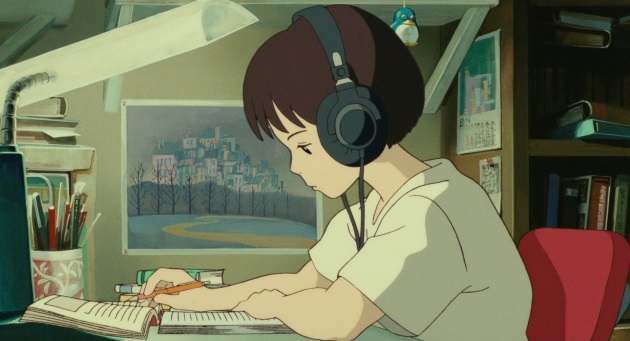
        Whisper Of The Heart is Studio Ghibli’s love letter to creatives and a picture which contains great insight into the uncertainty derived from growing up and the role of education in this nostalgic coming-of-age tale. Fourteen-year-old Shizuku Tsukishima is the cheerful and infectiously optimistic protagonist of the story. She manages to find the joy in the mundanity of everyday life from something as simple as the sun coming out to seeing a positive message on the side of a blimp. Just observe the pure joy she gets from finding a quirky antiques store in a suburb (perhaps a bit too much as she nearly gets hit by a car while running across the road and never realizes it). The eccentricity of Japan is even on subtle display from the fact that a pork pie hat can be worn in common parlance and a girl can pursue a chonky cat for quite some distance just for the fun of it. It’s this aspect of Whisper Of The Heart which really makes you want to cherish life’s little moments.

        Whisper Of The Heart is set over the course of 1994 (as indicated by Shizuku’s calendar), with a number of subtle indications for the passing of time throughout the film. The most noticeable of these being the seasonal variation of Shizuku’s school uniform with a white top for spring/summer and a navy-blue alternative for fall/winter. The initial catalyst of the story is set into motion when Shizuku’s father informs her that the local library is going through a transition from the old-fashioned book card system to a barcode system, much to her disappointment (I can recall my local library still using book cards in the early 2010’s). Goddammit modernity, sometimes the old ways are just better! It’s this tradition which ignites the film’s romance as Shizuku notices someone by the name of Seiji Amasawa has been taking out all the same books as her in this variation on The Shop Around The Corner formula re-imagined for the 1990’s. Shizuku and Seiji themselves aren’t too dissimilar to Jimmy Stewart and Margaret Sullavan in Ernst Lubitsch’s 1940 romantic comedy with Seiji’s initially jerky behaviour and Shizuku’s bookworm personality (unfortunately, when I was off this age any expression of a desire to read was social suicide – sad but true). 

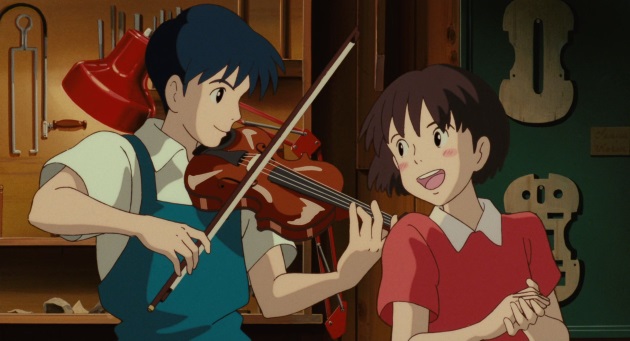
        As is a common recurrence in Studio Ghibli’s films, Whisper Of The Heart is the story of a young, teenage girl forced into a position of maturity (it does make sense that the female sex tends to be the focus of these stories as research has shown that girls on average mature faster than boys). One major interlocked aspect of Whisper Of The Heart is the classic conflict of education vs. hands-on/real-world experience. Shizuku is attending middle school (aka junior high school) and is studying for her high-school entrance exams. Her love interest Seiji on-the-other-hand opts to attend a trade school in Cremona, Italy to further learn the craft of making violins rather than attend high school, much against his parent’s wishes (high school is not compulsory in Japan). This disapproval highlights the lack of respect one can entail for a practical hands-on profession over a more middle-class, so-called “real job”. Part of Shizuku’s impetus to embark on her writing of a novel comes from the insecurity that Seiji is far more developed in his own art form. Her focus on writing begins to affect her school grades, feeling that her need to write a first draft of her novel within two months before Seiji returns from Italy is more important than her school grades. Unlike Seiji, Shizuku doesn’t know what she wants to do with her future. She asks her older sister Shiho when she decided on her future, to which she responds with the dubious answer, “I’m at university finding that out”. This quote is particularly prevalent from a UK-centric point-of-view, when official figures state in the year 2017/18, 50.2 per cent of English 17-30-year-olds had participated in higher education, 20 years after the New Labour government set the target of having 50% of young people attend university (with these degrees often being of a useless nature and provide no stepping stone to a future career). From a personal point of view, I didn’t know what I wanted to do with the rest of my life when I was 14 and it’s self-evident very few people of that age either have any idea. Seiji’s oddball choice of profession as a violin maker is an appropriate one at the end of the day as his character is an outlier of a person in their teens who has a definitive idea of what they want to do with their life. The film doesn’t take a position on the question on the role of higher education but does raise many a thought-provoking point as to its effectiveness. Come the film’s end, Shizuku returns to studying for her entrance exams. I can however relate to Shizuku’s unwillingness and nervous disposition to tell the rest of her family about her writing project even though they are aware something is occupying her time, to which her understanding parents sympathize and don’t question her on it any further.

        Seiji’s grandfather and owner of the antiques store Shiro explains how artists or writers develop and grow in their talents with a simple metaphor – “The rough stone is inside you. You have to find it and then polish it”. Shizuku holds intense self-doubt about her work, disagreeing with anyone when they praise her work. This intensely self-critical manner and strive for perfection overtakes her and leads to overpowering anxiety when she shows Shiro the first draft of her novel. To quote filmmaker Francis Ford Coppola, “I don’t think there’s any artist of any value who doesn’t doubt what they are doing.” – It’s this which really drives at the heart of Whisper Of The Heart. The picture showcases the highs and the lows that can be endured by creatives and parallels between the feeling of falling in love and the thrill that comes with creative pursuits. That scene in which a band has an impromptu performance of Country Roads as Shizuku sings her little heart out and gradually falls for Seiji (still unaware he is the boy on her book cards) combines these elements in a wonderfully corny scene. Whisper Of The Heart does hold parallels to fellow Ghibli film Kiki’s Delivery Service with protagonists succumbing to stress, burnout and depression (also is Shizuku’s older sister a recycled character model of Ursula?). Whisper Of The Heart is after all set in a country in which death by overwork is so tragically common that it even has a name – Karoshi (“You doctor yet? No Dad I’m 12. Talk to me when you doctor!”). The ultimate irony of this is that the Whisper Of The Heart’s director Yoshifumi Kondo would pass away 3 years following the film’s release from an aneurysm brought on by overwork. Whisper Of The Heart would be his only directorial feature, with Kondo joining the likes of Charles Laughton or Walter Murch as directors who have helmed only a single film, but what a film it would be.

        My first viewing of Whisper Of The Heart was somewhat marred by the film’s misleading (albeit still beautiful) poster, giving me the false assumption that Whisper Of The Heart was going to be a fantasy film in the vein of a picture like Labyrinth. This lead me to wonder when this non-existent fantasy element was going to kick in during the film’s first third, only to then realize it wasn’t that kind of film. The fantasy sequence inside Shizuku’s head which inspired the poster in which Shizuku and an anthropomorphic cat known as The Baron fly Superman ’78 style is a beautiful combination of fantasy and reality as those giant pillars (which do remind me of the backgrounds in Super Mario World) raise high into the sky above the suburbs of Shizuku’s world of West Tokyo. It’s easy to sound like a broken record when talking about the aesthetics of Studio Ghibli’s films, but god, this film is just so beautiful to look at it puts a smile on my face from the eye-popping colour of suburban Tokyo to those urban night-time landscapes. Even the film’s more mundane subjects such as the apartment block in which the Tsukishima family resides would be ugly in real life but has a certain beauty to it in the animated form. Correspondingly, the music score by Yuji Nomi is one of great variety from the whimsical nature of A Hilly Town to the Aussie outback vibe from The Cat Chases and even medieval-themed compositions with the track Engelszimmer. These pieces of orchestrated beauty make for a welcome contrast with the film’s urban setting however the film does also provide some more in-tune accompaniments to the Tokyo landscape with its use of electronic sounds and synthesizers as heard in Taking The Train and Starry Night Sky. Furthermore, I can’t help but notice similarities between the track A Hilly Town and the piece In The Evening Midst from the oddball, Japanese horror movie House, while these two aforementioned pieces of music surely must have influenced Michael Giacchino’s piece Married Life from Pixar’s Up (is it just me or do these three pieces of music work extremely well when listened to in tandem?). Whisper Of The Heart is also a rare instance of Ghibli film to feature licensed music with its recurring use of variations with John Denver’s Country Roads, including a real humdinger of a cover during the film’s end credits in which it is given the city-pop treatment. Correspondingly, like many a Japanese film, the always reliable sound of cicadas increases the atmosphere of anything tenfold.

        Whisper Of The Heart concludes with a very sudden marriage proposal from Seiji to Shizuku. In the original manga from which the film is adapted, Seiji only says “I love you” but the film’s screenwriter Hayao Miyazaki changed the line to “I can’t say how soon it’ll be, but would you marry me?“. To quote the big man himself in defending this position – “I wanted to make a conclusion, a definite sense of ending. Too many young people now are afraid of commitment, and stay on moratorium forever. I wanted these two to just commit to something, not just ‘well, we’ll see what will happen”. Putting aside the oddity of receiving and accepting a marriage proposal when neither are of legal marrying age, I do agree this sense of commitment coming from these characters gives the film’s conclusion greater emotional weight (although I will say the film ends very abruptly and could have done with a few seconds to let the viewer take it all in). The Japanese and English dubs have different lines of dialogue in this final scene. In the Japanese version, Seiji makes the aforementioned proposal to which Shizuku nods and Seiji asks if she’s sure to which she replies “That’s exactly what I wanted.” However, in the English dub, their discussion of marriage is more tenuous. Seiji asks, “Could you see us getting married someday?” to which Shizuku nods and they agree that his question was corny. It feels like those responsible for the picture’s English dub had a lack of faith in the source material and outright disrespected it with said changes. Regardless, I am a sucker for a good story of hopeless romantics and this impulsive love present in the original Japanese version of Whisper Of The Heart defiantly delivers on the desired level of swooning.