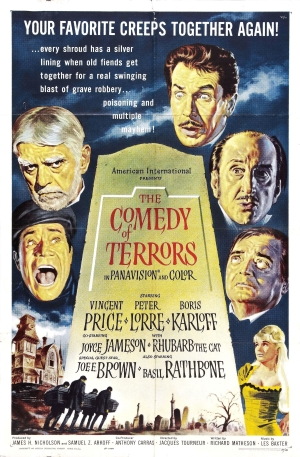
The Comedy of Terrors (1963)

horrorathon-2

A Graveyard Smash!

Four of classic Hollywood’s biggest horror icons together in a macabre comedy? Even if you’re not a diehard horror fan how can you turn down a film like this (if only Bela Lugosi had lived longer)? Each icon in The Comedy of Terrors plays to their strengths in this sitcom-like set up in which a group of characters, not all of whom can stand each other are forced to live and work together and have no way out of it. Surely there was potential in this to be a TV sitcom, at the short and sweet run time of only 83 minutes it feels like an extended TV episode.

Right of the bat the exposition explaining the film’s set up is a joy to listen to with the perfect comic timing from Vincent Price mercilessly insulting everyone to Boris Karloff’s random one-liners. Despite the film’s macabre tone, it does have an innocent element to it such as Price’s reaction to Peter Lorre’s poorly made coffin, “No one in their right mind would be caught dead in a thing like that”; nothing beats a distinguished actor delivering a corny pun.

Basil Rathbone is presented as the villain of the film, partially due to him being Basil Rathbone acting in an antagonist manner however his character isn’t doing anything wrong, he’s just trying to collect the debt he is owed from his tenants. Then again going all the way back to the Bible, those who collect owed money are always portrayed with scorn. After The Adventures of Robin Hood, The Comedy of Terrors has to be Basil Rathbone’s best ever moments on screen, showing off the full range of his talents from his swordsmanship and ability to recite Shakespeare all while hamming it up.

Vincent Price’s anti-hero is one real bad guy of the film, causing misery to those around him. Yet we still gravitate towards him in a reverse of the Basil Rathbone situation; because he’s Vincent Price. The relationship between Price and Lorre is the centrepiece of the film in a Pinky and The Brain like dynamic. I’m also surprised I didn’t notice Peter Lorre’s mask double until I had it pointed out to me, it’s the one aspect of the film which is actually creepy. Likewise, the other great member is the great Orangey aka Rhubarb the cat. As a cat lover, I appreciate the shots of the many shots the mean looking but still adorable feline.

The Color of Money (1986)

The Rules of the Game

I’ve never been more aroused by a film’s editing and cinematography than that featured in The Color of Money, a film which I ultimately enjoyed more than it’s predecessor The Hustler. It just so happens I first watched The Color of Money during my time as a film student and attempted to replicate many of the film’s shots and edits for a music video (and an intentionally 80’s music video at that) as I studied the cuts present in the film frame by frame. Needless to say, I was not entirely successful in my endeavour.

The Color of Money has the fast pace and rhythm of MTV music videos but still with a sense of old-school class and sophistication; right from the opening credits, I can tell this would be a movie dripping in atmosphere. A movie so snappy, fast-paced and full of quick edits, many of which come unexpectedly along with many unconventional camera movements yet it never feels disorientating or distracting as the scenes glide with such fluidity and ease. The cinematography on display here isn’t that of a David Lean production, no this is a movie which largely takes place in bars and pool halls yet it still has a sense of majesty and scope even if the shot in question is a close up of a drinking glass. Really the only edit I can fault is the very cheesy freeze frame of Paul Newman jumping out of a swimming pool. On the other hand, nobody uses licensed soundtracks better than Martin Scorsese. I get the impression scenes in the film were shot with the music in mind and not as an afterthought. With the opening scene, it feels like Phil Collins’ One More Night was specifically composed to fit the mood and tone of the scene.

The Color of Money however is not style over substance. I love the intriguing character triangle of a trio of hustlers as well as the harmony of two generations coming together. Tom Cruise is an actor I only like in certain parts but in roles such as Vincent, a cocky, male fantasy indulging character who embodies the entrepreneurial and capitalistic spirit of the 1980’s (like his character in Risky Business), I simply revel in – as Eddie puts it “a natural character”. Just as impressive are pool shots done by Cruise himself (he performed all but one of his own trick shots); makes me energised to play some pool myself.

San Francisco (1936)

picmonkey_image-3

It’s Going to Be a Bumpy Night

***This Review Contains Spoilers***

The disaster film is a genre thought of as being low brow but San Francisco is one of the few with class and sophistication. Like in James Cameron’s Titanic, the viewer is left waiting in suspense for the impending disaster as the emotional stakes rise. When the night of the earthquake arrives the movie draws out the final moments before the disaster; I’m left thinking to myself “It’s coming, it’s coming”. Also was it common back then to hold a ball at 5 in the morning?

The earthquake itself ranks among one of cinema’s greatest disaster sequences with the special effects and studio pyrotechnics making up for the less than stellar projection effects at the beginning of the film. The sequence shows the close up reactions of individuals just before they are killed by incoming debris as it lasts for the same amount of time which the actual earthquake itself did on Five-Thirteen A.M, April 18th, 1906 (or at least according to the movie, other sources state it occurred at 5:12 AM).  This is followed by the harrowing sight of death and destruction as Blackie Norton (Clark Gable) walks through the ruins of San Francisco as he observes the horrifying, brutal aftermath in a remarkable section of the film. Even famous silent directors D.W. Griffith and Erich Von Stroheim worked on the film without credit which shouldn’t come as a surprise as the plot of San Francisco would have been ripe for a grand silent melodrama.

On my first viewing, the ending of San Francisco felt far-fetched. I can see many people having an “Oh come on!” reaction but for me at least even on that first viewing, it still worked on an emotional level. However, after contemplating about the ending I have come around to accept the idea that a person, even a non-believer may turn to religion after experiencing something as horrendous as a natural disaster which leaves a trail of death and destruction. Although considering how religious the entire movie is I should have seen it coming not to mention the ending can be justified when looking at the deeper religious parallels within the film.

During the movie Mary Blake (Jeanette MacDonald) performs the opera Faust on stage as we are shown recreations of various portions of the opera; throughout San Francisco there are parallels to the story of Faust. The clash between the moral and immoral, Mary’s tendency to refuse Blackie’s advances, the fire seen at the beginning of the film to lines such as “You can’t take a woman and then sell her immortal soul”. Even during the earthquake’s aftershock, the underworld itself opens up (and one poor sucker falls into it); and at the very end of all this Blackie repents his sinful ways. If you can accept Blackie’s conversion then you still have to deal with the extremely corny, patriotic finale but I can still get a kick out of such cheese.

Jeanette MacDonald, what a voice! The reaction of the churchgoers listening on in awe when she sings in the choir is the same reaction as the viewer; San Francisco is, after all, a vehicle designed for the full range of her talents. Plus that title song is one catchy tune and I’m happy to hear it multiple times throughout the film. Likewise, Spencer Tracy appears in the film for 15 minutes and 58 seconds but he is the actor who leaves the biggest impression acting wise. Father Tim Mullin is the predecessor to Tracy’s Father Flanagan in Boy’s Town. Tracy was an actor who had the ability to play such a saintly character without it being sickly even as he inhabits the office of his church amongst the most heavenly lighting.

Is Blackie an atheist or just non-religious? The first dialogue between him and Father Mullin suggests he may not believe in God; “So you still believe in Santa Claus?” followed by Mullin’s response, “Trouble with you is that you don’t believe in anything”. The character relationship between Blackie and Father Mullin is the same which was seen in Manhattan Melodrama (in which Gable plays a similar character also called Blackie) and later in Angels With Dirty Faces. The two childhood friends who end up taking very different paths in life (one of moral servitude and the other of crime and corruption) yet their friendship prevails despite such contrasting lifestyles and views. Blackie Norton couldn’t be more of a Clark Gable character; a man under great pressure, business owner, runs for political office, has a way with women, cocky, street smart and a loveable jerk. It’s not clear to what extent his criminality runs to other than that he (along with numerous business owners in San Francisco) run his establishment without a license; there was still a bit of the Wild West in 1906 San Francisco.
The Criminal Code (1931)

Crime Doesn’t Pay

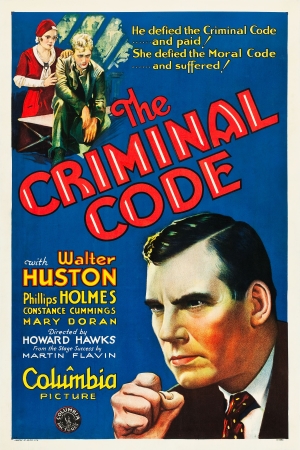
The Criminal Code explores the issue of turning a normal person who made a mistake into a criminal through time spent in prison and ends up abiding by the criminal code itself. The same subject matter is also explored in the movie Caged made 19 later; nothing seems to change. Robert Graham (Phillip Homles) is a sheltered pretty boy who got a rotten break (similar to Robert Montgomery in The Big House). However, unlike Montgomery in The Big House, Graham is put in a cell with two guys (including Boris Karloff’s Galloway) who look out for him. Although you do have to suspend your disbelief a bit over the movie fast forwarding six years and Graham not being remotely criminalised within that time. Among the film’s examination of the American legal and penal system, Walter Huston explains how it would be possible for someone to get off the hook for a crime such as manslaughter; “A year’s delay, a new trial, the witnesses would fade away, they always do, the whole mess would get cold, the papers would have something else to yap about. I’d get him off; he’d never serve a day”. Great thought provoking stuff.

Walter Huston plays the warden of the unnamed prison. He is stern but fair and a real “Yes sir!” type as evident from his first appearance with the manner in which he addresses a female witness (“Never mind that, pull down the shade”). The man is one lightning-fast talker who can interrogate like a boss but his greatest moment of badassery comes from the scene in which he goes into the prison yard to confront protesting, yammering prisoners face to face without any guards. Just look at the way he walks into the yard and lights up a cigar. As he approaches the prisoners the yammering stops and they don’t lay a hand on him. Simply put, this guy is badass. Perhaps unrealistically so but that’s why we have movies.

The Criminal Code was Boris Karloff’s first significant screen role in the part of Galloway. With his dominating, tall, lanky figure he steals the show; his monologue on why’s he’s in the slammer with the shadows across his face is hair-raising stuff. Galloway has a vengeance with a guard named Gleason which gives the film some dark comic relief such as the two awkwardly passing each other on the stairs to Karloff’s recurring use of the lines “I don’t like you” and “I got an appointment with you”. Likewise, the other memorable cast member, albeit in a very brief role is Andy Devine who is very hard to miss with that highly distinctive voice of his.

The Criminal Code uses the same set created for MGM’s The Big House released the year before. With its more intricate cinematography, the film doesn’t capture the sense of claustrophobia seen in The Big House but still captures the mundanity of prison life. As an early talkie, there is no music present in The Criminal Code but rather the sound of prisoners marching along with various other sound effects are just as effective as any music score could be.

The Criminal Code is also host to one of the most shocking moments in pre-code cinema (and was even featured in Karloff film Targets from 1968). When Galloway chases a squealer into a room while yammering is going on in the background from the prison yard, Galloway walks into the room with the squealer cornered as he slowly closes the door as the squealer looks on in terror. What happens next is up to the viewer’s imagination.

Dance, Fools, Dance (1931)

I Pity the Dancing Fool

Dance, Fools, Dance begins with a party onboard on yacht in which the younglings jump off the boat for a late night swim in their underwear while the older men are ignorant of a possible fall in stocks and the idea of forthcoming great depression; the last days of the carefree, roaring twenties seen through the lens of 1931.

Bonnie Jordan (Joan Crawford) and her brother Rodney (William Bakewell) are young, glamorous people who never worked a day in their life and show no resentment for it either, from a father who doesn’t want his children to have the hard time he had. They don’t exactly mourn over the death of their father but the loss of their fortune following the stock market crash is the tragedy which gets a reaction out of them. Regardless Bonnie deals with the loss of their fortune surprisingly well and accepts the fault of being left nothing from their father because she and her brother didn’t finish school. This is the crux of the character and what makes her interesting. She doesn’t choose the easy way out of getting married to a wealthy man even though the opportunity comes to her but rather desires the thrill to make it on her own as she herself later puts it.

I don’t believe many people are aware of just how endearing Crawford was in her younger, pre-shoulder pad days. In Dance, Fools, Dance she exemplifies a working-class heroine with an aura of refreshingly simple, straightforward bravery which really makes you route for her character; plus there is the joy of watching her flex her dancing talents.

Clark Gable is a mere 5th on the cast list, even William Holden (no, not that one) is higher than him but his introductory scene is hard to forget. The downbeat piano music as one of his servants puts a blazer on him as he then blows smoke in a woman’s face; tells you everything you need to know without a spoken word. Likewise, Bonnie’s brother Rodney is a memorable character himself as someone who is shocked by the criminal underworld where his alcohol came from before the depression after taking his supply of booze for granted for so long. Likewise, the other great cast member is Cliff Edwards as Bert Scranton who makes for an endearing comic sidekick and mentor to Bonnie.

Dance, Fools Dance isn’t quite a great film, its concept could be fleshed out and explored to a greater degree and would have been ripe for a remake (and maybe a title that wouldn’t sound like something a James Bond villain would say). Although even at that despite the film being imperfect it would still be hard to top with that endearingly creaky, early 30’s, pre-code charm.