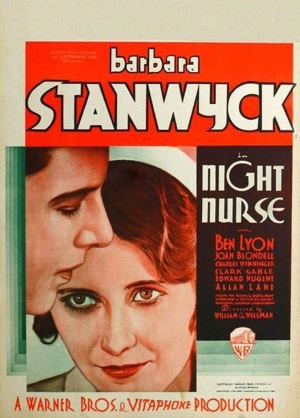
Night Nurse (1931)

I’m Nick…the Chauffeur!

It doesn’t take long into Night Nurse to see the film isn’t a very positive portrayal of the health care service circa depression-era United States. Dr. Kildare this is not and even makes 1934’s Men In White come off as a more an idealised vision of the health care system in the 1930’s; Night Nurse is anything but. All within the picture’s first ten minutes Lora Hart (Barbara Stanwyck) is turned down for the job as a nurse but then gets it after catching the fancy from another doctor. Likewise one of the interns is a pervert and fellow nurse Maloney (Joan Blondell) recommends tricking patients into thinking you’ve saved their life in order to get money out of them. Blondell’s character, in particular, I really found myself loathing from an actress who normally played such likable characters. She clearly dislikes her profession and even recites the Florence Nightingale pledge while chewing gum – Night Nurse is a movie with a wide range of despicable human beings on display. There is even a scene which appears to show an actual baby in distress and another in which children talk about in graphic terms of the mental and physical abuse they and their dead sister have received – not very comfortable viewing.

Director William Wellman was one of the most interesting filmmakers during the pre-code era, whose film’s go against the conception of movies from the early 1930s being static and lacking camera movement or fluidity. Night Nurse is a perfect example of the kind of pictures Warner Bros produced during the 1930’s; a thought-provoking socially conscious melodrama. Whether or not it’s exaggerated, the plot of hospital corruption and the ineffectiveness of both the hospital and the authorities to prevent child abuse, the movie does succeed in packing a punch. What does it say when the intervention of gangsters, people working outside the law are required to save the lives of two children? Warner Bros was also known for featuring ethnic casts in their movies. At the beginning of the movie a shot focuses on a group of Chinese people sitting around a hospital bed speaking in their native language, helping to set the film’s gritty mood. There is also an emphasises later in the film that the shop which is broken into in order to steal milk for a bath in order to save the lives of malnourished children is from a Kosher delicatessen. Is there a particular reason for this? This was 1931 but history has made of this scene of the delicatessen windows being smashed unintentional creepy.

The other major reason to watch Night Nurse is to see Clark Gable in the pre-stardom role of Nick the Chauffeur in his glorious 5 minutes and 25 seconds (approx) of screen time (yes, I timed it). The film builds up to his reveal with the name of this unscrupulous “Nick” being thrown around. His character’s introduction with the use of a camera zoom and the uttering of “I’m Nick…the chauffeur” gives me chills in one of the most memorable moments in pre-code cinema. Gable is scary enough as a dominating brute who wants to murder children and isn’t afraid to punch women or the elderly but this is multiplied by the fact that he’s dressed like a Nazi. Ok not really, it’s a chauffeur’s uniform but when I first saw him wearing this, my instant reaction was “Why is he dressed like an SS officer?” (likewise, just as equally striking is his costume choice of a black kimono). The role of Nick is an odd duckling in the career of Gable which shown he had the knack for playing terrifying villains – such unrealised potential. As much as the man’s appearance in the background is enough to make you go, “oh s—t!”, and in a big way sister.

Adventures of Don Juan (1948)

Juan But Not Forgotten

You could look at it cynically and view Adventures of Don Juan as a career life support, seeing Errol Flynn going to back to doing what made him famous in the first place after a string of unsuccessful pictures at the box office but it is none the less Errol Flynn returning to do what he does best. Despite not having done a swashbuckler since The Sea Hawk in 1940, Adventures of Don Juan manages to recapture the magic of his earlier days in this very dialogue driven swashbuckler. Flynn’s signs of ageing are increasingly apparent but considering his health and status as a star this would have been the final time Flynn could have headlined a big budget production such as this.

The Technicolor here doesn’t have the striking vibrancy of The Adventures of Robin Hood but the beautiful, detailed backdrops and very large scale sets with immaculate attention to detail are superb. The only complaint I have production wise is the very obvious use of footage taken from The Adventures of Robin Hood which sticks out from the rest of a movie which was filmed a decade later. It’s a shame they couldn’t get Michael Curtiz to direct for one last Flynn adventure or Erich Wolfgang Korngold to do the music score, none the less Max Steiner’s score does the job. I also previously knew Viveca Lindfors as the teacher from the 1985 comedy The Sure Thing. To see her 37 years earlier play a Spanish queen in the 17th century was such a contrasting role.

Unlike John Barrymore’s take on Don Juan in 1926, Flynn’s Don Juan uses the character’s insatiable lust for woman for laughs rather than for tragedy (I doubt a film in the tone of the Barrymore Don Juan could be made during the code era). Flynn’s Don Juan is a charmer but with a tad buffoonery to him, who’s lovemaking antics threaten relations between England and Spain. However, Flynn injects some John Barrymore into his performance with his manner of speaking, which it should then come as no surprise that Flynn would later portray Barrymore in Too Much, Too Soon. What is also taken over from the Barrymore Don Juan is the famous breathtaking epic dive down the stairs, and it does not disappoint.

The two villains in Adventures of Don Juan, the King of Spain (Romney Brent) and the Duke de Lorca (Robert Douglas) attempt to hatch a plan to build an armada in secret for world conquest and use shady tactics along the way such as abducting subjects by force for the navy. This was only a few years after the Second World War had ended and the memories of Hitler were still vivid in people’s minds. Robert Douglas channels a bit of Basil Rathbone in his performance while the partnership between these two villains is the classic Emperor/Darth Vader set up; with one figure taking the public limelight and the other pulling the strings behind the scenes; as the Duke de Lorca puts it, “I have no desire to sit on a throne, I much prefer to stand behind it”.

Silk Stockings (1957)

In Soviet Russia, Stockings Wear You!

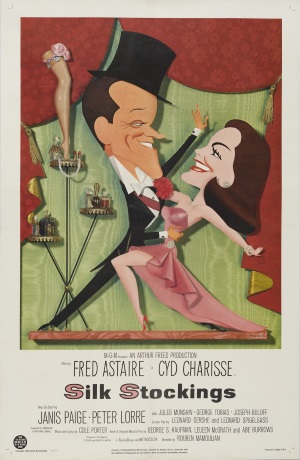
I’m rather disappointed with the latter era MGM musicals. High Society, Les Girls, Gigi; as one of the numbers in Gigi sums it up: “It’s a bore!” Silk Stockings is one of the better ones, not perfect but it shows this now increasingly outdated style of musical could still be glorious, despite their lack of economic viability from the rise of television. Whereas High Society came off to me as an unneeded remake of The Philadelphia Story, Silk Stockings manages to hold its own and not come off as a cheap remake Ninotchka, which was released prior to the cold war in 1939 (and not doing much good for American-Soviet relations). Silk Stockings was made right during the cold war and towards the end of the McCarthy years. It’s interesting seeing the story of love overcoming ideology retold from the cold war perspective in this critique of communism just like Ninotchka before it favours the gayety and decadence of the west to the rigid and gray world of the Soviet Union. While Silk Stockings may be moving denouncing communism it does paint a positive picture of Russian arts. The movie, however, is self-aware its propaganda, with the film being made within the film described as “The iron curtain dissolved by music” and Astaire gleefully proclaiming the film within a film as “what propaganda!”

The influence of the director Rouben Mamoulian is one of the aspects which helps elevate Silk Stockings. Mamoulian was one of the most innovative directors of the 1930’s, whose credits include the ground-breaking musicals Applause and Love Me Tonight. Although this was 1957 and his final film, he was an innovator of the genre and his handsome direction is apparent throughout the film. The musical numbers take full advantage of the Cinemascope frame, such as the number ‘We Can’t Go Back to Russia’ which features multiple people dancing at once in a long, unbroken shot. While Fred Astaire is dancing, Peter Lorre might be doing something amusing in the background. The dancing on display in the film is not Astaire’s most accomplished but is entertaining none the less. Mamoulian never worked with Ninotchka director Ernst Lubitsch, although Love Me Tonight did feature Lubitsch elements, as well as regular Lubitsch stars Maurice Chevalier and Jeanette MacDonald. Elements of the famous Lubitsch Touch are present throughout Silk Stockings; for example, when the Soviet commissar has just finished his first encounter with Ninotchka and is surprised to discover she is a woman, his secretary then bursts into the room to tell him this very fact, very much a Lubitsch inspired gag.

Cyd Charisse succeeds in holding her own, not merely doing an imitation of Greta Garbo; showing that she was an underrated actress as well as a great dancer. Plus it simply a pleasure seeing Fred Astaire and Cyd Charisse reunited again after The Band Wagon. Astaire could have conceivably played Melvyn Douglas’ role back in 1939 (I often wish the man could have done more non-musical comedic roles) so his casting does work; plus I’ve always championed Astaire’s for his unsung comic abilities. The casting of Peter Lorre as one of the three operatives is a brilliant decision, while Janis Page is also very entertaining as the uncultured actress Peggy Dayton.

The film’s selection of songs written by Cole Porter are very good. ‘Stereophonic Sound’ is a satire on the habits of moviegoers more concerned with a film’s technical aspects over the content of the film itself, while Cyd Charrise’s solo dance number captures the decadence of capitalism in the form of dance. The ‘Ritz Roll n’ Rock’ reflects the changing musical landscape from jazz to rock n’roll and appropriately so as this marked Astaire’s retirement from musicals, in the final number of the film dressed in his trademark top hat, white tie, and tails; what a send-off! Although my favourite number in the film is Astaire and Charisse dancing on a film set in ‘All You Dance’, simply beautiful. The big flaw I have with Silk Stockings, however, is the length; at the two hours the movie is too long and some trimming could have gone a long way. With thirty minutes chopped out, Silk Stockings could go from a good movie to a great one.

Dark Passage (1947)

The Man With Bogart’s Face

***This Review Contains Spoilers***

Dark Passage is one of the more experimental movies of Hollywood’s golden age with the majority of the film’s first third being filmed from the first person point of view of Humphrey Bogart’s character. I never thought a black & white movie from the 1940’s would remind me of a modern video game. I would like to see more films which experiment with this point of view style. MGM’s Lady In the Lake (also released in 1947) was filmed in POV for the entire film which the studio promoted by claiming the POV style was the most revolutionary style of film since the introduction of the talkies. Nope, it didn’t catch on. The use of POV took me off guard at first as I wanted to watch some Bogart but I did not get to see him on screen. Bogart’s distinctive voice alone though helps carry the picture, thanks in part to his many witty remarks. We’re then given a section of the movie in which Bogart doesn’t talk and is wrapped in bandages looking like a horror movie character (these scenes also make me squeamish). Considering we have to wait a whole hour until we finally see and hear Bogart in his entirely makes Dark Passage nothing short of a daring role.

For the plot, you do need to suspend your disbelief at the number of highly improbable coincidences. Irene (Bacall) just happens to be out painting near San Quentin on the day Vincent Parry (Bogart), the man she has an obsession with escapes and she knows where to find him. Oh, and she also happens to be friends with Madge (Agnes Moorehead) who gave false testimony in court against Parry that he murdered his wife.  I find it is easy however to just roll along with the ridiculous plot as the movie plays out like a dream, culminating in the satisfaction of seeing Bogart get his revenge on Agnes Moorehead (a useless old bag and a real love to hate character) and seeing these two characters getting their happily ever after together in South America. One minor complaint I have is the reveal of Frank Parry’s face on the newspaper, prior to getting plastic surgery; because the character doesn’t actually have Bogart’s face, I would have preferred the mystery of not knowing what he looks like. Also, a plastic surgeon who can give you the face of Humphrey Bogart? Someone should have told Woody Allen that in Play It Again Sam. Dark Passage in part sees the return of gangster Bogart but still has the romantic elements of his on-screen persona which he developed after achieving stardom. Right from the very beginning, we’re in classic gangster territory, a prisoner escaping from San Quentin, the type of setting not seen in a Bogart film since High Sierra. The on-location filming in San Francisco also really adds to the film, giving you a sense of the world the movie inhabits and Irene’s apartment with the two floors and the art deco designs – I want it!

I once said ‘All Through the Night’ was the most Hitchcockian film Bogart starred in but Dark Passage wouldn’t be far behind it. We get the innocent man falsely accused on the run while trying to prove his innocence. The focusing on landmarks (the Golden Gate Bridge), while the San Francisco setting has some Vertigo vibes. The trippy plastic surgery sequence feels reminiscent of the Salvador Dali dream sequence in Spellbound; while Madge’s death rings a bell of the character death shots in Vertigo in which someone falls from a great distance.

When attempting to review a movie, I can’t always predict how much I will have to say about it. Occasionally though you get movies like Dark Passage, which have layers and layers of fascinating details worth talking about. Dark Passage is my favourite Bogart & Bacall film, although to be honest, I was never a huge fan of their partnership. To Have and Have Not bored me and The Big Sleep was, well, a big sleep. Plus I never fully got the appeal of Lauren Bacall; she never struck me as a massively interesting screen presence.  I find Bacall plays a much more interesting character than in the previous two Bogie & Bacall pairings. Not a vamp but a lonely single woman who purses painting as a hobby.  During the first kiss between Bogart and Bacall, I had the reaction of “Ok, now I’m getting it”.

They Drive By Night (1940)

We’ve Got a Great Big Convoy Running Through the Night!

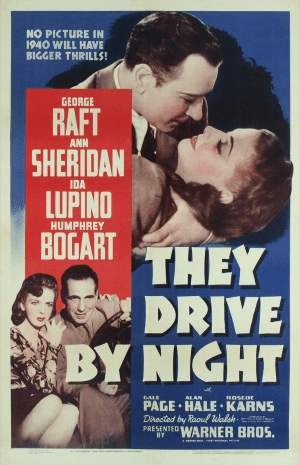
They Drive By Night captures the seedy and often dangerous world of the truck driver; the lack of sleep, the long distances to travel, the time missed with family, the comradery between truckers. The movie definitely highlights the dangers of trucking from the risk of falling asleep at the wheel, which in part lends itself to one very thrilling action sequence. With Warner Bros being the master of social commentary pictures, I enjoy movies like this which give you an insight into the lives of the lower class at the time; people trying to get by a day at a time with clearly little money to spare.

Thirty minutes into the picture we meet Ida Lupino, in my view possibly the epitome of the tough dame. Talk about a star-making performance, she owns the show as soon as she enters the picture. Every time she is in frame it’s hard to take your eyes off her as struts, poses and applies makeup to herself, even when her comedic foil of a husband Alan Hale is in frame acting like a buffoon. Her most notable scene in the film is one of the greatest, most gloriously over the top on-screen breakdowns ever committed to film. Charles Manson blamed The Beatles, Ida Lupino blamed the doors. Seeing Bogart as a family man is odd at first, the total opposite of his persona he would have in films such as those with Lauren Bacall. But he fits comfortably into the role, showing how adaptable an actor he was. George Raft is the weakest player out of the four stars, I’ve never seen Raft as much of an actor, but playing alongside these heavyweights manages to bring out the best in him.

What is the overall plot of They Drive By Night? There isn’t one; there’s no three-act structure. It’s almost like getting two movies for the price of one, with the first half focusing on trucking and the second half focusing on a murder. Comparing the two you wouldn’t think this is the same movie, but the odd combination works and makes for a unique viewing experience.

The Prizefighter and the Lady (1933)

Women Weaken Legs!

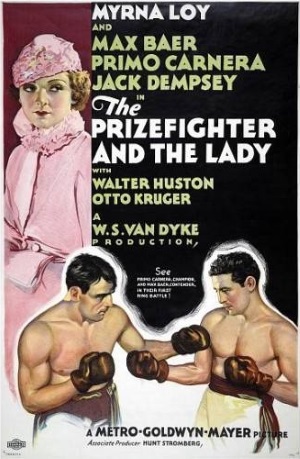
I’ve seen many a boxing film and despite having no real interest in the sport I find they often make for great stories – I consider The Prizefighter and the Lady (written by the great Francis Marion) as one of the great unsung boxing films with its less than conventional and exceedingly well acted and conveyed love triangle. What’s particularly striking about this romance is how intriguingly pathetic in a way it is. Belle (Myrna Loy) falls in love with a dunce of a jock named Steven (played by real-life boxer Max Baer) – “A big kid” as Belle calls him. Steven is a man who doesn’t seem to know any better and Belle is fully aware of this but can’t help that she has fallen for him; you really can feel the raw sexual attraction between these two, especially in their introductory scene in which Loy has nothing but a blanket draped over her.

The third end of the triangle of this not so swooning love story is Willie Ryan (Otto Kruger) as Belle’s original lover. Willie is a crime boss but is not presented as your typical hardnosed gangster (nor is it clear what the extent of his criminal activities are). Willie cares deeply for Belle and the two even talk openly about Belle’s newly found feelings for Steven. However, Belle eventually informs Willie she has got married to Steven and leaves him and her life as a socialite for more mundane and dowdy existence, leaving Willie with one heartbroken face with two tears coming off his face. – The Prizefighter and the Lady is full of little, subtle acting moments like this you wouldn’t notice on first viewing.

Perhaps that would be enough drama but no, Steven, the ladies man who is all muscles and no brain is cheating on Belle with multiple women. It does raise the question of what sane man would play adultery when you’re married to Myrna Loy?! The female lead of Prizefighter and the Lady would be a unique part for any major Hollywood actress. MGM was known for their glamorous stars yet here is Myrna Loy appearing dowdy and I suspect at times not be wearing any makeup – we are even introduced to her being lifted out of a car wreck and covered in dirt. While I’m not a fashion connoisseur every once in a while I will see a film from the 1930s and fawn over the outfits. Every outfit worn by Loy in The Prizefighter and the Lady is to die for. Likewise, her singing of the song Downstream River in the nightclub is enchanting, even if it’s obviously not her voice doing the singing. – She is a quintessential symbol of urbanity.

Oh yeah, and there is boxing in this film too, right? Older films generally aren’t known for their stellar boxing scenes. The film’s combination of slowed down footage and frequent cuts doesn’t look fantastic but it’s not totally immersion breaking. Likewise, I just wish the film could have done without the rather cheap, 7-minute long musical number entitled “Lucky Fella, Lucky Guy”. What more than compensates is the gorgeous high contrast cinematography in the boxing arenas; you can feel the grit and grime of the sweaty, smoke-filled atmosphere in another example of the type of neo-realism the pre-code era had to offer.

Gambit (1966)

Expectation/Reality

***This Review Contains Spoilers***

Like the other notable twist-laden Michael Caine movie Sleuth I can’t say much about Gambit without spoiling it. During the first 25 minutes, I was doubting if I was even going to enjoy the film. The characters appeared to be forgettable and two dimensional. Michael Caine outwits everyone but in an uninteresting manner while Shirley MacLaine never speaks nor shows any emotion or vulnerability with Herbert Lom plays an unimaginative caricature of a reclusive, eccentric millionaire. Like Sleuth on first viewing I thought that film was making a mistake during a certain section; with Gambit I felt the same way about the first section of the movie.

However, when it is revealed these first 25 minutes are just the idealised scenario for a heist played out in Michael Caine’s head I had the biggest smile on my face and the reaction of “You clever bastards!”. All of a sudden this seemingly boring film became fascinating with the scenario I had just seen played out now occurring again with a welcome sense of realism and with interesting, flawed characters, with much of the humour stemming from the differences between fact and fiction. It reminded of that popular internet meme ‘expectation/reality’ and came off to me like a satire of sorts on unimaginative writing and characters. Watching the film a second time I can now spot the moment of foreshadowing such as Michael Caine saying to his accomplice “Now pay close attention”. Of course, it wouldn’t be a heist movie without suspense and does the third act deliver, full of nail-biting moments and clever solutions.

Released in 1966 just prior to the rise of the New Hollywood movement, Gambit sees the final days of that distinctive old Hollywood glamour. Gambit is a very exotic movie at that with Shirley MacLaine being presented in the image of a goddess throughout and even her more common looking attire during the heist at the end is exceedingly stylish. Plus who can look more dapper as a cat burglar than Michael Caine? The back and forth between Caine and MacLaine is pure heaven. There are few other actresses with as playful an on-screen persona as Shirley MacLaine while Caine gets annoyed by her giddy, childlike attitude. I don’t care how many films I see which contain the “they hate each other but secretly love each other” dynamic, as long as it’s between a screen pairing with superb chemistry then I’ll never tire of seeing it.

Star Wars Episode I: The Phantom Menace (1999)

The Farce Awakens

Star Wars Episode I: The Phantom Menace is a movie I’m apprehensive to review; perhaps more than any other film ever. I only review movies if I feel I have something to interesting and unique to say. What unique viewpoint to do I have to give to the Star Wars prequels? –  possibly the three most heavily critiqued films ever. I decided to watch all three prequels again (and hopefully for the last time) in order to get a fresh perspective on them. I believe I may have some unique points of view to offer; plus I am among the populace who is addicted to discussing every aspect of George Lucas’ pop culture behemoth.

Don’t be too surprised when I tell you I hate the prequels – big shocker, right? However, The Phantom Menace is the prequel I dislike the least. The major aspect I find The Phantom Menace does have going for it over the other two prequels are the aesthetics. It comes the closest to resembling the original trilogy, if still incredibly far off. The Phantom Menace was shot on film and does feature on location filming and even some practical effects here and there, so the whole thing doesn’t come off looking like a video game as Episodes II and III did. There is a lot of eye candy to behold, such as the locations such as the Palace of Caserta in Italy (why do you want to film everything on a green screen when beautiful places like this exist in the world?), while the costume design – not something I would normally comment on – is very pleasing to the eyes. The only two scenes in The Phantom Menace which has a little bit of that excitement that I get watching the original trilogy are the pod race and final lightsaber duel between Obi-Wan, Qui-Gon and Darth Maul; an impressive display of acrobatics and is it’s not choreographed within an inch of its life like the duels in Episodes II and III. But even these few aspects of the film I do enjoy are ultimately superficial as there is no internal conflict nor am I emotionally invested.

What surprised me watching The Phantom Menace for the first time in a decade was just how incredibly frustrated I got. I’ve seen and read more reviews of this film over the years, analysing it to death and mocking every aspect of it. Watching the film again I expected to have reactions of “yeah it sucks, what else is new”, but sitting down and watching the entire thing my brain became so numb from the never-ending monotone exposition. I’m not even that keen on the John Williams score; it’s not bad by any means – far from it – but it feels too dark and moody for a Star Wars movie. As fine a piece of music as Duel of the Fates is, those booming choirs feel out of place for Star Wars. In regards to the most hated fictional character of all time, I don’t think Jar Jar is the absolute worst thing ever, I can at least tolerate him (if there’s any character in the prequel trilogy that bothers me for how ridiculous they are: its General Grievous). Plus at least he’s responsible for the only line from this film I like; “The ability to talk does not you intelligent”.

All three prequels lack the space western elements of the original trilogy, and I recall a comment that George Lucas intended The Phantom Menace to play out like a costume drama. Perhaps it’s own such a direction could have worked if you know, the execution wasn’t total pants. I can see what Lucas was perhaps going for in the story in trying to portray the fall of a democracy; the idea of radicals using political unrest as a means of coming to power – such as the Nazis using the turmoil caused by the great depression to amass power. Perhaps the empire isn’t such a bad thing, it appears under their command the universe became a more interesting place.

As someone who is interested in the relationship people have with popular culture, I find the most interesting aspect of The Phantom Menace is nothing in the film itself but rather its place in history. Think about it, the most anticipated movie of all time and it was a colossal letdown, and this occurring during the early days of the internet. What would the world of geekdom be like if The Phantom Menace actually lived up to expectations? Would an entire generation be less cynical?  Would internet culture be the same as it is today, possibly for the better?

The Devil and Miss Jones (1941)

Me and Miss Jones

The Devil and Miss Jones may be the best Frank Capra film he didn’t make and one of the last depression era comedies making it one of the last of its kind – a screwball comedy dealing with the conflict between social classes. The film presents a fascinating and shocking look at the treatment of workers in a department store during the final days of the depression, themes which would become obsolete with the US entry to the war.

The owner of the department store is J.P. Merrick (Charles Coburn). With this character, the movie shows the rich aren’t all bad people at heart. They’re just cut off from common people and their reality, unaware of the common man’s struggle and surround by advisors who think they know what’s best. Heck, J.P. doesn’t even remember what stores he owns! He brings himself down to his employee’s level by going undercover as a store worker in order to identify those who are trying to form a union. J.P. has the advantage that no one in the public knows what he looks like as his picture hasn’t appeared in a newspaper for 20 years, also no internet in 1941 would also be an advantage.

I don’t how if the treatment of the workers is realistic or exaggerated; just how relevant is this movie today? In one scene a store supervisor criticises a new worker (unaware it’s the store’s owner going undercover) in a bullying nature for their poor intelligence level test score. In another scene the department store addresses their workers at the end of the day as they stand in unison like a military dictatorship, threatening to fire anyone and preventing them from working in any department store in the city if they speak out against the company or associate with anyone who does. Next to many of the workers have a secret union meeting on top of a building, like a band of rebels coming together to take down an oppressive regime. The leader of the cause played by Robert Cummings states the company is letting employees go after 15 years when their salary is higher than a new employee and that they expect a quarter lifetime of loyalty to the one employer. At one point Jean Arthur even speaks during one emotionally rousing speech about how working “25 years for only two employers” as unacceptable –  I know those days have certainly passed us. The art deco department store itself is a beauty and offers a nostalgic look at the days before automation, when people had to be employed to do every task without the aid of computers.

Robert Cumming’s character is an activist rallying against the establishment; the type of person who would protect his country against its government. The type of character you don’t see often in classic films and likely would have been labelled a communist during the McCarthy era. In one pivotal scene at a police station he takes on abusive, power hungry cops and escaping charges by reciting the Constitution and then the Declaration of Independence at lightning fast speed to remind the officers of their rights; a real badass. A scene like this just goes to show you how people are unaware of their rights.

Jean Arthur and Charles Coburn are a superb and unconventional pairing. Yet you get two great romance plots for the price of one – old love and young love; Charles Coburn & Spring Byington and Jean Arthur and Robert Cummings. Like Frank Capra’s works, The Devil and Miss Jones is full of incredibly intimate, powerfully sentimental moments as two characters talk to each other as the rest of the world ceases to exist, such as the beach scene with Arthur and Cummings or the moment on the train with Coburn and Byington are all incredibly moving. Yet the intimate moment which strikes me the most is Arthur and Coburn’s discussion on love. Jean Arthur’s monologue on love feels so true; stating that two people can look at each other and see something way deep inside that no one else can see and distances her love from that seen in movies of love songs. She doesn’t think herself or her boyfriend are the greatest people in the world, yet doesn’t know if she’d care to live or die if she would never see him again. When this moment begins the sound effects of people talking in the background becomes increasingly faint and then loud again as other people enter the scene – it’s perfect. In terms of just pure comedy, just look the scene in which Jean Arthur dives across the table; an explosion screwball comedy in its purest form.

The More The Merrier (1943)

Three’s a Crowd

The More The Merrier represents the screwball genre adapting for the war years however this was at the end of the genre’s original run. I wonder why there were not more screwball comedies made during the war period? Did people become more cynical with the war or perhaps the genre was simply made for the depression era. Instead of taking on the establishment like the genre screwball did during the depression, The More The Merrier is supporting it. It is refreshing to see a propaganda film from the war years which is less gloomy and shows how common folk got on with their daily lives during the war.

My main flaw with The More The Merrier is Joel McCrea. He’s fine but that’s the problem, he’s only just fine; a serviceable actor who doesn’t leave a great impression. He’s the weak spot of a trio of characters who could have been much stronger with a more charismatic actor. Granted this was during the war and most of Hollywood’s big male leads were off in Europe kicking Hitler’s ass. Could Cary Grant have played the role instead, but perhaps a big star like that couldn’t play a role in he doesn’t show up until half an hour in. The trio of characters still manages to be fun with Jean Arthur playing the straight man and Charles Coburn as an immature and conniving old man who still seems like a kid at heart; while the romance between Arthur and MrCrea is still believable and handled very well as they spend the final third of the film quietly denying their feelings for each other.

Jean Arthur and Charles Coburn are one of the more unconventional screen pairings in Hollywood starring in three films together, just look at the morning schedule scene; comic choreographed brilliance and by far my favourite part of the film. When McCrea enters the picture though I feel it is never as strong. Also after you watch this movie you may find yourself saying “dam the torpedoes, full speed ahead!”, a lot.