Gambit (1966)

Expectation/Reality

***This Review Contains Spoilers***

Like the other notable twist-laden Michael Caine movie Sleuth I can’t say much about Gambit without spoiling it. During the first 25 minutes, I was doubting if I was even going to enjoy the film. The characters appeared to be forgettable and two dimensional. Michael Caine outwits everyone but in an uninteresting manner while Shirley MacLaine never speaks nor shows any emotion or vulnerability with Herbert Lom plays an unimaginative caricature of a reclusive, eccentric millionaire. Like Sleuth on first viewing I thought that film was making a mistake during a certain section; with Gambit I felt the same way about the first section of the movie.

However, when it is revealed these first 25 minutes are just the idealised scenario for a heist played out in Michael Caine’s head I had the biggest smile on my face and the reaction of “You clever bastards!”. All of a sudden this seemingly boring film became fascinating with the scenario I had just seen played out now occurring again with a welcome sense of realism and with interesting, flawed characters, with much of the humour stemming from the differences between fact and fiction. It reminded of that popular internet meme ‘expectation/reality’ and came off to me like a satire of sorts on unimaginative writing and characters. Watching the film a second time I can now spot the moment of foreshadowing such as Michael Caine saying to his accomplice “Now pay close attention”. Of course, it wouldn’t be a heist movie without suspense and does the third act deliver, full of nail-biting moments and clever solutions.

Released in 1966 just prior to the rise of the New Hollywood movement, Gambit sees the final days of that distinctive old Hollywood glamour. Gambit is a very exotic movie at that with Shirley MacLaine being presented in the image of a goddess throughout and even her more common looking attire during the heist at the end is exceedingly stylish. Plus who can look more dapper as a cat burglar than Michael Caine? The back and forth between Caine and MacLaine is pure heaven. There are few other actresses with as playful an on-screen persona as Shirley MacLaine while Caine gets annoyed by her giddy, childlike attitude. I don’t care how many films I see which contain the “they hate each other but secretly love each other” dynamic, as long as it’s between a screen pairing with superb chemistry then I’ll never tire of seeing it.

Star Wars Episode I: The Phantom Menace (1999)

The Farce Awakens

Star Wars Episode I: The Phantom Menace is a movie I’m apprehensive to review; perhaps more than any other film ever. I only review movies if I feel I have something to interesting and unique to say. What unique viewpoint to do I have to give to the Star Wars prequels? –  possibly the three most heavily critiqued films ever. I decided to watch all three prequels again (and hopefully for the last time) in order to get a fresh perspective on them. I believe I may have some unique points of view to offer; plus I am among the populace who is addicted to discussing every aspect of George Lucas’ pop culture behemoth.

Don’t be too surprised when I tell you I hate the prequels – big shocker, right? However, The Phantom Menace is the prequel I dislike the least. The major aspect I find The Phantom Menace does have going for it over the other two prequels are the aesthetics. It comes the closest to resembling the original trilogy, if still incredibly far off. The Phantom Menace was shot on film and does feature on location filming and even some practical effects here and there, so the whole thing doesn’t come off looking like a video game as Episodes II and III did. There is a lot of eye candy to behold, such as the locations such as the Palace of Caserta in Italy (why do you want to film everything on a green screen when beautiful places like this exist in the world?), while the costume design – not something I would normally comment on – is very pleasing to the eyes. The only two scenes in The Phantom Menace which has a little bit of that excitement that I get watching the original trilogy are the pod race and final lightsaber duel between Obi-Wan, Qui-Gon and Darth Maul; an impressive display of acrobatics and is it’s not choreographed within an inch of its life like the duels in Episodes II and III. But even these few aspects of the film I do enjoy are ultimately superficial as there is no internal conflict nor am I emotionally invested.

What surprised me watching The Phantom Menace for the first time in a decade was just how incredibly frustrated I got. I’ve seen and read more reviews of this film over the years, analysing it to death and mocking every aspect of it. Watching the film again I expected to have reactions of “yeah it sucks, what else is new”, but sitting down and watching the entire thing my brain became so numb from the never-ending monotone exposition. I’m not even that keen on the John Williams score; it’s not bad by any means – far from it – but it feels too dark and moody for a Star Wars movie. As fine a piece of music as Duel of the Fates is, those booming choirs feel out of place for Star Wars. In regards to the most hated fictional character of all time, I don’t think Jar Jar is the absolute worst thing ever, I can at least tolerate him (if there’s any character in the prequel trilogy that bothers me for how ridiculous they are: its General Grievous). Plus at least he’s responsible for the only line from this film I like; “The ability to talk does not you intelligent”.

All three prequels lack the space western elements of the original trilogy, and I recall a comment that George Lucas intended The Phantom Menace to play out like a costume drama. Perhaps it’s own such a direction could have worked if you know, the execution wasn’t total pants. I can see what Lucas was perhaps going for in the story in trying to portray the fall of a democracy; the idea of radicals using political unrest as a means of coming to power – such as the Nazis using the turmoil caused by the great depression to amass power. Perhaps the empire isn’t such a bad thing, it appears under their command the universe became a more interesting place.

As someone who is interested in the relationship people have with popular culture, I find the most interesting aspect of The Phantom Menace is nothing in the film itself but rather its place in history. Think about it, the most anticipated movie of all time and it was a colossal letdown, and this occurring during the early days of the internet. What would the world of geekdom be like if The Phantom Menace actually lived up to expectations? Would an entire generation be less cynical?  Would internet culture be the same as it is today, possibly for the better?

The Devil and Miss Jones (1941)

Me and Miss Jones

The Devil and Miss Jones may be the best Frank Capra film he didn’t make and one of the last depression era comedies making it one of the last of its kind – a screwball comedy dealing with the conflict between social classes. The film presents a fascinating and shocking look at the treatment of workers in a department store during the final days of the depression, themes which would become obsolete with the US entry to the war.

The owner of the department store is J.P. Merrick (Charles Coburn). With this character, the movie shows the rich aren’t all bad people at heart. They’re just cut off from common people and their reality, unaware of the common man’s struggle and surround by advisors who think they know what’s best. Heck, J.P. doesn’t even remember what stores he owns! He brings himself down to his employee’s level by going undercover as a store worker in order to identify those who are trying to form a union. J.P. has the advantage that no one in the public knows what he looks like as his picture hasn’t appeared in a newspaper for 20 years, also no internet in 1941 would also be an advantage.

I don’t how if the treatment of the workers is realistic or exaggerated; just how relevant is this movie today? In one scene a store supervisor criticises a new worker (unaware it’s the store’s owner going undercover) in a bullying nature for their poor intelligence level test score. In another scene the department store addresses their workers at the end of the day as they stand in unison like a military dictatorship, threatening to fire anyone and preventing them from working in any department store in the city if they speak out against the company or associate with anyone who does. Next to many of the workers have a secret union meeting on top of a building, like a band of rebels coming together to take down an oppressive regime. The leader of the cause played by Robert Cummings states the company is letting employees go after 15 years when their salary is higher than a new employee and that they expect a quarter lifetime of loyalty to the one employer. At one point Jean Arthur even speaks during one emotionally rousing speech about how working “25 years for only two employers” as unacceptable –  I know those days have certainly passed us. The art deco department store itself is a beauty and offers a nostalgic look at the days before automation, when people had to be employed to do every task without the aid of computers.

Robert Cumming’s character is an activist rallying against the establishment; the type of person who would protect his country against its government. The type of character you don’t see often in classic films and likely would have been labelled a communist during the McCarthy era. In one pivotal scene at a police station he takes on abusive, power hungry cops and escaping charges by reciting the Constitution and then the Declaration of Independence at lightning fast speed to remind the officers of their rights; a real badass. A scene like this just goes to show you how people are unaware of their rights.

Jean Arthur and Charles Coburn are a superb and unconventional pairing. Yet you get two great romance plots for the price of one – old love and young love; Charles Coburn & Spring Byington and Jean Arthur and Robert Cummings. Like Frank Capra’s works, The Devil and Miss Jones is full of incredibly intimate, powerfully sentimental moments as two characters talk to each other as the rest of the world ceases to exist, such as the beach scene with Arthur and Cummings or the moment on the train with Coburn and Byington are all incredibly moving. Yet the intimate moment which strikes me the most is Arthur and Coburn’s discussion on love. Jean Arthur’s monologue on love feels so true; stating that two people can look at each other and see something way deep inside that no one else can see and distances her love from that seen in movies of love songs. She doesn’t think herself or her boyfriend are the greatest people in the world, yet doesn’t know if she’d care to live or die if she would never see him again. When this moment begins the sound effects of people talking in the background becomes increasingly faint and then loud again as other people enter the scene – it’s perfect. In terms of just pure comedy, just look the scene in which Jean Arthur dives across the table; an explosion screwball comedy in its purest form.

Tonight (1984)

Don’t Look Down On This Album

I don’t make any apologies when I say I enjoy this much-dismissed album more than I do some of David Bowie’s more acclaimed works. Tonight is an actual album, unlike Let’s Dance which was more a collection of songs. In fact, from Bowie’s so-called “sell out” period I honestly think Tonight and Never Let Me Down are much stronger albums than Let’s Dance, half of which is comprised of very disposable tracks.

Loving the Alien is one of my very favourite Bowie songs. I didn’t think much of it when I first heard it in a single edit on The Best of Bowie but that changed when I heard the full-length version with the instrumental orchestral second half make for one hell of an atmospheric seven-minute epic. The lyrics are also among some of the most fascinating on a Bowie song, comparing the Templars (Christians) and the Saracens (Muslims) of the Middle Ages to the current Holy War in Palestine today, in other words, history is doomed to repeat itself – and who is the alien? God himself? The one both sides claim to be on their side.

The one issue with Tonight is that most the songs are not actually Bowie songs, they’re mostly covers of Iggy Pop songs but they’re quality covers. Compare them to Bowie and Mick Jagger’s cover of Dancing In the Street, which for the life of me I can’t figure out why people like that cover so much; the covers on Tonight have far superior arrangement and production values. Don’t Look Down is one of Bowie’s most relaxing songs, I don’t know how anyone could listen to it and say “this is a bad song”. Never being a Beach Boys fan, God Only Knows was never a favourite song of mine and I like Bowie’s version more than the original. The orchestral segments of the cover as well as it’s grander and atmospheric nature really does it for me over the original. Tina Turner’s appearance on the song Tonight doesn’t add anything to the song but doesn’t take anything away either, while Neighbourhood Threat is a terrific rocker, it’s so 80’s I love it. I found the final two songs on the album disappointing, I Keep Forgettin’ is disposable while Dancing With the Big Boys doesn’t do anything for me, although even these weak song I consider to be better than Let’s Dance’s weak songs. Also, that beautiful stained glass album cover alone would make Tonight worth buying on vinyl.

Why does 1980’s Bowie get dismissed as much as it does; because an artist who spent the previous decade working in the avant-garde started to make commercial pop music? If David Bowie was a new artist who first hit the scene with Let’s Dance would this output of music be looked upon with more respect? I like both sides of Bowie, the avant-garde and the mainstream pop star. However, if you’re back catalog is only comprised of music which is serious and there’s nothing which is just simply fun and laid back to counterbalance it, then things get stale.

The More The Merrier (1943)

Three’s a Crowd

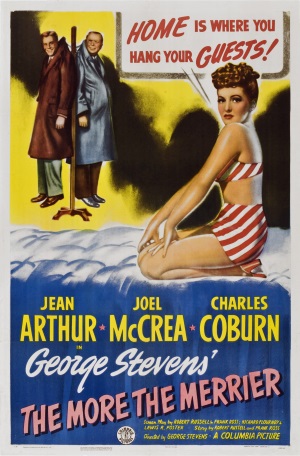
The More The Merrier represents the screwball genre adapting for the war years however this was at the end of the genre’s original run. I wonder why there were not more screwball comedies made during the war period? Did people become more cynical with the war or perhaps the genre was simply made for the depression era. Instead of taking on the establishment like the genre screwball did during the depression, The More The Merrier is supporting it. It is refreshing to see a propaganda film from the war years which is less gloomy and shows how common folk got on with their daily lives during the war.

My main flaw with The More The Merrier is Joel McCrea. He’s fine but that’s the problem, he’s only just fine; a serviceable actor who doesn’t leave a great impression. He’s the weak spot of a trio of characters who could have been much stronger with a more charismatic actor. Granted this was during the war and most of Hollywood’s big male leads were off in Europe kicking Hitler’s ass. Could Cary Grant have played the role instead, but perhaps a big star like that couldn’t play a role in he doesn’t show up until half an hour in. The trio of characters still manages to be fun with Jean Arthur playing the straight man and Charles Coburn as an immature and conniving old man who still seems like a kid at heart; while the romance between Arthur and MrCrea is still believable and handled very well as they spend the final third of the film quietly denying their feelings for each other.

Jean Arthur and Charles Coburn are one of the more unconventional screen pairings in Hollywood starring in three films together, just look at the morning schedule scene; comic choreographed brilliance and by far my favourite part of the film. When McCrea enters the picture though I feel it is never as strong. Also after you watch this movie you may find yourself saying “dam the torpedoes, full speed ahead!”, a lot.

The Gay Divorcee (1934)

The Old English Definition of Gay

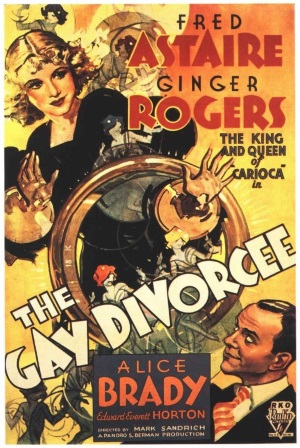
I had a period in which I was infatuated with the greatness that is Fred Astaire & Ginger Rodgers. Prior to this I often heard of them but I was occupied with later film musical of the 50’s. When I checked them out for myself I got it, oh boy did I get it. When together dancing or not, Fred and Ginger are in a world of their own and everyone else ceases to exist. Just look as Night & Day (my favourite Astaire and Rodger’s number), what could be more spellbinding? The Gay Divorcee is my favourite Astaire & Rodgers picture. This was their first film together as leads and yet a feel it gets everything right and I consider it a much better film than Top Hat which itself I find overrated.

I find the humour of The Gay Divorcee is more creative than that of Top Hat. Take the sequence in which Astaire finds Rodger in London by near impossible luck, then the two engage in a car chase into the countryside (how often do you get a car chase in a 30’s musical), and then in a wacky races type moment he goes ahead or Rodgers and gets road closed sign out of nowhere in order to stop her. Astaire’s stalker attitude could come off as creepy but he is charming enough to get away with it, making these moments morbidly funny. This whole sequence is so surreal and plays like a live-action cartoon as if the filmmakers are making fun of the film’s own highly improbably mistaken identity plot. This is much more clever than the handling of the mistaken identity plot in Top Hat. I don’t mean to completely undo Top Hat, I think it’s a good movie, just whatever Top Hat did I can’t help but feel The Gay Divorcee did much better. I’ve always championed Astaire’s unsung abilities as a comedian. His timing and line delivery is easily on par with the likes of Cary Grant; I wish he could have appeared in some non-musical comedies. Ginger Rodgers usually had a female companion throughout the series and I think Alice Brady is the best of them all with her histrionics; the sound of her voice alone cracks me up.

The Gay Divorcee may have slipped through the recently instated production code. If not then it certainly feels like a pre-code film, with sexual tension throughout and an air of scandalousness to the whole thing.

Fred and Ginger, they were gods!

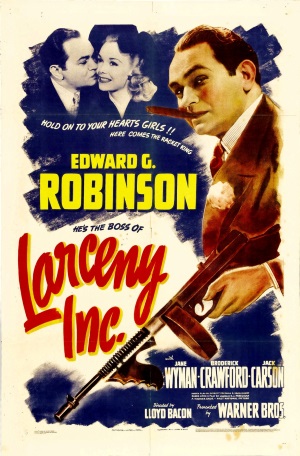
Larceny Inc. (1942)

Under Pressure

How can you resist a film like Larceny Inc once you’ve heard the plot? It’s one of those quirky film concepts I just love. A cocky criminal and his two buffoons buy a luggage store so they can dig their way into the bank next door. Perhaps the film’s greatest strength is how it plays out like a live action cartoon. Nothing ever goes beyond the scene in the moment; for example in one scene a set of oil pipes are burst during the digging process and the basement from which they are digging from is drenched in oil and yet this is never mentioned again. Even as one character who is not involved in the ban heist comes across the two drenched in the oil he bizarrely does not comment on their appearance; that’s the twisted cartoon world Larceny Inc incorporates. I’ve always thought actors from the 1930’s resembled cartoon characters with their exaggerated facial features and distinctive accents; very true with this cast including Edward G. Robinson, Jack Carson, and even a young Jackie Gleason; all live action caricatures.  Actors who emerged after the war generally didn’t have this and instead were actually more lifelike. You really get a sense of the world the movie takes place in with a street populated with such memorable and mostly ethnic characters giving the movie that Shop Around the Corner edge to it.

Maxwell aka Pressure’s gift wrapping has to be the comedic highlight of Robinson’s career; a comedy moment which couldn’t be timed more perfectly. His uttering of “$9:75”  is funny enough as it is but his pathetic attempt at gifting wrapping which follows had me in stitches. I also love Jack Carson’s attempt at hitting on Jane Wyman. This scene has nothing to do with the rest of the movie but has got to be the ultimate “skipping the pleasantries” monologue I’ve ever heard.

There are so many layers within Larceny Inc. Is the movie a celebration or an indictment on capitalism? The gangsters’ involvement in legitimate business is what makes them renounce their past ways but only after they’ve essentially been seduced and consumed by the capitalist system. Larceny Inc was released in 1942 just months after the US got involved in the war but the film’s production began prior to that with its themes of business and consumerism are completely counterproductive to the war effort, something I’ve noticed with many films released in 1942. There is also the irony that the gangster is the one who brings the community together and the authority figures in the movie are played as fools.

Larceny Inc can also join films like Rocky IV and Die Hard as Christmas movies which aren’t about Christmas, and Edward G Robinson dressed as Santa Claus? Sold!

Star Wars: The Force Awakens (2015)

Star Wars: The Next Generation

***This Review Contains Spoilers***

I find it harder with every passing year to take an interest in new release movies, and even I was more interested in newer films I would need them to sink in before reviewing. However, this is Star Wars we’re talking about! When it was first announced back in 2012 that a new trilogy of Star Wars movies was to be made, my initial reaction was “It will be better than the prequels, but will still suck”. The filmmakers had the gargantuan task of winning back all the cynical, jaded Star Wars fans like myself; I don’t think many people were jumping for joy when a new trilogy was announced. As more announcements about Episode VII came to light such as the film’s apparent use of practical effects and that it was going to be shot on film I compared it to a politician making false election promises; in other words, it’s a trap! Then came the first teaser and I couldn’t complain. It actually looks like what I want a Star Wars film to look like, but no, I’m not getting sucked in that easy! With the second teaser, I finally gave up; “shut up and take my money!”. While counting down the days towards this film’s release my love for Star Wars was reawakened.

I almost love The Force Awakens, I almost think it’s an excellent film. 80% of aspects in the film I am over the moon about and exceeded my expectations; 20% I am indifferent towards. As the movie begins there is no 20th Century Fox fanfare, but the silence over the LucasFilm logo works in its own way; plus at least there isn’t an insane amount of opening logos like most movies today. As soon as I seen “A long time ago…” and the opening crawl I was in full goosebumps mode. Although why does the crawl state “Episode VII” when the marketing does not? Due to this, I expected the crawl not to state the episode number, which means they’re acknowledging the prequels as canon, but whatever, those are in the past. The text in the crawl was perfect and the opening shot of a star destroyer hovering over a planet in the background, such striking imagery. The opening with the attack on the Jakku village actually reminded me of Apocalypse Now, surprisingly intense and even a bit violent. When Finn has the blood of another stormtrooper draped over his helmet, I already became emotionally invested in this character, and I haven’t even seen his face; if that’s not impressive then I don’t know what is. The landscapes of Jakku themselves had that sense of Laurence of Arabia grandeur and those shots of the downed star destroyers in the background are poster worthy material.

From the trailers, I got the impression the movie achieves the right balance between offering nostalgia but also giving us something new. The classic characters aren’t just there for nostalgia’s sake but they actually have important roles in the story. However if you told me that I would be raving more about the new characters as opposed to revisiting the old characters, I would have had the reaction of “yeah right!”. I can’t decide which character I love the most. Daisy Ridley without a doubt steals the show while her banter with Finn couldn’t be more fun to watch. Poe Dameron on the other hand, what a cool MF. He’s not necessarily the most complex character but he doesn’t have to be. He has that adventure serial, flyboy, pretty boy type charm; a guy you would just love to hang out with.

Captain Phasma, dam! I remember when I first saw her in the second trailer my instant reaction was, “Wow! that is freakin’ badass!”. She has the same type of appeal Boba Fett has, a ‘man with no name’ type who has few lines and only appears in a handful of scenes but leaves an indelible impression. I know this will sound like sacrilege to Star Wars fans but screw it, Captain Phasma > Boba Fett. I also loved the other notable villain General Hux, a character who is one dimensional in the best possible way. He’s just so delightfully evil and his speech on Star Killer Base in which he lays on the full Nazi vibes gave me the chills. I’m so glad they brought back the British bad guys, one of many aspects of Star Wars sorely missed in the prequels. To me, Star Wars isn’t Star Wars without generals with sinister English accents.

I wonder if Kylo Ren is intended to be a satire on fanboyism with his extreme idolisation of Darth Vader. Talk about a villain you feel sorry for, you condone his actions but completely understand why he does what he does. But what really fascinates me about Kylo Ren is the fact that he’s a whiny teenager, and when you think whinny teenager and Star Wars you probably think of Anakin Skywalker in Episodes II and III – except Kylo Ren is Anakin Skywalker done right. With Kylo Ren being the son of Han and Leia I can now say the Star Wars saga is a soap opera centered on the Skywalker/Solo family, making Star Wars the only soap opera to date I can say I like (well from Part IV onwards). Which brings me to my next point, Han Solo died! My favourite movie character of all time, killed by his own son. As soon as Han steps on that platform with no hand railings and a chasm below him I just knew this is it, he’s going to die. Chewie’s roar in response to witnessing Han’s death says it all; Han Solo (1977-2015). Luke Skywalker, on the other hand, is in the film at the very end for about 20-30 seconds and doesn’t speak, yet his appearance in the movie is still strangely satisfying. This along with Han’s death shows this movie has balls, and I respect it so much for that.

The Force Awakens is the darkest Star Wars film to date, even more than The Empire Strikes Back, but they still manage to counter this with the lightheartedness and the humour. Speaking of humour, I can say this is the funniest Star Wars film to date. Rey knowing more about the Falcon than Han and BB8’s using a lighter to give a thumbs up, comic brilliance.

So what am I indifferent about in The Force Awakens?  One of my issues with is the CGI standing out among the practical effects. The character of Maz Khanta for example, she seems like an interesting character but her computer-generated appearance takes me out of the film. Couldn’t she be a puppet or a person in a costume? I feel the character’s appearance could and should have been accomplished with practical effects. Yoda was a puppet in Episode I and CGI in Episode II, perhaps this trilogy could do this in reverse? Granted I am a practical effects purist (and of course I am overjoyed by the film’s extensive use of practical effects), and any use of CGI in a movie which is a follow up to a trilogy features the greatest and most memorable practical effects in cinema history is going to stand out. When I first saw Supreme Leader Snoke I was almost about to lose it. Are you kidding me? A giant humanoid who is 100s of feet tall in Star Wars? It was like nuke the fridge all over again. However, when we see Snoke is a giant hologram, I had a huge sigh of relief and even thought “that’s actually pretty clever”.  However, I do still find his CGI appearance to be problematic. I also wasn’t keen on Han escape scene; the CGI creature appeared rather generic and the action in the scene itself was not well executed.

The John Williams score itself does not particularly stand out. While it’s always nice to hear classic Star Wars themes again, the new compositions aside from Rey’s Theme are not very memorable. They get the job done but I doubt you’ll find yourself humming them like every piece of music in the original trilogy. Although the truth I wasn’t expecting any of the new compositions to stand out as John Williams hasn’t composed a truly great film score in my opinion since Catch Me If You Can.

Perhaps the film’s biggest fault is that it will never be the original trilogy, it will always be in its shadow; well for me at least anyway. The Force Awakens may grow on me more with when I see the bigger picture unveiled with the next two films, but I can say two hours flew by. I did check the time once, but because I didn’t want it to end. I was craving answers and wanted more. The movie leaves questions unanswered and lets your imagination fill in the blanks, unlike the prequels which spoon-fed information. I still want to see The Force Awakens again. Reviewing any Star Wars film is no easy task as I could literally write pages and pages of thoughts. Just like the original trilogy, I could take any scene and talk about it in depth and talk about every little moment or touch I loved.

In short: Star Wars is back baby!
The Prize (1963)

A Different Kind of Stockholm Syndrome

The Prize is my second favourite Hitchcock film he didn’t direct (my favourite being 1941’s All Through the Night). It’s not instantly engaging from the start as there is a lot of setting up to do but becomes more and more tense as the film progresses. In classic Hitchcock fashion, once the mystery kicks in your left scratching your head wondering if the protagonist just paranoid or is something fishy really going on.

I consider The Prize one of Paul Newman’s best films, giving him the opportunity to show off his not often exposed comedic chops. Newman is one of few select actors in which I can ask the question, “honestly, who doesn’t like Paul Newman?”; does there exist a more likable screen presence?  Likewise, Edward G. Robinson’s role is reminiscent of his part in The Whole Town’s Talking, playing a dual role of characters identical in appearance but with polar opposite personalities; while the hotel setting rings a bell of MGM’s own Grand Hotel some 31 years prior. plus when you set your movie in Sweden it seems inevitable that someone will mention Greta Garbo along the way. Hitchcock himself also never fully took advantage of the cold war. Torn Curtain, although I do think is underrated, is imperfect while Topaz is one of his dullest outings. It’s satisfying to see a superb Hitchcockian thriller with a plot about West vs. East.

North By Northwest has the auction scene in which Cary Grant makes a fool of himself to get caught by the police in order to get away from the bad guys; The Prize has the same scene but ups the ante with having it taking place during a nudist meeting and of course naturally of all the countries in the world to a nudist meeting, where else but Sweden. The Prize is not quite Hitchcock’s greatest hits but it’s the closet a film comes to being so. There are other allusions to other Hitchcock films including The Lady Vanishes, Foreign Correspondent, Saboteur, and Torn Curtain. Hang on, that one didn’t come until three years after this movie. Huh, was Hitchcock inspired by this Hitchcock clone/rip-off/ homage/whatever you want to call it. As far as imitations of someone else’s work goes it doesn’t get pulled off any better than this.

The Greatest Show On Earth (1952)

The Show Must Go On

***This Review Contains Spoilers***

The DVD release for The Greatest Show On Earth plays down its Academy Award win for Best Picture. Hang on, isn’t this supposed to be the highest accolade in the film world? Why would you downplay that your film won the award?  I guess Paramount are fully aware of the film’s reputation as one of the “worst Best Picture winners”. I normally have a rule when reviewing movies not to mention the Oscars because I feel it is so redundant to do so. “How did this beat ‘x’ picture?”, “Why didn’t ‘x’ get an Oscar nomination?” – such tiring statements. I believe Best Picture winners attract viewers to a film which they would unlikely watch otherwise and because of this many films get a bad reputation as “the film which beat such and such for Best Picture”.

The Greatest Show On Earth is one such film, made out to be worse than it is due to attracting an audience who would otherwise never watch it if it wasn’t for its Best Picture win. The Greatest Show On Earth is tons of fun; at times I had a carefree feeling that I was at an actual circus (minus the smell of elephant dung) with actual circus equipment being used for the movie’s filming. The Greatest Show On Earth beautifully captures this un-PC relic of another age (“you mean we all got to play in blackface?”) full of clowns, animals in captivity and human freaks. There is even an appearance of performers wearing costumes of Disney characters; good luck trying to put that in a non-Disney film nowadays! Likewise, the acrobatic scenes are suspenseful and you really get a sense of the scope and awe; the whole thing even feels like it has weight to it so I can forgive the odd jumpy edit. – The film packs a lot of material and dramatics into its runtime and I felt like I got my money’s worth.

You could look at The Greatest Show On Earth cynically and say it’s a commercial for Barnum and Bailey, well it’s a very entertaining commercial at that and a very informative one offering a documentary-like look at how the circus operates with the guidance of DeMille’s passionate narration. This was a change of pace to DeMille’s usual fare of historical and biblical epics but he still manages to throw some Christianity in there with the scene in which a priest and his Alter boys bless the circus train before it begins its season.

Tasked with Herculean effort of running a circus, you couldn’t get a more commanding choice than Charlton Heston in the Clark Gable type role as a man under great pressure to keep the operation running and pull the strings behind the scenes; not even a train crash or near-death deter him from putting on a show. However, when your movie stars James Stewart (albeit a supporting performance), isn’t any surprise he’s the best aspect of the film. I believe his role of Buttons the Clown is an underrated performance of his and one of his most tragic. He has a permanent smile on his face (really, his makeup never comes off at any point), yet has a dark, troubled past. Yep, it’s obvious symbolism but you can feel his pain throughout thanks to his quiet, subtle performance. As the movie progresses it takes a surprisingly dark turn, not only with the shockingly intense train wreck sequence (which really set a standard for special effects) but also the implication that Buttons, a former doctor had assisted his wife to kill herself. It’s very subtly implied but it’s still surprising that a mainstream blockbuster would have an assisted suicide subplot in an era dictated by the censorship of the Hay’s Code.