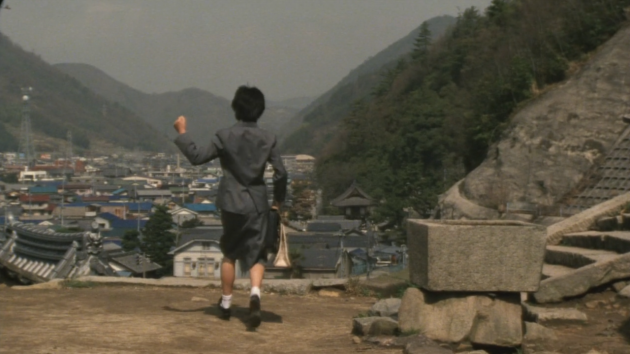
I only recently made a new addition to my vocabulary, “anemoia”; nostalgia for a time or place you’ve never known. A feeling I have experienced many a time before, but never had a word for until now. The Girl Who Leapt Through Time (時をかける少女/Toki o Kakeru Shōjo) is encapsulated in this specific feeling. Shot in director Nobuhiko Obayashi’s hometown of Onomichi (as part of his Onomichi trilogy), the film’s real-world locations create a tranquil yet painfully nostalgic representation of Japan’s Showa era and for parochial, small-town living. The film’s unnamed dwelling is full of traditional architecture and narrow streets, and although it is an urban setting, there is still a strong presence of nature within the setting. The film is even set during the cherry blossom season as if it weren’t already beautiful enough (although it appears many of the cherry blossoms have been superimposed into the image). Even the classrooms with their chalkboards and the townspeople’s use of analogue technology compound this blissful feeling. The film’s cinematography has a washed-out, hazy, dreamlike look, which, coupled with a melancholic, downbeat music score, evokes a sheer emotional anemoia, of which the closest film I can compare it to would be Cinema Paradiso.
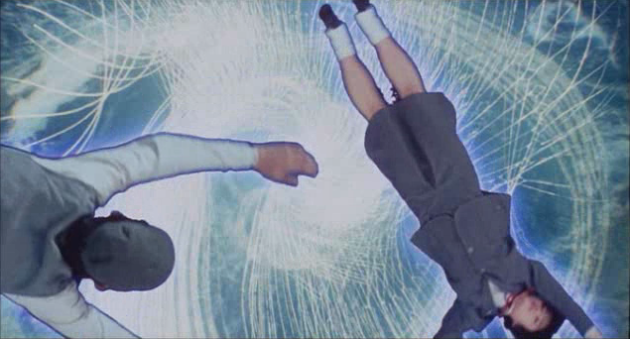
The Girl Who Leapt Through Time combines many visual styles. Not to the extreme which Obayashi did in his more popular film House, but still to an extent which showcases him as a unique auteur. The film opens with a school skiing trip, shot in dreamy black & white with a 4:3 aspect ratio. The sequence perfectly captures that studio backlot look from the 1940’s in particular, bringing to mind snowy scenes from Citizen Kane, or It’s a Wonderful Life (helping me to suspend my disbelief that one student states on the top of the mountain that he forgot to bring his skis). By stark contrast, on the other hand, the film’s big special effects showcase comes in the form of a time-travelling montage which features extensive use of moving time lapses (which personally bring me back to the early days of YouTube content creation) and an amalgamation of practical effects resembling a 1980’s music video.
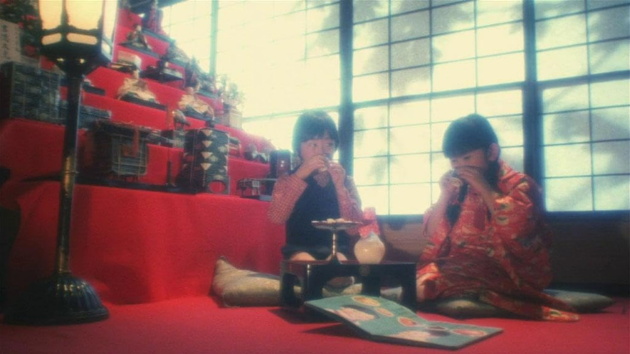
There is the irony that a movie which invokes such a feeling of longing for a different time and place is itself a movie about time travel. Kazuko Yoshiyama (Tomoyo Harada) unknowingly gets the ability to travel through time after exposure to lavender in the school science lab, to which she finds herself reliving Monday, 18th April (the time loop plot device was common in Japanese media before becoming popularised in the West through Groundhog Day). The in-universe logic of the film’s time travel mechanics is very vague, using lavender as a symbolic connection to the poppy field scene from The Wizard of Oz. These schematics are beside the point, however, as Kazuko has to use her knowledge of the day she has previously lived to save a friend from the danger (of that natural phenomenon etched into the Japanese physique), an earthquake. Likewise, in a particularly endearing if questionable scene, Kazuko travels back in time to witness a moment in which she and her childhood friend Fukimachi are playing when they accidentally cut their hands on the shards of a broken mirror. They immediately do the sensible thing and exchange bodily fluids via their open wounds. One interpretation of this moment is in relation to the Japanese idea of ketsuekigata, a widely popular belief system that blood type can be used to gauge compatibility between individuals. Either way, kids, don’t do this at home.
Harada’s youthful charm and ability to project a sense of innocent teenage romance within a love triangle help elevate the film above the two male leads, whom I do find very forgettable. The more significant of these two, Kazuko’s friend Fukimachi (Ryôichi Takayanagi), reveals he is from the year 2660, has a Ph.D pharmacy and informs us green planets will be scarce in the future due to an explosion in the population. This terrifying dystopian future, in which we rely on big pharma for our survival and hashtag, “Robert Malthus was right” is terrifying enough, but Kazuko is told all her childhood memories are all lies, created by Fukimachi. She is told she must lose her own feeling of anemoia (although the ending and her career choice would suggest this might not be the case).
This loops around to a piece of foreshadowing from the film’s beginning in which Kazuko states, “Science can be so unfeeling at times”. Fast forward to the future date of Saturday, April 16th 1994, and Kazuko has become a pharmaceutical researcher, a rather dowdy-looking woman who chooses to dedicate herself to a field of research over a love life. Science may be unfeeling, but the ending of The Girl Who Leapt Through Time is itself hard to stomach in its sheer melancholy. With her chosen path in life, it is stated that Kazuko turns down dates, never dresses up or wears make-up, and her mother even asks, “How can she be a bride if she keeps going like this?”. Even an unmistakably early 80’s, synth-heavy track as the final song over the fourth-wall-breaking end credits, doesn’t quite shake this feeling of sheer emotional weight.
What struck me most on my first viewing of House (or Hausu)was that alongside the film’s sheer over-the-top, phantasmagoric madness, I found the whole thing to be weirdly endearing. Initially, I was concerned I was getting into something awfully pretentious but I was able to surrender myself to the fact that I was watching a film which employees a different filmmaking technique in just about every scene. House has one of themost cliché of horror movie premises, yet it gives way to one of the most unique and weirdest viewing experiences with descriptions ranging from “Evil Dead on steroids” to “a Scooby-Doo episode directed by Mario Bava” – perhaps no other film holds a better claim to the title of being “one wild and crazy ride”.
Japan’s reputation for “WTFness” could make House a film easy to dismiss, however, there is a method to the madness. Director Nobuhiko Obayashi was a director of commercials before taking on the mantle of House, and the artifice of commercials is all over the film alongside (pre-MTV) music video style editing, of which I’m sure it’s no coincidence that House was shot using the 4:3 aspect ratio – the aesthetics of House are all about the embrace of artifice. A film of contradictions, House is an art-house film (or art-hausu film one could say, ba-tum-tiss!) and one which was reportedly a huge success with the youth demographic in Japan upon its release (with the film’s extraction of sex appeal from its young female stars as well as nudity in several scenes may have got many young men into the theatres). In this regard it’s also worth mentioning House stands out as it is uncommon for Japanese films to have an English language title. Yet at the same time House symbolizes a return to tradition, a rejection of realism in 1970’s cinema. Right from the opening prologue, the movie proclaims in the vintage Broadway font what you are about to see is “A Movie Presentation”. This is part of the reason why beyond its scenes with killer futons, man-eating pianos and decapitated heads biting girls on the derrière, House is as I previously mentioned, weirdly endearing – the director’s love for cinema comes through and feels like a celebration of the medium. If I were to compare House to another film it would have to be Buster Keaton’s Sherlock Jr. Both films celebrate the art form with their use of special effects which blur the line between reality and fantasy with both also featuring a movie within a movie. House has a Technicolor-look reminiscent of the work of Jack Cardiff with its use of deep, saturated colour with the film’s colour scheme remains largely consistent throughout with its use of oranges, reds and blues and being a horror picture, it does have that autumnal/Halloween vibe (even though it is set during the summer). Speaking of, as a horror film is House actually scary? Well, this measure is subjective of course but I did personally jump at the reveal of severed head of the character Mac as well as Gorgeous’ giant profile suddenly entering to the screen from the right.
House is like a feature-length dream with its mad array of images. The images from the film were conjured from the mind of a child, Obayashi’s pre-teen daughter Chigumi Obayashi (who does receive a conceptual credit and even has a cameo in the film as a shoemaker). I am dubious of having a child being a film’s creative consultant since the last movie I saw to do so was those dreadful Robert Rodriguez Spy Kids films but in House, this influence works and another aspect which makes the film endearing. To anyone who has never seen House, it’s difficult to put into words just how insane a film this is without sounding melodramatic. This encyclopedia of movie storytelling and its array of practical special effects wizardry is a joy to behold from primitive blue screen to the use of stop motion – there are a few films in which an obscene amount of effort is put into every shot. On the other hand, there are sections of House which do have a chilled-out nature to them and the cheesy vibes of Beach Party film. Just a warning that several sequences in the film do contain strobe lighting effects (as if the Japanese weren’t content enough with giving people seizures through Pokémon episodes). Upon my third viewing of House, I did find myself becoming more desensitized to its bizarre nature and more understanding the filmmakers’ mindset on how they could have created something like this. That said, where Mr. Togo’s transformation into a pile of bananas and the bear wearing the chef outfit fit into the grander scheme of things I can’t explain. I guess you got to have some randomness for randomness’ sake.
House follows seven girls each named after a single personality trait- Gorgeous, Kung Fu, Prof, Fantasy, Mac, Sweet and Melody. At the beginning of their summer break, they decide to spend some time at the country house of Gorgeous’ aunt, where all is not what it seems. The story does play as an inverse of Snow White and The Seven Dwarfs, seven girls each defined by a single personality trait, show up at a house in the middle of nowhere which is in need of cleaning, owned by an old woman who lives alone. Of the ensemble, Gorgeous is the closet to the film having a protagonist as she has a clearly defined arc, beginning with a subplot involving her father attempting to bring a stepmother into the family and freeing his daughter from domestic chores such as ironing his shirts in a story right out of a Yasujirō Ozu film. Even in the film’s opening scene, a teacher mentions how she is having an arranged marriage during the summer, a topic often explored in Ozu’s work. The only girl in the group named after a purely negative trait (and of course, she dies first) is the gluttonous Mac (derived from the English word “stomach”), although fantasy itself holds its negative aspects, My favourite of the group however has to be alpha in the form of Kung Fu, whose speciality skill leads to several very humorous (whether intentional or not) fight scenes against an array of moving objects.
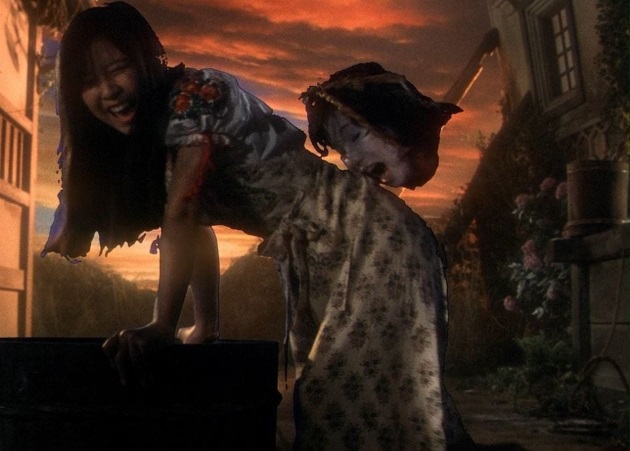
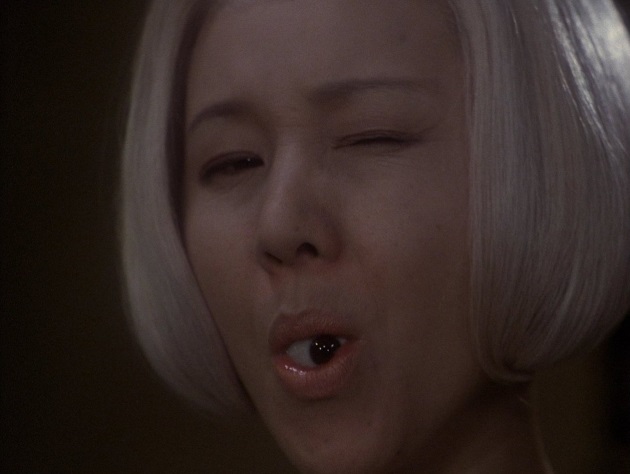
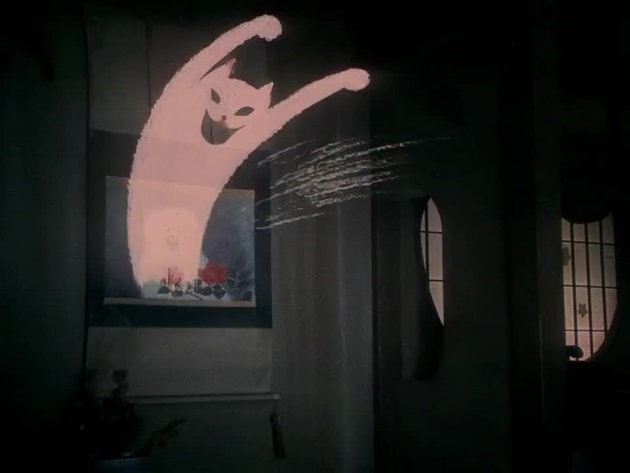
Acting as a mascot for House with its prominence in promotional material is the white ragdoll cat that joins the girls on their adventure (good kitty!). Cats hold a supernatural significance in Japan and it’s evident the cat in House is doing the bidding of a witch, even preventing Mr. Togo from joining the girls at the house to potentially rescue them. This witch in question is the aunt (Yōko Minamida) herself who proves to be an interesting figure. She has an ominous ghostly look to her and is portrayed in the mould of the classic Yurei, a ghost from Japanese folklore that cannot pass onto the afterlife. She is also vampiric in nature, wearing tinted glasses when going outside, and feeling unwell after being in the sun not to mention the interior of her house is very dark. Oddest of all, she feels revitalized by the presence of the girls which allows herself to not require the use of her wheelchair. The aunt is a Willy Wonka-like figure and the house is her factory as the girls are taken out one by one by the house itself, much of this done through the watchful eye of Gorgeous assuming the mantle of her aunt, becoming possessed by her in act of metamorphosis. Like the kids in Willy Wonka And The Chocolate Factory, it’s not made clear if the girls are actually killed literally or just in a metaphorical sense. Usually, in slasher films, the young people are killed as a comeuppance for their promiscuous actions, but do the girls in House deserve what they receive? One of the film’s themes and one which is confirmed by the director is how the trauma of World War II still affects the aunt whose finance never returned from the war and correspondingly how the seven girls take their peacetime living for granted. To quote Obayashi; “These girls born after the war and therefore unaware of how precious peace is, come to the house on summer vacation. The old woman’s bitterness about the war turns into an evil spirit and devours the girls”. This taking of peace for granted is showcased during the movie within a movie, in which a flash from a camera cuts to an atomic cloud, to which one of the girls makes the trite comment, “That looks like cotton candy”. This is at least the case with the subtitles on the US Criterion Collection release. On the UK Masters Of Cinema release, there are no subtitles on this shot even though giddy chatter from the girls can be heard. Speaking of subtitle differences between these two aforementioned releases, in the scene introducing Gorgeous’ father, a film composer who has just returned from Italy after working with Sergio Leone, his line of dialogue in the Criterion release states the rather unbelievable comment “Leone said my music was better than Morricone’s”. However, in the Masters Of Cinema release, the line is the less dramatic “Both Leone and Morricone liked it very much”. Is someone taking liberties in the translation process?
Of the various interpretations of House, that which strikes me the most is the film being a coming-of-age tale of Gorgeous’ urge to stay a young woman and refusal to enter womanhood. As the house eats the young girls, blood erupts from it, the blood of menstruation – a symbol of womanhood triumphing over youth. It’s also worth noting the blood in question comes from the cat, an alternative name for a cat is a…, ok you know what I mean. Likewise, when people are young they will have certain friends and as they become older they may move on from these friends as a result of maturity. Gorgeous’ dying friends can be seen to represent this while her stepmother going up in flames in the film’s final scene could be viewed as her lack of need for a mother figure in adulthood. I have read theories bringing this theory to greater extremes of analyses, in particular, an extensive write-up on the now defunct (but thankfully archived) IMDB boards in which a user by the name of nemuro8 proposes the seven girls all represent aspects of puberty (I’m not sure if I buy into it but it’s food for thought); “Fantasy represents naivety and the fear of the change. Mac represents hormonal changes with her increased appetite. Sweet represents the desire to fill expectations and the role of domestic life. Melody represents creativity and the desire to have fun. Kung-Fu represents courage and brashness. Prof represents logic and leadership. Gorgeous represents vanity and beauty.”
The soundtrack to House (which was released before the film had even entered production) deserves a review in its own regard as it works as a cohesive album rather than just a collection of songs (with most but not all of the tracks you wouldn’t guess are from a horror film). The jovial main theme of the film has a section with a superb synthesized rendition of the melody, which is only heard briefly in the film itself. Hungry House Blues on the other hand is a delta blues style track that only appears very briefly in the picture, however, this version on the soundtrack is a whooping 6 minutes long complete with plenty of slide guitar action and even has vocals in the style of a 1930’s Mississippian black man (who provided these vocals?). Buggy Boogie is a piece of early ’60s, rockabilly cheese while The Beach Boys style Cherries Were Made For Eating is a real uplifting, banger of a choon, provided by the band Godiego (whom makes a cameo in the film as the song is being played). Eat is in a way the defacto theme of Kung Fu, as the piece is played every time she gets involved in her trademark skill – a good piece if you need a quick dose of adrenaline and the one track which has an undeniably funky, 70’s sound. In The Evening Midst is the most profound track and the real centrepiece of both the film and album, an instrumental played by Melody several times throughout the film which acts as a relief to the horror surrounding it. The track feels similar to the piano melodies from David Bowie’s Hunky Dory and ends on a beautiful crescendo (it’s also worth noting, this piano melody does bear a striking resemblance to the piano riff on the song Welcome to the Black Parade by My Chemical Romance). The final track of both the album and film is titled House Love Theme, this Beatles-like calm after the storm which feels reminiscent of Abbey Road side B. This is the only song in House which actually features Japanese lyrics of which I am unable to find a translation of thus I can’t comment if the lyrics actually hold any thematic relevance to the film.
House is the kind of film to be watched on the big screen at a midnight showing alongside the likes of The Rocky Horror Picture Show. It does feel like was designed and destined to become one of the ultimate cult films. I do find myself fascinated by films such as this which remained unknown in the west for decades before obtaining a mass following. Of the film’s 149 reviews on IMDB, only 14 were written prior to the film’s first North American release in 2009. It makes you wonder what’s still out there…
](https://satinyourlap.com/wp-content/uploads/2026/03/mv5bmjc2yjfkmgqtnzizns00mtq3ltlhmdqtnwmymdazzmq5mznkxkeyxkfqcgc40._v1_fmjpg_ux1000_.jpg?w=300)
![House [ハウス/Hausu] (1977)](https://satinyourlap.com/wp-content/uploads/2022/10/resize.jpg?w=300)