](https://satinyourlap.com/wp-content/uploads/2026/03/mv5bmjc2yjfkmgqtnzizns00mtq3ltlhmdqtnwmymdazzmq5mznkxkeyxkfqcgc40._v1_fmjpg_ux1000_.jpg?w=300)
Absolute Anemoia
***This Review Contains Spoilers***
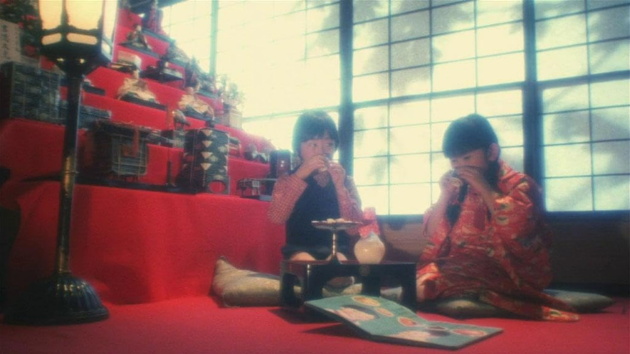
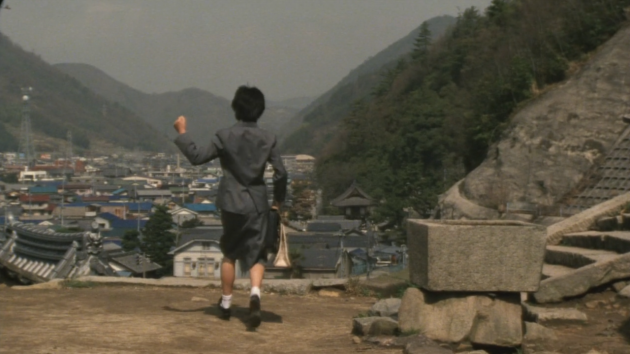
I only recently made a new addition to my vocabulary, “anemoia”; nostalgia for a time or place you’ve never known. A feeling I have experienced many a time before, but never had a word for until now. The Girl Who Leapt Through Time (時をかける少女/Toki o Kakeru Shōjo) is encapsulated in this specific feeling. Shot in director Nobuhiko Obayashi’s hometown of Onomichi (as part of his Onomichi trilogy), the film’s real-world locations create a tranquil yet painfully nostalgic representation of Japan’s Showa era and for parochial, small-town living. The film’s unnamed dwelling is full of traditional architecture and narrow streets, and although it is an urban setting, there is still a strong presence of nature within the setting. The film is even set during the cherry blossom season as if it weren’t already beautiful enough (although it appears many of the cherry blossoms have been superimposed into the image). Even the classrooms with their chalkboards and the townspeople’s use of analogue technology compound this blissful feeling. The film’s cinematography has a washed-out, hazy, dreamlike look, which, coupled with a melancholic, downbeat music score, evokes a sheer emotional anemoia, of which the closest film I can compare it to would be Cinema Paradiso.
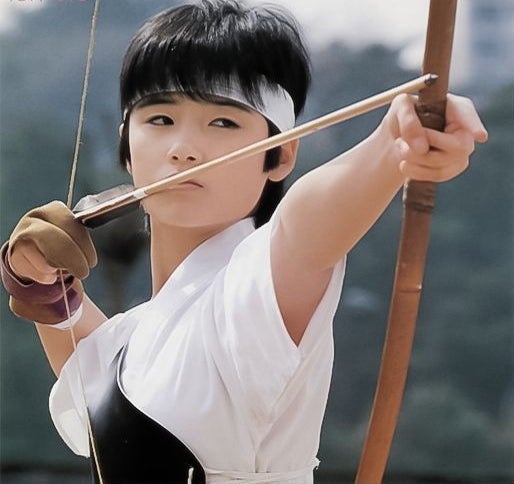
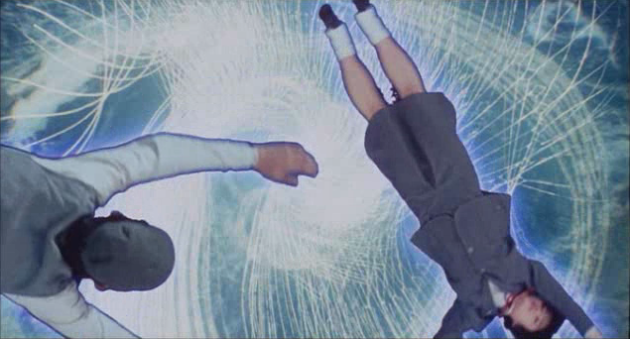
The Girl Who Leapt Through Time combines many visual styles. Not to the extreme which Obayashi did in his more popular film House, but still to an extent which showcases him as a unique auteur. The film opens with a school skiing trip, shot in dreamy black & white with a 4:3 aspect ratio. The sequence perfectly captures that studio backlot look from the 1940’s in particular, bringing to mind snowy scenes from Citizen Kane, or It’s a Wonderful Life (helping me to suspend my disbelief that one student states on the top of the mountain that he forgot to bring his skis). By stark contrast, on the other hand, the film’s big special effects showcase comes in the form of a time-travelling montage which features extensive use of moving time lapses (which personally bring me back to the early days of YouTube content creation) and an amalgamation of practical effects resembling a 1980’s music video.
There is the irony that a movie which invokes such a feeling of longing for a different time and place is itself a movie about time travel. Kazuko Yoshiyama (Tomoyo Harada) unknowingly gets the ability to travel through time after exposure to lavender in the school science lab, to which she finds herself reliving Monday, 18th April (the time loop plot device was common in Japanese media before becoming popularised in the West through Groundhog Day). The in-universe logic of the film’s time travel mechanics is very vague, using lavender as a symbolic connection to the poppy field scene from The Wizard of Oz. These schematics are beside the point, however, as Kazuko has to use her knowledge of the day she has previously lived to save a friend from the danger (of that natural phenomenon etched into the Japanese physique), an earthquake. Likewise, in a particularly endearing if questionable scene, Kazuko travels back in time to witness a moment in which she and her childhood friend Fukimachi are playing when they accidentally cut their hands on the shards of a broken mirror. They immediately do the sensible thing and exchange bodily fluids via their open wounds. One interpretation of this moment is in relation to the Japanese idea of ketsuekigata, a widely popular belief system that blood type can be used to gauge compatibility between individuals. Either way, kids, don’t do this at home.
Harada’s youthful charm and ability to project a sense of innocent teenage romance within a love triangle help elevate the film above the two male leads, whom I do find very forgettable. The more significant of these two, Kazuko’s friend Fukimachi (Ryôichi Takayanagi), reveals he is from the year 2660, has a Ph.D pharmacy and informs us green planets will be scarce in the future due to an explosion in the population. This terrifying dystopian future, in which we rely on big pharma for our survival and hashtag, “Robert Malthus was right” is terrifying enough, but Kazuko is told all her childhood memories are all lies, created by Fukimachi. She is told she must lose her own feeling of anemoia (although the ending and her career choice would suggest this might not be the case).
This loops around to a piece of foreshadowing from the film’s beginning in which Kazuko states, “Science can be so unfeeling at times”. Fast forward to the future date of Saturday, April 16th 1994, and Kazuko has become a pharmaceutical researcher, a rather dowdy-looking woman who chooses to dedicate herself to a field of research over a love life. Science may be unfeeling, but the ending of The Girl Who Leapt Through Time is itself hard to stomach in its sheer melancholy. With her chosen path in life, it is stated that Kazuko turns down dates, never dresses up or wears make-up, and her mother even asks, “How can she be a bride if she keeps going like this?”. Even an unmistakably early 80’s, synth-heavy track as the final song over the fourth-wall-breaking end credits, doesn’t quite shake this feeling of sheer emotional weight.

