![Late Spring [晩春/Banshun] (1949)](https://satinyourlap.com/wp-content/uploads/2022/02/flyer_large.jpg?w=300)
Sometimes It Snows In April
***This Review Contains Spoilers***
For some directors, it can take time before they hit their full stride. Alfred Hitchcock had been directing movies for 25 years prior to directing his most iconic works in the 1950s and ’60s. Correspondingly, Japanese filmmaker, Yasujirō Ozu had been directing for 22 years before he made Late Spring, in my opinion, his magnum opus (although I know others will argue in favour of Tokyo Story) and the beginning of his golden age in which he created a profound series of films about Japanese middle-class domesticity (whereas his work pre-1949 tended to focus more towards poverty-stricken families).

Late Spring is also the first entry of The Noriko Trilogy (alongside Early Summer and Tokyo Story), with all three films starring Setsuko Hara, often named The Eternal Virgin in her country of origin, and it’s not hard to see why. I would defy anyone to watch Late Spring and not fall in love with this capital G Goddess of feminine virtue – with her angelic, shy demeanour emanating a slightly bent over posture alongside a smile that could kill. Late Spring showcases her as an actress of amazing depth and able to convey such deep emotional range in the role of Noriko Somiya. There is somewhat of a contradictory nature to the character of Noriko when it comes to her conservative views. Noriko finds her uncle’s remarrying to be “distasteful” and “impure” and not afraid to say it to his face (albeit in a kindly manner) and can’t bear the idea of her widowed father doing the same thing. Hara is able to portray a character of such saintly purity (it’s even mentioned she does not drink) without it ever becoming sickenly so. Yet contradicting this is the reluctance she holds to get married herself.

The relationship Noriko shares with her widowed father, Shukichi (Chishū Ryū) is both odd and endearing. She is unemployed and takes joy in looking after her old father, acting as a housewife minus any incestuous implications. Details presented in Late Spring are scant about the character’s histories, allowing the viewer to fill in the blanks. I can assume the young woman would be inclined to share this kind of a relationship with her father due to their time during the war. It is mentioned during the course of the film that Noriko endured forced labour during this period and “had to run around to get food on her day off”, and is required to receive regular blood tests as a result. Chishū Ryū on-the-other-hand feels like he was born an old man, made to look older than he was in all three films of The Noriko Trilogy, and convincingly so.

At the age of 27 and still single, Noriko is approaching the “late spring” of her shelf life, reaching the age she would no longer be considered marriageable, but is unwilling to part from the status-quo arrangement she has with her father. Like a number of Ozu films, the story of Late Spring centers around arranged marriage, although anathema to viewers in the west, it does not detract from the universality of his work. A scene that really hits home for me is that in which Noriko’s aunt Masa (Haruko Sugimura) has a talk with Noriko about marrying. We’ve all been there, when an elder tells us to stop what we are doing and sit down to have a serious chat in which we feel uncomfortable but deep down we know they are correct even if one, like Noriko, signifies their objections but later comes to an eventual acceptance. Noriko’s arranged partner, Mr Kumataro Satake (aka Bear Boy), remains an off screen character, with the only detail passed onto the viewer about his physical appearance is that he looks like Gary Cooper, especially around the mouth but not the top half – allowing the viewer to once again fill in the blanks.

On a further personal note, I first watched Late Spring at the age of 28, only 1 year older than the character of Noriko, and despite this being a film about a young Japanese women’s pressure to get married in the years following the war, it still spoke to me on the basis that life is passing you by, that change is an inevitable part of life with the pain and heartache which comes with that must be endured. When Noriko speaks to her father at the end of a trip to Kyoto just before the wedding, she speaks of how “I just want to be with you, like this. I don’t want to go anywhere I’m happy being with you like this.” – Just ensure you have a box of Kleenex handy.
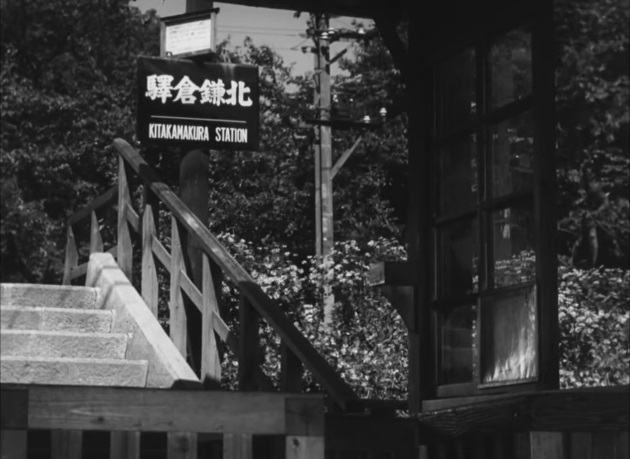
When watching any film of Ozu’s later period, the viewer will immediately be put into a great sense of ease with his trademark use of pillow shots (two or three quiet compositions usually showing an architectural detail, a banner in the wind, a tree or the sky) alongside the ever tranquil music scores. Unique however to the opening pillow shots of a railway station in Late Spring is the quaint, English feel to it, aided by the images of a gentle breeze in the leaves and the sound of birds chirping. If I was shown this opening out of context, I could swear it was neo-realist footage of a quiet, remote part of the English countryside. Likewise, the geometric nature of the interior of Japanese homes along with Ozu’s unique style of composition with use of the so called tatami shot is very pleasing to the eyes. This look into another culture extends to the film’s documentary-like aspects as we are treated to slices of everyday post-war Japanese life from kids playing baseball to the inclusion of a Noh play. The westernization present in Japanese films from this period can come off as a shock for first-time viewers of Japanese cinema such as the sight of Tokyo’s classical European architecture as seen in Late Spring.
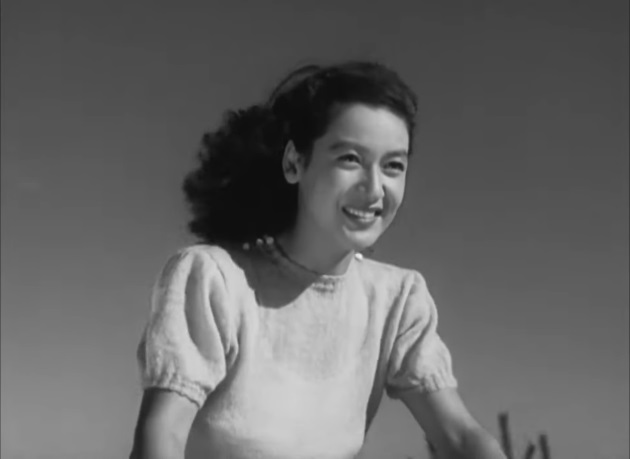
The scene in which Noriko and Hattori (Jun Usami) go for a recreational cycle by the seaside is the cinematic encapsulation for the joy of living. A scene bustling with freedom and a lust for life with the sight of a smiling Setsuko Hara with her hair blowing in the wind alongside the quirky, upbeat music which accompanies the scene should be in the pantheon of cinema’s most iconic moments. It also contains the unexpected but memorable inclusion of a Coca-Cola sign featured prominently in the foreground – one of the most memorable pieces of product placement I’ve seen in a film. This sign along with another road sign in English warning that the weight capacity of the bridge the duo are riding over is 30 tons (irrelevant information for the two cyclists but necessary for any military vehicles to pass over) could be interpreted as signs to the otherwise unseen US occupation. Concurrently, I believe it’s not unreasonable to assume that Aya’s (Yumeji Tsukioka) ex-husband of whom she speaks of throughout the course of the film is a US serviceman. Aya refers to him by the name “Ken”, which Shukichi assumes is short for “Kenkichi” however Aya never corrects him. The other significant clue is Aya’s difficulty in sitting in a traditional Japanese manner without her legs getting numb, suggesting she has become more used to the western manner of sitting.

The Wikipedia page for Late Spring is bizarrely long and extremely detailed, more famous films have less in-depth articles – the work of an eager fan perhaps? In my research, I have found Late Spring only received its first home video release in the United States in 1994 and the mass availability of the films from this master of cinema has only become reality within the last decade. Perhaps the discovery of Yasujirō Ozu‘s work in the west outside of film circles has only begun?
![Floating Weeds [浮草/Ukikusa] (1959)](https://satinyourlap.com/wp-content/uploads/2021/09/floating_weeds-149228130-large.jpg?w=300)


 Sat In Your Lap