Fours a Crowd (1938)

Release the Hounds!

***This Review Contains Spoilers***

Errol Flynn, Olivia de Havilland and Rosalind Russell in a screwball comedy? These are the kinds of cast ensembles which unleash the inner fanboy in me. Errol Flynn rarely got the chance in his career to perform comedy and here he proves he was cable of doing Cary Grant-esque comedy on the same level as well, Cary Grant. Sadly Four’s a Crowd’s lack of box office success prevented Warner Bros from putting him in more comedies

Although The Women is seen as the film which launched Rosalind Russell as a fast-talking comedic actress, Four’s a Crowd is the first film in which she plays such a character and her first turn as the working career woman (or “newspaper man” as she refers to herself here) which became synonymous with shades of Hildy Johnson coming through. She takes full advantage of the role, stealing the show with her impeccable timing which reportedly made Olivia de Havilland envious. De Havilland though is tasked with playing a dim-witted character which she performs without coming off as annoying as such characters can easily be.

Four’s a Crowd owes a certain debt to Libeled Lady featuring some similar plot trends and themes with its slam on the upper classes, the socialite lifestyle and the desperate lengths newspapers will go to in order to get a story and control the narrative. Even the opening title sequence is taken from Libeled Lady in which the cast do the same arm in arm walk but is full of moments of inspired zaniness to distinguish itself. The model train sequence which lasts for 16 minutes had to have come from creative minds; plus what’s funnier in an innocent, cute kind of way than grown men playing with model trains. However, there is one moment in Fours a Crowd which is one of the most bizarre gags I’ve ever seen in a film in which after escaping from a pack of guard dogs to the other side of a gate, he grabs one of the dog’s legs and bites it. I still don’t know how to react to it, whether I should laugh or be horrified or both! The plot gets very confusing very fast but in a good way culminating in a finale in which Errol gets the wrong girl at the end! Although the manner in which this happens is screwball antics at its finest.
The Divorce of Lady X (1938)

Heathcliff and Cathy’s Other Film

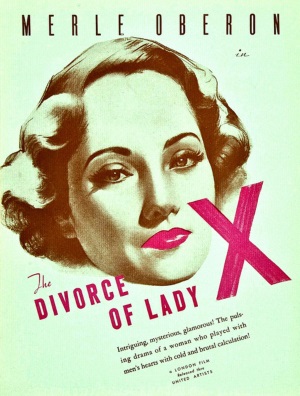
The Divorce of Lady X stands out from other screwball comedies for several reasons. Firstly it’s one of the few screwball comedies filmed in Technicolor which is complemented by the complimented by the luscious set design and brightly coloured ladies costume design. I do love that night club with its dreamlike painted backdrops as well as the miniature work of Trafalgar Square for the film’s opening shots (even if there are a bunch of empty buses driving). Second, it’s the only British screwball comedy I’ve come across to date, putting a British spin on this distinctly American genre. It’s fun watching typical screwball situations with an entirely British cast, set in Britain and with very British lines of dialogue (“You got marmalade all over your newspaper”).

Third and by far most importantly in what has to rank as one of the most bizarre of pre-stardom roles, it stars Laurence Oliver. Yes, the master of Shakespearean tragedy, perhaps the most respected and dignified actor of the 20th century as a stuffy gent who at first is delightedly full of himself but soon gets into all sorts of crazy shenanigans at the mercy of a screwy dame.  Merle Oberon plays one of the most ruthlessly manipulative characters I’ve seen in any film as she is able to weasel her way to get anything out of this man – the type of dame who destroys civilisations. Thus it doesn’t come as a surprise that Oliver goes head over heels for her despite all the anguish she causes him, likewise her previously having four husbands doesn’t help matters (also, that improvised cape made from a bedsheet she wears is such a brilliant touch). The chemistry between the performers works seamlessly and is aided by the sexual tension and undertones.

The first act of The Divorce of Lady X is one big farcical sequence centered around the sexual politics of the time; the fact that an unmarried man and woman sleeping in the same room was considered scandalous, even if there are two separate beds. This ties in nicely with how film critic Andrew Sarris defines the screwball comedy genre, “a sex comedy without the sex”.

Dinner at Eight (1933)

Guess Who’s Coming to Dinner

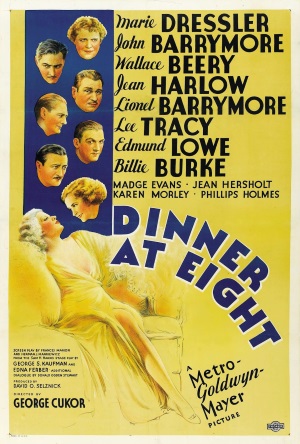
Ah, the 1930’s. No decade in cinema has since captured such an aurora of class and sophistication from the clothes worn to the way people talk; a world so removed from our own. It feels like there is no other time period in which it was as easy to make a movie about rich people and their rich people problems without it coming off as a metaphorical dick waving display of wealth. There are few better representations of this than Dinner at Eight. With the heavenly, dream-like music from the film’s opening titles; the viewer is transported to a world long, long gone. All of the stories in Dinner at Eight have tragic, to say the least, but Billie Burke as the socialite holding the impending dinner helps bring comic relief to the proceedings with her histrionics as well simply the sound of her voice. Aside from the largely carefree Burke, the rest of the characters don’t have much to look forward to with their impending affairs, bankruptcy, failing careers and illnesses.

John Barrymore’s story is my favourite; the quietly tragic demise of washed-up film star Larry Renault. His tender love scenes with Madge Evans are largely the opposite of the grandiose interaction with Greta Garbo in Grand Hotel; this is far more down to Earth. It’s not apparent when Renault first appears just what a bad state his career is in. As his segment progresses he becomes more and more pathetic as he becomes increasingly drunk and we learn more about his current state that he is only being offered a bit part in a play, he only has seven cents on him and the ultimate blow when his manager tells him he’s been a joke for years and never taken seriously as an actor; he had his good looks but he doesn’t even have that anymore. The subplot is prophetic of Barrymore’s own future as he spent his last few years as a washed-up actor and succumb to alcohol. There are hints in his performance to the egomaniac he would play the following year in Twentieth Century with his hotel room being littered with photographs of his own profile. With its haunting cinematography, Renault’s final outcome had me holding my breath with part of me wishing this could be its own film; a sort of predecessor to the story of Norman Maine in A Star Is Born.

The other storyline which particularly strikes me is Edmund Lowe’s. Once his wife confronts him about his ongoing affair with Jean Harlow, the two have a long serious chat in which she is completely understanding and forgives him. A stark contrast to any modern romantic comedy in which two characters would break up after a lengthy argument of one has betrayed the other, then get back together 20 minutes later. Are modern romantic comedies just so contrived and unreflective of real life, was adultery less frowned on back then or is it just a pre-code thing?

The early 30’s seems to be the one brief period in cinema history in which there was a number of older aged movie stars who box office draws; Wallace Beery, Marie Dressler, John Barrymore, Lionel Barrymore. There has never been another decade like it.

Continental Divide (1981)

The Continental

***This Review Contains Spoilers***

Early during Continental Divide as I was gradually enjoying the film more and more and becoming emotionally invested in its two characters (very emotionally invested I might add), storm clouds began forming over me. I came to the realisation that at some point the movie was going to pull of my least favourite movie cliché, the liar revealed. You know, the woman finds out the man isn’t what he claims to be, after a big monologue about how betrayed she feels, they break up, cue the sad montage music but 20 minutes late they forgive each other and live happily ever after, the end.

Thus it was a huge sigh of relief when Blair Brown’s (not the former British government cabinet) Nell Porter discovers John Belushi’s Ernie Souchak (a name which sounds like it’s taken from a 1930’s newspaper comedy) is secretly writing a news piece on her after he agreed not to during this early point in the film. They don’t argue about it, she happily accepts it. How about when Ernie discovers Nell has been meeting a man in the wilderness purely for sexual intercourse and not for a passionate relationship, does he freak out? No, he has no problem with it and that’s the way it should be! That’s one of the things I loved most about Continental Divide, it was like a big middle finger to the inane and contrived clichés which plague modern-day romantic comedies.

Continental Divide is one of my favourite man and woman alone in the wilderness type movies, in this screwball comedy for the 1980’s; which at the time advertised Belushi and Brown as the next Hepburn & Tracy. With the likes of His Girl Friday and Libeled Lady, Continental Divide has the underlying theme that long-term romantic relationships and careers in journalism are an apparent impossibility; only the typewriters are out in favour of computers. Although I do have to ask how many journalists have the levels of a celebrity among the populace as Ernie Souchak has, in which he is constantly recognised in the street. Likewise, Ernie Souchak’s employment of the Chicago Sun-Times is the paper film critic Rodger Ebert writes for, although there is no cameo or mention of him in the film, likely due to a conflict of interest.

Nell Porter is a woman so reclusive she lives in the mountains while attending to her study of Eagles. She has a desire for peace and quiet and I get the impression she is disenfranchised with civilisation, partly due to her dislike of the media. Having a female character like this is one of the reasons I’m so attracted to a love story like this, since weird girls are my thing. Plus speaking of the wilderness, does this movie look good! Filmed atop of actual mountains in Montana and Washington State, It just shows you that Planet Earth is the greatest movie set of all.

It is evident from both Continental Divide and his final film Neighbours that John Belushi was trying to escape typecasting. Continental Divide proves he had what it takes to be a romantic leading man, however, his time left on this world was short at this point but the legend lives on.

The Cheyenne Social Club (1970)

Quit Badmouthing the House!

The Cheyenne Social Club sounds like a bad idea on a number of levels. For beginners it stars two elderly actors towards the end of their careers in a comedy about prostitution, not to mention Gene Kelly would be one of the last people I would expect to be directing a western. For a long time it remained a movie I doubt I would ever watch yet much to my surprise the film turned out not only to be perfectly dignified but also very funny and surprising endearing. The idea of Jimmy Stewart being the owner of a brothel and becoming a sugar daddy sounds wrong on paper yet somehow it manages to work. The Cheyenne Social Club paints an idealized version of a whore house in which the women are proud of their profession and worship their boss. The movie doesn’t shun prostitution and while propaganda might be a strong word I certainly got the impression the movie was voicing its support for the legalisation of prostitution.

Henry Fonda is by far the funniest thing in the film; a child in an adult’s body living out a completely carefree existence with Stewart being the straight man and the grown-up one of the two. Even as soon as the film begins Fonda babbles through the entire opening credits which according to the movie lasts for literally over a thousand miles which helps distract from how ordinarily plain the test in the opening credits are. The relationship between the two is incredibly endearing with one of my favourite moments of the film is the two of them innocently sleeping in the same bed together. It is also very amusing as Fonda just follows Stewart wherever he goes as he has nothing else to do with his time but also because he just likes his company. It’s evident through their own screen chemistry that the two where lifelong friends. The film’s other major highlight is Stewart and Fonda’s discussing of politics (Stewart being a Republican and Fonda a Democrat) mirroring their real-life personas and bringing to mind an occasion when their friendship was almost brought to an end when they got engaged in a fist fight over politics in 1947 (“I don’t like to dispute you John but didn’t you always vote democratic?, Well…that was when I didn’t know any better”) .

The Cheyenne Social Club is the third of three films James Stewart and Henry Fonda starred in together. The first two of which are among the weakest films I’ve seen from ether actor. Thankfully the third time was the charm; it took 35 years to get these two legendary actors in a great film together but it was worth the wait.

Carefree (1938)

Freud & Ginger

On my first viewing of Carefree, I experienced something I never thought I would with Fred and Ginger, boredom. Initially I was expecting another spectacular musical showcase, however, the film is on a smaller scale (their shortest at only 80 minutes) than their previous outings and only contains a mere four musical numbers; making it more of a comedy with some singing and dancing than a full-fledged musical. With several movies behind them following a similar formula, if they were going to make another then they had to do something different or things would have become stale. I wished though that Fred Astaire could have done straight comedies during his career; Carefree is the closest thing to that.

None of the musical numbers in Carefree stand out as being among the best in the series. Fred Astaire’s number in which he plays golf while tap dancing sounds better on paper than it does in execution. I’m sure what he’s doing is no easy task yet it doesn’t look all that impressive to watch. The Yam, on the other hand, is a pretty standard number, but heck, it’s still Fred and Ginger dancing. I find the film’s most interest musical number is ‘I Used to be Color Blind’, the most experimental in the film, shot in slow motion and allowing the viewer to see Fred and Ginger’s grace in every detail.

For the only time in the series, Astaire plays a character who is not a dancer by profession, but rather a psychiatrist (although they do make sure to mention he once had aspirations of becoming a dancer). I don’t completely buy Astaire as a psychiatrist, but realism is not what these movies are about. Plus I’m sure the psychology on display here is of the “you are getting sleepy” variety as seen in movies. He doesn’t break his professional ethics though by pursuing his patient like his stalkerish attitude towards Ginger in other films in the series, instead, she wants him.

Carefree belongs to Ginger, playing a character whom has been put under hypnosis, giving her the opportunity to completely goof around in a childlike manner with big wide eyes, and it’s pretty funny stuff. How many movies do you get to see Ginger Rogers wielding a shotgun? Everyone needs at least one movie where they get to act stupid. The comedic assets of Ralph Bellamy and Jack Carson are big benefits to the film’s witty dialogue, where much of the film’s strength lies. Even if the dance numbers don’t fully exceed, as a screwball comedy, Carefree grows on me, of course, I am a sucker for these movies and the Astaire/Rodgers name, so good enough for me!

Cactus Jack (1979)

Meep Meep!

Kirk Douglas and Arnold Schwarzenegger did a movie together? Yeah, I couldn’t believe it at first either. But that’s only the tip the iceberg of bizarreness that is Cactus Jack. It’s also a live-action Road Runner cartoon! So let’s sum this up: “One of the all-time Hollywood greats and the granddaddy of cheesy action movies team up for a live-action road runner cartoon.” How did this movie bypass me for so long?

Douglas (in remarkable shape for 61) wasn’t as a big a star as he once was by the 1970s, so did he take this role due to lack of superior film offerings or was he not ashamed to show that he had a sense of humour about himself as the inept, out of his league outlaw Cactus Jack Slade. It’s also worth noting the relationship he has with his horse named Whiskey parallels to that he shared with a horse of the same name in a previous Kirk Douglas film Lonely are the Brave from 1962 – with the one difference being that the Whiskey in Cactus Jack acts in a cartoonish, anthropomorphic manner.

I’m also not sure if much of Arnold Schwarzenegger’s line delivery is supposed to be intentionally or unintentionally funny in the role of the male bimbo Handsome Stranger as he is oblivious to the sexual advances of Ann Margret’s Charming Jones. The scene in which Handsome narrates a flashback about when he tried to stop a bunch of runaway horses from injuring women, children and old men while trying his hardest to emote cracks me up.

The main problem with Cactus Jack is that the jokes are very hit and miss, from well-timed gems to moments of head-scratching awkwardness. At 85 minutes it’s already a short movie but even then it could have trimmed down to meet the requirements of its high concept premise. The roadrunner inspired gags are undoubtedly the highlight as Jack pulls props and elaborate setups out of thin air. By far my favourite gag is the classic painting a tunnel onto the side of a rock; having this gag in a cartoon is funny itself, however, I find having it played out in live-action is even funnier in the sense that I couldn’t believe they were doing a live-action rendition of this joke, having me pondering if that the carriage would really go through that painted tunnel.

On the other hand, other slapstick gags in the film don’t make a whole heap of sense even within the film’s cartoon world nor appear to have a clear method as to what Cactus Jack is trying to do in order to take down Handsome Stranger and Charming. Likewise, Cactus Jack is not a film that is particularly well-directed although a sleeker project would have less charm. This is the type of film I can watch more than once based purely on its novelty value and I’m happy it exists, even in its very flawed state.

Broadway Bill (1934)

A Day at the Races

***This Review Contains Spoilers***

Broadway Bill is Frank Capra’s forgotten follow up to It Happened One Night, likely due to the film being out of circulation until the 1990’s and what a shame too. Warner Baxter and Myrna Loy are not romantic leads as she is his sister in law but both of them have great admiration for each other with Dan Brooks (Baxter) referring to her affectionately as The Princess and Loy clearly in love with the man and holding the same ideals as him but unable to go any further due to family ties; I find this dynamic is more interesting than a standard romance. Capra originally wanted Clark Gable in the lead role but had to settle with Warner Baxter who at least seems to be the next best thing as he holds much of the same rugged, footloose appeal of Gable.

Broadway Bill features many of the same Capra-isms as seen in his other films. The small town of Higginsvillie being run by business mogul J.L Higggins played by Walter Connolly is a much more light-hearted version of Mr Potter from It’s a Wonderful Life. He is in control of his entire family who run his individual enterprises and even their own national bank as visualised in a gag in which the entire Higgin’s family proceed to eat dinner in perfect unison. They’re not the Rothschilds but they’re wealthy and powerful (“Higgins, that’s not a family, that’s a disease”). Yet at the end of the film J.L. gets rid of his businesses or as he puts it, gives back institutions to the people who founded them. Like the Sycamore family in You Can’t Take It With You, Dan Brooks want to leave behind his life of work in favour of leisure and enjoyment, ideals comparable to the counter-cultures of the 1960’s. After all what could be duller than running a paper box company? Unless you’re Seymour Skinner.

One of the most pivotal scenes in Broadway Bill involves one of the richest men in the world, J.P. Chase putting a $2 bet on Broadway Bill at 100/1 as a means to pass time will in hospital. When word gets out it spreads like wild-fire and the claims of what the amount of money he placed on the best become exaggerated from $2 to $20,000 to $50,000 all the way up to a quarter million. Simple message – don’t believe everything you hear.

I love Broadway Bill for its simple cheerful Innocence. This is one of several films which has managed to tug my heartstrings over the fate of a horse. One plot element even involves the horse Broadway Bill refusing to race because he doesn’t have his pet chicken called Skeeter. You wouldn’t find this kind of innocence today in a film which is supposedly made for adults.

Bringing Up Baby (1938)

Screwball Comedy on Steroids

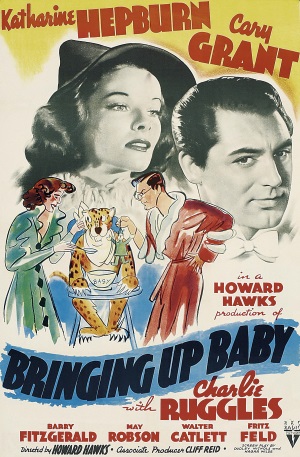
I make it no secret that the screwball comedy is my favourite genre of film. I can never get tired of these films – to me, this is the most anti-boring genre. Whenever I watch a great screwball comedy I’m on Cloud 9 and when it’s concluded I’m always left hungry for more (sometimes I even wish my life could play out like a screwball comedy!). Bringing Up Baby is the quintessential daffy dame/stuffy gentleman movie (a formula often imitated but never topped) and I find it endlessly fascinating this premise of how this woman constantly infiltrates this man’s life and she just won’t go away despite his best efforts. You think it would be easy that he could avoid her but the manner in which she keeps coming back into his life is comedic brilliance. Like many great comedies, the jokes present in Bringing Up Baby always take me by surprise no matter how many times I see it. Howard Hawks seems to have a distinctive style of slapstick comedy which separates his screwball comedies from others but why this is I can’t put my finger on – Hawks’ screwball simply has a distinctive electrically energy to it. Bringing Up Baby was produced at RKO studios, of whom I can’t help but notice their films have a distinctive imperfection of a grainy image quality and the use of soft lighting which is very easy on the eyes; the days when movie studios had their own distinctive styles.

I don’t think Katharine Hepburn ever looked more staggeringly beautiful than she does in Bringing Up Baby, displaying a girlish, Carole Lombard-like charm (I even find myself infatuated with the outfits she wears and her hairstyles in the film). Unlike other films of the genre, however, the romance is largely secondary to the rest of the story; with Susan (Hepburn) falling for David (Cary Grant) but not the other way around. Even with David eventually proclaiming his love for Susan I get the impression the two only remain (unlikely) friends. Likewise, the common screwball comedy theme of a crisis of masculinity is really played up here to the full with Grant wearing a woman’s dressing gown an even proclaiming in a fit of rage to be ”gay all of a sudden”.

David’s wild goose chase to obtain a dinosaur bone known as an ‘intercostal clavicle’ (a nonexistent fossil created for the movie) to complete the museum’s Brontosaurus skeleton, it’s eventual destruction at the hands of Susan as well as her treatment a leopard as a pet is all perfectly in tune with the character’s defiance of the natural order of things. Bringing Up Baby is the only screwball comedy I can think of which involves it’s cast interacting with a dangerous animal; I’m unsure why this never became a common screwball trope, I guess studios wouldn’t allow their cast and crew to be placed in such danger. My review title may sound hyperbolic but I’d pair Bringing Up Baby with You Can’t Take It With You as the most over the top, steroidal, off the wall offering in the screwball comedy genre. Watching Bringing Up Baby is like watching a movie with the fast-forward button turned on; the film is over before you know it. Old movies are slow and boring? Whoever came up with such nonsense?

ie) to complete the museum’s Brontosaurus skeleton, it’s eventfully destruction at the hands of Susan (Hepburn) as well as Susan’s treating a leopard as a pet is all perfectly in tune with the character’s defiance of the natural order of things. Bringing Up Baby is the only screwball comedy I can think of which involves it’s cast interacting with a dangerous animal; I’m unsure why this never became a common screwball trope, I guess studios wouldn’t allow their cast and crew to be placed in such danger. My review title may sound hyperbolic but I’d pair Bringing Up Baby with You Can’t Take It With You as the most over the top, steroidal, off the wall offering in the screwball comedy genre. Watching Bringing Up Baby is like watching a movie with the fast-forward button turned on; the film is over before you know it. Old movies are slow and boring? Whoever came up with such nonsense?

The Blues Brothers (1980)

The Ultimate Comedy

To date, The Blues Brothers remains the only instance in which after watching a movie for the first time, I watched it again the very next day. Several viewings later I’ve come to the decision that The Blues Brothers is my favourite film comedy.

The Blues Brothers is some of the most fun you’ll ever have with a motion picture. Just one incredibly fun set piece after another whether a car chase, a musical number or comedic showcase. Choosing a favourite moment? Now that’s difficult. The portion of the film which has me in the most hysterical fit is the sequence at Bob’s Country Bunker. Having a blues band with two lead singers who are as urban as it gets at a redneck bar in which everyone thinks they’re the night’s country music act and everyone is oblivious to this pink elephant in the room has me laughing just thinking about it (not to mention quite a dig at country music), and what country song are they able to play to the crowd? Why the theme song to a TV show of all things. In regards to the film’s musical numbers, let’s just say I bought the two-disc movie soundtrack very soon after watching the film, which gave me a solid twelve months of continuous music listening pleasure.

The brothers Jake and Elwood epitomise coolness with their black suits, sunglasses and stoic nature. Yet despite the film’s protagonists being criminals, The Blues Brothers is a film of strong moral character. The film makes fun of the antiquated nature of Catholicism while still celebrating faith-based virtues which can transcend to the secular viewer. Jake and Elwood have to save the Catholic orphanage they grew up in but are forced to raise the money to do so by honest means and at the end of the day, they do get punished for their bad deeds. Also, I have to ask, do churches as fun as that portrayed in The Blues Brothers actually exist in real life?

What other movie which has more reverence for its location (the only other film which instantly pops into my mind is Rocky with Philadelphia). Right from the opening shots of the industrial landscape, the city of Chicago is gloriously captured. For the best moment in the movie which captures the grit and grime of the city of Chicago is the scene on Maxwell street with John Lee Hooker playing cut to shots of stalls selling music tapes and other artefacts; such a beautiful sequence

Then there’s the film’s final car chase. I haven’t seen every famous movie car chase but I would happily place a wager that there is no other car chase in the history of cinema better than this. I believe a truly great action sequence is one in which there’s a sense of danger that someone can get hurt or even killed. Here I’m not only fearing for the fictional characters but also the real-life cast and crew. The number of cars involved and carnage that ensues is unprecedented; Grand Theft Auto years before Grant Theft Auto existed. With so many action movies featuring gargantuan levels destruction which means nothing and has no impact, they should take note from The Blues Brothers on how to make action sequences in which you can actually feel the weight and heft of everything from the screech of every tire to the sirens of every police car whizzing past the screen.

The lack of logic in The Blues Brothers only adds to its enjoyment. For example, the very obvious plot hole in which The Good Ole Boys arrive hours late at the country bar with no explanation would likely downgrade most movies; here it just enhances the surreal world inhabited by the Blues Brothers. My favourite illogical moment is the Illinois Nazi’s demise on the unfinished freeway; it makes no sense in the most wonderful way. The 80’s was pretty much the decade for epic, large-scale comedies such as The Blues Brothers. Only then could a film like this even get made.