Dance, Fools, Dance (1931)

I Pity the Dancing Fool

Dance, Fools, Dance begins with a party onboard on yacht in which the younglings jump off the boat for a late night swim in their underwear while the older men are ignorant of a possible fall in stocks and the idea of forthcoming great depression; the last days of the carefree, roaring twenties seen through the lens of 1931.

Bonnie Jordan (Joan Crawford) and her brother Rodney (William Bakewell) are young, glamorous people who never worked a day in their life and show no resentment for it either, from a father who doesn’t want his children to have the hard time he had. They don’t exactly mourn over the death of their father but the loss of their fortune following the stock market crash is the tragedy which gets a reaction out of them. Regardless Bonnie deals with the loss of their fortune surprisingly well and accepts the fault of being left nothing from their father because she and her brother didn’t finish school. This is the crux of the character and what makes her interesting. She doesn’t choose the easy way out of getting married to a wealthy man even though the opportunity comes to her but rather desires the thrill to make it on her own as she herself later puts it.

I don’t believe many people are aware of just how endearing Crawford was in her younger, pre-shoulder pad days. In Dance, Fools, Dance she exemplifies a working-class heroine with an aura of refreshingly simple, straightforward bravery which really makes you route for her character; plus there is the joy of watching her flex her dancing talents.

Clark Gable is a mere 5th on the cast list, even William Holden (no, not that one) is higher than him but his introductory scene is hard to forget. The downbeat piano music as one of his servants puts a blazer on him as he then blows smoke in a woman’s face; tells you everything you need to know without a spoken word. Likewise, Bonnie’s brother Rodney is a memorable character himself as someone who is shocked by the criminal underworld where his alcohol came from before the depression after taking his supply of booze for granted for so long. Likewise, the other great cast member is Cliff Edwards as Bert Scranton who makes for an endearing comic sidekick and mentor to Bonnie.

Dance, Fools Dance isn’t quite a great film, its concept could be fleshed out and explored to a greater degree and would have been ripe for a remake (and maybe a title that wouldn’t sound like something a James Bond villain would say). Although even at that despite the film being imperfect it would still be hard to top with that endearingly creaky, early 30’s, pre-code charm.

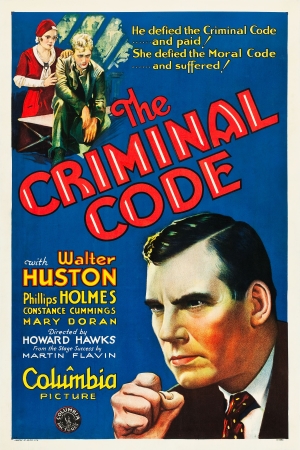
The Finger Points (1931)

Extra! Extra! Read All About It!

In order for gangsters to thrive, three forms of corruption are required; the corruption of politicians, the police and finally the press. Unlike the newspaper in Warner Bros’ Five Star Final (also released in 1931) the paper of The Finger Points known simply as The Press are proud to be socially responsible and even calling themselves “the world’s best newspaper”. However the paper’s employee’s don’t entirely relish in this corny mentality as seen when the editor gives a speech at the end of the working day on what he calls the paper’s crusade, yet afterwards, the employees just laugh it up. Likewise, we also discover that reporters for The Press often just avoid reporting on the activity of gangsters in order to avoid the consequences.

Breckenridge Lee (Richard Barthelmess) on the other hand goes on step further and takes bribes from gangsters in order to suppress stories. The plot of The Finger Points was inspired by the true story of Alfred “Jake” Lingle, a reporter for the Chicago Tribune whom had been suppressing stories for $60,000 a year from Al Capone. Lingle was shot to death on June 9th, 1930 – a day before he was to testify against Capone.

Richard Barthelmess was an actor with a gentle and sensitive nature that had a lot going on behind his deep-set brooding eyes. I don’t think any other actor could have performed the role of the naïve but eager go-getting southerner Breckenridge “Breck” Lee. At the beginning of the film he gives a letter to the managing editor of The Press from his former editor of the Savannah Constitution, calling Breckenridge Lee “one of the best reporters I’ve ever had” and “He’s got the stuff. All he needs is a chance to show it. Give him a break into the big league”. Breckenridge mentions he only did general reporting although can I assume Savannah isn’t as tough as New York City in a movie which showcases the divide between northerners and southerners. Likewise, Breck’s group of friends along with Marcia (Fray Wray) and Charlie (Regis Toomey) really make for a fun trio.

I’ve read a number of reviews calling Breck’s transition to corruption unconvincing – I must disagree. I find the film makes this transition convincing in several ways; the pressure he’s under from the hospital bills he has to pay, his general naivety plus it is evident from his previous journalistic success that the recognition is slightly going to his head.

The Finger Points opens with an impressive, showy shot of a moving train as the camera pans from one side of it to another, once again disproving the notion that films from the early 30’s where largely static. This is also exemplified with a number of long panning shots of the expansive and busy newspaper office with the sound of typewriters going on non-stop in the background; I never tire of the classic atmosphere of a newspaper office.

My main reason for seeking out this obscurity was for a certain Clark Gable in an early supporting role while on loan to Warner Bros from MGM. Along with Warner’s Night Nurse released the same year, Gable is the show stealer. He is nowhere near as overtly evil than his role in Night Nurse, instead of playing a sympathetic but still manipulative gangster in The Finger Points. He is also given more screen time than in Night Nurse, in this one of his best early screen roles.

The crime boss in The Finger Points is simply referred to as “Number 1” and during his one scene in the movie, he is only seen sitting from behind a desk with his back to the camera with a face which is never seen like Dr Claw from Inspector Gadget. There is even a shot which visualises the title of the movie in which we see a close up of Number 1’s hand holding a cigar and pointing his finger towards the camera. I love this whole sequence as it leans towards being a live-action cartoon but doesn’t take away from the serious nature of the film.

The Finger Points has never seen the light of day on home video. As I’ve said before, no other decade seems to have as many hidden gems as the 1930’s; a real archaeological site of cinema.

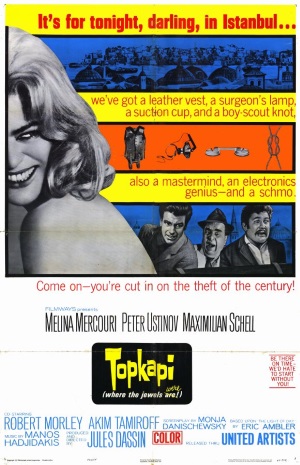
Topkapi (1964)

Mission Unpossible

***This Review Contains Spoilers***

Topkapi is one of those movies in which it is fun to look in the background at the colourful array of gadgets and gizmos. The film’s sets are a thing of beauty, full of beautiful, understated colours. This is the kind of movie to watch to watch on a hot summer’s day or to escape the winter blues. The movie was filmed on location and acts as a time capsules for 1960’s Turkey and Greece, and capturing in a documentary like for the nitty, gritty street corners of Istanbul.

The production code was all but gone in 1964, thus the movie is able to explain and able to show in detail how they are able to commit their crime with explanations of the security system in place and how to bypass them, as well as their undercover scheme and the heist plan; I just delight in that kind of exposition. There were the days before security cameras, therefore they aren’t an obstacle to get around. I also imagine they probably could have chosen to have the criminals get away scot-free if they had desired.

Peter Ustinov steals the show, in one of those performances which bring me levels of respect towards an actor playing a loveable sucker and the most unconvincing conman who can’t fool anyone to save his life. Oh, the other hand I’ve heard reviewers criticise the casting of a 44-year-old Melina Mercouri as a flirt who is not very attractive, I disagree. I find it’s an interesting character dynamic to have a somewhat maniacal nymphomaniac who isn’t particularly attractive yet has a lover who appears to legitimately sees something in her.

Topkapi may have the best heist sequence I’ve seen in a film. By this point in the film I’ve already attached a strong emotional interest in these characters, but during the heist itself, the characters played by Ustinov and Maximillian Schell develop an unexpected emotional bond which raises the stakes higher than they are. With a clumsy fool who is afraid of heights, a lighthouse being controlled from afar by other operatives and precise rope movements to moving an entire glass enclosure, I’m left with that glorious feeling of clenching your hands when something almost goes wrong.

The Yakuza [ザ・ヤクザ/Za Yakuza] (1974)

Perhaps You’ve Heard of the Yakuza, the Poison Fists of the Pacific Rim. The Japanese Mafia!

***This Review Contains Spoilers***

In the audio commentary for The Yakuza, director Sydney Pollack speaks of what attracted him to the project, that he wanted to create a film which examines the clash between western and eastern cultures. In particular, the opposing view the two share on forgiveness. The Christian ethic in the West believes that confession absolves one of guilt and sin, whereas in Japanese culture, forgiveness is something you must earn; if you cause pain, then the only way to atone for it is to inflict pain upon yourself. As protagonist Harry Kilmer (Robert Mitchum) is described at one point in the film, “When my brother spoke of you as a unique stranger, I took it to mean that you were a westerner who had values consistent with our own, that a man pays his own debts, discharges his own obligations, that they are all that make him a man”.

Kilmer is a World War II veteran who remained in Japan after the war and fell in love with a Japanese woman, Eiko Tanaka (Keiko Kishi). I find it difficult to imagine a better choice for the role of Harry Kilmer than Robert Mitchum. The ultra-cool, world-weary actor (who still retained a magnificent mane of hair in his old age) carries a real level of gravitas. An icon of film noir and someone who was often cast in movies about the war in the Pacific, his casting in this neo-noir on the seedy underworld of Japanese gangsters is a perfect marriage of actor and role.

The Yakuza is a love letter to Japanese cinema. You couldn’t ask for a non-Japanese production about Japan to be more respectful, thoroughly researched and authentic than The Yakuza. The opening credits themselves are reminiscent of the film Kaidan (1964), while the names of the Japanese actors appear in the traditional last name, first name format. The score by Dave Grusin is itself magnificent, combining eastern and western influences, delivering a real sense of aching beauty as it plays alongside scenes of the bustling, neon-lit Tokyo streets. The filmmakers clearly took full advantage of the Japanese locations at their disposal; the Kyoto International Conference Centre is an incredible piece of architecture (it’s not a 70’s movie unless there’s some brutalist architecture), while the sento (public bath) with its minimalist waterfall and carp-filled aquariums has a real Blade Runner vibe. Westernisation in Japan is often a shock to outsiders, and that is on display in The Yakuza, in particular, the scene in the nightclub in which patrons are singing My Darling Clementine. However, as stated early in the picture, “The farmers in the countryside may watch TV on their tatami mats, and you can’t see Fuji through the smog, but don’t let it fool you. It’s still Japan. And the Japanese are still Japanese.”

Kilmer and his friend Oliver Wheat (Herb Edelman) are so engaged with Japanese culture and its customs to the point that they’re second nature to them. Richard Jordan, as Dusty, on the other hand, acts as the audience surrogate character for the non-Japanese viewer as he experiences Japanese culture for the first time. He expresses a genuine interest and curiosity, such as when he gets too comfortable examining a katana sword, to expressing his observations; “When an American cracks up, he opens the window and shoots up a bunch of strangers. When a Japanese cracks up, he closes the window and shoots himself. Everything’s in reverse, isn’t it?”. The Yakuza is part of the Gaijin subgenre of films. A long lineup of films about foreigners’ interaction and navigation through Japanese culture, often confronting their own cultural blind spots. The Yakuza wouldn’t even be actor Ken Takakura’s (as Eiko’s brother Ken) final appearance in such a film, as he would also appear in Ridley Scott’s thematically similar Black Rain (1989) and the sports comedy Mr. Baseball (1992), playing the cultural counterpart to a foreigner. From what I understand, Takakura only had a perfunctory understanding of English, although watching The Yakuza, you would think the man is fully fluent.

The scenes involving the dealings of The Yakuza themselves give the film the vibe of being the oriental Godfather; suited men negotiating at desks while smoking cigarettes, with a strict hierarchy and their own set of customs (such as the introduction of extending their hand from their right knee to show they have no weapon). The Yakuza is a film with some very violent scenes, but it is not a schlocky film; thus, the violence is portrayed in a classy, arty tone and not gratuitously, with an effective combination of gunfire and katana duels. The film does, however, have one reality-bending moment in which a gangster has his arm chopped off, yet the severed arm continues to hold a gun and fires it in mid-air (either way, it looks cool). The film’s rescue plot, in which Harry, Dusty and Ken have to rescue a kidnapped American girl, and its messy aftermath is quite complicated and hard to follow with its web of conspiracy and double crossing, but even during my first viewing of The Yakuza, it didn’t detract from the film’s emotional core.

The romance angle of The Yakuza is established with a Casablanca-like set-up. After Eiko refuses to marry Harry (a love made forbidden due to family ties), Harry leaves Japan, but leaves Eiko a café named the Kilmer House as a sayonara gift. Following Harry’s return to Japan, he arrives at the Kilmer House just as the café is closing for the night, to greet Eiko for the first time in 20 years, as they subsequently spend the evening reliving their nostalgic memories of the occupation years. The Yakuza shows that Mitchum was not only a tough guy, but could also play a great romantic lead with a tough yet tender personality. So why did Eiko refuse to marry Harry despite being in love with him? In the film’s big final third twist, the man we are led to believe is Eiko’s brother, Ken (who returned from the jungle several years following the end of the war), is actually her husband. Although Ken was always grateful to Harry for saving Eiko’s life after the war, his current return to Japan is what leads to the death of their daughter, Hanako (Christina Kokubo), at the hands of Yakuza – a disbalancing of debt and obligation.

Upon Harry’s realisation that ‘’I destroyed his past and future”, Harry offers Ken an apology fitting of a former Yakuza, completing the overarching theme of the film. In a scene featuring some of the finest acting of Mitchum’s career, Harry performs the Yakuza ritual of Yubitsume (cutting off the tip of one’s little finger). During the scene, there is the nervous anticipation as Harry sits down, takes a deep breath, then takes out a handkerchief and knife with the look on his face of “I can’t believe I’m really going to do this”, before proceeding with the act itself. He offers the severed fingertip to Ken, as Harry’s face and voice are overcome with physical and emotional pain as he delivers words of sorrow in both English and Japanese (“No man has a greater friend”). The Yakuza ends with a sense of tragic yet melancholic closure. However, why did Eiko never tell Harry the truth all those years ago? Would the truth not have caused less heartache? The final interaction between Harry and Eiko puts a cap on this ambiguity:

I have no more secrets, do I, Harry?

Never run out of those darling.”

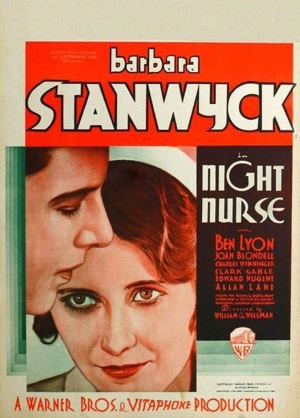
Night Nurse (1931)

I’m Nick…the Chauffeur!

It doesn’t take long into Night Nurse to see the film isn’t a very positive portrayal of the health care service circa depression-era United States. Dr. Kildare this is not and even makes 1934’s Men In White come off as a more an idealised vision of the health care system in the 1930’s; Night Nurse is anything but. All within the picture’s first ten minutes Lora Hart (Barbara Stanwyck) is turned down for the job as a nurse but then gets it after catching the fancy from another doctor. Likewise one of the interns is a pervert and fellow nurse Maloney (Joan Blondell) recommends tricking patients into thinking you’ve saved their life in order to get money out of them. Blondell’s character, in particular, I really found myself loathing from an actress who normally played such likable characters. She clearly dislikes her profession and even recites the Florence Nightingale pledge while chewing gum – Night Nurse is a movie with a wide range of despicable human beings on display. There is even a scene which appears to show an actual baby in distress and another in which children talk about in graphic terms of the mental and physical abuse they and their dead sister have received – not very comfortable viewing.

Director William Wellman was one of the most interesting filmmakers during the pre-code era, whose film’s go against the conception of movies from the early 1930s being static and lacking camera movement or fluidity. Night Nurse is a perfect example of the kind of pictures Warner Bros produced during the 1930’s; a thought-provoking socially conscious melodrama. Whether or not it’s exaggerated, the plot of hospital corruption and the ineffectiveness of both the hospital and the authorities to prevent child abuse, the movie does succeed in packing a punch. What does it say when the intervention of gangsters, people working outside the law are required to save the lives of two children? Warner Bros was also known for featuring ethnic casts in their movies. At the beginning of the movie a shot focuses on a group of Chinese people sitting around a hospital bed speaking in their native language, helping to set the film’s gritty mood. There is also an emphasises later in the film that the shop which is broken into in order to steal milk for a bath in order to save the lives of malnourished children is from a Kosher delicatessen. Is there a particular reason for this? This was 1931 but history has made of this scene of the delicatessen windows being smashed unintentional creepy.

The other major reason to watch Night Nurse is to see Clark Gable in the pre-stardom role of Nick the Chauffeur in his glorious 5 minutes and 25 seconds (approx) of screen time (yes, I timed it). The film builds up to his reveal with the name of this unscrupulous “Nick” being thrown around. His character’s introduction with the use of a camera zoom and the uttering of “I’m Nick…the chauffeur” gives me chills in one of the most memorable moments in pre-code cinema. Gable is scary enough as a dominating brute who wants to murder children and isn’t afraid to punch women or the elderly but this is multiplied by the fact that he’s dressed like a Nazi. Ok not really, it’s a chauffeur’s uniform but when I first saw him wearing this, my instant reaction was “Why is he dressed like an SS officer?” (likewise, just as equally striking is his costume choice of a black kimono). The role of Nick is an odd duckling in the career of Gable which shown he had the knack for playing terrifying villains – such unrealised potential. As much as the man’s appearance in the background is enough to make you go, “oh s—t!”, and in a big way sister.

Dark Passage (1947)

The Man With Bogart’s Face

***This Review Contains Spoilers***

Dark Passage is one of the more experimental movies of Hollywood’s golden age with the majority of the film’s first third being filmed from the first person point of view of Humphrey Bogart’s character. I never thought a black & white movie from the 1940’s would remind me of a modern video game. I would like to see more films which experiment with this point of view style. MGM’s Lady In the Lake (also released in 1947) was filmed in POV for the entire film which the studio promoted by claiming the POV style was the most revolutionary style of film since the introduction of the talkies. Nope, it didn’t catch on. The use of POV took me off guard at first as I wanted to watch some Bogart but I did not get to see him on screen. Bogart’s distinctive voice alone though helps carry the picture, thanks in part to his many witty remarks. We’re then given a section of the movie in which Bogart doesn’t talk and is wrapped in bandages looking like a horror movie character (these scenes also make me squeamish). Considering we have to wait a whole hour until we finally see and hear Bogart in his entirely makes Dark Passage nothing short of a daring role.

For the plot, you do need to suspend your disbelief at the number of highly improbable coincidences. Irene (Bacall) just happens to be out painting near San Quentin on the day Vincent Parry (Bogart), the man she has an obsession with escapes and she knows where to find him. Oh, and she also happens to be friends with Madge (Agnes Moorehead) who gave false testimony in court against Parry that he murdered his wife.  I find it is easy however to just roll along with the ridiculous plot as the movie plays out like a dream, culminating in the satisfaction of seeing Bogart get his revenge on Agnes Moorehead (a useless old bag and a real love to hate character) and seeing these two characters getting their happily ever after together in South America. One minor complaint I have is the reveal of Frank Parry’s face on the newspaper, prior to getting plastic surgery; because the character doesn’t actually have Bogart’s face, I would have preferred the mystery of not knowing what he looks like. Also, a plastic surgeon who can give you the face of Humphrey Bogart? Someone should have told Woody Allen that in Play It Again Sam. Dark Passage in part sees the return of gangster Bogart but still has the romantic elements of his on-screen persona which he developed after achieving stardom. Right from the very beginning, we’re in classic gangster territory, a prisoner escaping from San Quentin, the type of setting not seen in a Bogart film since High Sierra. The on-location filming in San Francisco also really adds to the film, giving you a sense of the world the movie inhabits and Irene’s apartment with the two floors and the art deco designs – I want it!

I once said ‘All Through the Night’ was the most Hitchcockian film Bogart starred in but Dark Passage wouldn’t be far behind it. We get the innocent man falsely accused on the run while trying to prove his innocence. The focusing on landmarks (the Golden Gate Bridge), while the San Francisco setting has some Vertigo vibes. The trippy plastic surgery sequence feels reminiscent of the Salvador Dali dream sequence in Spellbound; while Madge’s death rings a bell of the character death shots in Vertigo in which someone falls from a great distance.

When attempting to review a movie, I can’t always predict how much I will have to say about it. Occasionally though you get movies like Dark Passage, which have layers and layers of fascinating details worth talking about. Dark Passage is my favourite Bogart & Bacall film, although to be honest, I was never a huge fan of their partnership. To Have and Have Not bored me and The Big Sleep was, well, a big sleep. Plus I never fully got the appeal of Lauren Bacall; she never struck me as a massively interesting screen presence.  I find Bacall plays a much more interesting character than in the previous two Bogie & Bacall pairings. Not a vamp but a lonely single woman who purses painting as a hobby.  During the first kiss between Bogart and Bacall, I had the reaction of “Ok, now I’m getting it”.

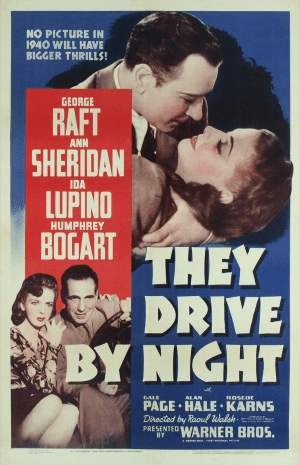
They Drive By Night (1940)

We’ve Got a Great Big Convoy Running Through the Night!

They Drive By Night captures the seedy and often dangerous world of the truck driver; the lack of sleep, the long distances to travel, the time missed with family, the comradery between truckers. The movie definitely highlights the dangers of trucking from the risk of falling asleep at the wheel, which in part lends itself to one very thrilling action sequence. With Warner Bros being the master of social commentary pictures, I enjoy movies like this which give you an insight into the lives of the lower class at the time; people trying to get by a day at a time with clearly little money to spare.

Thirty minutes into the picture we meet Ida Lupino, in my view possibly the epitome of the tough dame. Talk about a star-making performance, she owns the show as soon as she enters the picture. Every time she is in frame it’s hard to take your eyes off her as struts, poses and applies makeup to herself, even when her comedic foil of a husband Alan Hale is in frame acting like a buffoon. Her most notable scene in the film is one of the greatest, most gloriously over the top on-screen breakdowns ever committed to film. Charles Manson blamed The Beatles, Ida Lupino blamed the doors. Seeing Bogart as a family man is odd at first, the total opposite of his persona he would have in films such as those with Lauren Bacall. But he fits comfortably into the role, showing how adaptable an actor he was. George Raft is the weakest player out of the four stars, I’ve never seen Raft as much of an actor, but playing alongside these heavyweights manages to bring out the best in him.

What is the overall plot of They Drive By Night? There isn’t one; there’s no three-act structure. It’s almost like getting two movies for the price of one, with the first half focusing on trucking and the second half focusing on a murder. Comparing the two you wouldn’t think this is the same movie, but the odd combination works and makes for a unique viewing experience.

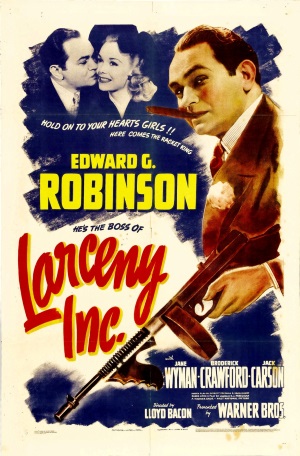
Larceny Inc. (1942)

Under Pressure

How can you resist a film like Larceny Inc once you’ve heard the plot? It’s one of those quirky film concepts I just love. A cocky criminal and his two buffoons buy a luggage store so they can dig their way into the bank next door. Perhaps the film’s greatest strength is how it plays out like a live action cartoon. Nothing ever goes beyond the scene in the moment; for example in one scene a set of oil pipes are burst during the digging process and the basement from which they are digging from is drenched in oil and yet this is never mentioned again. Even as one character who is not involved in the ban heist comes across the two drenched in the oil he bizarrely does not comment on their appearance; that’s the twisted cartoon world Larceny Inc incorporates. I’ve always thought actors from the 1930’s resembled cartoon characters with their exaggerated facial features and distinctive accents; very true with this cast including Edward G. Robinson, Jack Carson, and even a young Jackie Gleason; all live action caricatures.  Actors who emerged after the war generally didn’t have this and instead were actually more lifelike. You really get a sense of the world the movie takes place in with a street populated with such memorable and mostly ethnic characters giving the movie that Shop Around the Corner edge to it.

Maxwell aka Pressure’s gift wrapping has to be the comedic highlight of Robinson’s career; a comedy moment which couldn’t be timed more perfectly. His uttering of “$9:75”  is funny enough as it is but his pathetic attempt at gifting wrapping which follows had me in stitches. I also love Jack Carson’s attempt at hitting on Jane Wyman. This scene has nothing to do with the rest of the movie but has got to be the ultimate “skipping the pleasantries” monologue I’ve ever heard.

There are so many layers within Larceny Inc. Is the movie a celebration or an indictment on capitalism? The gangsters’ involvement in legitimate business is what makes them renounce their past ways but only after they’ve essentially been seduced and consumed by the capitalist system. Larceny Inc was released in 1942 just months after the US got involved in the war but the film’s production began prior to that with its themes of business and consumerism are completely counterproductive to the war effort, something I’ve noticed with many films released in 1942. There is also the irony that the gangster is the one who brings the community together and the authority figures in the movie are played as fools.

Larceny Inc can also join films like Rocky IV and Die Hard as Christmas movies which aren’t about Christmas, and Edward G Robinson dressed as Santa Claus? Sold!

White Heat (1949)

Get Up Stand Tall, Put Your Back Up Against the Wall

To date, White Heat remains the only instance in which my first encounter with an actor instantly turned me into a fan. Typically for me, I become a fan of a performer over a period of time and after seeing a number of their films. Not James Cagney though. The scene early during White Heat in which Cody Jarrett gets a headache and needs to be comforted by his mother, my instant reaction was, “I need to watch any movie with this guy I can get my hands on”. I have no hesitation putting Cagney’s performance as Cody Jarrett in my ten favourite movie performance of all time. At this point in my movie watching life I had never seen an actor so on fire, so electrifying. His twitchy mannerisms, machine gun way of speaking his violence against women and possibly above all, his mother complex, exposing an unsettling, adorable side. Like wow, you do not want to be stuck in an elevator with this guy. I would later discover White Heat came after the classic Warner Bros cycle of gangster movies, making White Heat a nostalgic revival of the genre, making Cody and his mother products of a different age. Margaret Wycherly as Ma Jarrett is the next great stand out performance for me, a character who appears as the stereotypical “aw shucks” mother common in classic Hollywood, but her attitude could not be more different.

Boy is this movie fast paced. White Heat is one of the few times my heart my beating so much out of how exciting the movie was. When the film was over I had the closest I could fell to that sense you get after coming off a rollercoaster, expect to get it from watching a movie. I feel that’s the best way, to sum up White Heat, a rollercoaster of violence and emotions. Even the scenes of police officers discussing Cody’s psychological tendencies and the examination of their late 1940’s tracking techniques are riveting, but they do save the best for last. The Warner gangster movies ended with incredible final scenes with brilliant closing lines, White Heat’s may be the best of them all. I question if I’ll ever experience such a high level of movie watching euphoria on a first time viewing again.

The Petrified Forest (1936)

This Is How The World Ends, Not With a Bang But With a Whimper

***This Review Contains Spoilers***

When I first watched The Petrified Forest I was at an unsure time in my life; fearful of the future and with my own sense of individualism and artistic ambitions. Watching Leslie Howard as Alan Squier, a failed artist who eventually takes his own life so a young girl could be the artist he never was made me fearful and depressed of what my own future held in store for me. I felt for this character to the point that it hurt because I was worried that someday I could become that character, perhaps not to that extreme but destined to a similar fate. Gabrielle (Bette Davis) on the other hand is stuck in a rut and dreams of going to France. No one in The Petrified Forest has much to look forward to; even the old man played by Charlie Grapewin gets very excited by the prospect of gangsters being nearby. Anything to create some excitement in the middle of the desert, excitement which doesn’t wain when he’s being held hostage by them. At the time when I watched this film and I was dealing with the uncertainty of if I would ever leave my hometown or would I always be stuck here. Few other films have ever had characters which spoke so directly to me.

The atmosphere in The Petrified Forest is intense enough that I can forgive the not so seamless transitions between real-life locations and the sets. With little to no use of non-diegetic music, the sound of a windstorm is more than enough to emphasize the prison of which the characters reside. I also highly recommend checking out Heat Lightning from 1934 which contains many similarities to The Petrified Forest in its setting and atmosphere as well as characters and plot points.

The Petrified Forest’s most notable contribution to cinema is the breakthrough role of Humphrey Bogart as Duke Mantee, a role in which he has never been more terrifying. I generally don’t think of Bogart as an actor who is scary but here he is a guy I would not want to be stuck in an elevator with, even with that distinct walk with his slouch and his arms bent in that manner as the dangle. – In most cases this would look ridiculous by Bogart makes it work. Bogart’s acting career had been marred with failure up until this point with this likely being his final chance to make it in Hollywood and no doubt must have fueled his performance. I know a film is good when I have to think and contemplate which actor (Howard or Bogart) gave the better performance.

How often do you get to see gangsters and intellectuals involved in such profound conversations? Howard and Bogart play characters whom are worlds apart yet develop a mutual respect for each other as they discover they share a bond with their individualism (also look out for Bogart’s head being framed over a moose head so it looks like he has antlers). Fascinating characters (all with such unique dynamics between each other) in a fascinating story is already one of the most important things I could ask for from a movie, even better when they affect me on a personal level.