
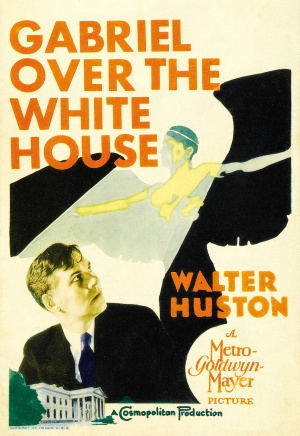
Gabriel Over the White House (1933)

I Love Democracy…

***This Review Contains Spoilers***

I do love the efficiency and streamlined nature of pre-code films. Within two minutes, the opening credits roll, followed by a montage of stock footage, and the story of Gabriel Over The White House is underway (unlike films today with a parade of 10 studio logos and a title screen that doesn’t appear until 40 minutes in).
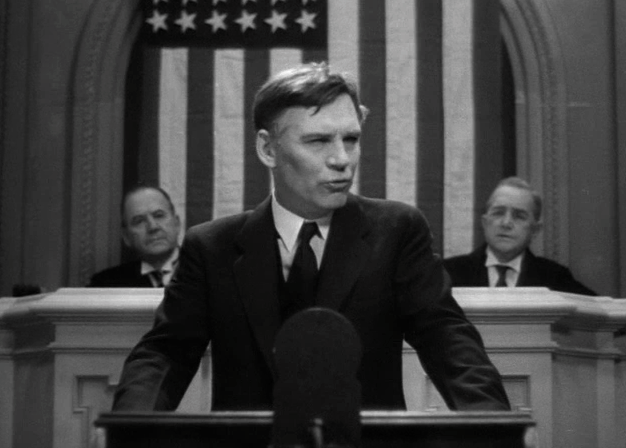
The newly elected President of the United States, Judson Hammond (Walter Huston), is sworn into office, yet behind closed doors, he and his inner circle treat the presidency as a joke. They engage in smarmy chatter and look down upon the populace (“When I think of all the promises I made to the people to get elected…by the time they realise you’re not going to keep them, your term will be over”). Hammond even takes the pen that Lincoln freed the slaves with and remarks, “Well, here it goes for Puerto Rican garbage”. To play up this disregard to an even greater degree, in a very unusual scene featuring a rare use of overlapping dialogue, the President and his nephew play a treasure hunt game in the Oval Office while the radio plays an activist speech. The audio from the dialogue between the President and his nephew becomes drawn out by that of the radio, as Hammond does not have a care in the world for what’s happening in the country. The only loyalty displayed by Hammond is towards what is simply referred to as “The Party” (“The party has a plan, I am just a member of the party”). Walter Huston has the look you would expect from a president from the early 20th century (not too dissimilar looking to Warren G. Harding or a clean-shaven William Howard Taft), while his sheer gravitas not only makes the hairs on your skin stand up, but he also prevents Hammond from coming off as just a caricature. Interestingly, however, he is a President without a First Lady, which would make him and James Buchanan the only unmarried presidents. 

Following a racing accident, Hammond goes into a coma. However, upon his reawakening, Hammond is no longer the man he once was; rather, a populist figure is born. “God might have sent the angel Gabriel to do for Jud Hammond what he did for Daniel”, states the President’s secretary, Pendie Molloy (Karen Morley), as the film makes no secret of indicating that Hammond will be enacting the will of God himself. Many scenes from this point onwards have a softer, more dreamlike look, with a higher contrast between black and white. In one moment shortly after Hudson’s awakening, he stares up in awe at a bright heavenly light shining upon his face, or as Pendie describes it, “the presence of a third being in the room”. Many a beautiful shot populates the film, from the dramatic zoom shot on Hammond (even if it does go in and out of focus) to some stunning set design with the art deco set of the film’s court martial scene.

The new Judson Hammond wastes no time getting things done with his newfound heavenly, populist political will. Right off the bat, he stops calling his staff nicknames and stands up to the members of his own party.

“Now, be careful. I might resign on you.”

“Your resignation is accepted.”

“Oh, well now, wait a minute, Jud, I was only suggesting…”

Hammond asks Congress to declare a state of national emergency to adjourn itself until normal conditions are restored, and during this period, he will assume full responsibility for the government. With the country under martial law, Hammond proceeds to tackle the issues of unemployment, mob rule, forcing over nations to pay their debts the US and by the film’s climax, literally enshrining world peace into a document signed by most nations in the world. Upon lending his own signature to the document, Hammond himself collapses and quickly passes away, lending further credence that he is enacting the will of God.
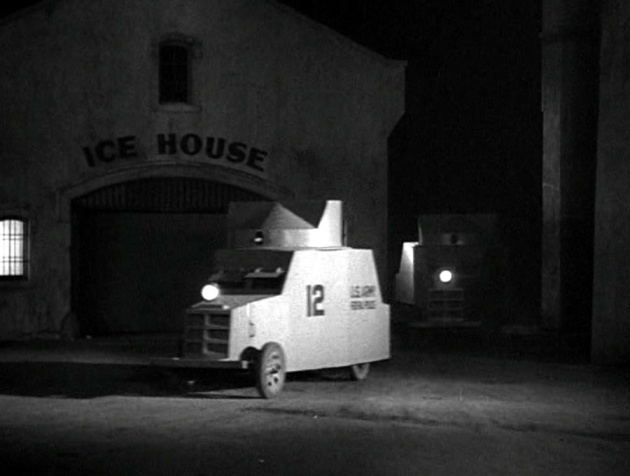
The subplot of Hammond’s efforts to eliminate the mob is particularly interesting. He praises gangster Nick Diamond (of course, he has a scar on his face) directly for “getting rid of most of his own kind”, relating to the theory in criminology that allowing one single crime syndicate to operate results in an overall reduction of crime. Hammond proceeds to create a federal police force to eliminate the mob, leading to two of the oddest scenes in the film, the first in which the mob attempts to assassinate Hammond on the grounds of The White House itself (was this more plausible in 1933?). The latter is a sequence which I can best describe as resembling the climax of every episode of Takeshi’s Castle. Following the arrest of Nick Diamond and his men, they are executed by way of an old school firing shot with the Statue of Liberty in the background (I’ll let you decide what is the intended symbolism, if any, of such a shot).

Is there a name for this kind of populist wish-fulfilment picture? The film which has the most striking similarities to Gabriel Over The White House is Ivan Reitman’s Dave (1993), in which an ineffective, uncaring president is replaced by a populist doppelganger who gets things done. Likewise, multiple sources online speak of an alternative European cut with 17 extra minutes, although such a cut has never been released on home video. Much is made of the fact that film was financed by media conglomerate William Randolph Hearst, although regardless of the agenda those behind the production may or may not have had (although it is worth noting that director Gregory LaCava would go on to direct the anti-New Deal May Man Godfrey in 1936), Gabriel Over The White House, whether by design or not, presents one central dilemma; should a nation be led by one all-powerful leader who can get things done, or have a system of checks and balances, which may be slow and inefficient? When watching Gabriel Over The White House, it’s easy to feel seduced by the temptation of having an all-powerful leader, a benevolent dictator, a king. Or once a crisis has abated, can we ever trust that a leader will lay down the powers given to him? History would say no, but Gabriel Over The White House allows the viewer to indulge in such a fantasy.

Stage Door (1937)

The Women

Stage Door is very much the poverty row version of MGM’s The Women. It features only one big box office star, another who had become box office poison and a supporting cast who would later go on to play notable prominent roles in later films (Lucille Ball, Ann Miller, Eve Arden).

Ginger Rogers and Katharine Hepburn where the two big rivals at RKO pictures with Rodger’s career on the up and Hepburn’s career on the down yet you can feel their mutual respect for each other as the film progresses (in the fictional realm at least). Stage Door follows a group of actresses living in a drab theatrical boarding house trying to make it in the world of show business. Right of the bat the movie is emotionally investing as the cast of street smarts constantly spew one-liners and witty remarks in an effort to try and deal with their lack of success amidst the depression-ridden 30’s; the film succeeds in evoking both laughter and sadness simultaneously with its barrage of highly relatable human emotion – The lightning-fast dialogue alone makes Stage Door worthy of multiple viewings.

Supposedly the filming of Stage Door began without a completed script resulting in much of the film’s dialogue being improvised. The interactions between the female cast feels real; the acting present in the movie doesn’t feel like acting, almost like I’m getting a voyeuristic insight into these character’s lives.  Likewise, the film even has an early appearance by Jack Carson as an over giddy lumberjack on an arranged date with Jean Maitland (Ginger Rogers); always a great screen presence no matter how brief his appearance is. I find Stage Door a one of a kind film; it has a raw quality, one that can’t be created intentionally making it a rare treat in many respects. The cast and dialogue is just too good that I really become attached to these characters and almost wish the film could be a bit longer.

Katharine Hepburn’s Terry Randall is another instance of Hepburn playing the odd one out. I do love Terry Randall, she’s the one character in the boarding house of whom clearly comes from an upper-class background and she is only one who achieves stage success by landing the lead in a play despite her lack of acting experience. With her go-getter attitude, Terry is the embodiment of the individual as summed up in one line: “You talk as if the world owed you a living. Maybe if you tried to do something for the theatre, the theatre would do something for you”.  I get the impression Stage Door purports the idea that one who comes from a lower class background will find it harder to overcome these ties and find success. In one dialogue exchange Terry asks the other women “do you have to just sit around and do nothing about it?” and the character played by Lucille Ball replies “maybe it’s in the blood, my grandfather sat around until he was 80”. Terry is clearly more dedicated to her craft than the other woman in boarding house, discussing Shakespeare and other aspects of theatrical arts, while the other conformist woman poke fun and shun her for it. This does make me question what they are doing there in the first place; I guess they have just been beaten down by the system that bad. One thing Terry is not, however, is a snob. She doesn’t look down on the girls from a high and mighty position and even makes the effort to learn their slang. When I doubt I will ask myself, what would Terry Randall do?

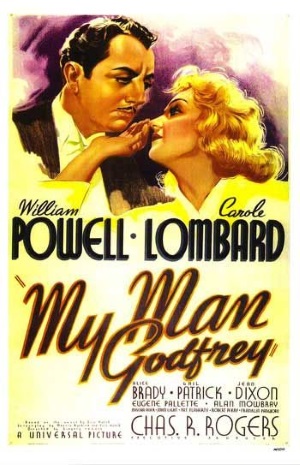
My Man Godfrey (1936)

She’s Electric, she’s in a family full of eccentrics.

***This Review Contains Spoilers***

Does a comedy film actually have to make you laugh? Can you have a comedy without any laughs in it? This was once a question posed by film critic Mark Kermode.  When thinking of this question, the first movie which comes to my mind if My Man Godfrey, a comedy which I love but there are only a few moments during it which make me laugh and even those few aren’t big laughs. This is despite the movie’s crazy screwball, gorilla imitating antics in which the straight man William Powell enters a cartoon world. But I would still call it a comedy as it’s a movie which leaves you feeling melancholic watching it.

William Powell’s role as Godfrey exemplifies why he is the master of words. He can take any regular sounding lines and turn them into something memorable and unique – it’s like poetry. Even as an unshaven bum Godfrey outclass anyone. Likewise It’s easy to fall in love with Carole Lombard watching My Man Godfrey; she succeeds in playing a ditsy scatterbrain in an endearing manner but I feel the real unsung cast member of the film is Gail Patrick, one of the most underrated actresses of the 30’s – it’s a shame she never became an A-list leading lady. She became typecast playing (for lack of a better term) bitches, but could do so with a dose of humanity.

I love those moments which describe a ridiculous situation which is never caught on camera. The mental image of Carole Lombard riding into a mansion on a horse, going up the stairs and leaving it in the library is an image better left to my imagination. Many modern film comedies would show such a display for the viewer to actually see and well, would just be cringey and embarrassingly unfunny in the process.

My Man Godfrey wasn’t based on a stage play but watching it you might think otherwise as long stretches of the film take place in real time. Plus you get one thing almost unheard of in films prior to the 1950’s, an intricate title sequence.  I consider My Man Godfrey along with You Can’t Take It With You as the two quintessential “kooky family” movies although “kooky” may be an understatement.

Screwball comedy was partially about making fun of the rich as retribution for the great depression; My Man Godfrey is probably the harshest attack on the rich which the genre ever made, partially because of just how somber the film is. The opening scene in which men are living in a shanty town by a dump or the scavenger hunt for bums (or so-called ‘forgotten men’) are shocking sights for any era. However, My Man Godfrey shows how the wealthy upper classes are not beyond redemption and are a necessary component for any functioning capitalist society.

At the beginning of the film, Godfrey utters “Prosperity is just around the corner”, a line misattributed to Herbert Hoover though a widely mocked platform of the Republican Party during the early days of the depression. Once Godfrey is hired by the Bullock family as their butler he uses his newfound position to work his way out of poverty. By pawning the necklace Cornelia planted in Godfrey’s bedroom in an attempt to frame him, Godfrey purchases stock which Mr. Bullock had sold and in turn saving the family fortune. Godfrey owes a debt to a wealthy family for bringing him out living in a literal dump but in return, he is responsible for saving the family’s fortune and bringing the dysfunctional Bullocks together.

It sounds like the movie makes an argument for supply-side economics. Less subtle however is the scene in which Eugene Pallete (I swear that man is the spitting image and voice of Alex Jones) as the head of the Bullock household says “I don’t mind giving the government 60% of what I make but I can’t do it when my family spends 50% of it”, followed by his wife’s response of “Well why should the government get more money than your own family?”. At the end of the film, Godfrey has opened his own diner at the dump from the beginning of the film and hiring his previously homeless chums. – People banding together to get themselves out of poverty and not relying on an FDR handout.