The Harder They Fall (1956)

The Pen Is Mightier Than The Sword

***This Review Contains Spoilers***

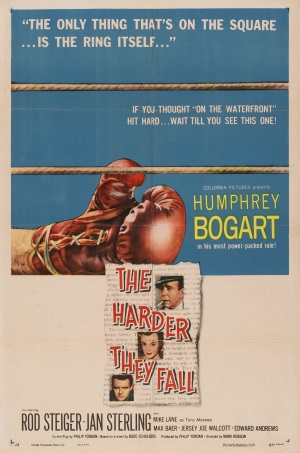
It’s unique to see Humphrey Bogart in a more contemporary, neo-realist 1950’s film in the form of The Harder They Fall. From the Saul Bass-inspired opening credits which help set up the plot (rather than just a series of static title cards) to the punchy music score, I imagine if Bogart lived longer and stared in movies for at least a few more years they would have been aesthetically in a similar vein to The Harder They Fall.

The Harder They Fall deals with corruption and fixing in boxing and how promoters exploit athletes regardless of their health or well being, providing an in-depth look at corruption in boxing as to who pulls the strings and how. The fight scenes themselves don’t suffer from the dilemma of old boxing films having dodgy looking bouts with sped-up footage or obviously fake punches, partially due to the fact that the fights within the film are staged and of poor quality fight tactics. Likewise, the grime and sweatiness of boxing arenas and training gyms never fail as effective subjects to capture on film, especially in black and white. Also, what’s the deal with that bus with the cardboard cutouts attached to it? It’s almost like a character in itself.

More so than any other Bogart film do we see such a striking generational clash with Bogart coming from the old school style of theatrical acting and Rod Steiger from the Marlon Brandon, method school style of acting. However, I’ve always found Bogart to be a very adaptable actor and he is able to seamlessly play of Steiger despite their acting styles being worlds apart. Bogart’s role as washed up columnist, Eddie Willis is one of the most interesting heroic performances of his career which combines Bogart’s trademarks of both world-weary cynicism but also, a sense of righteous morality as he deals with his moral and ethical conscience throughout the film. Eddie can draw up fake publicity for the not so talented, big lug Toro Moreno (Mike Lane), writing articles stating he is the heavyweight champion of South America, undefeated in 39 fights and largely get away with it – that’s the pre-internet world for you (“Nobody reads these west coast papers in the east”).

Eddie may take part in the world of boxing corruption but he never fully believes in what he is doing and tries to make the outfit as unscrupulous as possible. Not to mention he is the only person in the racket who genuinely cares about the gargantuan Toro, whereas the rest of the men couldn’t care less about him. Rod Steiger on the other hand as corrupt sports promoter Nick Benko is an impulsive, brash character who has no moral or ethical conscience – you have to ask does he actually believe in what he is doing is justified in his mind. Steiger chews the scenery throughout the film in a very shouty, loud-mouthed performance which has shades of DeNiro or Pacino coming through.

I had a sense of melancholy during the movie’s closing shots knowing this was the last time Bogart appeared on screen. Bogart was in poor health during the film’s production, suffering from lung cancer (although ironically it doesn’t stop him from lighting up during the movie). In the film’s conclusion, The Harder They Fall celebrates the power of writing as a force to fight wrong and enforce positive social change – proving once again the pen is mightier than the sword, or should I say boxing glove. In the powerful final shot, Eddie begins typing an article on boxing corruption and reformation for the sport, an aspiring sight for any budding non-fiction writers.

“The boxing business must rid itself of the evil influence of racketeers and crooked managers, even if it takes an Act of Congress to do it.”
Angels with Dirty Faces (1938)

Angels With Filthy Souls

***This Review Contains Spoilers***

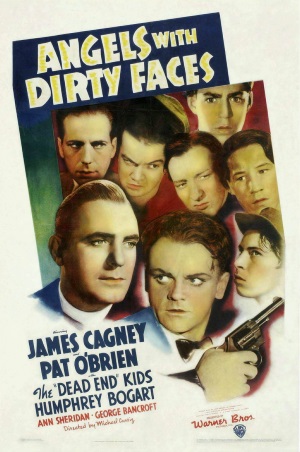
One of the things I love most about Angels with Dirty Faces is that proposes the age-old idea of a person’s entire destiny being defined by one single event. The fact that Jerry (Pat O’Brien) could run faster than his childhood friend Rocky (James Cagney) while being chased by the police for a petty crime would determine the paths they would take in life. If only Rocky could climb over that fence, things would have been so much different.

I’m a huge fan of the Warner Bros gangster movies of the 1930’s and Angels with Dirty Faces is probably the most classic of these movies In that it gets referenced and spoofed most in popular culture. These films deal with social issues, many of which are still relevant today. When I hear current news stories about crime and social issues, I often find myself thinking “They dealt with that in an old 30’s crime/gangster film”. Angels with Dirty Faces is no exception. Rocky Sullivan was never truly a criminal but his stay at a reformatory for his petty crime turned him into one. However, Pat O’Brien’s role of Father Jerry Connolly presents an incredibly stark contrast with today’s commonplace media reports of priests molesting boys. I find it fascinating to see a movie in which a member of the clergy is presented as someone who is treated with the utmost respect and entirely trustworthy, of course, this being an attempt to appease the Legion of Decency.

Even with the religious overtones, the movie still provides one of the most intriguing moral dilemmas ever presented in a movie; Rocky making the ultimate sacrifice. Before his execution, Father Connolly asks him to pretend going yellow and show people he was a coward by begging for mercy before being sent to the chair. The only thing Rocky has left is his reputation and he is being asked to throw that away so kids won’t look up to him and his lifestyle. Rocky does just this at the last moment, a complete rejection of the gangster way of life.

While nothing can top the pure electricity that is Cagey in White Heat, Angels With Dirty Faces gets my spot as the next most interesting performance in his career. The Dead End Kids give Cagney an element to his performance few other actors would rarely get the chance to express, likewise his real-life friendship with Pat O’Brien is easily apparent on screen with their interactions. Humphrey Bogart also appears in a pre-stardom supporting role. Despite only appearing in several scenes he nearly succeeds in upstages Cagney with his enigmatic screen presence. Plus that kid playing a young Cagney at the beginning of the film is very eerily like him.

Socially conscience pictures such as this which came from Warner Bros really give an insight into the lives of the common folk of the time. A moment which always stuck out to me in Angels With Dirty Faces is the basketball game because it’s the only classic-era film which comes to mind which features a basketball game thus showing an activity from the 1930’s which is still popular today. Likewise, the movie also acts as a historical document for the lingo among inner-city youths of the time. The performances given by The Dead End Kids feels like an early example of method acting; no surprise when watching this that it was once referred to as Italian street acting.

Michael Curtiz is undoubtedly one of the greatest craftsmen of Hollywood’s golden age (after all, in this same year he directed one of the most perfect things ever created, The Adventures of Robin Hood). The movie immediately flaunts it’s very handsome production values right from the opening shot. The execution finale of Angels with Dirty Faces alone is a masterpiece of cinematography with its prominent use of shadows, bright lighting and tilted camera angles. Here Curtiz creates a criminal underworld which is hard not to get sucked into. We might not want to emulate gangsters but we can’t help but be fascinated by them.

All Through the Night (1941)

A Mixture of Action Und Comedy

Bogart: Let’s Get Silly!

Mixing up so many genres into a single movie could potentially be a disaster yet I’ve perhaps never seen a better genre mash-up than All Through the Night. I’m astounded at this movie’s ability to have a bit of everything and pull it off so immaculately; bouncing back and forth between drama, comedy, action, murder mystery and even film noir. All Through the Night is the closest thing to a Hitchcock movie starring Humphrey Bogart in which an ordinary man gets caught up in espionage and becomes a fugitive for a crime he didn’t commit, with moments in the film such as the auction scene or Bogart deliberately getting arrested by police directly reminded me of North by Northwest; likewise the movie even stars Judith Anderson in the Mrs. Danvers hairstyle from Rebecca while Bogart’s exploits against the movie’s Nazi villains gives an urban Indiana Jones edge to the film. Even the movie’s final climatic moment had me on the edge of my seat and thinking to myself “how is he going to get out of this?!”. One top of that the film gets an additional boast with some truly superb use of shadows and lighting; All Through the Night really exemplifies the unique look of Warner Bros. movies of the 30’s and 40’s.

I may sound hyperbolic but the more I think about it, the role of Gloves Donahue may be the greatest performance of Bogart’s career; why you ask, versatility! Just like the tone of the film he is able to continually bounce back between being serious to just downright silly. Bogart has made me laugh during comedic moments in his other movies but I never knew he could make me laugh this side splittingly hard; from subtle moments such as throwing the reserved sign off a table in a nightclub to the more obvious in which he infiltrates and stalls a secret Nazi meeting. At another point he delivers the line “More here than meets the FBI”; I do love me a corny pun but with Bogart delivering it just makes it funnier – All Through the Night makes me wish he had starred in more comedies.

On top of all that, the character he plays is a momma’s boy yet he’s still badass! I find this aspect of his character is hilarious in itself. There’s something adorable about a tough guy who wears dotted bathrobes and loves cheesecake so much; exemplified even more with his mother being played by the ever motherly Jane Darwell. All Through the Night features a large selection of character actors at some of their best work and even features a young Jackie Gleason in one of his earliest film roles; what more secrets does this movie hold? If I was to find any point of contention with All Through the Night I wouldn’t have minded seeing a bit romance between Bogart and Kaaren Verne, but with a film that has this much merit, it’s hard to complain.

All Through the Night is an anti-Nazi propaganda film and an effective one at that. I find the satire here is on par with The Great Dictator and To Be or Not Be as the movie pokes fun at Nazi ideology. The leader of the branch of Nazi spies is portrayed by Conrad Veidt whom there was probably no one better at the time to play evil Nazis. Gloves Donahue is also a minor gangster which reflects the attitude of real-life gangsters of the time who worked with the government to infiltrate Nazi spies. One scene in the film involves Bogart giving a chilling monologue on how the Nazis will take people’s freedoms away in an argument against US isolationism in the ongoing war in Europe; all this however without even mentioning the word Nazi once throughout the film. Another interesting aspect of the film is the mentioning of an actual concentration camp Dachau. Being released in 1941 before the true nature of the camps where discovered, this is one moment I found quite chilling. All Through the Night was released in the US only 5 days before the attack on Pearl Harbor, although Warner Bros. had already long established themselves as an anti-Nazi studio.

By the time I watched All Through the Night I had already seen all of Bogart’s major movies and figured I was largely finished exploring the actor’s filmography, thus it came as such a delight discovering this obscure gem which satisfied me more than many of his more famous movies. This is the type of movie which makes me want to scream out, “Why the hell is this not more well known?!”, but then again its moments like these in which I live to be a cinephile.

The African Queen (1951)

Steamboat Bogie

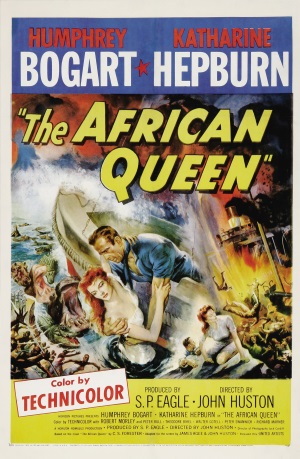
The African Queen is one of those perfect, anti-boring and instantly emotional engaging films that you never want to end. I never did I want to see Humphrey Bogart and Katharine Hepburn leave that tiny broken down old boat in an African rain forest – The African Queen is the film I measure all “man and woman who hate each other at the start but gradually fall in love” movies against. With the power of these actors, this transition comes off completely organically without a contrivance insight – even the point at which they fall in love can be pinpointed to an exact moment.

In showing how he was one of the most adaptable actors in cinema, Bogart leaves his usual urban dwellings and into the African jungle in the role of Charlie Allnut – the scruffy, carefree canuck of whom the recently commenced Great War in Europe means nothing to him nor does he appear to grasp its importance. It’s not until Rose (Katharine Hepburn) awakens a patriotic duty out of him does he perform his part to take out the German army. The scene in which Bogart goofs around with his intimation of various animals is surely the silliest moment of his career, but it’s all good fun – although I do have to ask am I the only one who gets some Bugs Bunny vibes with his performance here?

Katharine Hepburn’s Rose is one tough dame and does not appear to be a very likeable character during the first portion of the film. She doesn’t treat Charlie with any respect because he won’t agree with her demands, takes him granted and is interfering with what ain’t her property! But she’s Kate, she can do whatever she wants and get away with it, and we still love her for it (or at least that’s the case with me). Ultimately she makes more of a gentleman out of the scruffy, alcoholic slob – showing behind every great man is a great woman. Hepburn often played roles tailored towards her oddball personality, so I wonder if she held any hesitation portraying a Christian missionary and a more conservative, prudish woman (the film even features a recreation of the Walls of Jericho from It Happened One Night).

Jack Cardiff’s Technicolor cinematography has such striking vibrancy, a style distinctive from Hollywood Technicolor and one which captures Bogart and Hepburn’s rough, beat-up faces (devoid of any make-up) in such detail. Along with the sound effects of nature in the background and the occasional bit of wildlife, The African Queen is as close as a movie can get to make me feel like I’m a riverboat in East Africa. The African Queen was one of my earliest exposures to classic cinema, aeons before these movies took over my life and although I only saw the remaining 40 minutes, it stuck with me. In particular, the scene in which our duo starts getting eaten by insects; that scene always gives me the heebie-jeebies (even if it’s not a great special effect). The African Queen is within that rare category of films in which every viewing feels like a unique viewing experience, no matter how many times I watch it.