Drunken Angel [醉いどれ天使/Yoidore Tenshi] (1948)

Drain The Swamp

***This Review Contains Spoilers***

Drunken Angel marks the beginning of Akira Kurosawa’s golden age in the first of the 16 film collaboration with Toshiro Mifune (6th out of a whopping 21 films with Takashi Shimura). Drunken Angel is a movie thick with atmosphere, set in a slum with worn out buildings in which a lone guitar player comes out at night overlooking a toxic bog (possibly created from a bomb crater) laden with prostitutes next to a medical practice – a metaphor for all that was rotten about life in the wake of Japan’s catastrophic wartime defeat. You can almost feel the heat and humidity come off the screen while during the film’s daytime scenes the city comes alive with the diegetic music echoing in the background. No city is mentioned by name but a sign in the background of one scene reads in English “Social Center Of Tokyo”.

The chemistry between Toshiro Mifune and Takashi Shimura is electric – The chemistry between Toshiro Mifune and Takashi Shimura is electric – watching the two interact in the film’s opening scene they could easily carry the entire picture by themselves. A very youthful, handsome and suave Mifune is Matsunaga, a big shot member of the Yakuza (although the word is never mentioned in the film). With athletic agility, cat-like moves and his fashion choices of striped shirts and zoot suits, I do get some George Raft vibes from his performance. He shares a fascinating relationship with the brash, ill-tempered but dedicated Dr Sanada (Shimura) as he attempts to cure him of tuberculosis. The two hesitantly develop mutual respect for each other (Matsunaga reminds Sanada of himself during his youth as he states at one point) despite their highly tumultuous, sometimes violent interactions. In Drunken Angel Kurosawa doesn’t want to glamorize the Yakuza, but rather expose them as a blight on Japanese society. 

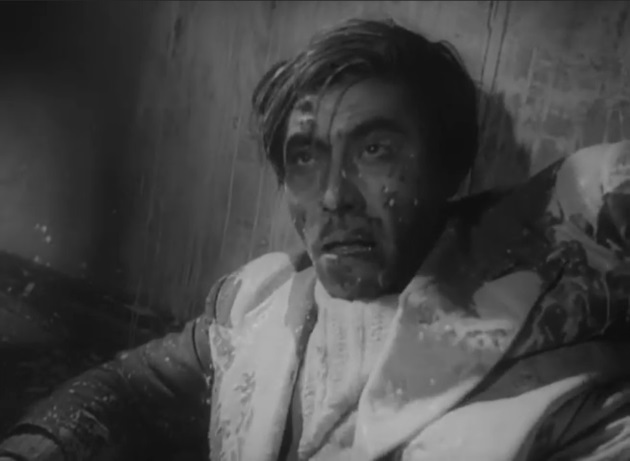
Drunken Angel is a classic story of addiction, in which “just one more drink” turns into a night of binging as Matsunaga drinks himself to death. The fantasy dream sequence involving Matsunaga opening a coffin on the beach only to find himself inside feels like something from a silent horror movie and is even quite Bergman-esque. It also feels reminiscent of the scene in The Empire Strikes Back in which Luke Skywalker finds his own face within Darth Vader’s helmet. The climax of Drunken Angel on the other hand features the type of cinematic images that you never forget as a weak and ill Matsunaga tries to fight his boss Okada as the two are covered in paint and scrambling on the ground before Mutsunga is stabbed and collapses by a balcony – it feels reminiscent of the iconic endings in various Warner Bros gangster films. Had this been a Hollywood production I can easily see it being a vehicle for James Cagney and Pat O’Brien, with perhaps Bogart as Okada?
It’s fascinating to see how much western trends are embraced in Japan, something which is often surprise to newcomers of Japanese film (I do love the interior of the dance hall with the giant playing cards on the walls as well as the Bolero Club with its Iberian ascetics and music). Yet at its heart Drunken Angel remains a story of post-war Japan with its characters and setting being an allegory using illness and contamination as a metaphor for the state of the nation. Matsunaga can be seen as a symbol of the Japan of yesteryear, struggling to find relevance in this new world while Sanada is a broken Japan trying to forge ahead. Sanda’s assistant Miyo (Chieko Nakakita) refuses to let go of her gangster, ex-boyfriend who ruined her life – a Japan which is pinning for what has been lost. However it is the young schoolgirl (Yoshiko Kuga) of whom Dr Sanda cures of tuberculosis provides the film with an optimistic, wholesome ending -a sign of Japan yet to come.

The Yakuza [ザ・ヤクザ/Za Yakuza] (1974)

Perhaps You’ve Heard of the Yakuza, the Poison Fists of the Pacific Rim. The Japanese Mafia!

***This Review Contains Spoilers***

In the audio commentary for The Yakuza, director Sydney Pollack speaks of what attracted him to the project, that he wanted to create a film which examines the clash between western and eastern cultures. In particular, the opposing view the two share on forgiveness. The Christian ethic in the West believes that confession absolves one of guilt and sin, whereas in Japanese culture, forgiveness is something you must earn; if you cause pain, then the only way to atone for it is to inflict pain upon yourself. As protagonist Harry Kilmer (Robert Mitchum) is described at one point in the film, “When my brother spoke of you as a unique stranger, I took it to mean that you were a westerner who had values consistent with our own, that a man pays his own debts, discharges his own obligations, that they are all that make him a man”.

Kilmer is a World War II veteran who remained in Japan after the war and fell in love with a Japanese woman, Eiko Tanaka (Keiko Kishi). I find it difficult to imagine a better choice for the role of Harry Kilmer than Robert Mitchum. The ultra-cool, world-weary actor (who still retained a magnificent mane of hair in his old age) carries a real level of gravitas. An icon of film noir and someone who was often cast in movies about the war in the Pacific, his casting in this neo-noir on the seedy underworld of Japanese gangsters is a perfect marriage of actor and role.

The Yakuza is a love letter to Japanese cinema. You couldn’t ask for a non-Japanese production about Japan to be more respectful, thoroughly researched and authentic than The Yakuza. The opening credits themselves are reminiscent of the film Kaidan (1964), while the names of the Japanese actors appear in the traditional last name, first name format. The score by Dave Grusin is itself magnificent, combining eastern and western influences, delivering a real sense of aching beauty as it plays alongside scenes of the bustling, neon-lit Tokyo streets. The filmmakers clearly took full advantage of the Japanese locations at their disposal; the Kyoto International Conference Centre is an incredible piece of architecture (it’s not a 70’s movie unless there’s some brutalist architecture), while the sento (public bath) with its minimalist waterfall and carp-filled aquariums has a real Blade Runner vibe. Westernisation in Japan is often a shock to outsiders, and that is on display in The Yakuza, in particular, the scene in the nightclub in which patrons are singing My Darling Clementine. However, as stated early in the picture, “The farmers in the countryside may watch TV on their tatami mats, and you can’t see Fuji through the smog, but don’t let it fool you. It’s still Japan. And the Japanese are still Japanese.”

Kilmer and his friend Oliver Wheat (Herb Edelman) are so engaged with Japanese culture and its customs to the point that they’re second nature to them. Richard Jordan, as Dusty, on the other hand, acts as the audience surrogate character for the non-Japanese viewer as he experiences Japanese culture for the first time. He expresses a genuine interest and curiosity, such as when he gets too comfortable examining a katana sword, to expressing his observations; “When an American cracks up, he opens the window and shoots up a bunch of strangers. When a Japanese cracks up, he closes the window and shoots himself. Everything’s in reverse, isn’t it?”. The Yakuza is part of the Gaijin subgenre of films. A long lineup of films about foreigners’ interaction and navigation through Japanese culture, often confronting their own cultural blind spots. The Yakuza wouldn’t even be actor Ken Takakura’s (as Eiko’s brother Ken) final appearance in such a film, as he would also appear in Ridley Scott’s thematically similar Black Rain (1989) and the sports comedy Mr. Baseball (1992), playing the cultural counterpart to a foreigner. From what I understand, Takakura only had a perfunctory understanding of English, although watching The Yakuza, you would think the man is fully fluent.

The scenes involving the dealings of The Yakuza themselves give the film the vibe of being the oriental Godfather; suited men negotiating at desks while smoking cigarettes, with a strict hierarchy and their own set of customs (such as the introduction of extending their hand from their right knee to show they have no weapon). The Yakuza is a film with some very violent scenes, but it is not a schlocky film; thus, the violence is portrayed in a classy, arty tone and not gratuitously, with an effective combination of gunfire and katana duels. The film does, however, have one reality-bending moment in which a gangster has his arm chopped off, yet the severed arm continues to hold a gun and fires it in mid-air (either way, it looks cool). The film’s rescue plot, in which Harry, Dusty and Ken have to rescue a kidnapped American girl, and its messy aftermath is quite complicated and hard to follow with its web of conspiracy and double crossing, but even during my first viewing of The Yakuza, it didn’t detract from the film’s emotional core.

The romance angle of The Yakuza is established with a Casablanca-like set-up. After Eiko refuses to marry Harry (a love made forbidden due to family ties), Harry leaves Japan, but leaves Eiko a café named the Kilmer House as a sayonara gift. Following Harry’s return to Japan, he arrives at the Kilmer House just as the café is closing for the night, to greet Eiko for the first time in 20 years, as they subsequently spend the evening reliving their nostalgic memories of the occupation years. The Yakuza shows that Mitchum was not only a tough guy, but could also play a great romantic lead with a tough yet tender personality. So why did Eiko refuse to marry Harry despite being in love with him? In the film’s big final third twist, the man we are led to believe is Eiko’s brother, Ken (who returned from the jungle several years following the end of the war), is actually her husband. Although Ken was always grateful to Harry for saving Eiko’s life after the war, his current return to Japan is what leads to the death of their daughter, Hanako (Christina Kokubo), at the hands of Yakuza – a disbalancing of debt and obligation.

Upon Harry’s realisation that ‘’I destroyed his past and future”, Harry offers Ken an apology fitting of a former Yakuza, completing the overarching theme of the film. In a scene featuring some of the finest acting of Mitchum’s career, Harry performs the Yakuza ritual of Yubitsume (cutting off the tip of one’s little finger). During the scene, there is the nervous anticipation as Harry sits down, takes a deep breath, then takes out a handkerchief and knife with the look on his face of “I can’t believe I’m really going to do this”, before proceeding with the act itself. He offers the severed fingertip to Ken, as Harry’s face and voice are overcome with physical and emotional pain as he delivers words of sorrow in both English and Japanese (“No man has a greater friend”). The Yakuza ends with a sense of tragic yet melancholic closure. However, why did Eiko never tell Harry the truth all those years ago? Would the truth not have caused less heartache? The final interaction between Harry and Eiko puts a cap on this ambiguity:

I have no more secrets, do I, Harry?

Never run out of those darling.”