Departures [おくりびと/Okuribito] (2008)

To The Faithful Departed

***This Review Contains Spoilers***

Cultures across the globe have different approaches to how they deal with their deceased. In my own Irish culture, it’s normal practice for the body of the deceased to be on open display prior to the closing of the casket, which, to my surprise, isn’t even the case across the sea in Great Britain. However, if there is one thing which is consistent amongst many cultures, it’s the taboo nature of death as a topic of discussion. In the anglosphere, people don’t even like to use blunt language as “dead people”, rather opting for language such as “passed away”, the late…”, “the departed”, “the deceased” or “those no longer with us”. Departures (おくりびと/Okuribito – “one who sends off“) is the only film I’ve ever seen about those who hold the job of handling bodies of the departed, well, at least in a serious manner (Night Shift, Weekend At Bernies).
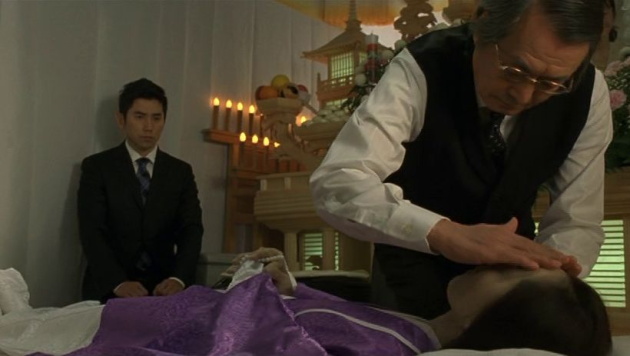
Departures depicts men known as Nōkanshi and details their custom of ‘encoffining’, in which the body is prepared for its so-called departure. This is accomplished through a procedure of cleaning, dressing and applying make-up; there is such a level of dignity, grace and even an artisanal nature to the procedure as it is performed with such intricate precision (even when it involves a man undressing a woman and touching her body). In a way, the procedure brings life back to the body, as the application of makeup returns colour to the face after the blood has been drained from the face.
However, despite the importance of death rituals in Japanese culture, the subject is considered “unclean” as everything related to death is thought to be a source of “kegare” (defilement). This is the contradiction at the core of Departures: a job which is so vital and dealing with something so universal, yet those who perform it are scorned upon and discriminated against. Daigo Kobayashi (Masahiro Motoki) is only one of three employees at the encoffining company NK Agent, alongside his world-weary Freudian father-figure boss Ikeui (Tsutomu Yamazaki) and the secretary Yuriko (Kimiko Uemura), whom is herself a social outcast. Daigo is even openly insulted by a patron during an encoffining ceremony, while an old friend, Yamashita (Tetta Sugimoto), highly chastises Daigo upon learning of his profession. Well, that is until his own mother dies and he receives a metaphorical comeuppance. This discriminatory treatment reaches its zenith when Daigo’s Mika (Ryoko Hirosue) wife, temporarily leaves him upon discovering what he does. From an outsider’s cultural perspective, it’s hard not to feel that the reactions Daigo receives are anything but unreasonable (but I understand that I come from a particular perspective).

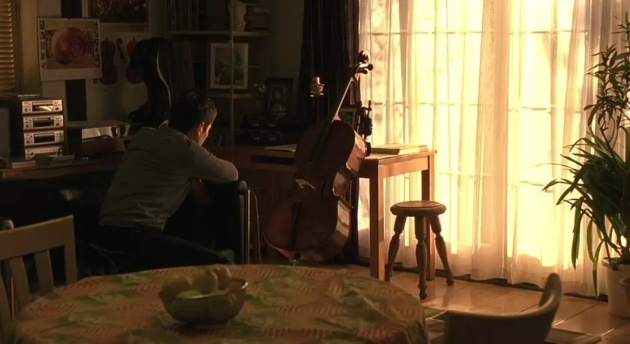
That being said, Daigo does receive praise from patrons during the course of the film for his work. This ties into the other (albeit positive) irony within Departures, that a man finds meaning in life through death. At the beginning of the film, Daigo is devastated to lose his job as a cello player in a Tokyo orchestra, as few people are attending their performances. This has been a lifelong ambition of Daigo as he has been playing the instrument since kindergarten (“You professional cello player yet?!”). This death of his music career, however, yields a new career, as just like in the real world, life doesn’t always turn out how we planned it (“What I’d always taken as my dream maybe hadn’t been one after all”). With so many people in the world stuck in dead-end (pardon the pun) jobs, Departures really showcases the importance of finding deep meaning and purpose in one’s work, and just what a spiritual privilege that can be.
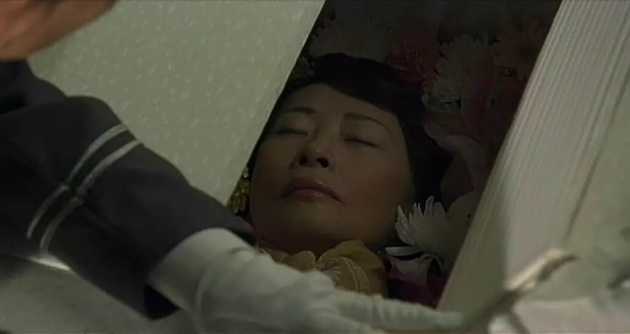
Despite the subject matter, Departures is not a dour film, far from it. In fact, upon watching again, I was surprised to find the film rather funny. From Daigo wearing a giant diaper to film an instructional video, to live octopus antics in the kitchen, Departures injects an appropriate degree of levity, but not in a way to break the mood. Even during the opening scene, Daigo discovers the deceased person in question was actually a gender dysphoric male once he discovers she has “a thing”, leading to a funny exchange between Daigo and his boss (but not in a way which feels inappropriate or out of place). This levity also extends to the film’s montage, in which the complete spectrum of people dealing with grief is displayed. One funeral sees a family laughing with tears of joy and leaving lipstick marks on the face of their deceased patriarch, while another family happily proclaims “bye-bye” and “thank you for everything” to their grandmother while she wears her favourite socks (really putting the fun in funeral). On the other end of the spectrum, the POV shot from the deceased Christian boy as the lid is slid over the coffin into darkness gives me goosebumps. Likewise, the emphasis of the cello in the film’s narrative not only ties in with the Japanese love of European classical music but also influences the music score. Composer Joe Hisaishi emphasises the use of cellos in his score of which he described the challenge of centring a score around the cello as one of the most difficult things he had ever done.

In a classic “would probably never happen in real life” scenario, Departures concludes with Daigo performing an encoffining for his estranged father, who left himself and his mother for a waitress when he was a child. Daigo finds in the hands of his father’s deceased body a rock (a counter piece to a rock his father gave him as a child to symbolise their bond), showing that he never forgot about his son and thus acting as a form of redemption for this deadbeat father. Although I do have to question if this is enough to really redeem his character, should there have been evidence for more active measures by his character in order to achieve redemption? Regardless, as presented in the film, one can view it through either the Eastern notion of forgiveness vs the Western Christian notion of forgiveness.

Forgiveness doesn’t erase karma, but it helps release attachment and hate vs “Forgive us our trespasses as we forgive those who trespass against us”.

Porco Rosso [Kurenai no ButaPorco] (1992)

Bringing Home The Bacon

***This Review Contains Spoilers***

Combining elements from CasablancaOnly Angels Have Wings and A Matter Of Life And DeathPorco Rosso is Studio Ghibli’s romantic, swashbuckling cocktail. Porco Rosso (Italian for Red Pig), real name, Marco Pagot is an ex-Italian World War I fighter pilot turned bounty hunter in the Adriatic Sea. Porco is a Bogartian figure with his cool detachment, political apathy and romantic distance, but his most significant character trait is that derived from his physical appearance. Porco has had a curse put upon him turning him into, well, an anthropomorphic pig. Why is the film’s protagonist a pig? The two most apparent interpretations being firstly a reference to the saying “when pigs fly” and the cultural perception in the west (as well as in faiths such as Judaism and Islam) of pigs being dirty animals (keeping in mind the film is set in a western country). A common reading is that Porco put the spell upon himself out of survivor’s guilt when the rest of his comrades died in battle. He views himself as swine – self-loathing and unworthy of living. It’s only through the validation and the friendship he shares with the character of Fio that comes to cure him of this affliction. How someone possesses the supernatural ability to turn into an anthropomorphic animal is never explained nor does anyone in this world question why there is a walking-talking hog existing among humans. Still, the film has enough going for it to overcome this suspension of disbelief (Porco is even a hit with the ladies despite his appearance so I guess looks aren’t everything). The film’s ending indicates the curse may have been lifted but ultimately leaves the question unanswered. 

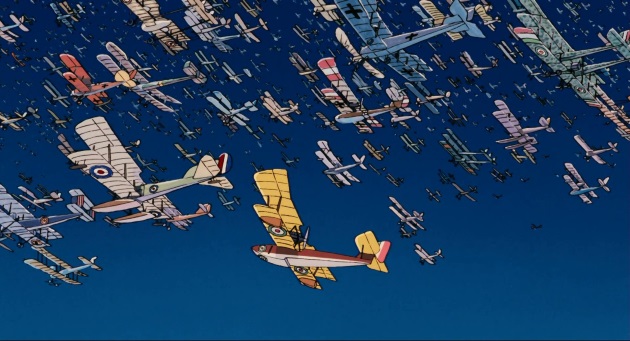
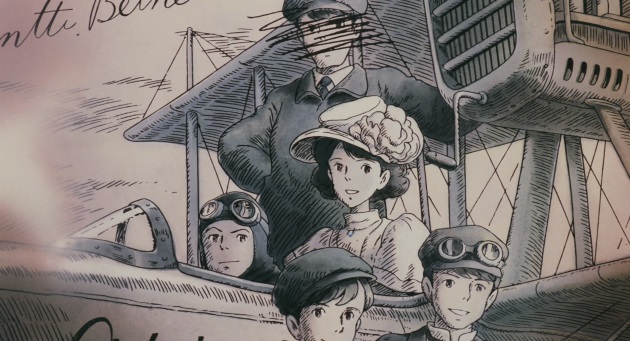
Porco Rosso is one of the few films directed by Hayao Miyazaki in which the historical and geographical setting is clearly defined and gives the director a chance to indulge in his Europhilia with the film’s picture postcard scenes of Italy and the Adriatic Sea. Academic Chris Wood states in his article “The European Fantasy Space and Identity Construction In Porco Rosso” that the film can be understood as a representation of wakon yōsai (Japanese spirit, western learning) – a tendency, since the Meiji period, for Japanese artists to paint Europe in a spectacular manner, while simultaneously maintaining the distance necessary to preserve a distinct sense of Japanese identity. Chris Wood states, “[In Porco Rosso] Europe is tamed, rendered as a charming site of pleasurable consumption, made distant and viewed through a tourist gaze“. So yes, Hayao Miyazaki is a European otaku. If there is a scene in the movie which captures this beautifully then it has to be the flashback to a young Porco (or Marco as he would have been known before his curse) and his longtime friend Gina lifting an early seaplane into the air in this display of pure unabashed nostalgia which captures the human desire to fly (thanks in large part of the enchanting music score by Joe Hisaishi). Likewise, one of the film’s most striking scenes has to be the flashback to Porco’s near-death experience and the origin of his curse. In this otherworldly sequence following a battle near the end of the war, Porco found himself in what the film describes as cloud prairie (I can’t find any reference to this term outside the movie), in which fighter planes from other nations rise above him into the sky as if there are entering heaven. The scene has similar vibes to the stairway to heaven from Powell & Pressburger’s A Matter of Life And Death while the use of synthesizers in the music score really makes it all the more captivating and eerie.

Porco Rosso is set during the final days of the roaring twenties and upon the onset of the Great Depression (“Farewell to the days of fun and freedom in the Adriatic”). The film’s setting also partakes in alternative history in which the wider Mediterranean Sea is beset with air pirates (albeit highly incompetent air pirates as reflected in their comical, circus-like theme music). From a romantic point of view it’s sad to say that air pirates are not real bar one incident in 1917 in which a civilian Norwegian schooner named Royal was boarded and captured by a party flying a German Zeppelin L23 – is the closest we’ve ever come to having steampunk fantasy become reality? As far as coinciding with actual history, Porco Rosso takes place during the days of Mussolini’s Italy as marchers in the street wave blue & green flags with bankers wearing the same design as armbands (this flag itself is fictional and was never an actual historical Italian flag). Porco is put under pressure from a former WWI comrade to join the state’s military to which he responds with the line “Better a pig than a fascist”. More sinister is the scene in which Porco pays off a loan at the bank and the teller asks him if he will invest in a patriot bond which of course, is only voluntary (wink wink). Despite its backdrop, Porco Rosso remains a largely apolitical film but if anything it shows that even under authoritarianism, life goes on.

The semi-love interest of Porco Rosso comes in the form of the pure feminine grace that is Madame Gina, of whom every flyer in the Adriatic is in love with as Fio claims. A longtime friend of Porco and his now deceased comrades, the film presents her as being “one of the guys” while not sacrificing any of her womanly demeanour. She will quickly run to a boat in a feminine stride but will make an epic and lengthy jump off the boat back onto the pier if required. Gina will dress to exemplance, even when in private and I do have to question if any particular Golden Age Hollywood actress is modeled after her? I am getting Mary Astor vibes myself. Gina occupies the island hotel known as the Hotel Adriano although it’s not made clear in the original Japanese version if she actually owns the establishment however, in the English dub, she refers to the place as “My restaurant” and the private garden as “my garden”. Regardless, the establishment is where all the hotshot flyboys of the Adriatic hang out where they kick back, relax and listen to Gina sing songs of lovers long lost. Like Rick’s Café Américain in Casablanca, there is an unwritten truce between all men. In the clouds, you may be enemies but at Gina’s place, everyone is your buddy. In her introductory scene, Gina shows little emotion in relation to having been told the news earlier in the day that her third husband had died in a flying accident, which as seen in films like Only Angels With Wings, was the norm in the early days of aviation. Porco and Gina share a “beauty and the beast” romance in which they never verbalise their feelings towards each other but you can tell there is a deep affection between the two. The other major female presence in Porco Rosso is the young Fio Piccolo, the counterbalance to Porco’s bleakness (and whose grandfather appears to be related to Hans Moleman). Porco doesn’t trust her to design him a new plane due to her being young and a girl says she understands this and doesn’t take offence. Rather Fio is aware that she needs to prove herself to him instead of just dismissing him as a sexist, well, pig (“Forgive my sins of using women’s hands to build a warplane”). However, it is somewhat odd the film concludes with narration from Fio’s point of view when this never happened at any other point in the film.

Porco Rosso does have one of the better Studio Ghibli English dubs, especially with the casting of Michael Keaton as the titular swine whose voice talents perfectly capture the world-weary cynicism of the character. I also enjoy Brad Garrett as the dopey pirate Capo while the announcer aboard the cruise liner as its being attacked by pirates adds some great deadpan humour to the proceedings. The sound mix of the dub is inferior when compared to the original while the lack of any reverb on the voices during the flying sequences is slightly jarring. Gina’s cover of the French song Le Temps Des Cerises is also re-recorded although there was no need to do so and I do consider the vocal performance on the original to be superior. Be that as it may, it’s Cary Ellwes’ southern drawl for the Errol Flynn-esque Donald Curtis which really add extra character to the dubbed version (in the Japanese version he is from Alabama whereas in the dub it mentions he is from Texas). The quasi villain of the picture, Curtis is a Hollywood actor who on his down time like Frank Sinatra, appears to converse with outlaws, while his delusions of grandeur thinking he will become President Of The United States with Madame Gina as his First Lady does make him somewhat endearing. Curtis does attempt to kill Porco by taking out his plane only to later discover his attempt was unsuccessful, eventually leading to the picture’s finale in which the two men sort out their differences through some mono e mono (in which Porco doesn’t even remove his glasses). I understand the psychological aspect of men making amends and even becoming friends after engaging in hand-to-hand combat, but Curtis did literally try to murder Porco earlier in the film, but I digress. Porco Rosso is another breed of artistic excellence from Studio Ghibli, you uncultured swine.

Castle In The Sky [Tenkū no Shiro Rapyuta/Laputa: Castle In The Sky] (1986)

Just The Two Of Us, Building Castles In The Sky

***This Review Contains Spoilers***

Castle In The Sky is one of those films upon a first-time viewing, it’s easily apparent how much of its fingerprints are over so much media that proceeded it in this Jules Vernesque, steampunk adventure. The heroes’ journey, chase movie follows youthful protagonists Pazu & Sheeta as they embark on the search for Laputa, a floating Tower of Babel of which the surface has the appearance of a deserted Hanging Gardens of Babylon. Little information is given about the history of Laputa, with the viewer given the task of filling in the blanks.

Castle In The Sky is littered with moments of pure wonderment and melancholy from scenes such as a cave being turned into a makeshift planetarium with the use of the element volucite (a fictional element sadly) to the sense of awe upon the arrival to Laputa itself. There is something about the blue skies in Studio Ghibli’s films which is endlessly beautiful to look at while the lighting present in the animation provides much visual stimulus (although I would just say the contrast with Sheeta’s pirate outfit between light and dark is too drastic). The physicality and sense of space the animators are able to convey as well as the suspense created in the film’s action sequences through the medium really is a remarkable feat. Correspondingly, a Ghibli film ain’t a Ghibli film without a rich and melodious score, especially courtesy of Joe Hisaishi. The main theme of the picture itself balances a line between its dark, mischievous yet optimistic tone. Some of my favourite highlights include Morning In Slag Ravine which is the ideal accompaniment to any morning sunrise to that piece which plays as Sheeta slowly Ancient Aliens herself from the sky is one catchy ditty. Likewise, the Celtic-sounding Memories of Gondoa conjures visions of the rural landscape of the British Isles and appropriately is used as Sheeta tends to cattle resembling that of the Scottish highlands. 

Pazu resides and works in a fantasy version of a Welsh mining town and I do have to ask was John Ford’s How Green Was My Valley used as a visual pretext for the film? Hayao Miyazki visited a Welsh mining town a year prior to the film’s release and in he appears to pay tribute to them in the film when Pazu utters the line, “Miners aren’t exactly wimps”. Ah Pazu & Sheeta, one true pairing if there ever was one. It is remarkable how attached one becomes towards this duo and their shared chemistry which is able to be portrayed through the medium of animation (take a sip every time Pazu screams “Sheeeeeta!”). No full-on romance ever develops between the two nor do they ever kiss but small displays of affection are present in this young love. In the sweetest scene in the film, Pazu & Sheeta are atop the pirate’s airship at night as Pazu gives reassurances to Sheeta that all will be fine, all while the pirate captain Dola unintentionally hears their endearingly innocent conversation.

As is recurring in Miyazaki’s films, Castle In The Sky showcases the innocence of youth and having minors overcome obstacles which force them into maturity. Like In Kiki’s Delivery Service, the young protagonists are thrust into positions of adult reasonability. Pazu lives by himself and works a full-time job (literally a minor-miner) while Sheeta is left to run her parent’s estate after their passing and it’s later revealed she has the responsibility of being part of the Laputa royal family. Furthermore, during the sequence as the military base is going up in flames, the absolute trauma in the face and voice of Sheeta is intense (although the duo later show no fear walking and even celebrating on platforms with drops in which they could fall to their deaths). I do believe the medium of anime is the best at portraying this sense of innocence and vulnerability due to the hallmarks of anime character design with those big wide eyes, the almond face shapes and the head-to-body ratio. This is where the English dub by Disney really falls short, James Van Der Beek and Anna Paquin sound far too mature for Pazu & Sheeta. Not only do their voices not match their clearly pre-pubescent appearance, but it also takes always from their characters and doesn’t replace it with an alternative that has any merit on its own (as was the case with Jiji in the Disney dub of Kiki’s Delivery Service). This is a shame as Mark Hamill and Cloris Leachman are fantastic in their respective roles but the casting of the children makes this dub hard listening.

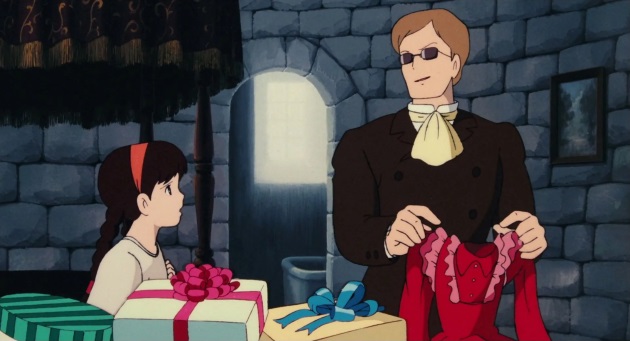
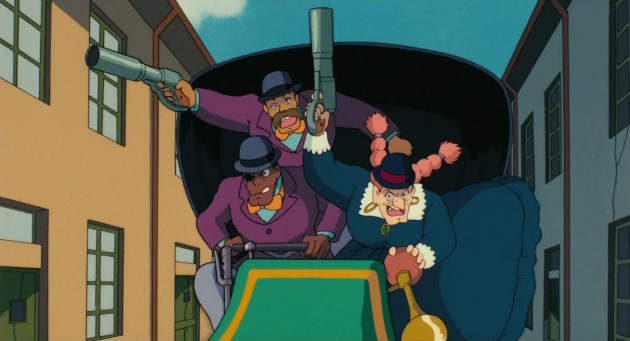
Castle In The Sky is a rare instance of Studio Ghibli film with an outright villain in the form of “that pencil pushing upstart” Colonel Muska. The man is one dapper gentleman but I never can brush off the creepy, groomer vibes when he tries to bribe Sheeta with fancy clothes. The other major foe in Castle In The Sky is none other than the government of this fictional land, and what better way to portray an overbearing, authoritarian government than by turning them into ze Germans of course, you vill eat ze boogs and vill like it! Furthermore, the appearance of firearms and ammunition in children’s animation is a shock to the western viewer rather than a fantasy Star Wars-style blaster. Once adjusted to this reality it is far more preferable rather than having them digitally altered into walkie-talkies. Then there are the bay guys turned good mid-film with the Marty Feldman look-a-like Dola and her band of pirates. The film doesn’t make it clear if Dola is the biological mother of her crew or mother in spirit but either way, their dynamic is like a more endearing version of Mom and her three sons from Futurama. Dola herself is really made an interesting character by her belief in traditional gender roles despite being a model of non-conformity herself. Despite wearing the pants, she insists Sheeta be ladylike and holds concern for Pazu’s lack of masculinity following his initial surrender when trying to rescue Sheeta.

I’ve read accounts that Castle In The Sky aired on UK television channel ITV 1 on Christmas Day 1989, with other accounts stating various surrounding dates including Christmas Day and New Year’s Eve of 1988. Either way, it’s remarkable that Castle In The Sky was able to make it to the west so quickly back then and odd by the way of a one-off TV airing. I’ve tried to find recordings or promotion material for this broadcast but have come up empty-handed – hopefully, someone can close a chapter on this lost media mystery.