Cultures across the globe have different approaches to how they deal with their deceased. In my own Irish culture, it’s normal practice for the body of the deceased to be on open display prior to the closing of the casket, which, to my surprise, isn’t even the case across the sea in Great Britain. However, if there is one thing which is consistent amongst many cultures, it’s the taboo nature of death as a topic of discussion. In the anglosphere, people don’t even like to use blunt language as “dead people”, rather opting for language such as “passed away”, “the late…”, “the departed”, “the deceased” or “those no longer with us”. Departures (おくりびと/Okuribito – “one who sends off“) is the only film I’ve ever seen about those who hold the job of handling bodies of the departed, well, at least in a serious manner (Night Shift, Weekend At Bernies).
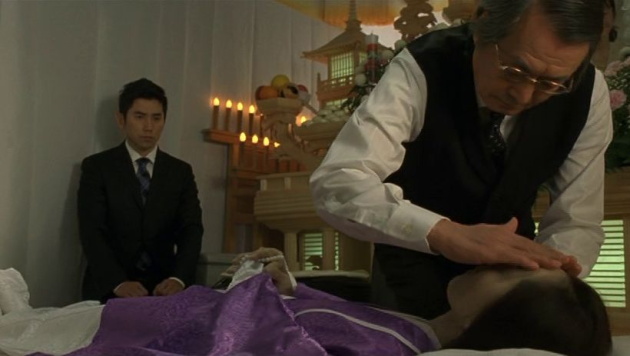
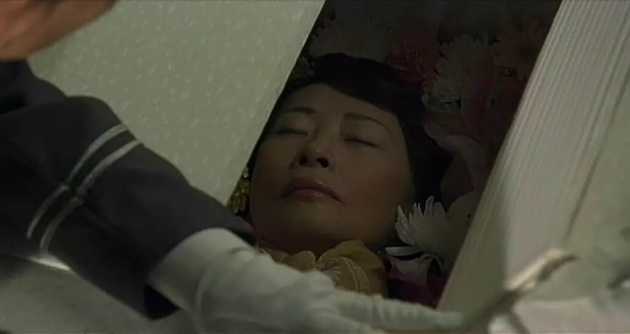
Departures depicts men known as Nōkanshi and details their custom of ‘encoffining’, in which the body is prepared for its so-called departure. This is accomplished through a procedure of cleaning, dressing and applying make-up; there is such a level of dignity, grace and even an artisanal nature to the procedure as it is performed with such intricate precision (even when it involves a man undressing a woman and touching her body). In a way, the procedure brings life back to the body, as the application of makeup returns colour to the face after the blood has been drained from the face.
However, despite the importance of death rituals in Japanese culture, the subject is considered “unclean” as everything related to death is thought to be a source of “kegare” (defilement). This is the contradiction at the core of Departures: a job which is so vital and dealing with something so universal, yet those who perform it are scorned upon and discriminated against. Daigo Kobayashi (Masahiro Motoki) is only one of three employees at the encoffining company NK Agent, alongside his world-weary Freudian father-figure boss Ikeui (Tsutomu Yamazaki) and the secretary Yuriko (Kimiko Uemura), whom is herself a social outcast. Daigo is even openly insulted by a patron during an encoffining ceremony, while an old friend, Yamashita (Tetta Sugimoto), highly chastises Daigo upon learning of his profession. Well, that is until his own mother dies and he receives a metaphorical comeuppance. This discriminatory treatment reaches its zenith when Daigo’s Mika (Ryoko Hirosue) wife, temporarily leaves him upon discovering what he does. From an outsider’s cultural perspective, it’s hard not to feel that the reactions Daigo receives are anything but unreasonable (but I understand that I come from a particular perspective).
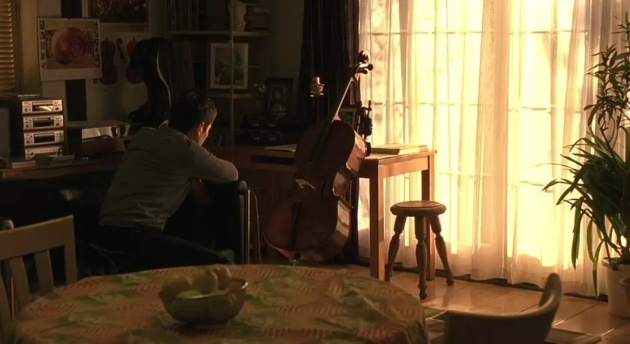
That being said, Daigo does receive praise from patrons during the course of the film for his work. This ties into the other (albeit positive) irony within Departures, that a man finds meaning in life through death. At the beginning of the film, Daigo is devastated to lose his job as a cello player in a Tokyo orchestra, as few people are attending their performances. This has been a lifelong ambition of Daigo as he has been playing the instrument since kindergarten (“You professional cello player yet?!”). This death of his music career, however, yields a new career, as just like in the real world, life doesn’t always turn out how we planned it (“What I’d always taken as my dream maybe hadn’t been one after all”). With so many people in the world stuck in dead-end (pardon the pun) jobs, Departures really showcases the importance of finding deep meaning and purpose in one’s work, and just what a spiritual privilege that can be.
Despite the subject matter, Departures is not a dour film, far from it. In fact, upon watching again, I was surprised to find the film rather funny. From Daigo wearing a giant diaper to film an instructional video, to live octopus antics in the kitchen, Departures injects an appropriate degree of levity, but not in a way to break the mood. Even during the opening scene, Daigo discovers the deceased person in question was actually a gender dysphoric male once he discovers she has “a thing”, leading to a funny exchange between Daigo and his boss (but not in a way which feels inappropriate or out of place). This levity also extends to the film’s montage, in which the complete spectrum of people dealing with grief is displayed. One funeral sees a family laughing with tears of joy and leaving lipstick marks on the face of their deceased patriarch, while another family happily proclaims “bye-bye” and “thank you for everything” to their grandmother while she wears her favourite socks (really putting the fun in funeral). On the other end of the spectrum, the POV shot from the deceased Christian boy as the lid is slid over the coffin into darkness gives me goosebumps. Likewise, the emphasis of the cello in the film’s narrative not only ties in with the Japanese love of European classical music but also influences the music score. Composer Joe Hisaishi emphasises the use of cellos in his score of which he described the challenge of centring a score around the cello as one of the most difficult things he had ever done.
In a classic “would probably never happen in real life” scenario, Departures concludes with Daigo performing an encoffining for his estranged father, who left himself and his mother for a waitress when he was a child. Daigo finds in the hands of his father’s deceased body a rock (a counter piece to a rock his father gave him as a child to symbolise their bond), showing that he never forgot about his son and thus acting as a form of redemption for this deadbeat father. Although I do have to question if this is enough to really redeem his character, should there have been evidence for more active measures by his character in order to achieve redemption? Regardless, as presented in the film, one can view it through either the Eastern notion of forgiveness vs the Western Christian notion of forgiveness.
Forgiveness doesn’t erase karma, but it helps release attachment and hate vs “Forgive us our trespasses as we forgive those who trespass against us”.
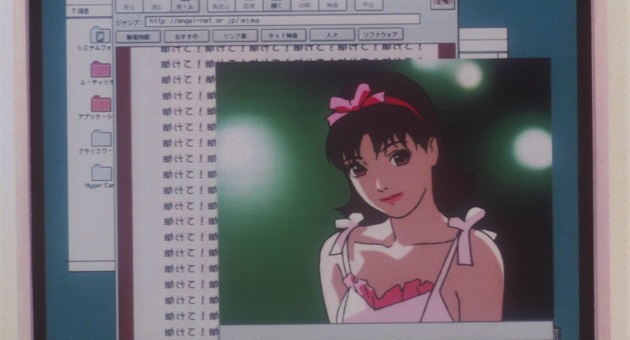
While I hate to use a cliché, normie-tier phrase, Satoshi Kon’s animated psychological thriller Perfect Blue, the story of a pop singer who transitions to become an actress and loses her grip on reality in the process, is a film exceedingly more relevant now than when it was first released back in 1997, and scarily so. Fast forward to the current age of the content creator in which people who hold a dedicated online following but are not household names nor would get recognized in the street are a dime a dozen. This stands in contrast to the 1990s and prior when the status of being a low to med-level celebrity with a niche fanbase like Perfect Blue’s protagonist, Mima Kirigoe, was not so democratized – as the famous quote often misattributed to Andy Warhol states, “In the future, everyone will be world-famous for 15 minutes”. The status of Mima Kirigoe is showcased during the film’s opening which cuts between an energetic live concert performance to Mima doing mundane activities such as buying groceries or riding the train before returning to her small, modest Tokyo apartment (itself a representation of the fascinating ecosphere that is the interior of tiny Japanese apartments in which every inch is in use). Perfect Blue features an early screen depiction of the internet from an age when web page design was at a very primitive and clunky stage (all the film is missing is that nostalgic dial-up connection sound). Likewise, the internet browser Mima uses is Netscape Navigator which at the time of the film’s production was the most popular internet browser on the planet, however, its popularity declined over the years and its development ceased in 2008. Mima is a total boomer when it comes to the internet and the dark side of fandom as seen through the web is something Mima is not prepared for. The majority of Mima’s fans throughout Perfect Blue are shown to be perfectly respectable, even standing up to the small minority of troublemakers at the opening concert and giving her friendly words of encouragement when she arrives at a TV studio. There is one fan however who gives Mima much more than she bargained for.
The fan in question is the creepy inbreed-looking stalker who is later given the name of Mr. Me-Mania – a terrifying figure with his crooked teeth, eyes so wide apart and even the build of Michael Myers. He is a counterbalance to the sweet and pleasant nature of Mima whose puppy dog eyes are larger than most other character’s in the film. Me-Mania is a man who cannot reconcile the image of Mima the wholesome pop-star with Mima the provocative actress – just observe the look of pure joy on his face during the performance of the song Alone But At Ease (even though this image occurs in a scene within Mima’s head and may not have actually occurred in reality, but more on that later). Me-Mania sets on getting revenge for having his perception of reality betrayed, murdering individuals involved in Mima’s transition to becoming an actress and (as he would see it) the perversion of her image, eventfully trying to take out Mima herself. There is one shot which tells the viewer everything about Me-Mania and how he views Mima – the point-of-view shot of him holding the image of Mima in his hand during the opening concert.
Within this early portrayal of the information superhighway, Perfect Blue explores the concept of the duality that exists between an individual and what would be referred to in years to come as an avatar, the image that comes to represent one’s carefully chiselled, romanticized image and personality – the image we present to the world as opposed to the lives we actually lead. Mima is informed of a website known as Mima’s Room in which someone (who is later revealed to be Me-Mania) is not only pretending to be Mima but is posting accurate information about her day-to-day life. The idea of not being in control of your image (whether online or off) as well as having no control over your own narrative is something Perfect Blue explores terrifying well and how it can lead to one losing their grip on reality. The image of the avatar is also metaphorically presented in the film by a ghostly image of Mima’s pop idol persona (with this metaphor doubly enforced by it appearing in the computer screen itself). This doppelganger acts as a sort of court jester with its bright colourful appearance as it bounces around like a near-weightless object and taunts Mima by telling her the (seemingly at the time) harsh truth that she has made the wrong career choice.
To return to the opening paragraph, only individuals of Mima’s status or higher would have been prone to becoming victims of this loss of control, but today any online content creator, online personality (or influencer to use that dreadfully narcissistic phrase) or even any random individual posting selfies on Instagram opens themselves as a target. Furthermore, most people can point to performers they were once a fan off but disliked a change of direction their image or career took – they didn’t fit the narrative we wanted or expected. Any sane person won’t dwell on this like an obsessive fan and go commit murder as a result; your average Joe has more important things in their life to worry about. Regardless, one lesson to take from Perfect Blue is that as a fan or consumer, one should not lose track of where a person starts and an avatar ends. As Satoshi Kon himself is quoted saying; “There’s a gap between the image people see of me and what I see myself. Perfect Blue is about the tragedy caused by that gap becoming too large”. A real-life example of when this did come to fruitarian was during the production of Perfect Blue itself in 1996, life would imitate art with the case of the Björk stalker Ricardo Lopez, whose extreme disillusionment in learning that Björk’s personal and romantic life didn’t align with his perception of who the artist was, culminated in him sending a bomb in the mail to the Icelandic singer (of which was intercepted by the police and no one was harmed), and proceeding to commit suicide himself believing the two of them would meet in the afterlife.
Satoshi Kon continued to explore the theme of fandom in his next film Millennium Actress, which is the yin to Perfect Blue’s yang, a film which explores the positive impact fandom can have. Perfect Blue also acts as an examination of the sacrifices and hardship one must endure for their art as well as the conflict between art and their personal life, with one of the most notable cinematic explorations of this theme being The Red Shoes (1948). In Perfect Blue, the later vision of Mima’s alter ego is seen wearing alongside a red dress, a pair of red shoes. Is there a connection or is my cinematic brain trying to draw strenuous ties that aren’t there? Furthermore, it’s well documented the influence Perfect Blue has had on Darren Aronofsky’s Requiem For A Dream and Black Swan, although two other films I can feel the influence from Perfect Blue would have to be One Hour Photo and Birdman or (The Unexpected Virtue Of Ignorance). However, if I was to select one film predating Perfect Blue which explores similar themes, it would have to be The Swimmer (1968), which going back to the theme of the duality between the person and the avatar, tells the story of a man who projects an avatar onto the world as opposed to the reality of his life which is vastly different.
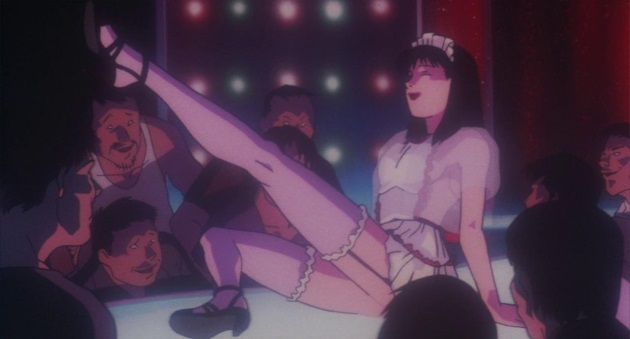
Prior to making the transition to become an actress, Mima was a pop-singer in a girl group known as CHAM!. More specifically, Mima is a certain type of Japanese pop-star known as an Idol. This form of Japanese pop-singer may come off as odd to the western viewer who is not initiated into Japanese popular culture with the sight of grown men at a concert watching three women dancing in titillating, pink maid outfits while singing to 90’s Euro Dance style songs. Yes, what a bunch of weirdoes. I myself am a man of more refined taste who is above such coomerish degeneracy…maybe. CHAM! has three songs featured in the film, two good uplifting jams (Angel Of Love and Alone But At Ease) and a solid ballad (Now Embraced By One’s Memories) when listened to in their full, uninterrupted versions rather than hearing brief snippets within the film intercut to the movie’s more unsettling content. Correspondingly, I was taken back on my first viewing of Perfect Blue by moments in the animation appearing that they wouldn’t look out of place in Clutch Cargo, although charm and character are derived from the film’s modest production values of a picture which is only 77 minutes in length (81 minutes with credits). Even with the film’s references to various 90’s-isms such as mini-disc players and outdated internet browsers, the film’s rich, saturated, film-noir-like colour scheme has a real 80’s, Blade Runner-esque vibe (throw a vaporwave soundtrack over the picture and it wouldn’t be out of place). Correspondingly, the piece titled Virtua Mima is the musical highlight of the film’s score, a piece which itself calls to the vocal-laden music in the Blade Runner score. However, the real musical mystery of Perfect Blue is that synth-pop song featuring a female vocal which plays during the strip club scene. The song is unlisted in the film’s credits and not included in any official or bootleg release of the soundtrack. The song is however used in the Japanese trailer in which a snippet can be heard in greater clarity than that edited into the film, however, the song’s title and the artist remain a mystery. Get on the case lost media sleuths!
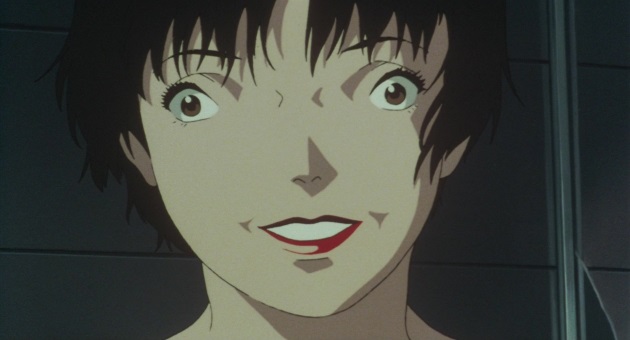
For Mima’s acting debut she lands a supporting role in a TV series called Double Bind. A cliché, CSI-like show featuring a Mulder & Scully style duo as unrealistically glamorous people attempting to solve crimes (“Why do psycho thrillers made in Japan turn out that way?”). The name Double Bind could be interpreted as a metaphor for how the show reflects the events occurring in the film from the various murders to Mima’s loss of sanity and her duels with an alternative persona. The show also foreshadows the twist ending regarding Mima’s manager Rumi Hidaka and her Dissociative Identity Disorder. Yes, it is revealed near the film’s conclusion that Mima’s manager Rumi was collaborating with Mr Me-Mania to get revenge on not only Mima but those who facilitated her image change (I also have to ask is there any connection between these two characters having their eyes spaced so far apart?). Like Me-Mania, Rumi herself could not reconcile Mima’s image change but went one step further. Rumi herself is a failed pop idol and instead became a manager of celebrity agency and was living through Mima’s success but took this to a more literal level with Rumi coming to see herself as Mima, leading to the disturbing sight of an overweight Rumi wearing a red idol dress and believing she is Mima the pop idol. Rumi attempts to take Mima out herself in a final clash, which once again going back to Blade Runner, does remind me of the final showdown between Rick Decker and Roy Batty on the rooftops in the sci-fi classic. During this clash, Rumi is shown as Mima’s pop idol doppelganger in a red dress, and like Roy Batty, displays superhuman jumping abilities and a distinct stain of blood on her face. As is the case of life imitating art with the parallels between Me-Mania and Ricardo Lopez, there is the reverse of art imitating life with the case of the murder of Mexican pop singer Selena by the president of her fan club Yolanda Saldíva in 1995. The most striking similarity between this real-life case and the fiction presented within Perfect Blue is Yolanda Saldíva reportedly turned her apartment into a shrine for her idol, which Rumi does by creating a duplicate of Mima’s living space within her own apartment. Ironically for a movie about pop idols, idolatry itself is one of its major themes. Therefore, my dear friends, flee from idolatry.
On first viewing of Perfect Blue, it would appear Rumi’s reaction to the filming of a rape scene featuring Mima for an episode of Double Bind is simply out of her concern for protégé, but when watching the film again aware of the real context, the scene takes on a different meaning. It is this key moment with Mima’s agreement and subsequent filming of a rape scene in which she plays a stripper at a club who is held down by multiple men as one man proceeds to penetrate her which signifies the destruction of Mima’s innocence. Even though the actions are not real and are only performances for a TV show it’s no less uncomfortable to watch (the actor pretending to rape even apologizes to Mima between takes). Mima’s other agent Mr. Tadokoro attempts to reassure Mima by telling her “Jodie whatshername did it too!”. The film they are referring to is The Accused (1988) starring Jodie Foster, which has a similarly staged rape scene atop a pinball machine in a bar. One of the questions raised by the filming of such an act is whether or not the scene is exploitive – for one I don’t like the slimy look on the writer’s face when is talking about the idea over the phone. Whereas The Accused is a serious film on a serious subject matter, Double Bind appears to be a show of the more trashy kind. Following the filming of the scene, Mima has a breakdown and admits to herself that she didn’t want to do it but the destruction of her innocence is complete as afterwards she starts giving interviews in provocative outfits and even poses for a nude photoshoot. This phenomenon is repeated time and again in the real world with numerous instances of child stars (more than often employed by Disney) whom once reaching an older age attempt to shed their squeaky clean images with a daring, more provocative one.
The opening moments of Perfect Blue feature three Power Rangers-looking dudes known as the Powertrons fighting a stereotypical bad guy, throwing off the viewer and giving the impression you’ve started watching a different genre of film, foreshadowing the reality-breaking nature of the picture. I’m not alone when I say I was left confused after my first viewing of Perfect Blue with the film’s 2nd half, in particular, being hard to decipher and even thinking about it several viewings later it still makes my head spin. This sense of disorientation along with scenes rarely transitioning in a conventional manner places the viewer inside the deteriorating mind of Mima. There are several times in which the film deliberately gives a false impression such as when Mima believes the statement “a link to Mima’s Room” means cameras are peeping into her apartment or when Mr. Tadokoro meets Mima alone in the car without Rumi, it gives the impression he’s going to do something sinister but no such thing occurs and the moment is never referenced again. Questions I have found myself asking when watching Perfect Blue several times include but is not limited to:
-Questioning if Mr. Me-Mania is real or not?
-When is the image of Mima’s pop-star doppelganger just her mental projection or Rumi dressed up as Mima?
-When is Mima actually in her apartment as opposed to the duplicate apartment created by Rumi?
-Is Rumi dressed as the pizza boy murdering the photographer or is Mima dressed as the pizza boy in a dream?
-During the four instances when Mima wakes up does that mean the proceeding scenes actually occurred or were they her dreams?
My brain hurts. Nonetheless, Perfect Blue brings to mind films like The Thin Man, The Maltese Falcon or Clue, films in which it is extremely difficult to make heads or tails of the story but trying to make sense of it ends up being beside the point.
Much tension during Perfect Blue is derived from whether or not Mima has made a big mistake quitting CHAM!, since they have found increased success without her (reaching the pop-charts for the first time) whereas Mima is only getting a few lines per episode of Double Bind and is soon being taunted by the image of her pop-idol doppelganger that she has made the wrong decision. However, Mima’s career decision appears to be affirmed come the end but I don’t believe the film entirely dismisses Mima’s tenure as a pop-singer as Mima herself states when visiting Rumi at a mental asylum, “I know I’ll never see HER ever again. But, thanks to her I am who I am today”. I believe with this she is referring to both Rumi and her former alter ego (I also believe this is the same reason why Mima chooses to prevent Rumi from getting hit by the van during their final clash despite the fact Rumi was trying to stab her to death). The lyrics to the CHAM! song Alone But At Ease reflects the un-intellectual nature of their pop music (“from comics than difficult books and I want to stay the way I am forever”), although to quote C.S Lewis, “When I became a man I put away childish things, including the fear of childishness and the desire to be very grown up”. Likewise, there is the key message as notably derived from Preston Struges’ film Sullivan’s Travels (1941), that you might not be creating high art, but the joy it brings to people’s lives is a more than worthy endeavour. The final moments of Perfect Blue show Mima is no longer only famous among a niche crowd but is known to normies as evidenced by the gossiping nurses who spot her leaving the asylum. There is a cheeky nature of the final shot as Mima does a semi-4th wall break, looking into the camera and cheerfully stating “No, I’m real!” (followed by the end credits featuring a song which is tonally at odds with much of the film but in a good, playful sort of way). Mima’s smile and comment are not only a play on the nurses but also solidifies the key point of the story – that she is now in control of her own identity.
I’ve never been more aroused by a film’s editing and cinematography than that featured in The Color of Money, a film which I ultimately enjoyed more than it’s predecessor The Hustler. It just so happens I first watched The Color of Money during my time as a film student and attempted to replicate many of the film’s shots and edits for a music video (and an intentionally 80’s music video at that) as I studied the cuts present in the film frame by frame. Needless to say, I was not entirely successful in my endeavour.
The Color of Money has the fast pace and rhythm of MTV music videos but still with a sense of old-school class and sophistication; right from the opening credits, I can tell this would be a movie dripping in atmosphere. A movie so snappy, fast-paced and full of quick edits, many of which come unexpectedly along with many unconventional camera movements yet it never feels disorientating or distracting as the scenes glide with such fluidity and ease. The cinematography on display here isn’t that of a David Lean production, no this is a movie which largely takes place in bars and pool halls yet it still has a sense of majesty and scope even if the shot in question is a close up of a drinking glass. Really the only edit I can fault is the very cheesy freeze frame of Paul Newman jumping out of a swimming pool. On the other hand, nobody uses licensed soundtracks better than Martin Scorsese. I get the impression scenes in the film were shot with the music in mind and not as an afterthought. With the opening scene, it feels like Phil Collins’ One More Night was specifically composed to fit the mood and tone of the scene.
The Color of Money however is not style over substance. I love the intriguing character triangle of a trio of hustlers as well as the harmony of two generations coming together. Tom Cruise is an actor I only like in certain parts but in roles such as Vincent, a cocky, male fantasy indulging character who embodies the entrepreneurial and capitalistic spirit of the 1980’s (like his character in Risky Business), I simply revel in – as Eddie puts it “a natural character”. Just as impressive are pool shots done by Cruise himself (he performed all but one of his own trick shots); makes me energised to play some pool myself.
I don’t make any apologies when I say I enjoy this much-dismissed album more than I do some of David Bowie’s more acclaimed works. Tonight is an actual album, unlike Let’s Dance which was more a collection of songs. In fact, from Bowie’s so-called “sell out” period I honestly think Tonight and Never Let Me Down are much stronger albums than Let’s Dance, half of which is comprised of very disposable tracks.
Loving the Alien is one of my very favourite Bowie songs. I didn’t think much of it when I first heard it in a single edit on The Best of Bowie but that changed when I heard the full-length version with the instrumental orchestral second half make for one hell of an atmospheric seven-minute epic. The lyrics are also among some of the most fascinating on a Bowie song, comparing the Templars (Christians) and the Saracens (Muslims) of the Middle Ages to the current Holy War in Palestine today, in other words, history is doomed to repeat itself – and who is the alien? God himself? The one both sides claim to be on their side.
The one issue with Tonight is that most the songs are not actually Bowie songs, they’re mostly covers of Iggy Pop songs but they’re quality covers. Compare them to Bowie and Mick Jagger’s cover of Dancing In the Street, which for the life of me I can’t figure out why people like that cover so much; the covers on Tonight have far superior arrangement and production values. Don’t Look Down is one of Bowie’s most relaxing songs, I don’t know how anyone could listen to it and say “this is a bad song”. Never being a Beach Boys fan, God Only Knows was never a favourite song of mine and I like Bowie’s version more than the original. The orchestral segments of the cover as well as it’s grander and atmospheric nature really does it for me over the original. Tina Turner’s appearance on the song Tonight doesn’t add anything to the song but doesn’t take anything away either, while Neighbourhood Threat is a terrific rocker, it’s so 80’s I love it. I found the final two songs on the album disappointing, I Keep Forgettin’ is disposable while Dancing With the Big Boys doesn’t do anything for me, although even these weak song I consider to be better than Let’s Dance’s weak songs. Also, that beautiful stained glass album cover alone would make Tonight worth buying on vinyl.
Why does 1980’s Bowie get dismissed as much as it does; because an artist who spent the previous decade working in the avant-garde started to make commercial pop music? If David Bowie was a new artist who first hit the scene with Let’s Dance would this output of music be looked upon with more respect? I like both sides of Bowie, the avant-garde and the mainstream pop star. However, if you’re back catalog is only comprised of music which is serious and there’s nothing which is just simply fun and laid back to counterbalance it, then things get stale.
I Wanna Hold Your Hand follows a group of fanboys and fanboyettes who put all modern day internet fan communities to shame on a journey to meet their idols. There’s a lot of screaming, shouting and overall hyperactivity with its lightning fast, 1930’s-like repertoire and I watched the entire film with the biggest smile on my face. Crazy over the top comedies like these are my forte and I Wanna Hold Your Hand is one of the most energetic I’ve ever seen. The film begins with Ed Sullivan (Played by Ed Sullivan look-a-like Will Jordan) on the set on his own show off air introducing the movie Patton style, setting the stage for just how big The Beatles had become by January 1964. This was only three months after the assassination of JFK but this is never mentioned in the film. The film shows how Beatlemania provided an escape from the real world.
Wendie Jo Sperber and Eddie Deezen (a voice forever implanted into my head from years of childhood exposure on Dexter’s Laboratory) as Rosie and Ringo (as he calls himself) are the two most hyperactive of the cast members. I find it adorable that these two, one a social outcast and the other puppy dog eyed time bomb being brought together through their insane Beatles’ worship; especially when Rosie tells Ringo, “You’re the only boy I feel I can really talk to”. Likewise, Pam Mitchell’s (Nancy Allen) scene in which she invades The Beatles’ hotel room as she strokes and licks Ringo Star’s guitar neck is erotic cinema at its finest (she even takes off her engagement ring and puts t into her shoe beforehand, nice touch). The cinematography really puts a lot of emphases put on that guitar neck only for Ringo himself to later comment that it’s covered in sticky stuff, sexy. I’d do the same thing as well, not with The Beatles but there are other celebrities of whom I was in their hotel room I would be rubbing my face against everything they’ve touched and don’t lie, you would too.
I Wanna Hold Your Hand also features Paul Newman’s daughter Susan Kendall Newman in her second of three film appearances. Her character of Janis is introduced complaining to the manager of a record store that “all I see around the store is Beatle albums. What about Bob Dylan, Joan Baez, don’t they get equal floor space?”; back to the USSR for you Ms. Frankfurt School. It seems every generation has their socially righteous trying to ruin everyone’s fun although the movie does manage to make her into a sympathetic and more likable character as the film progresses. The film even gives significant attention to Beatles’ haters. One of the film’s greasers Tony (Bobby Di Cicco) hates The Beatles so much he abuses Beatles’ fans and even attempts to sabotage their appearance on The Ed Sullivan Show; talk about haters gonna hate.
The other stroke of genius is while we do see The Beatles they are never shown in their entirety. Rather the film takes the Ben-Hur Jesus approach in which only the bodies are seen but never the faces. If they actually did cast actors to play The Beatles in which we see their faces it would take you out of the film. There are even shades of American Graffiti present in I Wanna Hold Your Wand with its early 1960’s setting, young people, rock music and cars.
I Wanna Hold Your Hand marked the directorial debut of Robert Zemeckis. Like in Zemeckis’ Forrest Gump years later, I Wanna Hold Your Hand combines fiction surrounding a historical event. Much of the film’s cast being reunited the following year in the comically less successful 1941 (directed by Steven Spielberg) despite also being written by Zemeckis and Bob Gale. I’ve always considered Zemeckis to be a much better director than Spielberg.
I Wanna Hold Your Hand captures that feeling of having such a strong devotion to something. As you become increasingly attached to these characters you feel that if they really did miss The Beatles performance on The Ed Sullivan Show then their lives really wouldn’t be worth living.
To date, The Blues Brothers remains the only instance in which after watching a movie for the first time, I watched it again the very next day. Several viewings later I’ve come to the decision that The Blues Brothers is my favourite film comedy.
The Blues Brothers is some of the most fun you’ll ever have with a motion picture. Just one incredibly fun set piece after another whether a car chase, a musical number or comedic showcase. Choosing a favourite moment? Now that’s difficult. The portion of the film which has me in the most hysterical fit is the sequence at Bob’s Country Bunker. Having a blues band with two lead singers who are as urban as it gets at a redneck bar in which everyone thinks they’re the night’s country music act and everyone is oblivious to this pink elephant in the room has me laughing just thinking about it (not to mention quite a dig at country music), and what country song are they able to play to the crowd? Why the theme song to a TV show of all things. In regards to the film’s musical numbers, let’s just say I bought the two-disc movie soundtrack very soon after watching the film, which gave me a solid twelve months of continuous music listening pleasure.
The brothers Jake and Elwood epitomise coolness with their black suits, sunglasses and stoic nature. Yet despite the film’s protagonists being criminals, The Blues Brothers is a film of strong moral character. The film makes fun of the antiquated nature of Catholicism while still celebrating faith-based virtues which can transcend to the secular viewer. Jake and Elwood have to save the Catholic orphanage they grew up in but are forced to raise the money to do so by honest means and at the end of the day, they do get punished for their bad deeds. Also, I have to ask, do churches as fun as that portrayed in The Blues Brothers actually exist in real life?
What other movie which has more reverence for its location (the only other film which instantly pops into my mind is Rocky with Philadelphia). Right from the opening shots of the industrial landscape, the city of Chicago is gloriously captured. For the best moment in the movie which captures the grit and grime of the city of Chicago is the scene on Maxwell street with John Lee Hooker playing cut to shots of stalls selling music tapes and other artefacts; such a beautiful sequence
Then there’s the film’s final car chase. I haven’t seen every famous movie car chase but I would happily place a wager that there is no other car chase in the history of cinema better than this. I believe a truly great action sequence is one in which there’s a sense of danger that someone can get hurt or even killed. Here I’m not only fearing for the fictional characters but also the real-life cast and crew. The number of cars involved and carnage that ensues is unprecedented; Grand Theft Auto years before Grant Theft Auto existed. With so many action movies featuring gargantuan levels destruction which means nothing and has no impact, they should take note from The Blues Brothers on how to make action sequences in which you can actually feel the weight and heft of everything from the screech of every tire to the sirens of every police car whizzing past the screen.
The lack of logic in The Blues Brothers only adds to its enjoyment. For example, the very obvious plot hole in which The Good Ole Boys arrive hours late at the country bar with no explanation would likely downgrade most movies; here it just enhances the surreal world inhabited by the Blues Brothers. My favourite illogical moment is the Illinois Nazi’s demise on the unfinished freeway; it makes no sense in the most wonderful way. The 80’s was pretty much the decade for epic, large-scale comedies such as The Blues Brothers. Only then could a film like this even get made.
Of the internet reviewers spawned from the satirical reviewing site That Guy With The Glasses, I consider Todd In The Shadows to be one of the very greatest productions the site offers. While other reviewers on TGWTG mostly focused on movies, video games and anime etc, Todd brought the much-needed sector of reviewing popular music to the site.
Todd Nathanson began producing videos on YouTube and eventually was accepted onto TGWTG.com and found new spread popularity on the site and I don’t think this could have happened at a better time, due to this being the period when the likes of Lady Gaga, Keh$a and The Black Eyed Peas where beginning or already had been dominating the top 40 pop charts. Pop music needed criticism and analyses more than ever, and that’s where Todd comes in.
A standard episode of Todd’s Pop Song Reviews involves an analyses of a recent U.S Billboard Top 40 pop song, a bad one of course. Each episode begins with a piano cover of the song which about to be reviewed, followed by an introduction to the song and the artist behind it. The songs themselves are pulled apart, with deep analyses of the lyrics (often pointing out how they don’t make sense) and often comments on the music video itself, followed by a final conclusion of the song. Each episode is filled with jokes, gags, and one-liners mixed in with the review itself but is all perfected flawlessly making Todd’s Pop Song Reviews both a hilarious and insightful look into the world of pop music. The guy is one hell of a comedy machine and you can get quite the music education from his show.
However, I still have yet to mention possibly the most important aspect of the series. Like many other internet reviewers, Todd has a gimmick. The simple genius that we don’t know that he looks like due to wearing a hoodie and being unlit within the shadows he inhabits. I love the mystery of not knowing what his physical appearance is and it’s also quite a romantic idea in itself. Todd has to communicate primarily through his voice and he certainly has a voice which does just that; clear and audible, pleasant to listen too, and strong enough to get his points across. Todd’s Pop Song Reviews is one the finest review shows the internet has to offer. Todd Nathanson isn’t a household name but I can call the guy one of my heroes.
Alas! A great Oasis album! The best Oasis album since Be Here Now (yes I am a “best since Be Here Now” person, not a “best since Morning Glory” person) one which is great from start to finish, unlike the patchy efforts of Heathen Chemistry and Don’t Believe the Truth. Dig Out Your Soul is the most ambitious Oasis album since Be Here Now. Their previous three albums missed the large-scale orchestras and choirs present in their 90’s output and instead relied more on the acoustic side of things. Dig Out Your Soul brought it all back, creating the most richly textured Oasis album – one soaked in a trippy, psychedelic, moody, 60s-inspired atmosphere.
The first good sign with Dig Out Your Soul is the album cover – it rocks! I haven’t seen an Oasis album cover that good since The Masterplan but onto the actual songs, the first two tracks are excellent and they’re not singles. The structure of Bag It Up reminds me of Rock ‘n’ Roll Star in how the final portion of the song has no vocals with epic over-the-top instrumentation. This along with The Turning and The Shock of Lightning are the most balls-to-the-wall rockers Oasis has done since the 90’s. Waiting For the Rapture is a good mid-tempo rocker, although I do feel the demo version is more atmospheric. Likewise, I consider I’m Outta Time to be the best song Liam ever wrote. Oasis isn’t the first band to come to mind when I think of love songs; with several of their songs such as Wonderwall, I’m unsure whether they would be classified as love songs but this is one song which can undeniably be classified as such and such a beauty at that. Falling Down is one of Noel’s finest accomplishments, showcasing Oasis’ vision of the apocalypse. It’s strangely prophetic this dark and brooding song would be Oasis’ final single, as well as with the album as a whole; signalling the final days of a band whose popularity was shrinking. The album still isn’t without its weak songs, coming in the form of Ain’t Got Nothin’ and The Nature of Reality. With the latter, I can tell you a lot of Oasis fans hate this song with a passion: Me? I think it’s more mediocre than terrible.
The other important aspect of Dig Out Your Soul which I’ve not heard anyone else mention is this may be a concept album, or at least that’s the impression I get. The songs tell a story of an impending apocalypse as we are told to “Bag It Up” because we are “Waiting for The Rapture” which occurs with “The Shock of the Lightning”. The use of a John Lennon quote sampled in I’m Outta Time reinforces the apocalyptic theme (“It’s every Englishman’s inalienable right to live where the hell he likes. What’s it going to do, vanish? It’s not going to be there when I get back.”), even more so as Lennon said this shortly before his own untimely death in 1980. The album’s remaining songs deal with the aftermath of the apocalypse such as the alien-sounding (Get Off Your) High Horse Lady and To Be Where There’s Life (I believe the title of that one explains itself). This all culminates in the album’s final song Soldier On, which we will carry onwards, until the very end.
Dig Out Your Soul can proudly sit beside Oasis’ first three albums and partially makes up for the band’s lackluster run during the 2000’s, but hey, we don’t look back in anger, I heard you say.
Oasis: 1991 – 2009
Dig Out Your Soul Era B-Sides and Rarities
In 2005 CD singles were on their last legs, by 2008/9 they had all but gone, becoming designated to collector’s items. With the three singles to come of Dig Out Your Soul, only one B-side was produced. Those Swollen Hand Blues from the Falling Down single – a good trippy, psychedelic number. The box set of Dig Out Your Soul contained a CD of bonus material comprised of alternative versions of songs, remixes and two alum outtakes, Boy With The Blues and I Believe In All. The rarities produced for Dig Out Your Soul won’t give the likes of Live Forever a run for their money but they are with unearthing.
I find Don’t Believe The Truth to be on par with Heathen Chemistry, half is great and the other half is filler. The album does benefit from a fresh sound with the band’s then-new drummer Zak Starkey which is easily apparent but it’s not enough to save the album from being hampered with filler songs. Turn Up The Sun is the weakest opener on an Oasis album but is still very good. However, the Dylan-esque Mucky Fingers offers a great change of pace among Oasis songs. Oasis isn’t the first band I think of when it comes to experimentation but songs like this do show they had their experimental moments. Lyla and The Importance Of Being Idle are deservedly classic Oasis and can rank among the band’s best work but my favourite song on the album is Let There Be Love. A song with what at first appears to be very simple lyrics is possibly the most socially consciousness song the band ever created.
Love Like A Bomb and The Meaning of Soul feel like incomplete songs to me, a shame since it feels like they are the basis for great songs. Guess God Thinks I’m Abel, Part Of The Queue and A Bell Will Ring fall into the annals of mediocrity that I have to listen to them again to even remind myself what they sound like. So yes, another patchy album but the songs which succeed are excellent.
Don’t Believe The Truth Era B-Sides and Rarities
As with the Heathen Chemistry B-sides, I was hoping the B-sides for the Don’t Believe the Truth would partially make up for the patchy album; unfortunately, this is not the case. These b-sides are some of the most boring songs in the Oasis catalog and when listening to all of them at once they feel like the same song over and over. The only song that I thought was slightly good is Sittin’ Here In Silence (On My Own) but only just. Although at the time this album was hailed as Oasis return to form, taking into account both the album and the b-sides I feel this period was the band at its most uninspired.
![Departures [おくりびと/Okuribito] (2008)](https://satinyourlap.com/wp-content/uploads/2025/03/mv5bmtuzotcwota2nv5bml5banbnxkftztcwndczmzczmg4040._v1_fmjpg_ux1000_.jpg?w=300)


![Perfect Blue [パーフェクトブルー/Pāfekuto Burū] (1997)](https://satinyourlap.com/wp-content/uploads/2022/11/perfect_blue-402927995-large1.jpg?w=300)














 Sat In Your Lap