You Belong to Me (1941)

The Guy Adam

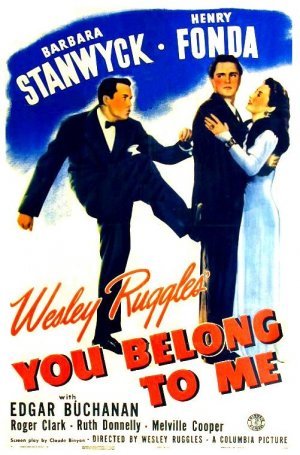
I usually avoid writing such comments as “Why does this movie have such a low IMDB rating?!” but I’m going to break my own rule this one time. Why does this movie have such a low IMDB rating?! You Belong to Me is of the funniest films I’ve ever seen, period. Giving me the type of gut-busting, side-splitting laughter I rarely get from even the funniest of comedies. I was in howls of consistent laughter for 90 minutes; unlike The Lady Eve which I feel loses steam in its final third. I only watched You Belong to Me in order to become a Barbara Stanwyck-Henry Fonda completest and was expecting something mediocre based on all the negative IMDB reviews but I have to ask the question mankind has pondered since the beginning of time, “What is wrong with you people!? Do you even understand the basic essence of comedy?!!” Ok, back to planet Earth.

The movie plays out like a newspaper comedy; the setup of a husband neglecting his wife due to his obligations to his job except in this case the profession is a doctor and it’s not the man, it’s the woman. Peter Kirk (Fonda) acts like a spoiled child throughout the film who doesn’t know any better yet he’s always too loveable and innocent to ever come off as annoying. Likewise, many of his shenanigans and dialogue are very Homer Simpsons like (“Patient dies while doctor ski-ies”). He goes to extreme lengths to have Helen Hunt (not the modern day actress but the character played by Stanwyck) as his own with his increasingly humorous paranoia, and while considering Stanwyck’s sexuality I can’t blame the guy. The man really does look like he’s in love with the woman which would come as no surprise as apparently, Fonda would tell his later wife he was still in love with Stanwyck. Peter Kirk has no purpose or ambition and doesn’t contribute a whole lot to society, unlike his polar opposite wife; the more mature of the two to say the least. Even with this comically absurd pairing, I did at times feel somber for the couple.

I don’t always say this with every romantic pairing I see however after watching all three movies they did together I do believe Stanwyck and Fonda could have been a regular film pairing up with there with the likes of Astaire & Rogers, Powell & Loy and Tracey & Hepburn. The chemistry they share is some of the best I’ve seen in old Hollywood stars; a match made in heaven if I’ve ever seen one.
The Women (1939)

Estrogen: The Movie

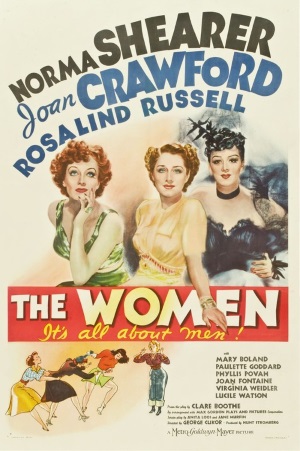
The Women is surely one of the greatest celebrations in cinema of femininity and the female form; even the animals featured in the film are all female in this unabashed display of women being women. Unless you’re easily offended by a movie in which the majority of its female cast are vicious gossips then stay away; stereotypes are greatly exaggerated as part of the film’s humour. As Sylvia Fowler (Rosalind Russell) puts it, “You know how those creatures are, babble babble babble babble babble, never let up for a minute”. That’s probably the best way to describe The Women by using one of its own lines of dialogue. Like the other notable female ensemble Stage Door, the dialogue in The Women is delivered so furiously it’s impossible to keep up with it. Watch the movie with subtitles turned on, it’s worth it to find gems of dialogue which can easily be missed (“It’s marvelous to be able to spread out in bed like a swastika”). I can also give the movie a few bonus points being a heterosexual male and all.

The Women explores the tribulations and dilemmas of whether sleeping dogs should lie. After Mrs. Mary ‘Stephan’ Haines (Norma Shearer) discovers her husband is having an affair with Crystal Allen (Joan Crawford) she receives advice from her mother (Lucille Watson) in one of the film’s most telling scenes. Her mother tries to justify Stephan’s infidelity under the guise of that’s what men will do (“A man has only one escape from his older self. To see a different self in the mirror of some woman’s eyes”) and ultimately that Stephan doesn’t actually love Crystal. Mary’s response to this? The classic “It’s current year” argument; “Back in your day mother when women were chattel and they did as men told them to. But this is today. Stephan and I are equals. We took each other at our own free will”. Mary ultimately agrees it’s not worth the destruction of the family to confront Stephan about his infidelity. The married women of The Women have a strong dedication to their husbands yet in this world adultery seems to be the norm rather than the exception, even Mary’s mother tells Mary that most wives do find out about this.

Norma Shearer really was made for the silver screen with a truly dominating movie-star aura. The character of Mary Haines is distinguished for being a bit of a tomboy in contrast to her more glamorous side. In her introductory scene as well as in her vacation reels she is dressed like a man (similar to how Shearer dressed in The Divorcee), poses with a pipe and can apparently fish better than her husband. Likewise, Joan Crawford is delightfully mean in the role of Crystal Allen, particularly with her scene in the bathtub which so ridiculously villainous she could be playing a mafia boss. Crawford’s first screen appearance was in 1925’s Lady of the Night in which she acted as a screen body double for Norma Shearer. Crawford and Shearer since became the two biggest rivals in MGM and The Women would be their second and final appearance on screen together in the closet thing at that point to a Baby Jane showdown, a battle of the egos. I believe you do have to give the Crawford the credit for her willingness to play such a nasty character especially considering she has the least amount of screen time of the three leads. This is a character after all who has no remorse for helping destroy a family and the impact that will have the Haines’ child Little Mary.

The stealer of the show, however, is the great greatness that is Rosalind Russell. She succeeds in being the center of attention in any scene no matter whom she is sharing the frame with thanks to her comedic timing (both verbally and physically) as well as her over the top outfits. Myrna Loy and Greta Garbo, on the other hand, were the only two major actresses at MGM who did not appear in the film. I can picture Myrna Loy in Norma Shear’s role although she would have been too big a star otherwise to play a supporting role. Garbo, on the other hand, is well, too much of an oddball to fit in with an ensemble like this.

The Great Depression? Ha, what depression?! There’s no sign of it here. It feels like there is no other time period than the 1930s in which it was easier to make a movie about rich people and their rich people problems without it coming off as a metaphorical dick waving display of wealth. The Women is one of the most decadent movies of the depression era, maybe even the most. The majority of the cast is dressed like a million dollars, every actress is light like a goddess and inhabiting a world which largely consists of retail stores and beauty salons. There is even time for a Technicolor fashion show which has no relevance for the rest of the plot, but it looks pretty. Lose yourself in this world of wealthy rather than being aghast at how bourgeois they are (“Weren’t you going to Africa to shoot?”). This kind of being made today (which unfortunately it was in the form of a remake) with the likes of the Sex and the City films would come off as a ghastly exercise in consumerist pornography (a term borrowed from Mark Kermode). On a side note also keep an eye out of the postcode sex references they got in there  (“Whatever Stephan doesn’t like I take it off”) while also look out for the topless woman in the mud bath at the beginning of the film not to mention Paulette Goddard’s clear lack of a bra.

With two hours of some of the finest actresses of the 1930’s spewing nonstop machine gun fire dialogue, scenery chewing and competing for the camera’s attention amongst an art deco wonderland, then I’m in movie heaven.

The Whole Town’s Talking (1935)

A Tale of Two Eddies

It’s already unexpected that John Ford directed a screwball comedy (as well as a film set in urban America, which he rarely did), even more so that it’s one of the inventive, inspired and quirky screwball comedies ever from a director who has no other association with the genre. The Whole Town’s Talking is a delight to watch as it unveils each increasingly surreal situation.

Edward G Robinson appeared in a number very quirky comedies such as The Amazing Dr Clittlerhouse, Brother Orchid and Larceny Inc which have made me prefer him in comedy over drama. Here you get two Robinsons for the price of one playing the dual role of the lovable, naive Jonsey and the notorious gangster Mannion. I believe this may be Robinson’s best performance. Not only does he play two characters who look the same but are worlds apart in terms in personality, he also has to play Mannion pretending to be Jonsey! Even though he is held in high regard as an actor, I feel Edward G. Robinson has never been truly celebrated for just how versatile he is; going far beyond the gangster roles he is most famous for. The film’s use of spilt screen and back projection techniques are executed to a seamless degree. In one particular shot featuring the Robinsons sharing the frame, notice how the smoke coming from Mannion’s cigar enters the other end of the frame over Jonsey.

Jean Arthur’s Miss Clark is one of the coolest, craziest and more carefree characters ever. When she finds out she has been sacked after arriving to work late she doesn’t care in the slightest. Or how about when she discovers that Jones keeps a picture of her by his bedside which he stole from her at the office. She isn’t disturbed, she finds it cute! Everything she does is so laid back and without a care in the world; I love this character!

The only minor complaint I have with The Whole Town’s Talking is the possible plot hole at the beginning of the film in which Jones rushed out of his apartment after the realisation he is late for work he leaves the bath running. This had me thinking that when he returned home his house would become flooded but the running bathtub is never addressed. Regardless, the film’s screwiness is in no short supply. This movie not getting the recognition it deserves? Mannion!

Vivacious Lady (1938)

Old School

Sex! Now that I’ve got your attention, it’s fascinating to see just how many references to the birds and the bees permeate the seemingly innocent veneer of Vivacious Lady. James Stewart and Ginger Rodgers where dating during the filming and it’s certainly apparent on screen with the levels of sexual tension between the two with these stars never appearing more youthful than they do here. There are many code breaking moments in Vivacious Lady from the opening scene with the exotic dancers in the nightclub and their tail feathers being pushed in Stewart’s face to Stewart breaking into a women’s only apartment block after visiting hours.

It’s clear that the University in the fictional town of Old Sharon is full of students eager to get it on from every other male student wolf whistling Ginger to the large number of couples occupying the boathouse at night. I mean the President of University and Stewart’s father played by Charles Coburn even comes right out and says it, “We are having the usual spring difficulties between our male and female students a little early this season. Too much fraternising in the lockers”.  – The Hays Code? What code?

However on closer examination of Vivacious Lady something dawned on me – there’s a very unusual incest thing going on between the main characters. Francey (Ginger Rogers) was going out with Peter’s (James Stewart) brother Keith (James Ellison) before they met, however, Francey marries Peter shortly after they meet for the first time even though she was still going out with Keith at the time. Even when Keith finds out he is perfectly ok with this arrangement and himself and Francey continue to act in an overly intimate manner throughout the film for people who are cousins. Likewise just get look at this dialogue exchange:

“I remember I married you”

“Oh no, she married me”

“So were cousins”

“You and your cousins can use that drawing room now.”

Incest aside, unlike other screwball comedies Vivacious Lady is actually more grounded in reality with its use of more deadpan humour. There are no over the top misunderstandings or histrionics (not that there’s anything wrong with that sort of thing) but rather the characters react in a manner in which people would in real life. Just look at the reaction of Peter’s father whenever he tells him he got married, it’s lifelike but manages to be no less funny. This was one of the four films in which Beulah Bondi played Jimmy Stewart’s mother; I can’t imagine a more convincing choice to be the mother of the on-screen, boy next door Jimmy Stewart persona. Likewise, is there a better choice to play an overly conservative father than Charles Coburn? I can speak for a friend of mine who couldn’t believe just how much he related to Jimmy Stewart and the manner he acts towards Ginger Rogers such as Stewart’s attempts to make advances but keeps backing away under nerves. The two of them really do feel like a bunch of young love-struck kids.

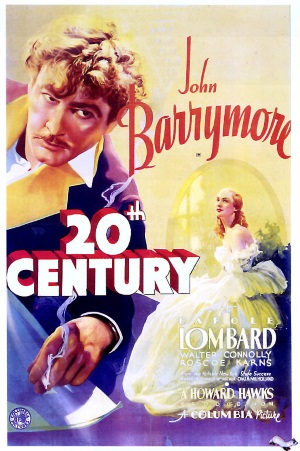
Twentieth Century (1934)

Overacting at Its Finest

John Barrymore in Twentieth Century. Simply put. Every once in a while I may stumble upon a screen performance which leaves an indelible impression, brings me new levels of respect towards a performer and to even write a review. That’s the effect John Barrymore’s tour de force had on me in Twentieth Century. Barrymore is an absolute beast as the egomaniac Oscar Jaffe delivering one of my favourite film performances ever.

Barrymore had earned the reputation of being a ham actor although that’s perhaps the nasty way of putting it. Theatrical style acting may seem outdated and laughable to many nowadays but it is a style unto itself. When Barrymore asked director Howard Hawks why he should play the role of Oscar Hawks replied: “It’s the story of the biggest ham on Earth and you’re the biggest ham I know”. The film even foreshadowed Barrymore’s own future as he himself became a washed up actor in the final years of his life like how the character of Oscar Jaffe becomes a shadow of his former self. Really has there ever been a more impassioned performance which is hammed up to 11 than this. Barrymore doesn’t just chew the scenery in every scene he is in, he devours it like a ravenous dog; he’s the definitive representation of the angry stage director stereotype. Just look at his breakdown scene when his Tribley leaves him for Hollywood, one of the greatest displays of histrionic acting poweress. Oscar Jaffe really is a fascinating character. It isn’t just enough for him to tell an employee of his theater that they have been fired, he has to tell them in the most melodramatic fashion “I close the iron door on you!”, or what about his constant comparisons to his present occurrences to scenes from famous plays or historical events. Half of what this man says is more melodramatic than Charlton Heston and William Shatner combined. Barrymore was known as The Great Profile and rightfully so; talk about an enigmatic screen presence.

The sheer energy between Barrymore and Carole Lombard is incredible in this ultimate battle of the egos; both of these two performers cross that line in comedy of playing hateful, selfish, despicable characters you can’t help but love. Carole Lombard herself has an endearing, childlike quality to her, getting overly emotional when Jaffe insults her acting ability; appropriate though since much of the film is two adults acting like children. The first portion of the film is comprised of a stage rehearsal, showcasing an impressive display of actors playing actors giving bad performances with Jaffe insulting them at every turn (“The old south does not yodel”)  but it’s the film’s second half in which things really get crazy, taking place onboard the Twentieth Century Limited. When I first watched the film I found the subplot with the religious fanatic to feel out of place at first but trust me when I say the payoff is worth it. Twentieth Century is very screamy and very shoutey but there are many little subtle touches such as the establishing shot at the start of the film of a poster advertising the Jaffe theater (showcasing the man’s insane ego); possibly the funniest establishing shot I’ve ever seen. Also, keep an ear out for several references to Svengali, adapted to film in 1931 also starring John Barrymore. I also must give a shout out to Mary Jo Mathews, the actress who plays Valerie Whitehouse. She only has several lines in the entire film yet I’m intrigued by her; she appears to have star quality to her.

Along with It Happened One Night released the same year, Twentieth Century movie marks the birth the screwball comedy. I can never get enough of these films, they’re incredibly addictive and they always leave me with the feeling of wanting more. I don’t like to be labeled as one of those “they don’t make ‘em like they used to” people actually who am I kidding, of course, I do.

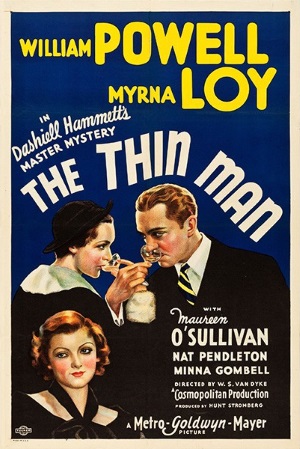
The Thin Man (1934)

Meddling Adults

William Powell and Myrna Loy, will I ever get bored of watching these two? I wish I could possess the wit and charm of William Powell, someone who can still remain classy and have a way with words even when inebriated (which is often). I wish I could be married to a woman like Myrna Loy. For Nick and Nora Charles being married is just one crazy murder mystery solving adventure after another! With so many movies in which marriage is a hindrance, here are two people who revel in being married without the worry of children (for now anyway).  I find myself jealous at these two for their existence of seemingly never-ending fun. It’s no wonder audiences of the 1930’s where attracted to these escapist fantasies in their droves.  Sometimes a man and a woman with impeccable chemistry is all you need for cinematic greatness.

The Thin Man gave birth to Myrna Loy receiving the label “the perfect wife”. Loy disliked this label but it’s not hard to see why she got such a reputation. She seems too perfect to exist like she was conjured out of the mindsets of what heavenly actress should be. It’s not all just Nick and Nora though, there is an entertaining supporting cast including the Wynet family, the classic screwball comedy troupe of the oddball family. It’s not My Man Godfrey levels but they are a bunch of nuts, with my favourite being the wannabe criminologist who is the polar opposite of the suave Nick Charles.

The Thin Man is a fairly inexpensive feature but shows how you can do so much with so little. The sequels had larger budgets and never captured the feeling or the intimacy of the first film. The scene in which Nick and his dog Asta go sleuthing by themselves in an inventor’s laboratory is almost entirely silent, features gorgeous noir cinematography and has me breathless watching the whole thing; setting the stage for the shady noir world of the 1940’s. I’ve seen The Thin Man several times and I still don’t understand the plot yet that doesn’t make the movie any less engaging. Rather it makes me want to watch the film again in hopes that I eventually will understand the plot.

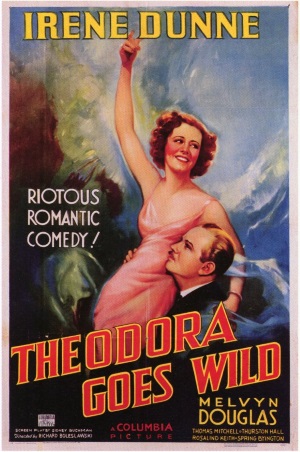
Theodora Goes Wild (1936)

Fifty Shades Of Screwball

***This Review Contains Spoilers***

Theodora Goes Wild was released two years into Hollywood’s production code and yet the entire premise of the movie is one huge “how did they get away with that?!”. Only The Lady Eve, Ball of Fire and The Moon Is Blue perhaps out do it in terms of most pre-code post-code films. A film with a heroine who writes risqué novels and rebels against her ultraconservative, God-fearing, Helen Lovejoy type aunts who deem it their obligation to keep the fictional town of Lynnfield, Connecticut (yet another screwball comedy set in the state) the one last pure, God-fearing town in America. Moral puritans who try to ruin everyone else’s fun and claim to speak for a larger group- every generation has them. Theodora Goes Wild proceeds with an ending in which the once silent majority Lynnfield show their true colours. – This movie hasn’t lost an ounce of relevance for today’s world.

The scene at the beginning of Theodora Goes Wild in which the local literary group read passages from the latest “scandalous” novel from author Caroline Adams really is jaw-dropping. However, the local newspaper run by Thomas Mitchell starts printing a serialization of the scandalous bestseller in an effort to show the town how people live, love and learn in the real world. Little do they know Caroline Adams is their own Theodora Lynn, a Sunday school teacher who’s been playing the church organ since she was 15. Under the rules of the Production Code, a character must receive a punishment for their so-called “immoral” actions. Not here though! Despite Theodora rebelling against her God-fearing upbringing, she receives no punishment. Whoever said old movies are stuffy and the dreaded “O” word, outdated?

Despite writing highly successful adult novels, Theodora’s conscious still objects to it and thus requires a bit of Melvyn Douglas as Michael Grant to ignite Theodora’s sexual awakening after he seduces her while wearing a vest as his only piece of torso. Despite neither of these two performers being sex symbols, it’s surprising how steamy this scene comes off. Melvyn Douglas plays a potentially creepy stalker but is charming enough and carefree to a comic degree that he gets away with it. The man has adapt comedic timing (I never tire of that whistling of his) and it’s easy to see why Douglas was one of the most reliable male co-stars of the time. However what succeeds in making him a more interesting character is the discovery that Michael is actually just as repressed as Theodora due to being enslaved in a hateful marriage on behalf of his father’s political livelihood. Once Michael liberates Theodora from her small town way of life she returns the favour and liberates him from his New York, bourgeois decorum.

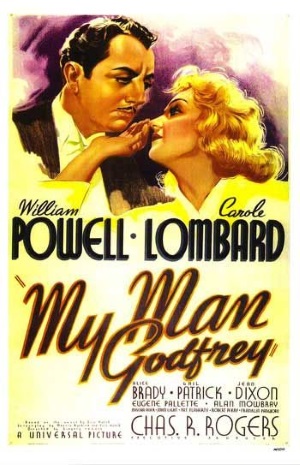
My Man Godfrey (1936)

She’s Electric, she’s in a family full of eccentrics.

***This Review Contains Spoilers***

Does a comedy film actually have to make you laugh? Can you have a comedy without any laughs in it? This was once a question posed by film critic Mark Kermode.  When thinking of this question, the first movie which comes to my mind if My Man Godfrey, a comedy which I love but there are only a few moments during it which make me laugh and even those few aren’t big laughs. This is despite the movie’s crazy screwball, gorilla imitating antics in which the straight man William Powell enters a cartoon world. But I would still call it a comedy as it’s a movie which leaves you feeling melancholic watching it.

William Powell’s role as Godfrey exemplifies why he is the master of words. He can take any regular sounding lines and turn them into something memorable and unique – it’s like poetry. Even as an unshaven bum Godfrey outclass anyone. Likewise It’s easy to fall in love with Carole Lombard watching My Man Godfrey; she succeeds in playing a ditsy scatterbrain in an endearing manner but I feel the real unsung cast member of the film is Gail Patrick, one of the most underrated actresses of the 30’s – it’s a shame she never became an A-list leading lady. She became typecast playing (for lack of a better term) bitches, but could do so with a dose of humanity.

I love those moments which describe a ridiculous situation which is never caught on camera. The mental image of Carole Lombard riding into a mansion on a horse, going up the stairs and leaving it in the library is an image better left to my imagination. Many modern film comedies would show such a display for the viewer to actually see and well, would just be cringey and embarrassingly unfunny in the process.

My Man Godfrey wasn’t based on a stage play but watching it you might think otherwise as long stretches of the film take place in real time. Plus you get one thing almost unheard of in films prior to the 1950’s, an intricate title sequence.  I consider My Man Godfrey along with You Can’t Take It With You as the two quintessential “kooky family” movies although “kooky” may be an understatement.

Screwball comedy was partially about making fun of the rich as retribution for the great depression; My Man Godfrey is probably the harshest attack on the rich which the genre ever made, partially because of just how somber the film is. The opening scene in which men are living in a shanty town by a dump or the scavenger hunt for bums (or so-called ‘forgotten men’) are shocking sights for any era. However, My Man Godfrey shows how the wealthy upper classes are not beyond redemption and are a necessary component for any functioning capitalist society.

At the beginning of the film, Godfrey utters “Prosperity is just around the corner”, a line misattributed to Herbert Hoover though a widely mocked platform of the Republican Party during the early days of the depression. Once Godfrey is hired by the Bullock family as their butler he uses his newfound position to work his way out of poverty. By pawning the necklace Cornelia planted in Godfrey’s bedroom in an attempt to frame him, Godfrey purchases stock which Mr. Bullock had sold and in turn saving the family fortune. Godfrey owes a debt to a wealthy family for bringing him out living in a literal dump but in return, he is responsible for saving the family’s fortune and bringing the dysfunctional Bullocks together.

It sounds like the movie makes an argument for supply-side economics. Less subtle however is the scene in which Eugene Pallete (I swear that man is the spitting image and voice of Alex Jones) as the head of the Bullock household says “I don’t mind giving the government 60% of what I make but I can’t do it when my family spends 50% of it”, followed by his wife’s response of “Well why should the government get more money than your own family?”. At the end of the film, Godfrey has opened his own diner at the dump from the beginning of the film and hiring his previously homeless chums. – People banding together to get themselves out of poverty and not relying on an FDR handout.

The Moons Our Home (1936)

The Whole of the Moon

The Moons Our Home is one of my favourite super obscure films with only 139 users ratings on IMDB as of writing this review and a proclamation from Bill Murray as one of his favourite films (look up his appearance on the Siskel and Ebert Holiday Gift Guide 1988 in which he mentions he would like a video cassette of the film for Christmas). The Moons Our Home has only recently seen its due on DVD on the Universal Vault Series although when I watched the film I had to access it through a torrent. Not the greatest image quality but as a big fan Margaret Sullavan and a Henry Fonda enthusiast I was overjoyed to get a hold of the film and was not let down in the slightest.

What surprised me about Margaret Sullavan’s performance as movie star Cherry Chester (real name Sarah Brown) is how much she reminded me of Jean Harlow, always changing mood within a split second. Sullavan and Harlow are two actresses I didn’t think I would ever compare so it’s fascinating to see this aspect of her screen persona I didn’t even know existed. Right from the beginning of the film Cherry Chester is screaming, throwing tantrums and acting like an all-round pretentious drama queen. There is even a Hepburn-esque quality to her character with her fierce desire to be independent as well as clothing choices of a turtleneck and trousers.

Henry Fonda’s role as the explorer Antony Amberton is very much the same as we are introduced to his character escaping from a group of screaming fans which he compares to his daring exploits from the jungles of Africa to the peak of Mount Everest like a male Greta Garbo. Also, notice how all his fans are giddy women, yeah I don’t think he’s exactly Roald Amundsen. Sullavan and Fonda had previously been married, making their pairing feel more tender and genuine with moments like their histrionics in the snow being as adorable as they are funny. The Moon’s Our Home also features innovative use of split screen in which Sullavan and Fonda are given half of the screen to represent different rooms in which they move in parallel and symmetrical tandem.

The other aspect which so effectively carries The Moon’s Our Home is all the great character actor moments with the likes of Beulah Bondi, Margaret Hamilton, and Walter Brennan as the hard of hearing justice of the peace; a brief but very funny role. However, I think the best of these moments involves Charles Butterworth as Horace, the man who is chosen by Cherry/Sarah’s grandmother as her arranged husband. This is despite in his many unsuccessful marriage proposals to different women. Listen to how mundanely and awkwardly he describes how he will “lift her off her feet” while being distracted by a game of solitaire. The Moon’s Our Home is full of moments like this which are funny on different levels.

It’s already a joy to discover a film I love, even more so when it’s a film that almost no one else will watch in a million years. It gives me the sense that it’s my movie. I guess this is what hipsters must feel like listening to bands no one else has heard off.

The Major and the Minor (1942)

Su, Su, You’re a Knockout!

***This Review Contains Spoilers***

The Major and the Minor is the film which made me fall in love with Ginger Rogers, turning me into the obsessive fan I am now. Miss Rogers is Susan “Susu” Applegate, who transforms her 30-year-old body into that of a 12-year-old and does so completely convincingly and in my view gives the finest performance of her career. You must have a heart of stone not to fall in love with the endearing alter ego oddball that is Susu; a natural anomaly of a tall child (‘Swedish stock’ as she refers to her family) and “a very peculiar child” as Major Kirby (Ray Milland) describes her. – Susu’s response to this, “you bet I am” sums things up perfectly. I question how many actresses would have the ability to do such a feat. Being a super fan I would say that she should have won an Oscar for this acting marvel but I doubt the Academy would pay much attention to a weird little irrational comedy like this.

Oh yes, weird, that is our key word here. If the premise of a 30-year-old disguised as a 12-year-old in order to get a half fare on a train ticket doesn’t have you raising an eyebrow then how about throwing her into a military academy with 300 male pre teen cadets. The whole family can enjoy The Major and the Minor, the kids can enjoy the smart-alecky humour and the adults can enjoy the sexual innuendo….centered around children. That’s one of the things that makes this movie great, it’s so wrong on many levels (yet feels so right, or something like that) but contains that kind of innocence and naivety that only classic Hollywood can pull off. The British Board of Film Classification gives the film a current rating of “U” with the description, “contains very mild sex references”, although I believe that’s a gross understatement. Imagine if Lolita was a screwball comedy, you would have a result somewhere along the lines of The Major and the Minor.

Ray Milland is an excellent leading man, well a leading man to a character whom he thinks is a child (yes this movie becomes more wrong the further I analyse it). I wonder how must have felt delivering such lines as “You like boys Susu?, 300 of them, all they’re all yours”. The ending of The Major and the Minor itself is disturbing on a number of levels. When Major Kirby discovers Susu is actually an adult and they presumably now fall in love as seen in the final scene, is he going to fantasize that he’s going out with the 12-year-old Susu? My other favourite cast member here is Diana Lynn as an intellectual child planning to become a scientist. This kid is so badass, I’m actually quite jealous of her. Normally kids in movies tend to get on my nerves, but not when they’re able to outwit the adults, as seen here.

The Major and the Minor was Billy Wilder’s American directorial debut and already he has made the first in a long line of masterpieces. Exploring his films (including those he has written) I feel has been a journey for me through the annals of classic Hollywood and for helping to shape my sense of humour. The Major and the Minor marks another milestone in that journey.