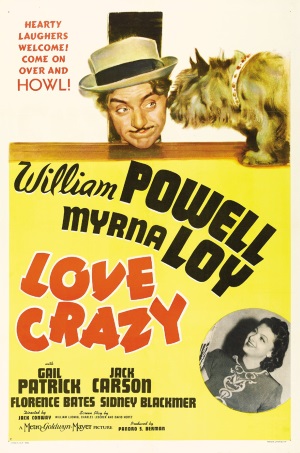
Love Crazy (1941)

Serving the Nuts

I believe every great actor should have at least one movie in which they get to go completely over the top and out of character (Barrymore in Twentieth Century, Leslie Howard in Its Love I’m After, Bogart in Treasure of the Sierra Madre, Stewart in Vertigo). For William Powell, Love Crazy provided him with his opportunity in easily the most slapstick oriented comedy ether Powell or Myrna Loy ever done; from heads being stuck in elevator doors to characters slipping on the same rug several times throughout the film. It’s not John Barrymore levels of over the top but compared to William Powell’s usual soft-spoken persona it’s pretty over the top.

Love Crazy is the William Powell show all the way, showcasing the complete range of his abilities as a comedic actor in a plot which is like a tabloid newspaper story turned into a screwball comedy; a jokey representation of mental illness which wouldn’t be politically correct by today’s standards. All the more fun then! One of the scenes from any film Powell has appeared which I feel best demonstrates his comedic timing is when he is tasked with convincing a lunacy commission of his sanity by placing shaped blocks into their corresponding holes. It’s such a basic task yet with his overzealous confidence he still manages to convincingly screw it up; it works on so many levels. Yet as the film progresses, I end up feeling particularly sorry for his character due to losing a wife like Myrna Loy and having her despise you, all over one improbable misunderstanding.

But not to undo Myrna Loy with her stand out moment being a surprisingly erotic scene with Jack Carson in which both of them are bare-shouldered and she even utters the line, “It will smell like an orgy”. On top of that, I find myself in awe that there is a straight up dick joke in this movie (“He has to have his torso free when he shoots his bow and arrow”). Of all the sneaky jokes they got past the censors I’ve heard in screwball comedies, this is one of the most unsubtle. Likewise, Gail Patrick who plays Powell’s former girlfriend appears to be a bit of a nymphomaniac; badly wanting him shortly after meeting for the first time in years despite both of them now being married, not to mention it’s his anniversary night! Just listen as the seductively tells Powell “Stevie I’m bored!”. There’s quite a bit of setting up in Love Crazy but the payoffs are worth it. Love Crazy also gets a big boost from the apartment sets designed by Cedric Gibbons. The painted backdrops of skyscrapers high in the sky and the art deco shading, it’s beautiful.

I had the benefit of going into Love Crazy unaware of the screwball hijinks which occur during the third act. If it’s not too late for you, I recommend doing the same otherwise stop reading but yes, William Powell dresses up in drag as a tall, butch woman and convincingly at that. He even goes to the length of sacrificing his trademark moustache – now that’s commitment.
The Lady Eve (1941)

So Close, Yet So Far

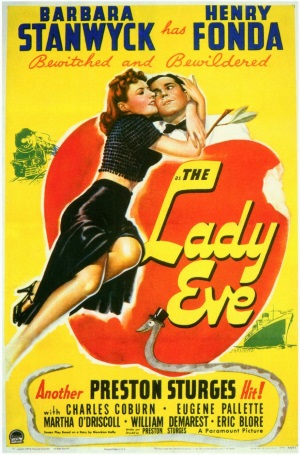
The Lady Eve is a conflicting film. The first hour is some of the most perfect romantic comedy I’ve ever seen, however, it falls apart around the one hour mark. However, what is it that makes the first hour so perfect? Firstly it didn’t take too long for me to realise that Henry Fonda and Barbara Stanwyck are one of the most flawless screen pairings ever, the perfect combination of sexy meets innocent. Watching these two I get the impression they must have been head over heels for each other. I’ve read that apparently Henry Fonda would later tell his wife he was still in love with Barbara Stanwyck, dam! But then again, after having your hair caressed by Stanwyck for 3 minutes and 51 seconds, who wouldn’t be?!

The Lady Eve is a prime example of a “How did they get away with that?!” movie. I’m not aware of what Stanwyck’s ideological or moral beliefs were but a number of her films are some of most sexually suggestive old Hollywood films I’ve seen. There’s her pre-code work such as Baby Face but in the postcode era, we have Ball of Fire, Double Indemnity and of course, The Lady Eve. Call me old-fashioned but movies were sexier when the actors kept their clothes on. Vilma Banky did more with one raised eyebrow than an entire (Warning! Problem in Sector 7G).

So where does it all go wrong, well about 50 minutes into The Lady Eve, the movie pulls my least favourite movie cliché of all time, “the liar revealed”. You know, when a character is exposed as a fraud causing a relationship to end, even though you know they’re going to get back together again by the end of the movie. Having this cliché is bad enough, however, I thought it was only a contrived modern invention but here it is in 1941. At least they don’t drag it out like any rubbish modern-day romantic comedy would.

I’ve found Preston Sturges’ films to be indiscipline, his films all have their moments of greatness but at times they delve into over the top absurdity, even by screwball comedy standards. During the later part of The Lady Eve it’s hard to buy into Stanwyck disguising herself as another woman who doesn’t look massively different from her previous self in order to win back Henry Fonda. Oh, and he buys into the charade, the dope! Part of me wished the entire movie could have just been the two of them on the boat and it would have been a perfect film, however the final third still has some hilarious moments, such as Eugene Pallette frantically banging the table demanding his breakfast, or Fonda getting his suit destroyed three times at a party, a perfectly timed slapstick gag if I’ve ever seen one.

On a second viewing of The Lady Eve, I still have the same reaction to the first hour but I did find myself more forgiving of the last third. With my love of screwball comedies and the pairing of Stanwyck and Fonda, perhaps with additional future viewings, I may become completely forgiving of the last half hour. The first hour is just that perfect.

It Happened One Night (1934)

What Is the Deal With Donut Dunking?!

***This Review Contains Spoilers***

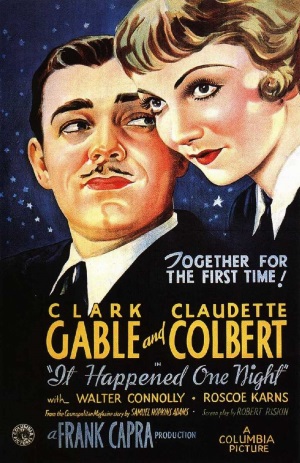
It Happened One Night was my first exposure to what I now consider to be my favourite genre of film, the screwball comedy. I’ll never forget the feeling of exuberance at watching Clark Gable run to his boss at the newspaper to pitch a story about how he’s fallen in love with a princess, such energy, such emotion; I had never felt such a way from watching a movie before. It Happened One Night is the famous and most widely seen film of its genre and I believe it deserves such an accolade; something unforgettable is happening in every scene, whether funny or tender, jam-packed little details to spot on every viewing. It Happened One Night along with Twentieth Century gave birth to the screwball comedy, but it isn’t the only sub-genre it set a standard for. The runaway princess movie, the road movie and the newspaper comedy all owe their debts to it.

In his opening scene, Clark Gable is introduced as the king; couldn’t be more adapt. Watching the movie closely I can say that everything this man says is pure gold from his art of donut dunking, art of clothes removal, the different methods hitchhike signaling and his wall of Jericho. Then it dawned on me just how Seinfeldian this movie is. Much of Clark Gable’s dialogue in this movie could be a Jerry Seinfeld stand up routine. It’s easy to see how many screwball comedies have influenced modern day sitcoms; all that’s missing is the laugh track.

Claudette Colbert is one of the most famous incumbents of The Gable Treatment; what I like to call the macho manner in which Gable treats his leading ladies. Of course for any other actor to have this characteristic they would be an unlikable brute, but because it’s Gable it works. I also have to ask did the scene in which Gable eats a raw carrot while attempting to hitch-hike with his usual confidence and cockiness inspire Bugs Bunny? Ah Gable, has never ever existed a more charismatic human being?

Fours a Crowd (1938)

Release the Hounds!

***This Review Contains Spoilers***

Errol Flynn, Olivia de Havilland and Rosalind Russell in a screwball comedy? These are the kinds of cast ensembles which unleash the inner fanboy in me. Errol Flynn rarely got the chance in his career to perform comedy and here he proves he was cable of doing Cary Grant-esque comedy on the same level as well, Cary Grant. Sadly Four’s a Crowd’s lack of box office success prevented Warner Bros from putting him in more comedies

Although The Women is seen as the film which launched Rosalind Russell as a fast-talking comedic actress, Four’s a Crowd is the first film in which she plays such a character and her first turn as the working career woman (or “newspaper man” as she refers to herself here) which became synonymous with shades of Hildy Johnson coming through. She takes full advantage of the role, stealing the show with her impeccable timing which reportedly made Olivia de Havilland envious. De Havilland though is tasked with playing a dim-witted character which she performs without coming off as annoying as such characters can easily be.

Four’s a Crowd owes a certain debt to Libeled Lady featuring some similar plot trends and themes with its slam on the upper classes, the socialite lifestyle and the desperate lengths newspapers will go to in order to get a story and control the narrative. Even the opening title sequence is taken from Libeled Lady in which the cast do the same arm in arm walk but is full of moments of inspired zaniness to distinguish itself. The model train sequence which lasts for 16 minutes had to have come from creative minds; plus what’s funnier in an innocent, cute kind of way than grown men playing with model trains. However, there is one moment in Fours a Crowd which is one of the most bizarre gags I’ve ever seen in a film in which after escaping from a pack of guard dogs to the other side of a gate, he grabs one of the dog’s legs and bites it. I still don’t know how to react to it, whether I should laugh or be horrified or both! The plot gets very confusing very fast but in a good way culminating in a finale in which Errol gets the wrong girl at the end! Although the manner in which this happens is screwball antics at its finest.

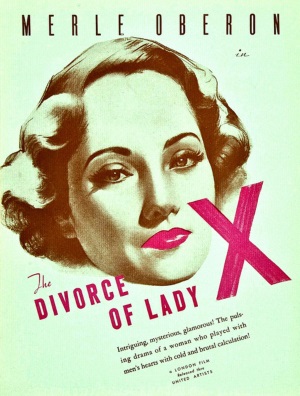
The Divorce of Lady X (1938)

Heathcliff and Cathy’s Other Film

The Divorce of Lady X stands out from other screwball comedies for several reasons. Firstly it’s one of the few screwball comedies filmed in Technicolor which is complemented by the complimented by the luscious set design and brightly coloured ladies costume design. I do love that night club with its dreamlike painted backdrops as well as the miniature work of Trafalgar Square for the film’s opening shots (even if there are a bunch of empty buses driving). Second, it’s the only British screwball comedy I’ve come across to date, putting a British spin on this distinctly American genre. It’s fun watching typical screwball situations with an entirely British cast, set in Britain and with very British lines of dialogue (“You got marmalade all over your newspaper”).

Third and by far most importantly in what has to rank as one of the most bizarre of pre-stardom roles, it stars Laurence Oliver. Yes, the master of Shakespearean tragedy, perhaps the most respected and dignified actor of the 20th century as a stuffy gent who at first is delightedly full of himself but soon gets into all sorts of crazy shenanigans at the mercy of a screwy dame.  Merle Oberon plays one of the most ruthlessly manipulative characters I’ve seen in any film as she is able to weasel her way to get anything out of this man – the type of dame who destroys civilisations. Thus it doesn’t come as a surprise that Oliver goes head over heels for her despite all the anguish she causes him, likewise her previously having four husbands doesn’t help matters (also, that improvised cape made from a bedsheet she wears is such a brilliant touch). The chemistry between the performers works seamlessly and is aided by the sexual tension and undertones.

The first act of The Divorce of Lady X is one big farcical sequence centered around the sexual politics of the time; the fact that an unmarried man and woman sleeping in the same room was considered scandalous, even if there are two separate beds. This ties in nicely with how film critic Andrew Sarris defines the screwball comedy genre, “a sex comedy without the sex”.

Continental Divide (1981)

The Continental

***This Review Contains Spoilers***

Early during Continental Divide as I was gradually enjoying the film more and more and becoming emotionally invested in its two characters (very emotionally invested I might add), storm clouds began forming over me. I came to the realisation that at some point the movie was going to pull of my least favourite movie cliché, the liar revealed. You know, the woman finds out the man isn’t what he claims to be, after a big monologue about how betrayed she feels, they break up, cue the sad montage music but 20 minutes late they forgive each other and live happily ever after, the end.

Thus it was a huge sigh of relief when Blair Brown’s (not the former British government cabinet) Nell Porter discovers John Belushi’s Ernie Souchak (a name which sounds like it’s taken from a 1930’s newspaper comedy) is secretly writing a news piece on her after he agreed not to during this early point in the film. They don’t argue about it, she happily accepts it. How about when Ernie discovers Nell has been meeting a man in the wilderness purely for sexual intercourse and not for a passionate relationship, does he freak out? No, he has no problem with it and that’s the way it should be! That’s one of the things I loved most about Continental Divide, it was like a big middle finger to the inane and contrived clichés which plague modern-day romantic comedies.

Continental Divide is one of my favourite man and woman alone in the wilderness type movies, in this screwball comedy for the 1980’s; which at the time advertised Belushi and Brown as the next Hepburn & Tracy. With the likes of His Girl Friday and Libeled Lady, Continental Divide has the underlying theme that long-term romantic relationships and careers in journalism are an apparent impossibility; only the typewriters are out in favour of computers. Although I do have to ask how many journalists have the levels of a celebrity among the populace as Ernie Souchak has, in which he is constantly recognised in the street. Likewise, Ernie Souchak’s employment of the Chicago Sun-Times is the paper film critic Rodger Ebert writes for, although there is no cameo or mention of him in the film, likely due to a conflict of interest.

Nell Porter is a woman so reclusive she lives in the mountains while attending to her study of Eagles. She has a desire for peace and quiet and I get the impression she is disenfranchised with civilisation, partly due to her dislike of the media. Having a female character like this is one of the reasons I’m so attracted to a love story like this, since weird girls are my thing. Plus speaking of the wilderness, does this movie look good! Filmed atop of actual mountains in Montana and Washington State, It just shows you that Planet Earth is the greatest movie set of all.

It is evident from both Continental Divide and his final film Neighbours that John Belushi was trying to escape typecasting. Continental Divide proves he had what it takes to be a romantic leading man, however, his time left on this world was short at this point but the legend lives on.

Broadway Bill (1934)

A Day at the Races

***This Review Contains Spoilers***

Broadway Bill is Frank Capra’s forgotten follow up to It Happened One Night, likely due to the film being out of circulation until the 1990’s and what a shame too. Warner Baxter and Myrna Loy are not romantic leads as she is his sister in law but both of them have great admiration for each other with Dan Brooks (Baxter) referring to her affectionately as The Princess and Loy clearly in love with the man and holding the same ideals as him but unable to go any further due to family ties; I find this dynamic is more interesting than a standard romance. Capra originally wanted Clark Gable in the lead role but had to settle with Warner Baxter who at least seems to be the next best thing as he holds much of the same rugged, footloose appeal of Gable.

Broadway Bill features many of the same Capra-isms as seen in his other films. The small town of Higginsvillie being run by business mogul J.L Higggins played by Walter Connolly is a much more light-hearted version of Mr Potter from It’s a Wonderful Life. He is in control of his entire family who run his individual enterprises and even their own national bank as visualised in a gag in which the entire Higgin’s family proceed to eat dinner in perfect unison. They’re not the Rothschilds but they’re wealthy and powerful (“Higgins, that’s not a family, that’s a disease”). Yet at the end of the film J.L. gets rid of his businesses or as he puts it, gives back institutions to the people who founded them. Like the Sycamore family in You Can’t Take It With You, Dan Brooks want to leave behind his life of work in favour of leisure and enjoyment, ideals comparable to the counter-cultures of the 1960’s. After all what could be duller than running a paper box company? Unless you’re Seymour Skinner.

One of the most pivotal scenes in Broadway Bill involves one of the richest men in the world, J.P. Chase putting a $2 bet on Broadway Bill at 100/1 as a means to pass time will in hospital. When word gets out it spreads like wild-fire and the claims of what the amount of money he placed on the best become exaggerated from $2 to $20,000 to $50,000 all the way up to a quarter million. Simple message – don’t believe everything you hear.

I love Broadway Bill for its simple cheerful Innocence. This is one of several films which has managed to tug my heartstrings over the fate of a horse. One plot element even involves the horse Broadway Bill refusing to race because he doesn’t have his pet chicken called Skeeter. You wouldn’t find this kind of innocence today in a film which is supposedly made for adults.

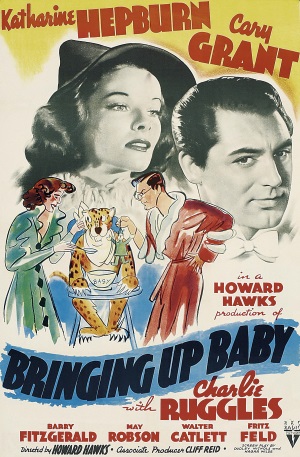
Bringing Up Baby (1938)

Screwball Comedy on Steroids

I make it no secret that the screwball comedy is my favourite genre of film. I can never get tired of these films – to me, this is the most anti-boring genre. Whenever I watch a great screwball comedy I’m on Cloud 9 and when it’s concluded I’m always left hungry for more (sometimes I even wish my life could play out like a screwball comedy!). Bringing Up Baby is the quintessential daffy dame/stuffy gentleman movie (a formula often imitated but never topped) and I find it endlessly fascinating this premise of how this woman constantly infiltrates this man’s life and she just won’t go away despite his best efforts. You think it would be easy that he could avoid her but the manner in which she keeps coming back into his life is comedic brilliance. Like many great comedies, the jokes present in Bringing Up Baby always take me by surprise no matter how many times I see it. Howard Hawks seems to have a distinctive style of slapstick comedy which separates his screwball comedies from others but why this is I can’t put my finger on – Hawks’ screwball simply has a distinctive electrically energy to it. Bringing Up Baby was produced at RKO studios, of whom I can’t help but notice their films have a distinctive imperfection of a grainy image quality and the use of soft lighting which is very easy on the eyes; the days when movie studios had their own distinctive styles.

I don’t think Katharine Hepburn ever looked more staggeringly beautiful than she does in Bringing Up Baby, displaying a girlish, Carole Lombard-like charm (I even find myself infatuated with the outfits she wears and her hairstyles in the film). Unlike other films of the genre, however, the romance is largely secondary to the rest of the story; with Susan (Hepburn) falling for David (Cary Grant) but not the other way around. Even with David eventually proclaiming his love for Susan I get the impression the two only remain (unlikely) friends. Likewise, the common screwball comedy theme of a crisis of masculinity is really played up here to the full with Grant wearing a woman’s dressing gown an even proclaiming in a fit of rage to be ”gay all of a sudden”.

David’s wild goose chase to obtain a dinosaur bone known as an ‘intercostal clavicle’ (a nonexistent fossil created for the movie) to complete the museum’s Brontosaurus skeleton, it’s eventual destruction at the hands of Susan as well as her treatment a leopard as a pet is all perfectly in tune with the character’s defiance of the natural order of things. Bringing Up Baby is the only screwball comedy I can think of which involves it’s cast interacting with a dangerous animal; I’m unsure why this never became a common screwball trope, I guess studios wouldn’t allow their cast and crew to be placed in such danger. My review title may sound hyperbolic but I’d pair Bringing Up Baby with You Can’t Take It With You as the most over the top, steroidal, off the wall offering in the screwball comedy genre. Watching Bringing Up Baby is like watching a movie with the fast-forward button turned on; the film is over before you know it. Old movies are slow and boring? Whoever came up with such nonsense?

ie) to complete the museum’s Brontosaurus skeleton, it’s eventfully destruction at the hands of Susan (Hepburn) as well as Susan’s treating a leopard as a pet is all perfectly in tune with the character’s defiance of the natural order of things. Bringing Up Baby is the only screwball comedy I can think of which involves it’s cast interacting with a dangerous animal; I’m unsure why this never became a common screwball trope, I guess studios wouldn’t allow their cast and crew to be placed in such danger. My review title may sound hyperbolic but I’d pair Bringing Up Baby with You Can’t Take It With You as the most over the top, steroidal, off the wall offering in the screwball comedy genre. Watching Bringing Up Baby is like watching a movie with the fast-forward button turned on; the film is over before you know it. Old movies are slow and boring? Whoever came up with such nonsense?

Auntie Mame (1958)

Live! Live! Live!

It’s hard for me not to be complete enamoured by a movie and a character like Auntie Mame. Two and half hours of zany histrionics with a central character who is a free-thinking, non-conformist and constantly has a joyous, optimistic outlook on life; oh, and did I mention she is a total screwball. Few other fictional characters seem to lead such an exciting life that I as the viewer am actually is jealous off (“Life is a banquet, and most poor suckers are just starving to death!”). If I ever amass a huge fortune then perhaps I can try to emulate the lifestyle of Mame. Ok even with a huge fortune that probably wouldn’t be possible in this mundane realm that is reality but I can at least try.

Auntie Mame is one of the most liberal movies to come out of the 1950’s. Mame’s carefree, flamboyant, free thinking and non-conformist lifestyle clashes with a decade which is thought of as being the most conformist of the 20th century. It should come as no surprise this movie has a huge gay following as the title character is essentially a drag queen. At the beginning of the movie, we see Mame throwing a party full of bohemians, intellectuals and champagne socialists (“Karl Marx, is he one of the Marx Brothers?”), essentially the predecessors to the modern day hipster. During the first 50 minutes of Auntie Mame the liberals are the ones having fun while the stuffy, puritan conservative Mr Babbock is being driven mad by Mame’s antics and instance that her nephew be sent to a be sent to a progressive school over a conservative prep school, a school with ancient Greek principles, has no uniforms and as the movies implies, teaches sex education in a very odd manner.

However, Auntie Mame isn’t a total demonisation of conservatives. In the middle portion of the movie she does end up getting married to a southern gentleman and an oil tycoon of whom lives on a plantation and goes fox hunting, which does show you that love can overcome ideology. Likewise, when Mame returns to her apartment after the death of her husband, the next few incarnations of her constantly redesigned apartment as well as her outfits are not as camp, possibly suggesting her husband’s influence on her. Well at least until the second last incarnation of her apartment which is very avant-garde.

With the movie’s references to sex and homosexuality among other things, Auntie Mame falls into the category of “how did they get away with that?”. Yet as liberal as the movie is for its time (and in many respects still is), the liberal of today is the conservative of tomorrow. Some of Mame’s actions wouldn’t rub with the modern left such as her desire to settle down with a man and her motherly instincts.

The Kaleidoscope opening credits set the stage for a film which is a feast for the eyes and ears. They really put effort into these early widescreen era title sequences in one of many attempts for a film to compete against television. Likewise, Mame’s lavish apartment is a masterpiece of set design as it evolves throughout the movie, with each incarnation being as impressive as the last. The movie doesn’t lose its stage roots which each act ending with the dimming of the lights with the spotlight on Mame before completely going to dark.

I am a huge Rosalind Russell fan and I know it’s a cliché expression but it usage couldn’t be any more adept here: this is the role she was born to play! How is it possible of a human being to talk at such a voracious rate? I do wonder how long the script for Auntie Mame must have been. There are probably more words in this movie than the Encyclopedia Britannica. Whenever there is a moment free of any dialogue I have little think to myself, “Oh yes, silence, I forgot what that feels like”.  When Roz’s motor mouth isn’t running, she’s pulling at my heartstrings; there are times when I wish I could just go into the screen and hug her. I can’t stress enough my love for the actress, the performance and the fictional character. Auntie Mame is an encapsulation of pure unmitigated joy. When I’m feeling down, I know what movie I’ll be turning to.

After the Thin Man (1936)

All In The Family

***This Review Contains Spoilers***

After the Thin Man clearly has a much higher budget than the first film so it does loose the grittier, low budget charm of the original but it still works in its own glossier way. I don’t think any of The Thin Man sequels reached the standard of the first film but this was the best of them.

After the Thin Man gives William Powell some of the best comedic moments of his career; the scene in which he has a conversation with the snoring gentlemen I could watch over and over; he manages to maintain composure and still act sarcastic no matter how frustrated he gets. Although my favourite part of the film is just watching Nick and Nora trying to get an important clue from Asta by chasing him through their giant manner of a house. Just how does a retired detective and a woman who doesn’t work manage to afford to live in a palace like this during the great depression anyway? Every movie in the series had a long sequence in which Nick would go sleuthing on his own in the dark with no dialogue or music, and rightfully so, it’s so captivating. The plot is even the easiest in the series and I was actually just barely able to keep up with it.

The film’s most notable contribution to cinema is having James Stewart’s first really notable screen role. This would be the only time in his career in which he would play a villain as the suspiciously motivated David Graham. At the end of the film when he’s revealed to be the murder culprit, he has a breakdown and threatens everyone at gunpoint before being thwarted and then arrested. Jimmy Stewart as a heartless murderer who is sent to prison, what kind of crazy movie is this? It’s disheartening in a way to see this but of course, this was before he became forever enshrined as the everyman. He does pull off the role and displays he was a natural acting talent from the start of his career and shows he could have potentially portrayed convincing villains. Also look out for the Asian bodyguard who throws his hat to get a gun from Jimmy Stewart’s hand, Oddjob anyone?