Gabriel Over the White House (1933)

I Love Democracy…

***This Review Contains Spoilers***

I do love the efficiency and streamlined nature of pre-code films. Within two minutes, the opening credits roll, followed by a montage of stock footage, and the story of Gabriel Over The White House is underway (unlike films today with a parade of 10 studio logos and a title screen that doesn’t appear until 40 minutes in).
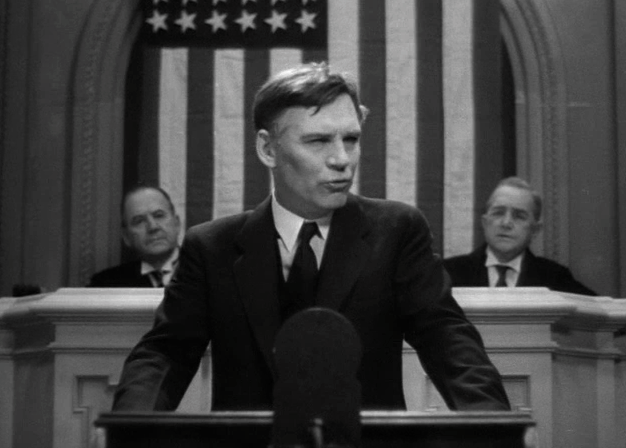
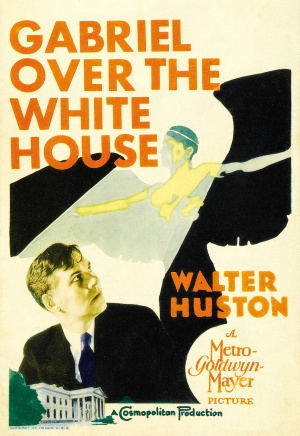
The newly elected President of the United States, Judson Hammond (Walter Huston), is sworn into office, yet behind closed doors, he and his inner circle treat the presidency as a joke. They engage in smarmy chatter and look down upon the populace (“When I think of all the promises I made to the people to get elected…by the time they realise you’re not going to keep them, your term will be over”). Hammond even takes the pen that Lincoln freed the slaves with and remarks, “Well, here it goes for Puerto Rican garbage”. To play up this disregard to an even greater degree, in a very unusual scene featuring a rare use of overlapping dialogue, the President and his nephew play a treasure hunt game in the Oval Office while the radio plays an activist speech. The audio from the dialogue between the President and his nephew becomes drawn out by that of the radio, as Hammond does not have a care in the world for what’s happening in the country. The only loyalty displayed by Hammond is towards what is simply referred to as “The Party” (“The party has a plan, I am just a member of the party”). Walter Huston has the look you would expect from a president from the early 20th century (not too dissimilar looking to Warren G. Harding or a clean-shaven William Howard Taft), while his sheer gravitas not only makes the hairs on your skin stand up, but he also prevents Hammond from coming off as just a caricature. Interestingly, however, he is a President without a First Lady, which would make him and James Buchanan the only unmarried presidents. 

Following a racing accident, Hammond goes into a coma. However, upon his reawakening, Hammond is no longer the man he once was; rather, a populist figure is born. “God might have sent the angel Gabriel to do for Jud Hammond what he did for Daniel”, states the President’s secretary, Pendie Molloy (Karen Morley), as the film makes no secret of indicating that Hammond will be enacting the will of God himself. Many scenes from this point onwards have a softer, more dreamlike look, with a higher contrast between black and white. In one moment shortly after Hudson’s awakening, he stares up in awe at a bright heavenly light shining upon his face, or as Pendie describes it, “the presence of a third being in the room”. Many a beautiful shot populates the film, from the dramatic zoom shot on Hammond (even if it does go in and out of focus) to some stunning set design with the art deco set of the film’s court martial scene.

The new Judson Hammond wastes no time getting things done with his newfound heavenly, populist political will. Right off the bat, he stops calling his staff nicknames and stands up to the members of his own party.

“Now, be careful. I might resign on you.”

“Your resignation is accepted.”

“Oh, well now, wait a minute, Jud, I was only suggesting…”

Hammond asks Congress to declare a state of national emergency to adjourn itself until normal conditions are restored, and during this period, he will assume full responsibility for the government. With the country under martial law, Hammond proceeds to tackle the issues of unemployment, mob rule, forcing over nations to pay their debts the US and by the film’s climax, literally enshrining world peace into a document signed by most nations in the world. Upon lending his own signature to the document, Hammond himself collapses and quickly passes away, lending further credence that he is enacting the will of God.
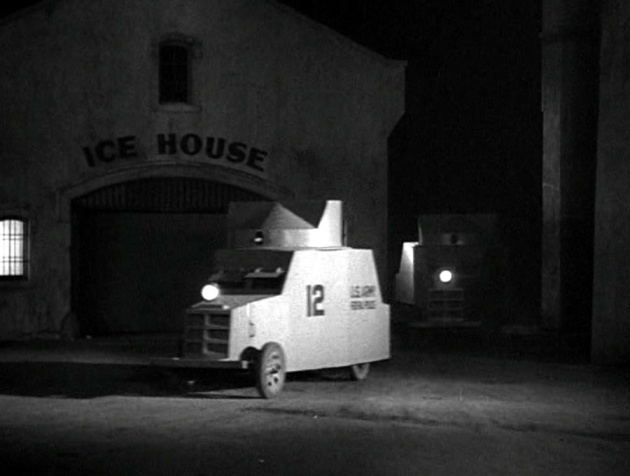
The subplot of Hammond’s efforts to eliminate the mob is particularly interesting. He praises gangster Nick Diamond (of course, he has a scar on his face) directly for “getting rid of most of his own kind”, relating to the theory in criminology that allowing one single crime syndicate to operate results in an overall reduction of crime. Hammond proceeds to create a federal police force to eliminate the mob, leading to two of the oddest scenes in the film, the first in which the mob attempts to assassinate Hammond on the grounds of The White House itself (was this more plausible in 1933?). The latter is a sequence which I can best describe as resembling the climax of every episode of Takeshi’s Castle. Following the arrest of Nick Diamond and his men, they are executed by way of an old school firing shot with the Statue of Liberty in the background (I’ll let you decide what is the intended symbolism, if any, of such a shot).

Is there a name for this kind of populist wish-fulfilment picture? The film which has the most striking similarities to Gabriel Over The White House is Ivan Reitman’s Dave (1993), in which an ineffective, uncaring president is replaced by a populist doppelganger who gets things done. Likewise, multiple sources online speak of an alternative European cut with 17 extra minutes, although such a cut has never been released on home video. Much is made of the fact that film was financed by media conglomerate William Randolph Hearst, although regardless of the agenda those behind the production may or may not have had (although it is worth noting that director Gregory LaCava would go on to direct the anti-New Deal May Man Godfrey in 1936), Gabriel Over The White House, whether by design or not, presents one central dilemma; should a nation be led by one all-powerful leader who can get things done, or have a system of checks and balances, which may be slow and inefficient? When watching Gabriel Over The White House, it’s easy to feel seduced by the temptation of having an all-powerful leader, a benevolent dictator, a king. Or once a crisis has abated, can we ever trust that a leader will lay down the powers given to him? History would say no, but Gabriel Over The White House allows the viewer to indulge in such a fantasy.

The Wet Parade (1932)

Drink!

***This Review Contains Spoilers***

The Wet Parade is unusually long for a pre-code film at 2 hours resulting in a real mini-epic and an informative history lesson on the topic of the prohibition of alcohol in The United States by people who had just lived through it. Whereas most films on the topic focus on the criminal side of prohibition, The Wet Parade focuses on how it affected regular law abiding people.

The first act of The Wet Parade takes places in the American south and this portion of the film does meander a bit (also what is up with that cut made 19 minutes into the movie? – It couldn’t have been less jarring if they tried). None the less it’s worth patient wait for the shocking, pre-code melodramatics this act has to offer as Lewis Stone in the role of a southern gentleman succumbs to the bottle in the most over the top fashion. It’s not enough that he ends up victim to alcoholism; he has to be found dead in a literal pigsty. After the proceeding funeral his daughter Maggie (Dorothy Jordan) offers a beautiful, histrionic breakdown after seeing her father’s friends using whiskey have a toast to their departed friend (“And I only hope I live to see the day, that every bit that was ever made is poured into a cesspool where it belongs”). So yes, just blame the drink and not place any personal responsibility on her father’s lack of self-control. – More on this later.

The remainder of The Wet Parade takes place in New York City in which Maggie is introduced to the hotel owning Tarleton family and their son Kip (Robert Young). Walter Houston as the father of the family couldn’t ham it up more if he tried in the role of Pow Tarleton with his manly, Victorian demeanor. Pow is a hardcore Democrat and Woodrow Wilson fanboy as he drunkenly fawns over the commander in chief. Early in the film, he is seen giving a rousing political speech on the street which is contrast to a Republican elsewhere as it intercuts to both sides accusing the other of infringing on people’s liberates. –  Huston himself would go on to portray a fictional POTUS himself the following year in Gabriel Over the White House.

Films dealing with politics in Hollywood’s golden age rarely would mention actual political parties and by extension not identify characters as being associated with actual real-life parties (at most they would imply party connections). The Wet Parade is an exception to this as various characters are identified as being either Republican or Democrat. There is no clear political alliance The Wet Parade sides with yet it is an interesting observation that all the identified Democrats in the film are rowdy men’s men and heavy drinkers (“I never knew a Republican that could hold more than a pint”) while the two identified Republicans are pretty boys who don’t drink.

The Wet Parade provides an overview of the events which eventually leads to prohibition being enacted. This begins with the re-election of Woodrow Wilson in 1916 and immediately after the results come in on election night, a group of Democrats sing a loud isolationism chant which dissolves into stock footage of marching troops to George M. Cohen’s ‘Over There’. – Nice one. With the US involved in the Great War we see the food control act introduced which Pow refers to as “the hick towns of the Bible belt are behind this, a snide blue-nosed trick to force the county into prohibition”. The Anti-Saloon League then begins pushing to get the Food Control Act into permanent, national law. This is followed by a scene in which we see the angry reaction from the soldiers in the trenches on whom it’s supposed to benefit, frustrated that they won’t be able to get a drink once they return home.

Following the introduction of prohibition, Pow’s wife catches him with a drink in the basement and grabs the bottle off him before smashing it on the floor. Pow strangles her then proceeds to beat her up, killing the poor woman in one of the most shocking moments in pre-code cinema. As a result, Kip and Maggie unite to crusade against the illegal alcohol trade, united by the damage and death alcohol has brought upon both their families. There is a historical analogy in this as long-time leader of the Anti-Saloon League Wayne Wheeler was himself was motivated by his disdain for alcohol due to a childhood incident in which an intoxicated hired hand accidentally stabbed Wheeler with a hayfork.

The Wet Parade showcases the negative effect alcohol can have on people’s lives but more importantly demonstrates how prohibition caused more problems than it solves, removing the tool rather than going to the root of the problem. As one of the gangsters in the film describes the illegal trade, “An industry bigger than the one they abolished”. The film even goes as far as acknowledging the government was behind the poisoning alcohol which made drinkers lose their sight. In one scene Kip and Maggie are given a good talking down by a friend (Neil Hamilton) in a line which best sums up the moral crusade which was prohibition; “People have been drinking for thousands of years, you can’t keep liquor away from people that want it. The minute you tell them they can’t have it more of them are going to stop drinking and get drunk instead.”

Rounding out the large cast of The Wet Parade is Myrna Loy during her bad girl phase. Her character is based on actress and speakeasy owner Texas Guinan and she even utters Guinan’s catchphrase “Give the little lady a big hand!”. The movie does not let down in its Loy factor and she has a satisfying amount of screen time even if it takes an hour until she first appears.

The Wet Parade is directed by Victor Fleming, most famous for directing The Wizard of Oz and Gone With the Wind both in the same year. I think The Wet Parade may be the most interesting film he’s done outside of that. Outside of the film’s opening act in the American south, the remainder of the picture moves at a very brisk pace and features a large number of long takes. The Wet Parade is one of the most informative films on this period of American history and makes for a great double feature with the James Cagney prohibition spanning gangster picture The Roaring Twenties.

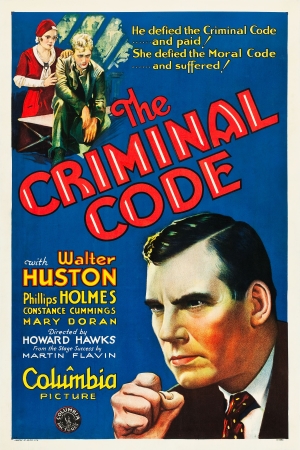
The Criminal Code (1931)

Crime Doesn’t Pay

The Criminal Code explores the issue of turning a normal person who made a mistake into a criminal through time spent in prison and ends up abiding by the criminal code itself. The same subject matter is also explored in the movie Caged made 19 later; nothing seems to change. Robert Graham (Phillip Homles) is a sheltered pretty boy who got a rotten break (similar to Robert Montgomery in The Big House). However, unlike Montgomery in The Big House, Graham is put in a cell with two guys (including Boris Karloff’s Galloway) who look out for him. Although you do have to suspend your disbelief a bit over the movie fast forwarding six years and Graham not being remotely criminalised within that time. Among the film’s examination of the American legal and penal system, Walter Huston explains how it would be possible for someone to get off the hook for a crime such as manslaughter; “A year’s delay, a new trial, the witnesses would fade away, they always do, the whole mess would get cold, the papers would have something else to yap about. I’d get him off; he’d never serve a day”. Great thought provoking stuff.

Walter Huston plays the warden of the unnamed prison. He is stern but fair and a real “Yes sir!” type as evident from his first appearance with the manner in which he addresses a female witness (“Never mind that, pull down the shade”). The man is one lightning-fast talker who can interrogate like a boss but his greatest moment of badassery comes from the scene in which he goes into the prison yard to confront protesting, yammering prisoners face to face without any guards. Just look at the way he walks into the yard and lights up a cigar. As he approaches the prisoners the yammering stops and they don’t lay a hand on him. Simply put, this guy is badass. Perhaps unrealistically so but that’s why we have movies.

The Criminal Code was Boris Karloff’s first significant screen role in the part of Galloway. With his dominating, tall, lanky figure he steals the show; his monologue on why’s he’s in the slammer with the shadows across his face is hair-raising stuff. Galloway has a vengeance with a guard named Gleason which gives the film some dark comic relief such as the two awkwardly passing each other on the stairs to Karloff’s recurring use of the lines “I don’t like you” and “I got an appointment with you”. Likewise, the other memorable cast member, albeit in a very brief role is Andy Devine who is very hard to miss with that highly distinctive voice of his.

The Criminal Code uses the same set created for MGM’s The Big House released the year before. With its more intricate cinematography, the film doesn’t capture the sense of claustrophobia seen in The Big House but still captures the mundanity of prison life. As an early talkie, there is no music present in The Criminal Code but rather the sound of prisoners marching along with various other sound effects are just as effective as any music score could be.

The Criminal Code is also host to one of the most shocking moments in pre-code cinema (and was even featured in Karloff film Targets from 1968). When Galloway chases a squealer into a room while yammering is going on in the background from the prison yard, Galloway walks into the room with the squealer cornered as he slowly closes the door as the squealer looks on in terror. What happens next is up to the viewer’s imagination.

The Prizefighter and the Lady (1933)

Women Weaken Legs!

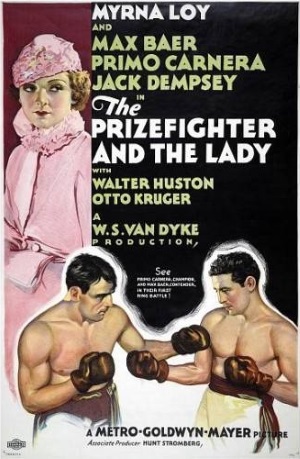
I’ve seen many a boxing film and despite having no real interest in the sport I find they often make for great stories – I consider The Prizefighter and the Lady (written by the great Francis Marion) as one of the great unsung boxing films with its less than conventional and exceedingly well acted and conveyed love triangle. What’s particularly striking about this romance is how intriguingly pathetic in a way it is. Belle (Myrna Loy) falls in love with a dunce of a jock named Steven (played by real-life boxer Max Baer) – “A big kid” as Belle calls him. Steven is a man who doesn’t seem to know any better and Belle is fully aware of this but can’t help that she has fallen for him; you really can feel the raw sexual attraction between these two, especially in their introductory scene in which Loy has nothing but a blanket draped over her.

The third end of the triangle of this not so swooning love story is Willie Ryan (Otto Kruger) as Belle’s original lover. Willie is a crime boss but is not presented as your typical hardnosed gangster (nor is it clear what the extent of his criminal activities are). Willie cares deeply for Belle and the two even talk openly about Belle’s newly found feelings for Steven. However, Belle eventually informs Willie she has got married to Steven and leaves him and her life as a socialite for more mundane and dowdy existence, leaving Willie with one heartbroken face with two tears coming off his face. – The Prizefighter and the Lady is full of little, subtle acting moments like this you wouldn’t notice on first viewing.

Perhaps that would be enough drama but no, Steven, the ladies man who is all muscles and no brain is cheating on Belle with multiple women. It does raise the question of what sane man would play adultery when you’re married to Myrna Loy?! The female lead of Prizefighter and the Lady would be a unique part for any major Hollywood actress. MGM was known for their glamorous stars yet here is Myrna Loy appearing dowdy and I suspect at times not be wearing any makeup – we are even introduced to her being lifted out of a car wreck and covered in dirt. While I’m not a fashion connoisseur every once in a while I will see a film from the 1930s and fawn over the outfits. Every outfit worn by Loy in The Prizefighter and the Lady is to die for. Likewise, her singing of the song Downstream River in the nightclub is enchanting, even if it’s obviously not her voice doing the singing. – She is a quintessential symbol of urbanity.

Oh yeah, and there is boxing in this film too, right? Older films generally aren’t known for their stellar boxing scenes. The film’s combination of slowed down footage and frequent cuts doesn’t look fantastic but it’s not totally immersion breaking. Likewise, I just wish the film could have done without the rather cheap, 7-minute long musical number entitled “Lucky Fella, Lucky Guy”. What more than compensates is the gorgeous high contrast cinematography in the boxing arenas; you can feel the grit and grime of the sweaty, smoke-filled atmosphere in another example of the type of neo-realism the pre-code era had to offer.