![The Bad Sleep Well [The Worse The Villian, The Better They Sleep/悪い奴ほどよく眠る/Warui Yatsu Hodo Yoku Nemuru/] (1960)](https://satinyourlap.com/wp-content/uploads/2024/10/poster-resize.jpg?w=300)
The Corporations Sit There In Their Corporation Buildings And See, They’re All Corporationy And They Make Money
***This Review Contains Spoilers***
The Bad Sleep Well (悪い奴ほどよく眠る/ Warui Yatsu Hodo Yoku Nemuru, which translates to The Worse The Villain, The Better They Sleep) is Akira Kurosawa’s loose adaptation of Hamlet. By replacing the kings and queens of ye olden days with the chairmen of mega corporations, Kurosawa transports Shakespeare’s tale to the (then) contemporaneous sinister underworld of corporate Japan (in which the opening music score by Masaru Sato infuses jazz in with primal toms-toms as a perfect musical metaphor for this deadly urban jungle). Koichi Nishi (Toshiro Mifune) marries Yoshiko (Kyoko Kagawa), the daughter of wealthy industrialist Iwabuchi (Masayuki Mori), in an attempt to avenge the death of his father, of whom he believes Iwabuchi and his corporation are to blame. This, however, is only scratching the surface of a bizarre revenge scheme. Is Nishi’s wild and crazy plan to be or not to be?

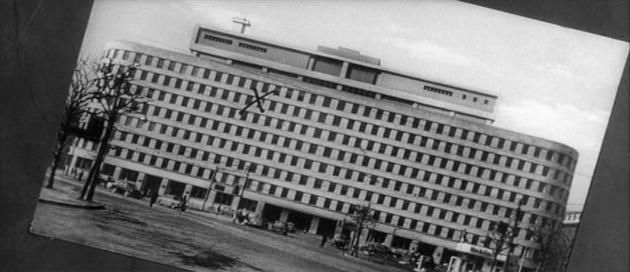
The Bad Sleep Well has one of cinema’s most intriguing and unique first acts. The plot, characters and relationships are established through the wedding of Nishi and Yoshiko. This is not your average ceremony, however. Rather, it is a public, voyeuristic and somewhat dystopian affair swarming with journalists in which the main focus is not on the coming together of two families but rather a focus on corporate business. The wedding not only acts as the tying of a union between a man and a woman, but more so the amalgamation of the fictional entities of Dairyu Construction and Public Corp. Whereas in Hamlet the titular protagonist stages a play referencing his father’s murder, watching for the King’s reaction to the scene to ascertain whether he did commit the crime in question, in The Bad Sleep Well Nishi (unbeknownst to the attendees) has the most bizarre and superlative wedding cake delivered. A cake which is modelled after the company headquarters with a rose marking the window from which Nishi’s father plunged to his death. Aside from the intriguing, bizarre nature of this opening 20 minutes, the sequence is also made highly effective by the chatter of the onlooking journalists as well as the wedding narrator, acting as an effective way to deliver exposition – as a viewer, you become just as curious as the onlooking media men. The sequence concludes with a fitting meta-reference by two of the journalists: “Best one act I’ve ever seen.” “One act? This is just the prelude.”

The not-so-benevolent conglomerate that is Public Corp are sending officials instructing people to take their own lives or else an assassin will be sent out to do so. This is seen early in the film when a man is told by company officials, “You’ll carry this through until the end”, and immediately proceeds to throw himself in front of a moving car. With this threat in place, a government official named Wada (Kamatari Fujiwara) attempts to commit suicide by throwing himself into a volcano (and I thought Hara-Kiri was hardcore), but is prevented from doing so by Nishi (in order that he can use Wada to expose Public Corp). I might be able to accept Nishi knows about Wada’s attempt to commit suicide, but how does he know the location where he intends to do so? Likewise, at the volcano itself, Nishi waits until he can make a bad-ass entrance, even though Wada has had the opportunity to go ahead and jump into the volcano – typical movie-land logic.

In The Bad Sleep Well, Mifune is clean-shaven and suited up with specs. Yet, Mifune has the ability to play such a dorky-looking character and still look cool (“Well, well, a big muscle-bound nerd”). Likewise, he is playing a male secretary in Japan circa 1960, although no reference is made to working in a traditionally female job being beneath him. Nishi, however, is not a man you want to get on the wrong side of. From his unsettling use of a whistle motif (similar to that which is seen in Fritz Lang’s M), to going full Christian Bale’s Batman through extorting a man by hanging him out of the same window his father supposedly committed suicide. He even torments the already suicidal Wada even more by showing him his own funeral (itself a dystopian affair in which a corporation itself shows its respect by laying two huge wreaths).

Nishi’s plan, however, is complicated by the fact that he inadvertently finds himself falling in love with Yoshiko, stating he can’t take advantage of the girl after being “touched by her innocent nature on their wedding night”. Yoshiko is particularly vulnerable due to having limb length discrepancy (one leg is longer than the other), due to a motorcycling accident. In a film full of humanity at its worst, the sweet and sentimental love story within does act as a counterbalance. We get classic aborted kiss cliché, but I do appreciate films of many decades past never partaking in the dreaded liar-revealed cliché. Yoshiko’s feelings towards Nishi are reciprocated even when she is fully aware of his plan, rather than having that scene in every contemporary rom-com (you know the one); “No Yoshiko-chan, I can explain!”. Nishi, however, is not alone in his revenge plan, as he is assisted in creating a fake identity by his long-time friend and war buddy, Itakura (Takeshi Kato). There is something endearing about their bromance in that friends could be so tight to the point that he is willing to assist in such an elaborate plan. Like, yes, I will help you switch identity and use my car-repair store as a hideout in order to help you marry into a family so that you can expose an evil corporation.

The most contentious aspect of The Bad Sleep Well, however, is that of Nishi’s death. His murder occurs off-screen and is described to the viewer by Itakura, in a reverse of the classic “show, don’t tell rule” of storytelling. I am off two minds on this aspect of the story. On the one hand, it comes as a big shock to be told Nishi has suddenly been killed, and like the characters hiding out in the bombed-out factory, you can feel their palpable sense of anger and disappointment. On the other hand, for a movie which in many ways was very over the top with its jumping-into-volcanoes levels of shenanigans, it does feel quite anti-climactic. Yet, in a way, this anti-climax feels somewhat appropriate. After all, this is a story in which the bad guys win. The Public Corporation Vice President, Iwabuchi is a perfect representation of the banality of evil. While he has a human side when he is seen being a homely, domestic figure as he cooks dinner at home for his children, he is the head of a corporation which literally Jeffery Epsteins anyone how could speak out of turn with their Clinton-style body count and can shut down stories in the media, Hunter Biden laptop style (it’s hard to watch The Bad Sleep Well and not find analogies through the lens of 2020’s online political discourse). Iwabuchi speaks of his plans to run for political office, so it’s your best guess at what happens next.
Good does not always triumph. Sometimes, the dark side overcomes what Lincoln called the better angels of our nature.
![Scattered Clouds [Two in the Shadow/乱れ雲/Midaregumo] (1967)](https://satinyourlap.com/wp-content/uploads/2023/02/mv5bzdhlztjmmgutzwrjmi00mgu0lwfhzdytywm3mzvjzdniytuxxkeyxkfqcgdeqxvymjg1njgwmzg40._v1_fmjpg_ux1000_.jpg?w=300)


 Sat In Your Lap