
Laughing Sinners (1931)

I’d Rather Laugh With The Sinners Than Die With The Saints

Laughing Sinners is surely some good publicity for The Salvation Army. The plot of Ivy/Bunny (Joan Crawford) leaving her previous life behind and finding happiness in the helping of others is moralising but never came off to me as overly preachy. I like Laughing Sinners despite the film’s inconsistency with sections of the movie having little to no impact on the overall story. The first twenty minutes of set up, for example, could easily have been done in half the time. Yet despite this, there is a powerful emotional undercurrent at the heart of Laughing Sinners with a number of highly moving scenes making up for the less than stellar portions of the film.

At least some of these weaker moments are made passable from the presence of a comical, stereotypical Italian chef to a bizarre dance number in which Joan Crawford is dressed as a scarecrow; go figure. Likewise, another real highlight in Laughing Sinners is a scene in the park depicting a charity picnic which has such naturalism in both its documentary-like appearance as well as the acting; a piece of neorealism which doesn’t feel like a movie set.

As soon as Clark Gable enters the picture at 22 minutes the film truly takes off. Any scene with Crawford and Gable is pure magic with the sincerity in their interactions which at no point feels like acting. I don’t think there’s any other actress of the time who can as effectively as Crawford make you pour out your heart for the poor woman and rarely has she ever looked as angelic as she does here in her Salvation Army uniform. Likewise, many people will laugh at the idea of Clark Gable playing a Salvation Army officer but Laughing Sinners provides a side of Gable I wish more people could see. Like his role of Dr Ferguson in Men In White (1934), the part of Carl Loomis is saintly without delving into the sickly with his ability to project a real sense of warmth especially with his interaction with children.

This is one of the few films in Gable’s career in which he isn’t a romantic lead as he only remains in the friend-zone with Joan. Never again would we see Gable as more of a boy scout and less the alpha male; as he cooks, wears sweaters and aprons and lives with his aunt.
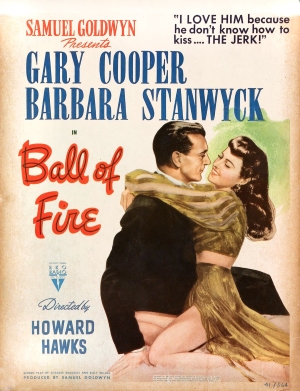

 

Ball of Fire (1941)

sex3

The Kind of Woman Who Makes Entire Civilisations Topple

Ball of Fire is the more grown up, risqué version of Snow White and the Seven Dwarfs; even during the opening scene the film’s cast of professors are seen walking in tandem through Central Park like the seven dwarfs as they adhere to a strict daily seclude in an attempt to compile an encyclopaedia of all human knowledge. The film plays off the public perception of bureaucrats, bankers, librarians and people in other such mundane professions. Are they such sheltered, socially awkward individuals who are in bed at 9 every night and have likely never been in a relationship? The recurring Howard Hawks’ theme of male bonding is ever present in Ball of Fire, although here it is all the more goofy with a cast of characters playing nerds. Regardless there still remains one very poignant scene in which Professor Oddly (the only bachelor of the group) recounts about his past wife and the men start singing.

There are few other character entrances in film more entertaining than that of Barbara Stanwyck as Sugarpuss O’Shea (a not so innocent name by today’s standard) as she enters the picture singing and dancing with Gene Krupa and his orchestra – could the character’s fast-living personality be summed up in a more entertaining manner? Likewise, that dress! No wonder Edith Head had decades working in the industry. Notice it’s nonstop sparkling every moment it’s on screen, making Stanwyck look all the more tantalising. Almost all the outfits worn by Stanwyck in Ball of Fire are clearly designed to make her look as sexually appealing as possible. When Professor “Potsy” Potts (Gary Cooper) and Sugarpuss are alone, the sexual sparks fly and when she holds up a leg she gives a group of socially awkward, sheltered middle-aged to old men a sexual awakening. It’s all the more poignant that the man she seduces is played a Gary Cooper; a contrast to his boy scouty screen image. Here Cooper is a nerd, and while he did play tough guys on screen, he will always be that boy next door. Ball of Fire is full of lines and moments which wouldn’t feel out of place in a film made before the production code. At the beginning of the film, we even see Professor Potts arousing the funder of the encyclopaedia project by merely talking to her in an attempt to convince her to keep the project running.

Ball of Fire is worth watching multiple times for all the lines you can easily miss out on. For example, when a garbage man (Allen Jenkins) comes into the house to ask the men for assistance on radio quiz, one of the questions regards the correct way to state a mathematical problem: “2 and 2 is 5, 2 and 2 are 5, 2 or 2 makes 5”. Cooper states the correct answer is “2 and 2 are 5” however the mathematician of the group then states “2 and 2 are 4” followed by the garbage man responding, “that’s a good one, nobody’s gonna get that”. Am I detecting a sneaky Orwellian statement pre-1984?