The Divorce of Lady X (1938)

Heathcliff and Cathy’s Other Film

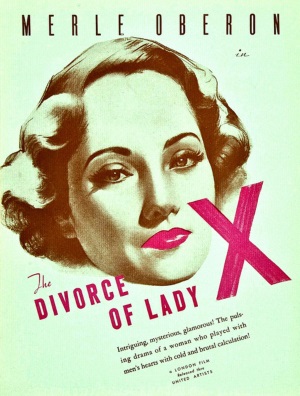
The Divorce of Lady X stands out from other screwball comedies for several reasons. Firstly it’s one of the few screwball comedies filmed in Technicolor which is complemented by the complimented by the luscious set design and brightly coloured ladies costume design. I do love that night club with its dreamlike painted backdrops as well as the miniature work of Trafalgar Square for the film’s opening shots (even if there are a bunch of empty buses driving). Second, it’s the only British screwball comedy I’ve come across to date, putting a British spin on this distinctly American genre. It’s fun watching typical screwball situations with an entirely British cast, set in Britain and with very British lines of dialogue (“You got marmalade all over your newspaper”).

Third and by far most importantly in what has to rank as one of the most bizarre of pre-stardom roles, it stars Laurence Oliver. Yes, the master of Shakespearean tragedy, perhaps the most respected and dignified actor of the 20th century as a stuffy gent who at first is delightedly full of himself but soon gets into all sorts of crazy shenanigans at the mercy of a screwy dame.  Merle Oberon plays one of the most ruthlessly manipulative characters I’ve seen in any film as she is able to weasel her way to get anything out of this man – the type of dame who destroys civilisations. Thus it doesn’t come as a surprise that Oliver goes head over heels for her despite all the anguish she causes him, likewise her previously having four husbands doesn’t help matters (also, that improvised cape made from a bedsheet she wears is such a brilliant touch). The chemistry between the performers works seamlessly and is aided by the sexual tension and undertones.

The first act of The Divorce of Lady X is one big farcical sequence centered around the sexual politics of the time; the fact that an unmarried man and woman sleeping in the same room was considered scandalous, even if there are two separate beds. This ties in nicely with how film critic Andrew Sarris defines the screwball comedy genre, “a sex comedy without the sex”.

Dinner at Eight (1933)

Guess Who’s Coming to Dinner

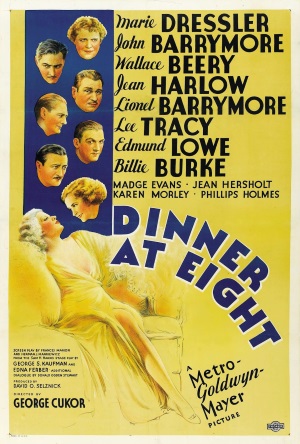
Ah, the 1930’s. No decade in cinema has since captured such an aurora of class and sophistication from the clothes worn to the way people talk; a world so removed from our own. It feels like there is no other time period in which it was as easy to make a movie about rich people and their rich people problems without it coming off as a metaphorical dick waving display of wealth. There are few better representations of this than Dinner at Eight. With the heavenly, dream-like music from the film’s opening titles; the viewer is transported to a world long, long gone. All of the stories in Dinner at Eight have tragic, to say the least, but Billie Burke as the socialite holding the impending dinner helps bring comic relief to the proceedings with her histrionics as well simply the sound of her voice. Aside from the largely carefree Burke, the rest of the characters don’t have much to look forward to with their impending affairs, bankruptcy, failing careers and illnesses.

John Barrymore’s story is my favourite; the quietly tragic demise of washed-up film star Larry Renault. His tender love scenes with Madge Evans are largely the opposite of the grandiose interaction with Greta Garbo in Grand Hotel; this is far more down to Earth. It’s not apparent when Renault first appears just what a bad state his career is in. As his segment progresses he becomes more and more pathetic as he becomes increasingly drunk and we learn more about his current state that he is only being offered a bit part in a play, he only has seven cents on him and the ultimate blow when his manager tells him he’s been a joke for years and never taken seriously as an actor; he had his good looks but he doesn’t even have that anymore. The subplot is prophetic of Barrymore’s own future as he spent his last few years as a washed-up actor and succumb to alcohol. There are hints in his performance to the egomaniac he would play the following year in Twentieth Century with his hotel room being littered with photographs of his own profile. With its haunting cinematography, Renault’s final outcome had me holding my breath with part of me wishing this could be its own film; a sort of predecessor to the story of Norman Maine in A Star Is Born.

The other storyline which particularly strikes me is Edmund Lowe’s. Once his wife confronts him about his ongoing affair with Jean Harlow, the two have a long serious chat in which she is completely understanding and forgives him. A stark contrast to any modern romantic comedy in which two characters would break up after a lengthy argument of one has betrayed the other, then get back together 20 minutes later. Are modern romantic comedies just so contrived and unreflective of real life, was adultery less frowned on back then or is it just a pre-code thing?

The early 30’s seems to be the one brief period in cinema history in which there was a number of older aged movie stars who box office draws; Wallace Beery, Marie Dressler, John Barrymore, Lionel Barrymore. There has never been another decade like it.

The Country Girl (1954)

Bing on a Binge

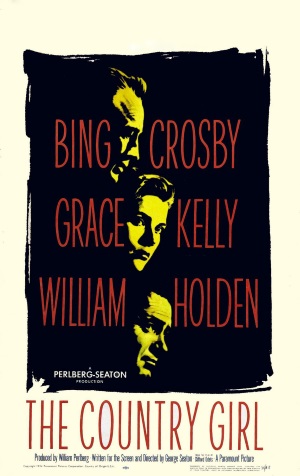
It’s good enough when a movie can impress me with an excellent performance delivered from an actor whom I didn’t think had the chops to do so, now multiply that by three and you’ve got The Country Girl.

I had only previously seen Bing Crosby in several musicals and comedies. He’s never struck me as an enigmatic screen presence but serviceable none the less. Thus surprise performance # 1 in The Country Girl. Why didn’t Crosby do more dramatic roles in his career? This is one of most powerful performances I’ve ever seen as a washed-up alcoholic performer who has hit rock bottom. Like Ray Milland in The Lost Weekend and Jack Lemon in Days of Wine and Roses, Crosby’s performance has helped convince me never to start drinking (or at least that would be the case since I’ve never had any intention of starting).

Yet I would still say he’s outdone by William Holden, surprise performance #2. I’ve found Holden to be very hit or miss as an actor, possibly relying on great directors to get a good performance out of him otherwise he comes off to me as forgettable. The jury is still out on his abilities as an actor but never less after watching The Country Girl again, I can say this is my favourite performance I’ve seen him deliver giving so much raw energy as a driven stage producer.

Finally in the triangle of surprise is Grace Kelly. Prior to watching The Country Girl, I was becoming increasingly anti-Grace Kelly, questioning if she was even a very good actress. Here in this dowdy, playing against type role, my opinion of her changed. I have a rule when it comes to reviewing not to talk about Oscars as I see complaining about awards to be futile and cliché. Yet this is one exception in which I’m forced to break it due to the controversy surrounding her win. Judy Garland’s role in A Star Is Born is one of my favourite film performances of all time and should have won her the Oscar that year however if The Country Girl had been released most other years I would have been more than happy to see Grace Kelly get the Oscar.

Without delving into a mindless praise fest I really was left flabbergasted by this trio of performers aided with the help of the film’s unforgettable sense of atmosphere as Grace Kelly puts best herself: “There’s nothing quite so mysterious and silent as a dark theatre, a night without a star.”

Continental Divide (1981)

The Continental

***This Review Contains Spoilers***

Early during Continental Divide as I was gradually enjoying the film more and more and becoming emotionally invested in its two characters (very emotionally invested I might add), storm clouds began forming over me. I came to the realisation that at some point the movie was going to pull of my least favourite movie cliché, the liar revealed. You know, the woman finds out the man isn’t what he claims to be, after a big monologue about how betrayed she feels, they break up, cue the sad montage music but 20 minutes late they forgive each other and live happily ever after, the end.

Thus it was a huge sigh of relief when Blair Brown’s (not the former British government cabinet) Nell Porter discovers John Belushi’s Ernie Souchak (a name which sounds like it’s taken from a 1930’s newspaper comedy) is secretly writing a news piece on her after he agreed not to during this early point in the film. They don’t argue about it, she happily accepts it. How about when Ernie discovers Nell has been meeting a man in the wilderness purely for sexual intercourse and not for a passionate relationship, does he freak out? No, he has no problem with it and that’s the way it should be! That’s one of the things I loved most about Continental Divide, it was like a big middle finger to the inane and contrived clichés which plague modern-day romantic comedies.

Continental Divide is one of my favourite man and woman alone in the wilderness type movies, in this screwball comedy for the 1980’s; which at the time advertised Belushi and Brown as the next Hepburn & Tracy. With the likes of His Girl Friday and Libeled Lady, Continental Divide has the underlying theme that long-term romantic relationships and careers in journalism are an apparent impossibility; only the typewriters are out in favour of computers. Although I do have to ask how many journalists have the levels of a celebrity among the populace as Ernie Souchak has, in which he is constantly recognised in the street. Likewise, Ernie Souchak’s employment of the Chicago Sun-Times is the paper film critic Rodger Ebert writes for, although there is no cameo or mention of him in the film, likely due to a conflict of interest.

Nell Porter is a woman so reclusive she lives in the mountains while attending to her study of Eagles. She has a desire for peace and quiet and I get the impression she is disenfranchised with civilisation, partly due to her dislike of the media. Having a female character like this is one of the reasons I’m so attracted to a love story like this, since weird girls are my thing. Plus speaking of the wilderness, does this movie look good! Filmed atop of actual mountains in Montana and Washington State, It just shows you that Planet Earth is the greatest movie set of all.

It is evident from both Continental Divide and his final film Neighbours that John Belushi was trying to escape typecasting. Continental Divide proves he had what it takes to be a romantic leading man, however, his time left on this world was short at this point but the legend lives on.

Cinema Paradiso (1988)

The Cinema Has No Boundary, It Is A Ribbon Of Dream

***This Review Contains Spoilers***

Giuseppe Tornatore’s Cinema Paradiso is the ultimate movie lovers’ movie. A film which perfectly captures the obsessive and domineering power cinema has over its dedicated fans and their lives. In the manner of how the picture’s protagonist Toto becomes enchanted and engulfed by the movies, Cinema Paradiso is a movie which succeeds in doing just that. Cinema Paradiso takes the viewer back to a time when the movie theatre was at the heart of a community, where people would even have sex in the middle of a crowded theatre and teenage boys would engage in acts of self-pleasure to what was on screen (must be a European thing), or alternatively, many would just go to enjoy a nap. Cinema Paradiso is my favourite Italian film but also my favourite film not in the English language, and what a rich experience it is. Even the Italian people’s over-the-top, histrionic nature is hugely entertaining – now that’s a good-a pizza pie! The music, scenery and vibrant architecture of the village of Giancaldo on the island of Sicily immediately draw me in with the stone buildings, fountains, cobblestone streets and wide open squares free of automobiles. This contrasts with the film’s latter scenes set in the modern day, where modernity has replaced a world in which the influence on Ancient Rome still lingered and instead with something more superficial and ugly.

Cinema Paradiso follows the relationship between the child Salvatore “Toto” Di Vita and his Freudian father figure Alfredo (Philippe Noiret), a projectionist at the local cinema. Alfredo himself is very much a mythical character; he has no back-story or even a surname (he does have a wife yet we only see her briefly), yet he succeeds in being one of the most unforgettable characters in film history. He is a man who appears to have never made much for himself in life yet to Toto, this cinema projectionist is the most fascinating man in the world – the archetype of a loser with a heart of gold. This is one aspect of the story which really punches one in the gut; Alfredo prevents Toto from going down the same road as he did but at the cost of moving to Rome and never seeing him again of his family again as the village would have a destructive influence on the artistic development of someone like Toto. The job of a projectionist is no path for a young man of whom the world is his oyster. Ultimately, this works, as we learn from the opening and closing of the theatrical cut of Cinema Paradiso (more on the director’s cut later) that Toto holds a job of some esteem in the film industry (possibly a director although it’s not made clear) and lives in a not too shabby Rome apartment, but only by the way the of great sacrifice imposed by Alfredo. The man may not have had much education, but it’s clear he had the wisdom of age.

The question has to be asked, is Cinema Paradiso the most tear-inducing film ever made? I recommend wearing a life jacket while watching this movie or you will drown in your own waterworks. This is one of few films that give me teary-eyed goosebumps even thinking about it or by listening to the music score by Ennio Morricone. The entire score is one of few I can listen to in its entirety, full of compositions of pure tranquillity to reminisce on days gone by. I hate to imagine how much of a nihilist one would have to be not moved by the scene in which Alfredo makes a projected image travel along the walls of the projection room and into the town square accompanied by the booming music score. Alternatively, take the scene in which or a lonely teenage Toto walks through the streets of Giancaldo just as New Years rolls in after being rejected by his love Elena. I also personally find it hard to retain a straight face at the utter soul-crushing scene near the film’s end as the adult Toto walks through the abandoned interior of the Paradiso on the day before it is set to be demolished to make way for a car park. However, it is the final scene in which Cinema Paradiso really does save the best for last, a conclusion which is movie magic of the highest magnitude. Aside from being a tribute to the 20th century’s greatest art form, Cinema Paradiso is full of emotions of nostalgia, youth, love and the losses we have to deal with during our lives. Like the stamp of any truly great film, Cinema Paradiso is a movie which you don’t want to end and the streamlined version of Cinema Paradiso is Cinema Perfecto. Oh yes, there’s more, with the director’s cut of Cinema Paradiso which adds not only so much more additional material to the film, but so much more depth and complexity to its characters which bares discussion.

For the original Italian release or director’s cut, Cinema Paradiso had a run time of 173 minutes and for the international release, it was cut to 124 minutes. The biggest difference with the director’s cut is the far greater examination of the relationship between Toto and Elena, transforming what is a subplot in the cut version into one of the main focuses of the story, especially during the picture’s third act. In the theatrical cut, there is only a hint that Elena’s middle-class parents object to her relationship with Toto but in this longer version, this objection is on full display. However more significantly, we learn in a crucial flashback scene, that it is Alfredo himself who worked to end this young love, viewing Elena as another obstacle to Toto’s artistic development. Toto and Elena’s contemporary reunion scene is an incredibly lengthy and talkly affair, outlasting by great magnitude any other scene in the film but its emotional payoff is satisfying and in the end, both characters come to accept that Alfredo was justified in his actions.

In the theatrical cut of Cinema Paradiso it’s merely hinted that Toto has become a film director but in this version, it that not only the case, but he is also famous enough that he is recognised by fans in a bar. In regards to other new scenes, that in which the film acknowledges the rise of television by having a game show projected in the Paradiso via a teleprojector much to Alfredo dismal is a nice addition, foreshadowing the eventual demise of the local cinema. Other scenes however I did find unnecessary such as adult Toto’s encounter with the street punks in Rome to Toto’s friend Boccia getting some action in the countryside. Although the one scene I really didn’t need to see was Toto losing his virginity to a cougar in an empty paradiso and just before meeting his later love, taking away from the character’s innocence. I have to say I greatly prefer the shorter, more streamlined version of the Cinema Paradiso. The additional material of the director’s cut greatly affects the film’s pace and takes away much of the mystery posed by the shorter cut. Likewise, the majority of the additional scenes are set in the modern day and stylistically do feel very distant from those set in the Sicilian village of the ’40s and ’50s, thus at times, it does feel like I’m watching an entirely different film altogether. That said, even though it is a flawed version of the film, I am glad this cut exists as it does contain its own merits turning the film into something of an epic and reminding me of another film with an Ennio Morricone score with similar coming-of-age themes, Once Upon A Time In America.
The Cheyenne Social Club (1970)

Quit Badmouthing the House!

The Cheyenne Social Club sounds like a bad idea on a number of levels. For beginners it stars two elderly actors towards the end of their careers in a comedy about prostitution, not to mention Gene Kelly would be one of the last people I would expect to be directing a western. For a long time it remained a movie I doubt I would ever watch yet much to my surprise the film turned out not only to be perfectly dignified but also very funny and surprising endearing. The idea of Jimmy Stewart being the owner of a brothel and becoming a sugar daddy sounds wrong on paper yet somehow it manages to work. The Cheyenne Social Club paints an idealized version of a whore house in which the women are proud of their profession and worship their boss. The movie doesn’t shun prostitution and while propaganda might be a strong word I certainly got the impression the movie was voicing its support for the legalisation of prostitution.

Henry Fonda is by far the funniest thing in the film; a child in an adult’s body living out a completely carefree existence with Stewart being the straight man and the grown-up one of the two. Even as soon as the film begins Fonda babbles through the entire opening credits which according to the movie lasts for literally over a thousand miles which helps distract from how ordinarily plain the test in the opening credits are. The relationship between the two is incredibly endearing with one of my favourite moments of the film is the two of them innocently sleeping in the same bed together. It is also very amusing as Fonda just follows Stewart wherever he goes as he has nothing else to do with his time but also because he just likes his company. It’s evident through their own screen chemistry that the two where lifelong friends. The film’s other major highlight is Stewart and Fonda’s discussing of politics (Stewart being a Republican and Fonda a Democrat) mirroring their real-life personas and bringing to mind an occasion when their friendship was almost brought to an end when they got engaged in a fist fight over politics in 1947 (“I don’t like to dispute you John but didn’t you always vote democratic?, Well…that was when I didn’t know any better”) .

The Cheyenne Social Club is the third of three films James Stewart and Henry Fonda starred in together. The first two of which are among the weakest films I’ve seen from ether actor. Thankfully the third time was the charm; it took 35 years to get these two legendary actors in a great film together but it was worth the wait.

The Champ (1931)

Wallace Beery, Boxing Picture, What Do You Need, A Roadmap?

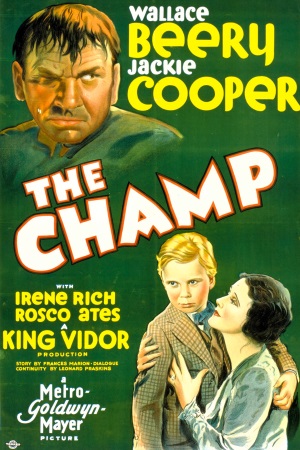
I can’t imagine what kind an inhuman monster devoid of feelings one would have to be in order to not be moved by this film. Jackie Cooper as Dink and Wallace Beery as his father simply referred to as ‘The Champ’ is one of the most heartfelt and compelling on-screen relationships I’ve ever seen. A father who is a loser yet his son worships him despite the father not keeping his promises to stop drinking and gambling; regardless the father truly loves his son back. Despite his questionable character as a viewer I still feel a sympathetic liking for the character. With these two I feel I’m observing real human behaviour, not acting.

The film’s naturalistic and unmanufactured feel just doesn’t extend to the performances, partially thanks to the widespread use of real-world locations. Champ and Dink’s bedroom also appears run down and unpolished, it doesn’t look like your typical shiny Hollywood interior set; is it even a set at all? The Champ also disproves the misconception of movies from the 1930’s being static, right from the opening scene as the camera pans in several unbroken shots or the sequence in which Champ arises from bed in the morning with the camera following and zooming in on his movements are the room.

I initially reacted of dismay when Dink’s mother and her husband tries to separate him from The Champ, screaming to myself in my head “how dare you destroy this beautiful relationship!”. Thankfully I was glad they just didn’t just descend into becoming cliché villains. Child actors typically get on my nerves, not because of the children themselves but because of the way they are portrayed in movies, often as dim-witted and overly cutesy (it seems Dink is smart enough that he even drives a full of adults in one scene, even if the steering wheel movements don’t match that of the car’s). Not here though. Every time Jackie Cooper utters the name of The Champ (“Come on Champ”, “I want The Champ!”) I have myself a laugh of joy. Watch and let the waterworks roll.

Carefree (1938)

Freud & Ginger

On my first viewing of Carefree, I experienced something I never thought I would with Fred and Ginger, boredom. Initially I was expecting another spectacular musical showcase, however, the film is on a smaller scale (their shortest at only 80 minutes) than their previous outings and only contains a mere four musical numbers; making it more of a comedy with some singing and dancing than a full-fledged musical. With several movies behind them following a similar formula, if they were going to make another then they had to do something different or things would have become stale. I wished though that Fred Astaire could have done straight comedies during his career; Carefree is the closest thing to that.

None of the musical numbers in Carefree stand out as being among the best in the series. Fred Astaire’s number in which he plays golf while tap dancing sounds better on paper than it does in execution. I’m sure what he’s doing is no easy task yet it doesn’t look all that impressive to watch. The Yam, on the other hand, is a pretty standard number, but heck, it’s still Fred and Ginger dancing. I find the film’s most interest musical number is ‘I Used to be Color Blind’, the most experimental in the film, shot in slow motion and allowing the viewer to see Fred and Ginger’s grace in every detail.

For the only time in the series, Astaire plays a character who is not a dancer by profession, but rather a psychiatrist (although they do make sure to mention he once had aspirations of becoming a dancer). I don’t completely buy Astaire as a psychiatrist, but realism is not what these movies are about. Plus I’m sure the psychology on display here is of the “you are getting sleepy” variety as seen in movies. He doesn’t break his professional ethics though by pursuing his patient like his stalkerish attitude towards Ginger in other films in the series, instead, she wants him.

Carefree belongs to Ginger, playing a character whom has been put under hypnosis, giving her the opportunity to completely goof around in a childlike manner with big wide eyes, and it’s pretty funny stuff. How many movies do you get to see Ginger Rogers wielding a shotgun? Everyone needs at least one movie where they get to act stupid. The comedic assets of Ralph Bellamy and Jack Carson are big benefits to the film’s witty dialogue, where much of the film’s strength lies. Even if the dance numbers don’t fully exceed, as a screwball comedy, Carefree grows on me, of course, I am a sucker for these movies and the Astaire/Rodgers name, so good enough for me!

Captain Blood (1935)

There Will Be Blood

Captain Blood, the one that started it all – the breakthrough roles for Errol Flynn and Olivia de Havilland and the first of their eight films together. The picture which saw the first of eleven films Flynn would make with director Michael Curtiz and the movie which helped establish Erich Wolfgang Korngold as one of Hollywood’s greatest composers. Captain Blood ushered in a new era for the swashbuckler, a genre which was huge in the 1920s but became practically non-existent during the pre-code era.

Talk about a great start for two careers; two unknown actors being cast in a major production at one of Hollywood’s biggest studios. Should Hollywood have taken risks like this more often or was Captain Blood just one freakishly lucky gamble? With his long hair and muscular physique I don’t think Errol Flynn has ever appeared more attractive than he was in Captain Blood; he certainly never looked this beat up than he did in any of his subsequent movies. Reportedly during production scenes had to be reshot as Flynn’s acting had improved so dramatically over time. The man is a far better actor than he’s given credit for and perhaps the only other man in Hollywood who could rival Clark Gable in terms of pure swagger (just look at his ability to manipulate those two foolish doctors into assisting him into escaping from the island). The scenes between Errol Flynn and Olivia de Havilland are pure movie magic. When they’re in isolation it’s like they’re suddenly in a whole world of their own – it’s truly phenomenal chemistry. De Havilland was only 19 during the filming of Captain Blood, and it never ceases to amaze me I watch her in a film and knowing that she is still with us as of writing this review. Likewise, it is worth the 70-minute wait until Basil Rathbone finally enters the picture as the larger-than-life, French playboy Captain Levasseur.

In contrast to MGM’s Mutiny On The Bounty from the same year, Captain Blood does suffer slightly from being a more studio-bound product with no location filming (with the exception of the swordfight between Blood and Levasseur) or the aid of a life-size ship recreation. It’s also odd that the film is quite reliant on inter-titles to progress the plot, a silent-era holdover which still made it to 1935. Regardless, under the direction of Curtiz, the topical, palm tree-laden sets do come to life.

Dr Peter Blood reflects Flynn’s real-life personality if the man’s biographical tales are anything to go by – a free spirit who “has had enough adventure for 6 years to last him 6 lifetimes”. The plot of Captain Blood is a surprisingly empowering tale of defiance against corrupt and unjust authority. Blood is a doctor whom after following his sacred duty as a physician and giving medical aid to a wounded rebel during the Monmouth Rebellion in England circa 1685, is sentenced to slavery in a Caribbean colony and denied even the right to a fair trial. Captain Blood, however, is not your typical pirate picture. Blood and his band of escaped convicts do not bare eye patches, peg legs or utter “shiver me timbers”. They are not bloodthirsty pirates and do uphold moral convictions such as disdain the molestation of women (their articles forbid such action). Blood is not too dissimilar to Robin Hood and his Merry Men, they are not revolutionaries but rather outlaws who want to see the rightful king returned to the throne of England.

Cactus Jack (1979)

Meep Meep!

Kirk Douglas and Arnold Schwarzenegger did a movie together? Yeah, I couldn’t believe it at first either. But that’s only the tip the iceberg of bizarreness that is Cactus Jack. It’s also a live-action Road Runner cartoon! So let’s sum this up: “One of the all-time Hollywood greats and the granddaddy of cheesy action movies team up for a live-action road runner cartoon.” How did this movie bypass me for so long?

Douglas (in remarkable shape for 61) wasn’t as a big a star as he once was by the 1970s, so did he take this role due to lack of superior film offerings or was he not ashamed to show that he had a sense of humour about himself as the inept, out of his league outlaw Cactus Jack Slade. It’s also worth noting the relationship he has with his horse named Whiskey parallels to that he shared with a horse of the same name in a previous Kirk Douglas film Lonely are the Brave from 1962 – with the one difference being that the Whiskey in Cactus Jack acts in a cartoonish, anthropomorphic manner.

I’m also not sure if much of Arnold Schwarzenegger’s line delivery is supposed to be intentionally or unintentionally funny in the role of the male bimbo Handsome Stranger as he is oblivious to the sexual advances of Ann Margret’s Charming Jones. The scene in which Handsome narrates a flashback about when he tried to stop a bunch of runaway horses from injuring women, children and old men while trying his hardest to emote cracks me up.

The main problem with Cactus Jack is that the jokes are very hit and miss, from well-timed gems to moments of head-scratching awkwardness. At 85 minutes it’s already a short movie but even then it could have trimmed down to meet the requirements of its high concept premise. The roadrunner inspired gags are undoubtedly the highlight as Jack pulls props and elaborate setups out of thin air. By far my favourite gag is the classic painting a tunnel onto the side of a rock; having this gag in a cartoon is funny itself, however, I find having it played out in live-action is even funnier in the sense that I couldn’t believe they were doing a live-action rendition of this joke, having me pondering if that the carriage would really go through that painted tunnel.

On the other hand, other slapstick gags in the film don’t make a whole heap of sense even within the film’s cartoon world nor appear to have a clear method as to what Cactus Jack is trying to do in order to take down Handsome Stranger and Charming. Likewise, Cactus Jack is not a film that is particularly well-directed although a sleeker project would have less charm. This is the type of film I can watch more than once based purely on its novelty value and I’m happy it exists, even in its very flawed state.