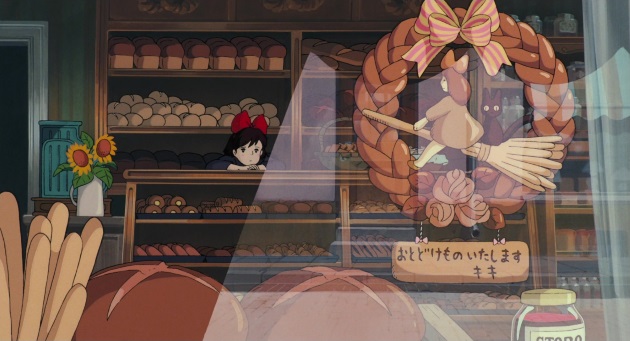
From Up On Poppy Hill [コクリコ坂から/Kokuriko-zaka Kara] (2011)

Close Knit Family

***This Review Contains Spoilers***

Opening a film in which the protagonist is seen getting out of bed and going about their morning routine is one of the most cliché ways of beginning a story (i.e, every student film ever), but From Up On Poppy Hill is so utterly likeable that I don’t care. Set in Japan’s port city of Yokohama circa 1963, the romantic, seaside setting really amps the film’s likeability with the accompanying nostalgic soundtrack being a pure delight from the opening ragtime theme to the Nina Rota style compositions as well as the use of Kyu Sakamoto’s Ue o Muite Arukō (known in the US as Sukiyaki in which it charted at number 1 in 1963). With a script from Miyazaki Sr and directed by Miyazaki Jr, From Up On Poppy Hill is structured like a melodrama with its use of dramatic flashbacks and the common melodramatic trope of a maritime setting. At one point the picture even makes reference to its melodramatic state (“It’s like some cheap melodrama”).

Umi Matsuzaki is the eldest child in her family and has responsibility thrust upon her following her father’s death and her mother’s departure to study abroad resulting in her making everyone’s meals, keeping fiancés in check and raising maritime signal flags every morning. The selfless and humble nature of a character like this could easily come off as aggrandizing but rather the character of Umi does come off as somewhat inspirational with her ability to bring out the best in those around her, earning her the title of “Goddess of good luck”. Umi develops feelings for fellow student Shun Kazama, however, Shun ends up discovering as a result of post-war circumstances, that Umi is actually his sister (although this turns out not to be the case come the film’s end). The two are forced to continue as only friends although it’s evident they are trying to retrain their feelings for each other. This culminates in a scene by a bus stop in which Umi states “I’m in love with you Shun. Even if we’re related, even if you’re my brother, my feelings will never change” to which Shun responds “I feel the same about you”. There is historic precedence for this as From Up On Poppy Hill is set at the time following the war in which young couples in Japan couldn’t be too sure that they were not related in some way but it doesn’t change the fact that the scene is an absolutely jaw-dropping moment. The scene is played out to be romantic and perhaps the movie could have dealt with the subject matter in a different manner as opposed to upping the swoon factor over an incestuous relationship but I digress.
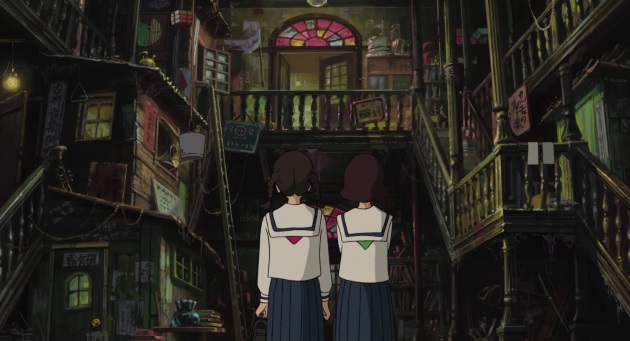
The other major plot point present in From Up On Poppy Hill regards the theme of traditionalism vs modernism as the students of the local high-school try to save their clubhouse known as The Latin Quarter which is set to be demolished and replaced with a new building ahead of the 1964 Tokyo Olympics. The Latin Quarter in its old state is a massive, creaky building with so much character contained within its walls in which every inch is in use – as a viewer I did become invested in its conservation. At a demolition meeting, Shun runs onto the stage like Elmer Gantry and declares “There’s no future for people who worship the future and forget the past”. Unintentionally prescient with this theme is that come the turn of the decade when From Up On Poppy Hill was released, the west had entirely done away with traditional animation on the big screen (bar a few pockets), whereas Japan has so far never let it go. Correspondingly, it is wholesome just how passionate these students are about learning (in particular the overly enthusiastic philosophy-loving giant) with The Latin Quarter having a club for just about every intellectual pursuit. Compare this to any American film set in a frat house where anarchy, mischief and mayhem are the name of the game. Alongside Umi and the responsibility thrust upon her, all these kids are more than ready for adulthood. I for one welcome our new oriental overlords.

Speaking of references to other pictures, in one of the film’s establishing shots, a single factory chimney is shown emitting Pink smoke whereas the others emit regular smoke. Anyone who has seen Akira Kurosawa’s High and Low will understand this possible reference, keeping in mind the Kurosawa picture is also set in Yokohama and was released in 1963 (so I can assume both these movies unofficially take place in the same universe). Likewise, when Umi sees her mother’s red slippers as an indication that she has returned home after months away, is this a nod to The Wizard Of Oz and its famous line “There’s no place like home”?

If there is one great standout supporting character in From Up On Poppy Hill has to be the high school’s chairman Chief Director Tokumaru, a total chad with his rough, gravely voice, larger-than-life figure, flawless posture and upbeat personality. He is not at all a typical, slimy bureaucrat and understands the kids on their level and is sympathetic to their cause. When the kids go to visit his office in Tokyo, he asks Umi in the past tense “what did your father do?”. There is no indication that he knew the kids beforehand and seems to instinctively know her father was dead. Having a figure like this in a position of power probably explains how the students were able to infiltrate the Ikiru level bureaucracy to save The Latin Quarter.  

Whisper Of The Heart [耳をすませば/Mimi o Sumaseba] (1995)

I Don’t Think There’s Any Artist Of Any Value Who Doesn’t Doubt What They Are Doing

***This Review Contains Spoilers***

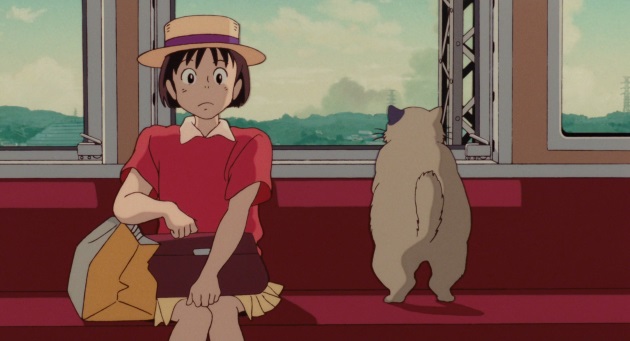
Whisper Of The Heart is Studio Ghibli’s love letter to creatives and a picture which contains great insight into the uncertainty derived from growing up and the role of education in this nostalgic coming-of-age tale. Fourteen-year-old Shizuku Tsukishima is the cheerful and infectiously optimistic protagonist of the story. She manages to find the joy in the mundanity of everyday life from something as simple as the sun coming out to seeing a positive message on the side of a blimp. Just observe the pure joy she gets from finding a quirky antiques store in a suburb (perhaps a bit too much as she nearly gets hit by a car while running across the road and never realizes it). The eccentricity of Japan is even on subtle display from the fact that a pork pie hat can be worn in common parlance and a girl can pursue a chonky cat for quite some distance just for the fun of it. It’s this aspect of Whisper Of The Heart which really makes you want to cherish life’s little moments.

Whisper Of The Heart is set over the course of 1994 (as indicated by Shizuku’s calendar), with a number of subtle indications for the passing of time throughout the film. The most noticeable of these being the seasonal variation of Shizuku’s school uniform with a white top for spring/summer and a navy-blue alternative for fall/winter. The initial catalyst of the story is set into motion when Shizuku’s father informs her that the local library is going through a transition from the old-fashioned book card system to a barcode system, much to her disappointment (I can recall my local library still using book cards in the early 2010’s). Goddammit modernity, sometimes the old ways are just better! It’s this tradition which ignites the film’s romance as Shizuku notices someone by the name of Seiji Amasawa has been taking out all the same books as her in this variation on The Shop Around The Corner formula re-imagined for the 1990’s. Shizuku and Seiji themselves aren’t too dissimilar to Jimmy Stewart and Margaret Sullavan in Ernst Lubitsch’s 1940 romantic comedy with Seiji’s initially jerky behaviour and Shizuku’s bookworm personality (unfortunately, when I was off this age any expression of a desire to read was social suicide – sad but true). 

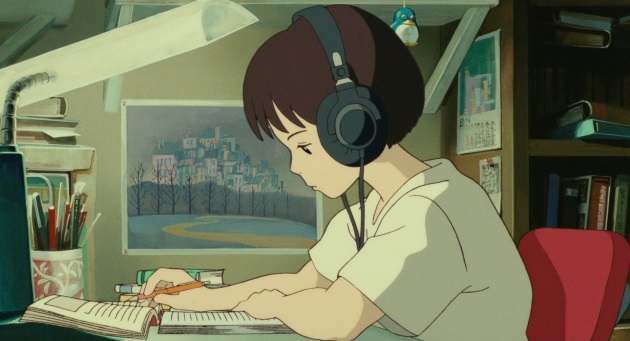
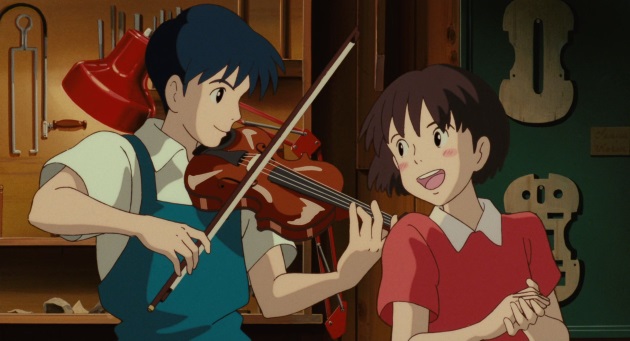
As is a common recurrence in Studio Ghibli’s films, Whisper Of The Heart is the story of a young, teenage girl forced into a position of maturity (it does make sense that the female sex tends to be the focus of these stories as research has shown that girls on average mature faster than boys). One major interlocked aspect of Whisper Of The Heart is the classic conflict of education vs. hands-on/real-world experience. Shizuku is attending middle school (aka junior high school) and is studying for her high-school entrance exams. Her love interest Seiji on-the-other-hand opts to attend a trade school in Cremona, Italy to further learn the craft of making violins rather than attend high school, much against his parent’s wishes (high school is not compulsory in Japan). This disapproval highlights the lack of respect one can entail for a practical hands-on profession over a more middle-class, so-called “real job”. Part of Shizuku’s impetus to embark on her writing of a novel comes from the insecurity that Seiji is far more developed in his own art form. Her focus on writing begins to affect her school grades, feeling that her need to write a first draft of her novel within two months before Seiji returns from Italy is more important than her school grades. Unlike Seiji, Shizuku doesn’t know what she wants to do with her future. She asks her older sister Shiho when she decided on her future, to which she responds with the dubious answer, “I’m at university finding that out”. This quote is particularly prevalent from a UK-centric point-of-view, when official figures state in the year 2017/18, 50.2 per cent of English 17-30-year-olds had participated in higher education, 20 years after the New Labour government set the target of having 50% of young people attend university (with these degrees often being of a useless nature and provide no stepping stone to a future career). From a personal point of view, I didn’t know what I wanted to do with the rest of my life when I was 14 and it’s self-evident very few people of that age either have any idea. Seiji’s oddball choice of profession as a violin maker is an appropriate one at the end of the day as his character is an outlier of a person in their teens who has a definitive idea of what they want to do with their life. The film doesn’t take a position on the question on the role of higher education but does raise many a thought-provoking point as to its effectiveness. Come the film’s end, Shizuku returns to studying for her entrance exams. I can however relate to Shizuku’s unwillingness and nervous disposition to tell the rest of her family about her writing project even though they are aware something is occupying her time, to which her understanding parents sympathize and don’t question her on it any further.

Seiji’s grandfather and owner of the antiques store Shiro explains how artists or writers develop and grow in their talents with a simple metaphor – “The rough stone is inside you. You have to find it and then polish it”. Shizuku holds intense self-doubt about her work, disagreeing with anyone when they praise her work. This intensely self-critical manner and strive for perfection overtakes her and leads to overpowering anxiety when she shows Shiro the first draft of her novel. To quote filmmaker Francis Ford Coppola, “I don’t think there’s any artist of any value who doesn’t doubt what they are doing.” – It’s this which really drives at the heart of Whisper Of The Heart. The picture showcases the highs and the lows that can be endured by creatives and parallels between the feeling of falling in love and the thrill that comes with creative pursuits. That scene in which a band has an impromptu performance of Country Roads as Shizuku sings her little heart out and gradually falls for Seiji (still unaware he is the boy on her book cards) combines these elements in a wonderfully corny scene. Whisper Of The Heart does hold parallels to fellow Ghibli film Kiki’s Delivery Service with protagonists succumbing to stress, burnout and depression (also is Shizuku’s older sister a recycled character model of Ursula?). Whisper Of The Heart is after all set in a country in which death by overwork is so tragically common that it even has a name – Karoshi (“You doctor yet? No Dad I’m 12. Talk to me when you doctor!”). The ultimate irony of this is that the Whisper Of The Heart’s director Yoshifumi Kondo would pass away 3 years following the film’s release from an aneurysm brought on by overwork. Whisper Of The Heart would be his only directorial feature, with Kondo joining the likes of Charles Laughton or Walter Murch as directors who have helmed only a single film, but what a film it would be.

My first viewing of Whisper Of The Heart was somewhat marred by the film’s misleading (albeit still beautiful) poster, giving me the false assumption that Whisper Of The Heart was going to be a fantasy film in the vein of a picture like Labyrinth. This lead me to wonder when this non-existent fantasy element was going to kick in during the film’s first third, only to then realize it wasn’t that kind of film. The fantasy sequence inside Shizuku’s head which inspired the poster in which Shizuku and an anthropomorphic cat known as The Baron fly Superman ’78 style is a beautiful combination of fantasy and reality as those giant pillars (which do remind me of the backgrounds in Super Mario World) raise high into the sky above the suburbs of Shizuku’s world of West Tokyo. It’s easy to sound like a broken record when talking about the aesthetics of Studio Ghibli’s films, but god, this film is just so beautiful to look at it puts a smile on my face from the eye-popping colour of suburban Tokyo to those urban night-time landscapes. Even the film’s more mundane subjects such as the apartment block in which the Tsukishima family resides would be ugly in real life but has a certain beauty to it in the animated form. Correspondingly, the music score by Yuji Nomi is one of great variety from the whimsical nature of A Hilly Town to the Aussie outback vibe from The Cat Chases and even medieval-themed compositions with the track Engelszimmer. These pieces of orchestrated beauty make for a welcome contrast with the film’s urban setting however the film does also provide some more in-tune accompaniments to the Tokyo landscape with its use of electronic sounds and synthesizers as heard in Taking The Train and Starry Night Sky. Furthermore, I can’t help but notice similarities between the track A Hilly Town and the piece In The Evening Midst from the oddball, Japanese horror movie House, while these two aforementioned pieces of music surely must have influenced Michael Giacchino’s piece Married Life from Pixar’s Up (is it just me or do these three pieces of music work extremely well when listened to in tandem?). Whisper Of The Heart is also a rare instance of Ghibli film to feature licensed music with its recurring use of variations with John Denver’s Country Roads, including a real humdinger of a cover during the film’s end credits in which it is given the city-pop treatment. Correspondingly, like many a Japanese film, the always reliable sound of cicadas increases the atmosphere of anything tenfold.

Whisper Of The Heart concludes with a very sudden marriage proposal from Seiji to Shizuku. In the original manga from which the film is adapted, Seiji only says “I love you” but the film’s screenwriter Hayao Miyazaki changed the line to “I can’t say how soon it’ll be, but would you marry me?“. To quote the big man himself in defending this position – “I wanted to make a conclusion, a definite sense of ending. Too many young people now are afraid of commitment, and stay on moratorium forever. I wanted these two to just commit to something, not just ‘well, we’ll see what will happen”. Putting aside the oddity of receiving and accepting a marriage proposal when neither are of legal marrying age, I do agree this sense of commitment coming from these characters gives the film’s conclusion greater emotional weight (although I will say the film ends very abruptly and could have done with a few seconds to let the viewer take it all in). The Japanese and English dubs have different lines of dialogue in this final scene. In the Japanese version, Seiji makes the aforementioned proposal to which Shizuku nods and Seiji asks if she’s sure to which she replies “That’s exactly what I wanted.” However, in the English dub, their discussion of marriage is more tenuous. Seiji asks, “Could you see us getting married someday?” to which Shizuku nods and they agree that his question was corny. It feels like those responsible for the picture’s English dub had a lack of faith in the source material and outright disrespected it with said changes. Regardless, I am a sucker for a good story of hopeless romantics and this impulsive love present in the original Japanese version of Whisper Of The Heart defiantly delivers on the desired level of swooning.

Kiki’s Delivery Service [魔女の宅急便/Majo no Takkyūbin] (1989)

Someone Left The Cake Out In The Rain

***This Review Contains Spoilers***

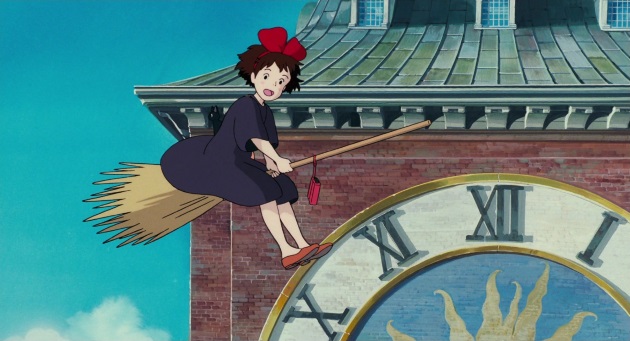
For a country which reportedly has one of the world’s highest stress rates (and perhaps as a result), Japan has produced some of the screen’s most tranquil and relaxing viewing experiences, whether it’s the works of Yasujirō Ozu or Studio Ghibli. Kiki’s Delivery Service tells the story of a trainee witch travelling to a city and using her flying skills to start her own delivery service. Set in the fictional city of Koriko (or Corico as some sources spell it), an urban dwelling inspired by Stockholm and the small Swedish town of Visby which is given no real-world area however the geographical layout of the city within the film feels incredibly well defined (bring on the Kiki’s Delivery Service open-world video game). Director Hayao Miyazaki is quoted as having said “Kokiro has one side on the shores of the Mediterranean, and the other on the Baltic Sea [laughs]”. Correspondingly, Miyazaki states Kiki’s Delivery Service takes place in an alternative 1950s Europe in which both world wars never happened and this rejection of modernity is a constant theme throughout Studio Ghibli’s output. It’s easy to lose yourself in the world within Kiki’s Delivery Service with its classical European architecture, cobblestone streets and houses equipped with traditional ovens. During the film’s opening, Kiki wants to leave her tiny village in the countryside for the city, yet to the viewer, this place is heaven on Earth with its green fields, bright blue skies and cosy cottages. The accompanying music score by Joe Hisaishi features many moments of joyful bliss with a mix of classical European, vaudevillian and ragtime music. On A Clear Day radiates that feeling of a sunny day while the piece which plays as Kiki arrives in her newfound hometown titled A Town With An Ocean View is dark yet optimistic. My favourite piece is that played over the unveiling of painting featuring Kiki titled An Unusual Paining in which the dreamlike, new-age mystic piece leaves one with a sense of wonder.

Kiki’s Delivery Service is one of the best films about entrepreneurialism and the entrepreneurial spirit. The world of Kiki’s Delivery Service appears to be a libertarian paradise, a world which appears to be devoid of any business regulation (“Oi mate, you got a loicense to deliver that cake?”) in which children are driving cars, flying permits are not required for amateur aircraft, a minor can own a business, there is no mention of child labour laws nor any mention of Kiki continuing or ever having attended a school and a place in which you can invent flying machines without any apparent regulations – what Ayn Rand would describe as “full, pure, uncontrolled laissez-faire capitalism”. This lack of regulation or government oversight extends to the fact that Kiki leaves her home to be independent while still a minor at the age of 13. Her mother does mention “nobody leaves home that young anymore”, but aside from this, no concern is raised for a 13-year-old going off to live by herself nor any form of social services is present to get involved. Is this form of libertarianism and capitalism presented here ultimately a fantasy that would not work in real life with the presence of predatory big business (or am I over-analyzing a film for subtext that’s not there)? Miyazaki once stated about capitalism: “During the time I was trying to conclude Nausicaä , I did what some might think is a turnabout. I totally forsook Marxism. I decided it was wrong, that historical materialism is also wrong, and that I shouldn’t see things with it.” Only a few years following the release of Nausicaä of the Valley of the Wind, Miyazaki would craft fictional benevolent capitalists like the ever so loving and joyful Osono, the owner of the bakery Gütiokipänjä and a compassionate, benevolent landlady who showcases the human side of business (likewise, there’s something comic about the mere presence of Osono’s unnamed husband, the tall, buff, stoic figure who utters little more than a grunt). Kiki’s Delivery Service is a film which conveys the value of money as Kiki has to carefully budget what money she has after arriving in town, forcing herself to live off pancakes and work for her money while other kids her age spend their time procrastinating and driving cars. It’s moments like her visit to the grocery store and her sticker shock over the price of items which really makes the film so down to Earth.

The overall sweet, wholesome nature of Kiki’s Delivery Service makes my inner valley girl wants to proclaim, “like omg, cutest movie ever!!”. Everything about the titular heroine is unbearably cute from her facial expressions to her over the top reactions to even the slightest bit of good news and her occasional hyperactive nature. Kiki is seen as modern by the standards of her village yet old fashioned by the standards of the city. She struggles to fit in with the city’s children yet is able to engage with two elderly ladies thanks in part to her knowledge of how devices such as how a wood-burning oven works. Kiki is repulsed by how rude the children in the city act from the overly-inquisitive girl hunter Tombo to the ungrateful girl who receives the herring pie from her grandmother. This theme of maturity extends to the relationship Kiki shares with her cat Jiji. After she loses her powers which include the ability to speak to Jiji, it remains the one power she does not regain at the film’s conclusion. I do find it somewhat heartbreaking that Kiki never regains this ability but then again, speaking to a cat as if they’re human is in itself a rather childish thing to do and thus a sign of Kiki’s newfound maturity as she gets older. It does raise the question if Jiji could actually speak to Kiki in the first place or was it just in her mind? Yet in the English dub, Kiki restores her ability to speak to Jiji at the end, regardless Phil Hartman’s sarcastic Jiji makes the English dub worth watching.

So by all accounts, Kiki’s Delivery Service sounds like the most based, conservative, red-pilled, right-wing movie ever made espousing the values of tradition, power of the individual and the pick yourself up from the bootstraps mentality? Well not quite. Kiki is after all practising pagan witchcraft rather than being a good God-fearing Christian. Although in all seriousness, God is actually mentioned in both the dubbed version and the English subtitles of the original Japanese version in which Ursula states – “The spirit of witches. The spirit of artists. The Spirit of bakers! I suppose it must be a power given by God. Sometimes you suffer for it”. Although this is not the line in the original script and is a creation of the English subtitles the film still contains the ever slight reference to religion with Kiki flying past a Christian church in the opening credits. It’s not difficult to buy into the fantasy premise in which witches with supernatural abilities openly co-exist in society, and can even marry non-witches such as Kiki’s father (are her powers genetically passed down from her mother?). However these are not witches in the traditional sense, there are no devils, pentagrams or virgin sacrifices present in the film (Kiki’s mother is introduced creating a potion using modern science equipment). There does appear to be one dark side presented about these witches in which Jiji remarks “Crows used to be witches’ servants” to which Kiki angrily responds “That was a long time go, okay?” – make of that what you will. Also, while it is odd to bring up, I am forced to mention as it does come off as peculiar for the western viewer is the inclusion of many up-skirt shots throughout the film. It’s not sexual but no doubt will cause some monocles to fall into champagne glasses. That said, Miyazaki actually has a reasoning for this. On page 138 in The Art Of Kiki’s Delivery Service, he is quoted saying “It’s a rite of passage for her to fly over the city with her underwear exposed” – make of that what you will.

Despite lacking a villain within the story, Kiki’s Delivery Service does manage to set up a finale with an action set piece and one which utilizes Miyazaki’s love of aviation. Likewise, I do enjoy how Studio Ghibli’s films make the end credits a part of the movie-watching experience, something I wish more films would do general (Kiki’s continued use of a bassline broom after the destruction of her traditional witches’ broom is a nice touch). The aforementioned subplot of Kiki losing her powers immediately reminded me of the similar subplots in Superman II and Spider-Man 2. In all three films, the loss of powers comes from stress, burnout, the descent into depression and the inability to lead a normal life (granted Superman choose to give his powers up voluntarily but the comparison still holds). Kiki’s Delivery Service can be read as an allegory for modern young creatives trying to make it on their own with Kiki’s magic being used as a metaphor for artistic expression whether it’s attempting to become a YouTuber or trying to run a successful movie review blog (wink, wink) and attempting to accompany this into a work-life balance. The other character who reflects the passion for a creative to turn their passion into a job is the painter Ursula. She speaks of how her pursuit of painting is what gets rid of her frustrations and her remedy for the loss of creativity involves “Take[ing] long walks, look at the scenery, doze off at noon. Don’t do a single thing” – and yes, on a personal level this I can relate to. Kiki’s Delivery Service is as fine a tribute to the creative and entrepreneurial spirit and regardless of your passion, “Sometimes you suffer for it”.