![Spring, Summer, Fall, Winter… and Spring [봄 여름 가을 겨울 그리고 봄/Bom yeoreum gaeul gyeoul geurigo bom] (2003)](https://satinyourlap.com/wp-content/uploads/2026/07/ssfws.jpg?w=300)
Remove The Stone Of Shame… Attach The Stone Of Triumph!
***This Review Contains Spoilers***
It is a cliché to describe a film as poetic, but Spring, Summer, Fall, Winter…and Spring is one instance in which I will do just that, as it is one of the most metaphorically and symbolically dense films I’ve ever seen. Although the picture is deeply rooted in Buddhist theology, the themes of the film transcend this into the realm of shared human experiences with concepts basic enough for anyone to understand. The most prominent of these (being baked right into its structure) is the cycle of life, which, as the title suggests, sees the movie tell its story over 5 vignettes, each taking place years apart and during one of the seasons of the year, before coming full circle once again. Likewise, the film is grounded in symbolising the significance of the number 4, from the aforementioned four seasons to the prominence of the four elements (earth, air, fire and water) to the most theologically significant for this picture, the Four Noble Truths in Buddhism. Although director Kim Ki-duk himself was a Christian, Spring, Summer, Fall, Winter…and Spring does feel like Everything You Always Wanted To Know About Buddhist Theology, *But Were Afraid To Ask.
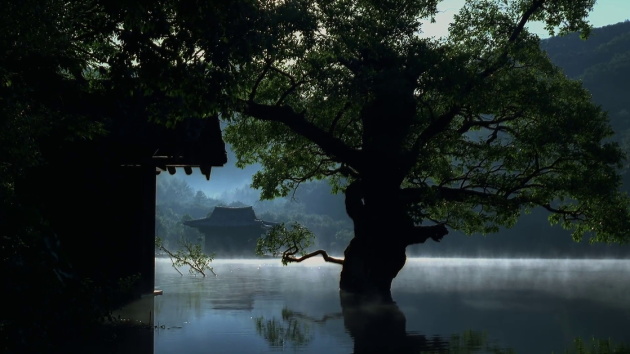
Spring, Summer… takes place on a floating Buddhist hermitage on a lake surrounded by forests and mountains, in which an old unnamed monk (Oh Yeong-su) and his child apprentice (Jong-ho Kim) live out their days. The location itself is the Jusanji Pond in Cheongsong County, North Gyeongsang Province in South Korea, an artificial lake, although one with a mystical aura (reportedly, the film’s production company had to convince the South Korean Ministry of Environment through six months of negotiations to film at the location). Spring, Summer… begins as a pair of wooden doors on the lake open (acting like a pair of stage curtains), revealing this near-mythical world with its thick morning mist and striking reflections in the water (similar to the setting Ki-duk had previously explored in his film The Isle). Many of the film’s panoramic views of the lake are genuinely breathtaking, from the deep, intense reds and oranges of fall to the snow- and ice-covered landscapes of winter.
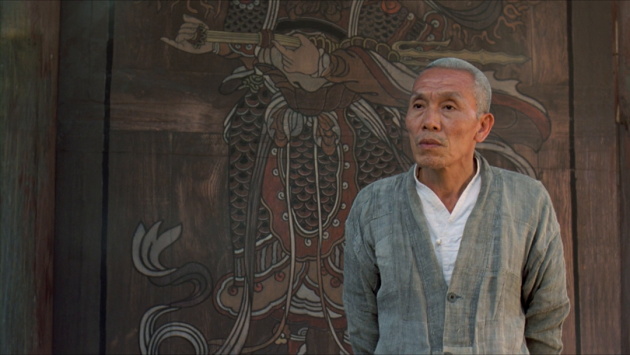
If media has taught me anything, it’s that if I travel into the wilderness of a far eastern land, I will meet a wise old man who will bestow me knowledge and wisdom far beyond my current puny understanding (the older monk in Spring, Summer… does have his share of Master Yoda-like lines; “Lust awakens the desire to possess. And that awakens the intent to murder”). During the first of the film’s vignettes, that taking place during spring, the older Monk delivers his first lesson. The child monk in his spare time finds pleasure in tying small animals to rocks and laughing so innocently at their pain (which itself is unsettling to watch). The older monk observes his actions and thus ties a large rock onto the boy’s back while he is sleeping, so that he may now carry a literal burden of guilt on his back. The older monk tells him he will only remove the rock once he has removed the rocks from the animals he tied up.
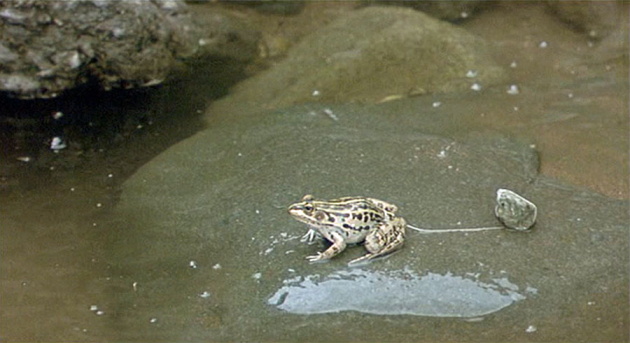
Kim Ki-duk’s films are controversial for their on-screen depictions of animal cruelty. In Spring, Summer…, the torture of a frog, fish and snake is captured on screen. While I’m not going to pretend I’m bothered by this on a personal level, I will offer some mild criticism, as there is some clear hypocrisy on the part of the older monk (and the director too), as later in the film, the older monk performs calligraphy with a cat’s tail, to which the cat itself is clearly in pain. This is one aspect which I do find uncomfortable to watch, but there is also the fact that it comes after the older monk was criticising the boy for tying up the animals. Regardless, this doesn’t undo the power of the penance, as during the later winter vignette, the younger monk (now a man) chooses to undergo the same punishment.
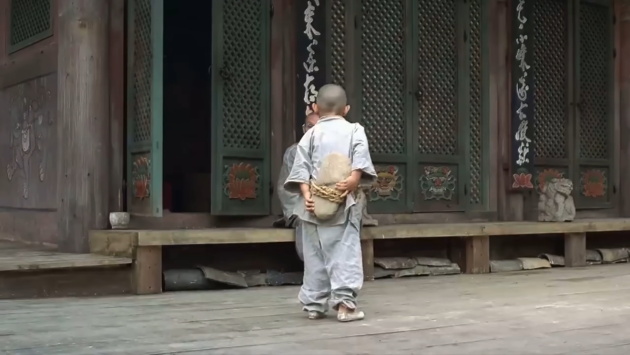
Concurrently, when the child monk takes the boat by himself across the lake to abuse the animals, the older monk later appears behind him on land to observe his behaviour. How did the older monk make his way to land, completely dry, when they only have one boat? The movie gives a potential answer to this, as during the fall vignette, when the younger monk, now an adult man, is being taken away by the authorities, the rowboat will not move at first despite the police officer attempting to row. It appears the older monk may have a supernatural pull on the boat, which may also offer an explanation as to who is opening the gates at the beginning of each vignette (with the exception of the fall vignette opening, in which it transitions to reveal the older monk is the one opening the gate). Spring, Summer… is an example of a film in which its lack of explanation enhances the dreamlike nature. Why is a young boy being raised by an older monk on a floating hermitage in the middle of nowhere? One possible explanation, which is supported by the film’s latter portion, is based on reported real-life cases of babies in the past being abandoned at churches and monasteries; however, the film doesn’t feel incomplete without these answers. Even the film’s place in time is left ambiguous, with the dress of the outsiders who visit the hermitage being only one of the few indications that the film takes place throughout the late 20th/early 21st century.
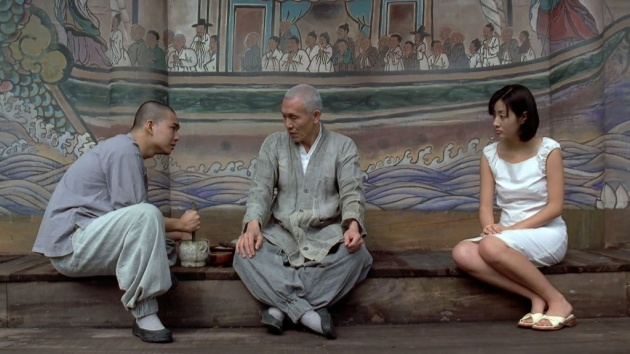
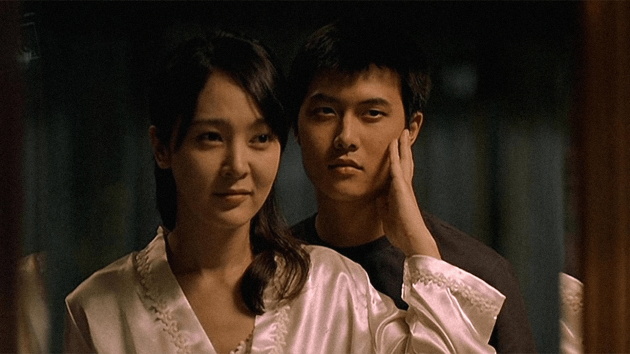
During the summer vignette, with the younger monk now a teenager, an unnamed young girl (Yeo-jin Ha) arrives at the hermitage to be cured of her illness. What is the illness? This is never explained. Only some vague comments, such as the girl’s mother (Kim Jeong-yeong) commenting to the boy, “You look so very healthy” and “This tree is over 300 years old. You will grow as healthy as this tree.” Assuming this is the younger monk’s first interaction with the opposite sex and that he would otherwise be living a life of celibacy, he develops a primal yet innocent interest in her, touching her body and not understanding boundaries. Primal is the key word here, as the relationship they develop is not a romantic one, but one of pure lust, in which the two eventually do make love. It is this portion of the film which brings to mind the Lady Eve in The Garden of Eden, as the girl’s presence upsets the natural order of things at the lake. For example, inside the hermitage, there is a door leading into a bedroom with no walls attached. My initial reaction was to find this comical, as it is a well-established visual gag in Western animation to feature a freestanding doorframe with no walls attached, yet characters still obey the “rules” of the doorway (another aspect which enhances the dreamlike nature of the film). However, with the presence of the girl, the younger monk comes to disregard the wall-less doorway; an abandonment of the restrictions governing his life.
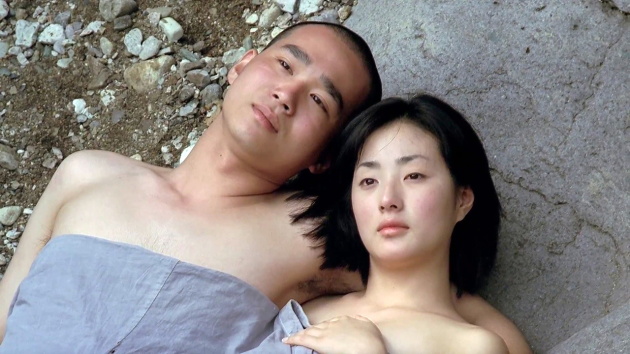
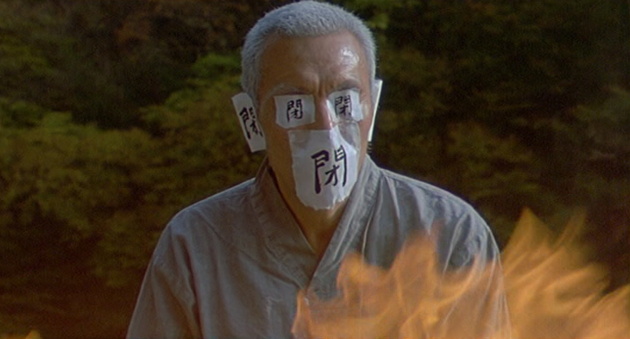
Once the older monk finds the couple in the aftermath of another love-making session, he determines that the girl has been cured. He declares, “Then it was the right medicine”, although it’s not clear exactly what he is referring to. The younger monk, however, has been infected by modernity, as he leaves the hermitage to go and live a regular life, only to return in the fall vignette. The boy, now a devastated and unkempt man, returns to the lake on the run from the authorities after murdering his wife for adultery (it is not made clear, however, if the woman he murdered was the ill girl from summer). As penance for his crimes, the older monk has the man carve and then paint an extensive array of Chinese characters on wood. This does lead to one of the film’s more oddly endearing moments, in which the two plainclothes police officers sent to the hermitage to arrest the man (who had been disrespecting the sanctity of the site with their littering and gun target practice) end up joining in the calligraphy and take a genuine interest in it. Once the man has finally been taken away by the officers, the older monk chooses to end it all and commits self-immolation, as his eyes, ears and mouth are covered by the Chinese character for shut or close (閉). Why does he do it? It’s up to you, my dear friend, the viewer, to make your own interpretation. Regardless, the powerful and harrowing imagery is apt to showcase the closing of the reproductive cycle that autumn represents.
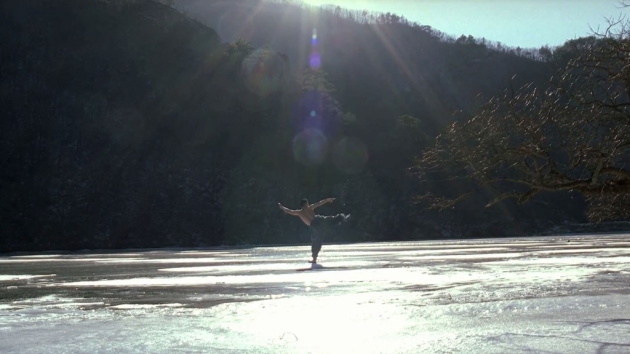
In the winter vignette, the man, now older, returns to the abandoned and run-down hermitage to revitalise it. For the remainder of the film, the man is played by director Kim Ki-duk himself. According to the audio commentary on the Umbrella Blu-ray release, Ki-duk’s self-casting was a last-minute replacement, yet he performs the role remarkably well, especially with the physicality he displays. Many of his scenes involve him shirtless in sub-zero temperatures as he performs penance by once again carrying a giant rock on his back and performing a Korean Buddhist martial art known as Sunmudo (complete with some impressive mid-air kicks).
During the winter rebuilding of the hermitage, a woman arrives with a baby to abandon, with such shame that she keeps her face covered (only for herself to fall into a hole in the ice). The man, now the new elder monk, must raise the child like his predecessor raised him. Much of the action present within Spring, Summer… may lead many viewers to find it a very cynical film on the human condition. Delight in torturing other living things, corruption of that which was pure, murder, disrespect for the sacred, abandonment of responsibility. During the film’s final vignette, …and Spring, the new young monk (played by the same young actor as the first young monk) is once again finding joy in torturing animals, this time by putting rocks in the mouth of a fish and a frog. That said, the film in no way leaves me feeling cynical. To come full circle myself to the Four Truths of Buddhism:
Spring (Childhood and Ignorance)
Summer (Adolescence and Desire)
Fall (Adulthood and Anguish)
Winter (Maturity and the Path)
…and Spring (Rebirth)
I’m by no means a theologian (“mention something out of a Charlton Heston movie and suddenly everybody is a theology scholar”), and while Spring, Summer, Fall, Winter…and Spring in many ways shows the cynical and destructive side of humanity, its spiritual structure shows that existence remains beautiful despite this. It is a cliché to describe a film as poetic, but Spring, Summer, Fall, Winter…and Spring is one instance in which I will do just that, as it is one of the most metaphorically and symbolically dense films I’ve ever seen…
![3-Iron [빈집/Binjip] (2004)](https://satinyourlap.com/wp-content/uploads/2026/06/mv5bmtm1odiwnzm5ov5bml5banbnxkftztcwnjk5mdkymq4040._v1_fmjpg_ux1000_.jpg?w=300)