
![3-Iron [빈집/Binjip] (2004)](https://satinyourlap.com/wp-content/uploads/2026/06/mv5bmtm1odiwnzm5ov5bml5banbnxkftztcwnjk5mdkymq4040._v1_fmjpg_ux1000_.jpg?w=300)
A Little Less Conversation…
***This Review Contains Spoilers***
Is it harder to construct a film with little or no dialogue compared to the average parlance-filled production? While the general rule of filmmaking is “show, don’t tell”, dialogue is still an important tool for revealing character motivations, relationships, plot information, themes, emotional states, etc. Since the majority of movies in existence (barring silent pictures) are comprised of characters speaking to each other, to watch a movie with this tool stripped out, it really makes you consider all that goes into the art of storytelling through only visual means. 3-Iron (Binjip) is one of several productions in which (the late) director Kim Ki-duk excels at this very feat.

Not a single word is spoken by the two leads in 3-Iron (almost), yet the film still creates compelling characters through only visual means. The film’s initially unnamed young protagonist (Jae Hee) (later revealed to be called Tae-Suk) is a drifter who enters and lives in people’s homes while they are on vacation. However, he is likely not a poor man. He is a well-groomed, pretty boy with an expensive motorcycle and a passion for golf (hence 3-Iron), suggesting that perhaps wealth aids this dangerous and unethical hobby of his.

This pastime is aided by his technical know-how. He can identify when no one is home by placing restaurant flyers on the doors of homes, and when the flyer hasn’t been taken down after a period of time, he picks the door lock and makes his way in (as well as listening to the messages on the answering machines inside). From there, he treats the dwelling like his own home (watching TV, taking a bath, self-pleasuring himself in bed). Tae-suk, however, is not a thief (at least not in the traditional sense). He keeps the homes he has broken into clean, does the laundry, waters plants and even fixes broken electronics, thus helping create empathy from the viewer. This, however, doesn’t undo the ethical dimension of his actions. In much of the world, the protection of private property is held as sacrosanct and for good reason. To have someone break into your house feels incredibly violatory and people even end up moving house because of it. Why does Tae-suk partake in this hobby? Is he simply a thrill seeker and/or mentally unwell (especially since he remains mute) or a perverted voyeurist (his collection of selfies taken alongside family portraits would suggest so)?
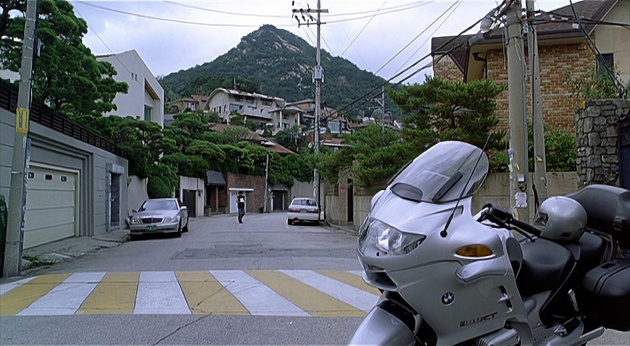
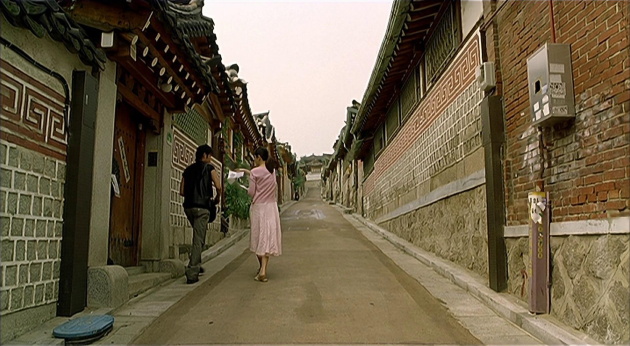
These sequences of Tae-suk scouting and then breaking into people’s homes feel very reminiscent of French filmmaker Jean-Pierre Melville. In particular, his seminal film Le Samouraï (1967), which, like 3-Iron, depicts lengthy dialogue-free sequences in which illegal activity is perpetrated in meticulous detail but with a sense of calm and harmony. From the quiet, empty scenes of the suburban streets of Seoul to the film’s wide showcase of Korean home design, 3-Iron has a sense of comforting domesticity. Likewise, the film even acts as a nostalgic representation of the pre-Internet of Things world with its array of early 2000’s tech. Although the most memorable filming location present in the film is Seoul’s famous Bukchon Hanok Village, a residential area comprised of picturesque traditional Korean houses known as Hanok. Having been there myself in 2025, I can say there is no way that the officials monitoring visitors would allow anyone to attach flyers to the doors nowadays (although I don’t know if that would have been the case either in 2004).
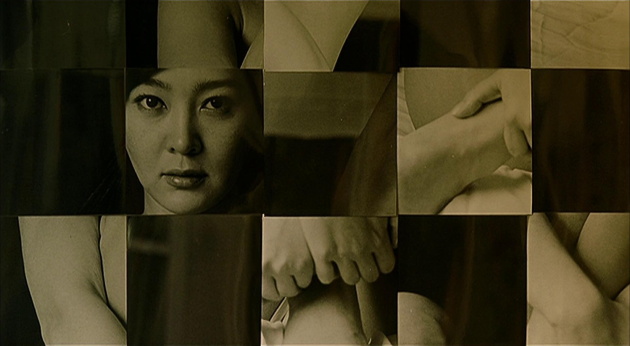
Tae-suk’s blurred world of fantasy vs reality comes to a head when he finds out he is not alone in the house of a wealthy businessman, when he meets his abused and black-eyed laden wife (Lee Seung-yun). Like Tae-suk, she is also mute but is able to portray a sense of torment through purely visual means. Not fearing Tae-suk, the two form a bond and leave the house together to escape her abusive marriage, all while, as a viewer, I ask myself if they will ever actually break their silence. The law, however, eventually catches up to the two delinquents, with Tae-suk thrown in prison and the wife returned to her abusive husband.
Depending on how you choose to interpret the final act of 3-Iron, Tae-suk may have died during his incarceration and became a literal ghost (as indicated later by his weight scale reading of “0”), or through the stealth manovers he learnt during this period (to avoid the regular beatings of a corrupt officer), has escaped from prison and has had a metaphorical transformation into a ghost. The following portion of the film plays out like a semi-horror film in which, through a series of voyeuristic point-of-view shots (even feeling quite Michael Myers-esque), he gets revenge on a corrupt police officer who wronged him, with the 3-Iron and some golf balls as his weapon of choice.
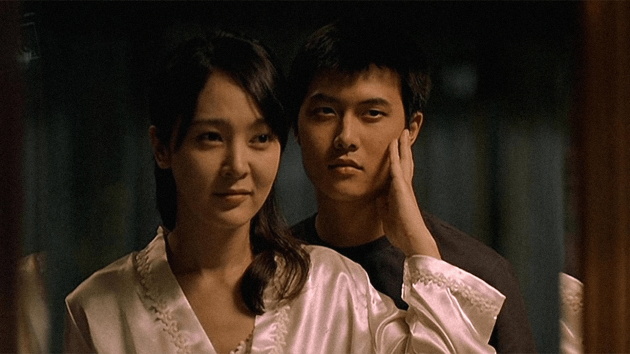
Tae-suk returns to the house of the abused woman, where the blurring of fantasy and reality reaches its zenith. Tae-suk remains in the house in view of the wife, while the husband is unaware of his presence. The woman smiles for the first time and utters her only line in the movie, “I love you”. The husband thinks the line is directed at him, but it’s actually to Tae-suk standing behind him. All three characters are now living a lie, yet for perhaps the first time in the film, all three appear content. “It’s hard to tell the world we live in is either a reality or a dream”.

