A Woman’s Face (1941)

Two-Faced Woman

A Woman’s Face is a trashy, pseudo-horror movie like film but one presented as an A-picture melodrama. I’ve watched A Woman’s Face five times as of writing this review and gets better every time I watch it. Within the last year, I’ve felt the motivation to watch the film three times, something which is almost unheard of for me; this movie is that good. I’ve now decided, screw it, this is my favourite Joan Crawford film and considering there’s tough competition from Whatever Happened to Baby Jane?, Mildred Pierce and The Women, that’s saying a lot.

Every major cast member in A Woman’s Face is superb. I know that sounds like a generalization but it’s true. Firstly there’s Conrad Veidt as Torsten Barring. I adore every second this man is on screen; he’s just so delightfully sinister but in the most absorbingly charming manner – I’m swept off my feet by his presence. I can completely buy into the romance he shares with Anna Holm (Crawford) because he looks past her facial disfigurement and is unbothered by it. Melvyn Douglas is the other great charmer of the cast, whom I’ve yet to see paired with an actress who he didn’t share great chemistry. Ossa Massen, Reginald Owen, Albert Bassermann, Marjorie Main (unrecognisable here) and Donald Meek are also all equally memorable and stand in the strong characterisations of their roles. Likewise on re-watching look out for the moments of foreshadowing (“You love children? I loathe them”).

Then there’s Crawford herself in a once in a lifetime role as a facially disfigured woman, a part few actresses would be prepared to play. Her character of Anna Holm only engages in deceitful acts because of society’s mistreatment of her since childhood but is otherwise good at heart. Anna tries to make the best for herself and doesn’t dwell into a victimhood complex (“I don’t care for pity ether”); she runs her own tavern, pursues different talents and less virtuously is involved in criminality. Regardless throughout the film my heart pours out for the poor woman and yet even with the disfigurement I still find Crawford to be incredibly beautiful in this film, nor does the disfigurement ever take away from the asset that is her stunning body. If anything the moment in which Anna returns from a shopping trip and is wearing a very excessive blouse to take attention away from her face is the one moment in the film in which her character comes off to me as pathetic sight.

A Woman’s Face is one of the few thrillers George Cukor directed with echoes of Hitchcock throughout, such as the shots of the smelter plant and a waterfall in the background (similar to the scenery in films such as Foreign Correspondent), to the film’s suspenseful scenes such as that atop the cable car. This sequence itself is absent of any music, simply allowing the sound of the nearby waterfall and the smelter plant increase the tension while the film’s climax, on the other hand, offers a sort of Ben-Hur on sleds finale. Since I consider this film far superior to Hitchcock’s thriller offering that year of Suspicion, Cukor out Hitchcocked Hitchcock. With Cukor being one of the great masters of his trade, the cinematography of A Woman’s Face is a feast for the eyes. Technically speaking, the scenes at the hospital and Anna’s subsequent unbandaging are my favourite part of the film. Along with A Woman’s Face and the 1934 medical drama Men In White, it makes me wonder if it’s just me or do medical interiors and apparatuses make for some of the best subjects to capture on film.

Being a remake of a Swedish film, there’s something somewhat unconventional about A Woman’s Face for a Hollywood film. The movie does manage to capture the essence of its Northern European setting (despite much of the cast supporting American accents) and offers a slice of Swedish culture with its dancing sequence.

I consider 1941 to be the greatest year in the history of cinema. The output of this single year is the jealous vain of entire decades and A Woman’s Face just adds to this. Melodrama seems to have a bad reputation for no good reason. Like many things, it can be done well and done poorly. A Woman’s Face represents the old Hollywood melodrama tailored to perfection.

White Heat (1949)

Get Up Stand Tall, Put Your Back Up Against the Wall

To date, White Heat remains the only instance in which my first encounter with an actor instantly turned me into a fan. Typically for me, I become a fan of a performer over a period of time and after seeing a number of their films. Not James Cagney though. The scene early during White Heat in which Cody Jarrett gets a headache and needs to be comforted by his mother, my instant reaction was, “I need to watch any movie with this guy I can get my hands on”. I have no hesitation putting Cagney’s performance as Cody Jarrett in my ten favourite movie performance of all time. At this point in my movie watching life I had never seen an actor so on fire, so electrifying. His twitchy mannerisms, machine gun way of speaking his violence against women and possibly above all, his mother complex, exposing an unsettling, adorable side. Like wow, you do not want to be stuck in an elevator with this guy. I would later discover White Heat came after the classic Warner Bros cycle of gangster movies, making White Heat a nostalgic revival of the genre, making Cody and his mother products of a different age. Margaret Wycherly as Ma Jarrett is the next great stand out performance for me, a character who appears as the stereotypical “aw shucks” mother common in classic Hollywood, but her attitude could not be more different.

Boy is this movie fast paced. White Heat is one of the few times my heart my beating so much out of how exciting the movie was. When the film was over I had the closest I could fell to that sense you get after coming off a rollercoaster, expect to get it from watching a movie. I feel that’s the best way, to sum up White Heat, a rollercoaster of violence and emotions. Even the scenes of police officers discussing Cody’s psychological tendencies and the examination of their late 1940’s tracking techniques are riveting, but they do save the best for last. The Warner gangster movies ended with incredible final scenes with brilliant closing lines, White Heat’s may be the best of them all. I question if I’ll ever experience such a high level of movie watching euphoria on a first time viewing again.

The Shop Around the Corner (1940)

The Other Jimmy Stewart Christmas Movie

The Shop Around the Corner was the first Ernst Lubitsch film I saw and as soon as the characters started interacting with each other I instantly knew this was a guy who knew how to handle dialogue in what is referred to as the so-called ‘Lubitsch Touch’. With such levels of subtly, this is the kind of movie that needs to be watched multiple times and gets better every time you do so. Often there will be a verbal joke in which I am unaware it even is a joke and it will take a few seconds to catch onto it. Most of Lubitsch’s films were set in Europe as this was where he was from. The shop of Shop Around the Corner is in Budapest, Hungary. The world this movie is set was on the brink of destruction in 1940 but there is no mention of this in the film. Just like how the film harkens back to a more peaceful time it also acts like a nostalgia portal to a time before the internet or big corporate businesses. A shop which is a physical, hands-on and above all a communal experience. The shop is a world onto its own populated by unforgettable characters.

Like Lubitsch, most of Margaret Sullavan’s movies also took place in Europe, I don’t know of the reason for this, however; a big coincidence or did she deliberately choose to star in movies with European settings? James Stewart and Margaret Sullavan aren’t remotely Hungarian but classic Hollywood movies aren’t exactly known for their realism in this regard. I also find it humorous how Klara is able to get a job by walking into a store and proving she is capable of selling items; if only it were that easy in real life!

The Shop Around the Corner is one of the prime examples of the classic “they hate each other but are really in love”; in fact, they really hate each other. Stewart’s Alfred Kralik is actually a real asshole; he’s brash and very opinionated. Likewise, Margaret Sullavan isn’t a sexy, glamorous Hollywood star; Klara Novak is a down to Earth, intellectual. As the movie progresses you so badly want these two characters to end up together to the point that it hurts. These aren’t two performers with great chemistry, these are two performers with incredible lifelike chemistry which blends the dividing line between fiction and reality. If ever there was an on-screen couple how where made for each other, this is it.

Rope (1948)

Is Murder an Art?

Rope is one of those rare movies which is totally engrossing within less than five minutes, no doubt in my top 5 films by the master himself. Hitchcock successfully recreates the theatrical experience for the big screen. The set of Rope looks a bit fake and washed out and even the colour cinematography has a washed out feel to it, this all being part of the charm of course. The actors strand in unnatural positions when talking, avoiding having their back facing the audience when speaking; unnatural for real life that is, normal for the warped reality of a stage play. Above all, the entire movie takes place in real time through a series of ten minute takes and all this happens while there is a dead body in the room.

The characters played by Farley Granger and John Doll, as well as their teacher (James Stewart), hold a Nazi-like ideology that murder is “an art a few superior beings should be allowed to practice”, rather than those such as say, people who are Harvard undergraduates. The character’s discussion on the justification for murder is chilling as they make it sound scarily convincing. Rope is based a true story from the 1920’s and adapted into a play in 1929 although it’s clear the movie is set during the period it was made due to the fashions and the mentioning of movie stars from the era. It does seem unlikely in the aftermath of the atrocities during the Second World War that people would be so openly discussing such fascist ideas which were more common in the United States during the 20’s and 30’s.

The movie is about homosexuality although I didn’t catch onto this. I’m not the best person when it comes to identifying gay characters unless they’re really gay (hey sisters!). I’ve heard criticism of Stewart being miscast in the role as he apparently doesn’t make a convincing gay character thus the homosexual love triangle from the play is not present in the film. Judging the film on its own merits however Rope is a major step in his evolution as an actor, away from his gawky roles he was known for up until this point. His breakdown at the end is one of the acting highlights of his career and gives me the chills watching it.

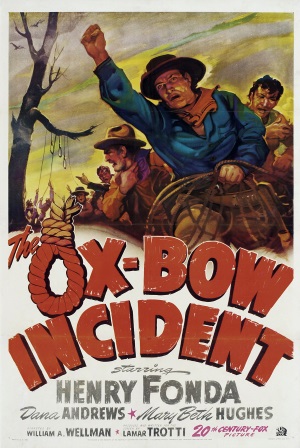
The Ox-Bow Incident (1943)

The Mob Doesn’t Think. It Has No Mind of Its Own. The great Spencer Tracy said in Fury!

***This Review Contains Spoilers***

When I think to myself what are the most pessimistic films, The Ox-Bow Incident is one of the first to come to mind. This is the type of film you never forget. Whenever I hear a story in the news related to mob mentality, I always think ‘The Ox-Bow Incident’! In the same way how any news story of political corruption or ineffectiveness makes me think Mr Smith Goes to Washington. The eerie music throughout the film sets the tone that something bad is going to happen.

This is the type of film that needs public exposure. It showcases how people can be pack animals who will rally behind something whether or not it’s true; demanding quick, speedy justice regardless of the consequences, with an ending which is a pessimistic punch to the gut, making you feel bad about humanity. The characters having no patience for the legal system and bend the law to fit their own agendas by allowing a deputy sheriff to deputise others. The result: three men are lynched on flimsily evidence that later turn out to be innocent. And if that wasn’t bad enough; the man they were accused of murdering is actually still alive. Remember just how easily false information can spread – do you hear that internet?

All the cast members of The Ox-Bow Incident have their moment in the sun, although it’s Dana Andrews is the one of who steals the show for me – just what you expect for a man threatened with lynching for a crime he is not proven to have committed. The hung bodies themselves don’t appear on screen as this would have been too graphic for the time. Only their shadows appear which is no less a powerful image.

Henry Fonda’s character is like the man in the painting in the saloon who is about to reach out for a woman – “In reach but can’t do anything about it”. Henry Fonda was not a producer on The Ox-Bow Incident but it’s likely had more of a role than just an actor. At the age of 14, Fonda’s father took him to witness the lynching of a young black man accused of rape – an event which had a profound impact on him, so it’s clear the material of The Ox-Bow Incident was of prime interest to him. Even in the film’s trailer he appears as himself talking about the book and film, and states “it’s not ethical for an actor to talk about a picture he’s in”. Yikes, times have changed!

Lynching was still prevalent in 1943 and the movie takes a jab at southerners with much of the posse being southern stereotypes. One of them even says at one point “Down in Texas where I come from we just get a man and string him up”, and even the unofficial leader of the posse Major Tetley wears a Confederate uniform.

The movie also packs a punch with its critique on machismo. The character of Major Tetley tries to make himself out to be more than he is while trying pathetically to be manly and tough. He tries to make a man out his effeminate and possibly gay adopted son (Tetley refers to him at one point as a “female boy”) by forcing him to be part of the lynching mob; needless to say things end in a tragic state. The son barely utters a word throughout the film until the end in which he gives a monologue to his father on what a depraved animal he is – such a release of anger. Likewise, Jane Darwell plays an annoying loud-mouthed old hag (ugh, that laugh) who is essentially one of the guys and believe you me: you just want to tape her mouth shut.

At only 75 minutes the film doesn’t screw around and gets straight to the point. The only disruption in the film’s pacing is a subplot regarding Henry Fonda’s character and his ex-girlfriend. I haven’t got any answers to how this is relevant to the rest of the plot. Westerns are not my favourite genre so to enjoy one they have to be incredibly well done or stand out of the crowd. In The Ox-Bow Incident, the western setting is merely a backdrop. The film has a low budget complete with obviously fake backdrops but it’s unlike anything else being made in Hollywood at the time. The film I found it held the most resemblance towards was Paths of Glory but preceding it by 14 years. The world wasn’t ready for The Ox-Bow Incident in 1943 – but is it still ready?

Mouse In Manhattan (1945)

These Little Town Blues…

Tom & Jerry were a defining part of my childhood. I could spend hours watching T&J shorts on Cartoon Network when I was younger and to be honest, this is my favourite; was then and still is now. As a kid, I would always get excited when this short came on TV.

Mouse in Manhattan is not a traditional Tom & Jerry short at all; there are no chases or the carnage you would usually associate with Tom & Jerry. It begins with Jerry leaving his life in the country in favor of the bright lights and Broadway of New York City. Tom only appears briefly at the beginning and at the end but Jerry leaves him a note showing that the two could be friends from time to time. The rest of the cartoon involves Jerry’s escapades in the Big Apple and plays out like a silent film with Jerry succumbing to the odd pratfall in the vein of Keaton or Chaplin; it’s all such fun to watch. Take the moment when Jerry is dancing and ice skating with the dolls on the table; could a piece of animation be more beautiful? During the short things go from really romantic to really dark quick but it all ends well. They still throw a black face joke in there with Jerry’s head being put into a container of shoe polish. I can tell you right not that these moments were left intact when showing these cartoons on the UK Cartoon Network and Boomerang when I was a child.

The locations Jerry visits in New York such as Grand Central Station appear very empty but who cares, just look at the beauty of it! Those painted backdrops have such scope to them. What really makes Mouse in Manhattan perfection, however, is the music. You might recognize it from the opening credits of My Man Godfrey but this rendition of” Manhattan Serenade” I feel is superior and I doubt could ever be topped. Tom and Jerry shorts always evoke nostalgia in me but Mouse in Manhattan just evokes that feeling to a far greater degree.

The Mortal Storm (1940)

I Did Nazi That Coming

I try to avoid calling movies underrated or saying “Why is this not more well known?!”, otherwise, I would sound like the most malfunctioning record but as to why The Mortal Storm is not more famous goes beyond just my own personal preferences. The fact that Hollywood’s then biggest studio Metro Goldwyn Mayer would release an anti-Nazi film at a time when the US and Germany were not involved in any conflict should be a bigger deal than it is. To give some historical context, although it seems hard to believe nowadays, fascist and other Nazi-like ideas were out in the open throughout the United States during the 20’s and 30’s (heck, just look at the film Gabriel Over the White House from 1933, also released by MGM, or the public initial backlash against films with pro-interventionist sentiments such as Sergeant York or To Be Or Not To Be). Prior to the US involvement in the war, there was even uncertainty as to whether or not the US should take part in the conflict in Europe.

The Mortal Storm being overlooked is criminal. It deserves the special edition DVD treatment with documentaries behind its production. I’m sure there must be an interesting story behind the making of this film. MGM has generally been seen as a studio who played it safe, thanks in part to its conservative studio head Louis B. Mayer. So it comes as a surprise The Mortal Storm would come from this studio and they paid the price. The Mortal Storm lead to MGM films being banned in Germany. The word Nazi is never used once throughout the film, while the characters I can only assume are Jews are referred to as Non- Aryan. I wonder if this was done to prevent further controversy surrounding the film but it’s still an incredibly brave picture.

The core story is about how Nazism tore German families and friends apart due to racial and political differences. The Roths (Jewish I assume) are a happy picture postcard family one day, the next there are completely torn apart. Things go bad for the family from the moment in which it’s announced Hitler has become chancellor of Germany as the adopted, non-Jewish sons of the Roth family begin saying disturbing yet enthusiastic comments (“If peasants want to keep their cows they better have the right politics”). Likewise, the patriarch of the Roth family and the professor of the town’s local university played by Frank Morgan is treated with the highest levels of respect one day and is awarded for his contributions to the fatherland. Not long after Hitler’s rise to power his students are boycotting his class after he states that science has shown there is no difference between the blood of various races.

The Mortal Storm is a work of propaganda, not that there’s anything wrong with that. Propaganda is an art form in itself, one which tries to get an emotional reaction out of the viewer in order to convert them to one side. The Mortal Storm achieves just that. The tension during the film just builds and builds, concluding in an ending which is one huge punch to the gut.

Watching the film again in order to write this review I surprised just how engaging it was on a further viewing. There are many little touches I never noticed previously, such as when Robert Young’s character announces his engagement to Margaret Sullavan, James Stewart is the only character the room who does react with joy. I do also have to ask how Stewart, a man who would become a World War II hero and later supporter of the Vietnam war must have felt playing a character who is a pacifist.

Majority of the film is shot on sets with the use of painted backgrounds and miniatures, yet the whole thing still looks fantastic and looks more idyllic than real-world locations could. You really get a sense for this small town in the Alps. The only complaint if any I can find with the film is that opening narration which is overly bombastic.

The casting of the previously paired Shop Around the Corner stars couldn’t be more perfect. James Stewart and Margaret Sullavan play two friends who are forced to become lovers due to the impending circumstances – I can’t recall any other movies which portray a love story like this. Sullavan often portrayed characters who represented bravery; her voice is so fragile yet powerful at the same time. The cast isn’t the only tie the film shares with The Shop Around the Corner; both films represent a European society which was on the brink of destruction. The Mortal Storm shows how even an enlightened society can turn to authoritarianism.

The Major and the Minor (1942)

Su, Su, You’re a Knockout!

***This Review Contains Spoilers***

The Major and the Minor is the film which made me fall in love with Ginger Rogers, turning me into the obsessive fan I am now. Miss Rogers is Susan “Susu” Applegate, who transforms her 30-year-old body into that of a 12-year-old and does so completely convincingly and in my view gives the finest performance of her career. You must have a heart of stone not to fall in love with the endearing alter ego oddball that is Susu; a natural anomaly of a tall child (‘Swedish stock’ as she refers to her family) and “a very peculiar child” as Major Kirby (Ray Milland) describes her. – Susu’s response to this, “you bet I am” sums things up perfectly. I question how many actresses would have the ability to do such a feat. Being a super fan I would say that she should have won an Oscar for this acting marvel but I doubt the Academy would pay much attention to a weird little irrational comedy like this.

Oh yes, weird, that is our key word here. If the premise of a 30-year-old disguised as a 12-year-old in order to get a half fare on a train ticket doesn’t have you raising an eyebrow then how about throwing her into a military academy with 300 male pre teen cadets. The whole family can enjoy The Major and the Minor, the kids can enjoy the smart-alecky humour and the adults can enjoy the sexual innuendo….centered around children. That’s one of the things that makes this movie great, it’s so wrong on many levels (yet feels so right, or something like that) but contains that kind of innocence and naivety that only classic Hollywood can pull off. The British Board of Film Classification gives the film a current rating of “U” with the description, “contains very mild sex references”, although I believe that’s a gross understatement. Imagine if Lolita was a screwball comedy, you would have a result somewhere along the lines of The Major and the Minor.

Ray Milland is an excellent leading man, well a leading man to a character whom he thinks is a child (yes this movie becomes more wrong the further I analyse it). I wonder how must have felt delivering such lines as “You like boys Susu?, 300 of them, all they’re all yours”. The ending of The Major and the Minor itself is disturbing on a number of levels. When Major Kirby discovers Susu is actually an adult and they presumably now fall in love as seen in the final scene, is he going to fantasize that he’s going out with the 12-year-old Susu? My other favourite cast member here is Diana Lynn as an intellectual child planning to become a scientist. This kid is so badass, I’m actually quite jealous of her. Normally kids in movies tend to get on my nerves, but not when they’re able to outwit the adults, as seen here.

The Major and the Minor was Billy Wilder’s American directorial debut and already he has made the first in a long line of masterpieces. Exploring his films (including those he has written) I feel has been a journey for me through the annals of classic Hollywood and for helping to shape my sense of humour. The Major and the Minor marks another milestone in that journey.

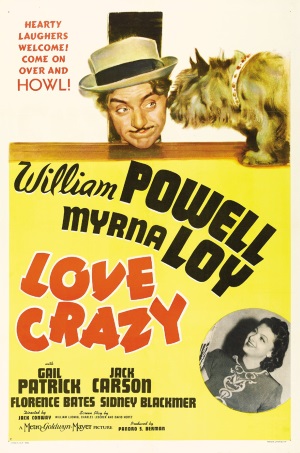
Love Crazy (1941)

Serving the Nuts

I believe every great actor should have at least one movie in which they get to go completely over the top and out of character (Barrymore in Twentieth Century, Leslie Howard in Its Love I’m After, Bogart in Treasure of the Sierra Madre, Stewart in Vertigo). For William Powell, Love Crazy provided him with his opportunity in easily the most slapstick oriented comedy ether Powell or Myrna Loy ever done; from heads being stuck in elevator doors to characters slipping on the same rug several times throughout the film. It’s not John Barrymore levels of over the top but compared to William Powell’s usual soft-spoken persona it’s pretty over the top.

Love Crazy is the William Powell show all the way, showcasing the complete range of his abilities as a comedic actor in a plot which is like a tabloid newspaper story turned into a screwball comedy; a jokey representation of mental illness which wouldn’t be politically correct by today’s standards. All the more fun then! One of the scenes from any film Powell has appeared which I feel best demonstrates his comedic timing is when he is tasked with convincing a lunacy commission of his sanity by placing shaped blocks into their corresponding holes. It’s such a basic task yet with his overzealous confidence he still manages to convincingly screw it up; it works on so many levels. Yet as the film progresses, I end up feeling particularly sorry for his character due to losing a wife like Myrna Loy and having her despise you, all over one improbable misunderstanding.

But not to undo Myrna Loy with her stand out moment being a surprisingly erotic scene with Jack Carson in which both of them are bare-shouldered and she even utters the line, “It will smell like an orgy”. On top of that, I find myself in awe that there is a straight up dick joke in this movie (“He has to have his torso free when he shoots his bow and arrow”). Of all the sneaky jokes they got past the censors I’ve heard in screwball comedies, this is one of the most unsubtle. Likewise, Gail Patrick who plays Powell’s former girlfriend appears to be a bit of a nymphomaniac; badly wanting him shortly after meeting for the first time in years despite both of them now being married, not to mention it’s his anniversary night! Just listen as the seductively tells Powell “Stevie I’m bored!”. There’s quite a bit of setting up in Love Crazy but the payoffs are worth it. Love Crazy also gets a big boost from the apartment sets designed by Cedric Gibbons. The painted backdrops of skyscrapers high in the sky and the art deco shading, it’s beautiful.

I had the benefit of going into Love Crazy unaware of the screwball hijinks which occur during the third act. If it’s not too late for you, I recommend doing the same otherwise stop reading but yes, William Powell dresses up in drag as a tall, butch woman and convincingly at that. He even goes to the length of sacrificing his trademark moustache – now that’s commitment.

The Lady Eve (1941)

So Close, Yet So Far

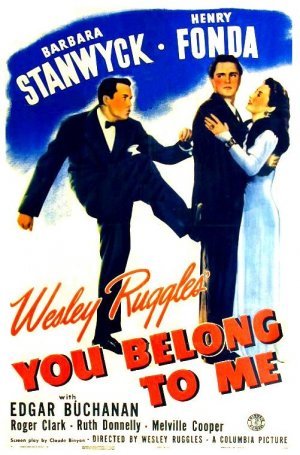
The Lady Eve is a conflicting film. The first hour is some of the most perfect romantic comedy I’ve ever seen, however, it falls apart around the one hour mark. However, what is it that makes the first hour so perfect? Firstly it didn’t take too long for me to realise that Henry Fonda and Barbara Stanwyck are one of the most flawless screen pairings ever, the perfect combination of sexy meets innocent. Watching these two I get the impression they must have been head over heels for each other. I’ve read that apparently Henry Fonda would later tell his wife he was still in love with Barbara Stanwyck, dam! But then again, after having your hair caressed by Stanwyck for 3 minutes and 51 seconds, who wouldn’t be?!

The Lady Eve is a prime example of a “How did they get away with that?!” movie. I’m not aware of what Stanwyck’s ideological or moral beliefs were but a number of her films are some of most sexually suggestive old Hollywood films I’ve seen. There’s her pre-code work such as Baby Face but in the postcode era, we have Ball of Fire, Double Indemnity and of course, The Lady Eve. Call me old-fashioned but movies were sexier when the actors kept their clothes on. Vilma Banky did more with one raised eyebrow than an entire (Warning! Problem in Sector 7G).

So where does it all go wrong, well about 50 minutes into The Lady Eve, the movie pulls my least favourite movie cliché of all time, “the liar revealed”. You know, when a character is exposed as a fraud causing a relationship to end, even though you know they’re going to get back together again by the end of the movie. Having this cliché is bad enough, however, I thought it was only a contrived modern invention but here it is in 1941. At least they don’t drag it out like any rubbish modern-day romantic comedy would.

I’ve found Preston Sturges’ films to be indiscipline, his films all have their moments of greatness but at times they delve into over the top absurdity, even by screwball comedy standards. During the later part of The Lady Eve it’s hard to buy into Stanwyck disguising herself as another woman who doesn’t look massively different from her previous self in order to win back Henry Fonda. Oh, and he buys into the charade, the dope! Part of me wished the entire movie could have just been the two of them on the boat and it would have been a perfect film, however the final third still has some hilarious moments, such as Eugene Pallette frantically banging the table demanding his breakfast, or Fonda getting his suit destroyed three times at a party, a perfectly timed slapstick gag if I’ve ever seen one.

On a second viewing of The Lady Eve, I still have the same reaction to the first hour but I did find myself more forgiving of the last third. With my love of screwball comedies and the pairing of Stanwyck and Fonda, perhaps with additional future viewings, I may become completely forgiving of the last half hour. The first hour is just that perfect.