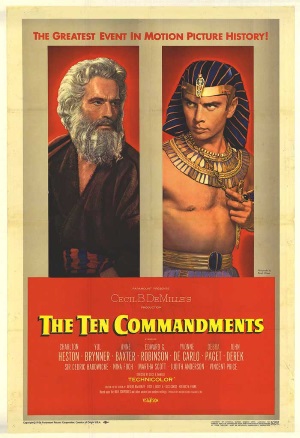
The Ten Commandments (1956)

Old Testament, Real Wrath of God Type Stuff

Upon viewing with my own eyes Cecil B DeMille’s motion picture production of The Ten Commandments, I can only conclude that is cinematic entertainment worthy of the almighty himself and one of which I can wholeheartedly recommend to my fellow man. For man shall be entertained by the will of great cinema, not be the will of inferior productions, for cinema is cinema.

Ok, I won’t talk like that for the entire review but yes, I love old Hollywood epics. The sheer scope, the bombastic music scores, the rich storytelling, everyone talking like they’re Laurence Olivier with everything they say being an epic monologue of well, biblical proportions. You can’t get films like this made anymore. No studio would be willing to finance such a project nor would moviegoers be willing to watch a film four hours long; they would run for the hills if you even suggest it to them.

From the films I’ve seen or have tried to watch from Cecil B. DeMille (aside from The Greatest Show on Earth which I also enjoyed) his work comes off to me as dull, turgid experiences. The Ten Commandments is an unashamedly old-fashioned, stagey and creaky film even for its time but that was DeMille’s Victorian style. Yet with the Ten Commandments, all these DeMillen elements work; perhaps his entire career was leading up to this one film. The Ten Commandments is one of the most classic of old Hollywood epics tapping in with the public’s fascination with Egyptology. No scene during all fours hours of The Ten Commandments feels unneeded, something interesting is always going on with special effects and sets which get better with age; fake but in a good way. Moses parting the sea is one of the greatest and most awe-inspiring special effects shots in cinema history; I can never take my eyes off the screen when it as it occurs.

Only a handful of scenes in The Ten Commandments were filmed on location with the majority being filmed within the confines of studio sets. Yet it is impressive how DeMille is able to create such a vast world in spite of this, beaming with life and personality; a lavish ancient Egyptian fantasy land that you can lose yourself in and one which feels lived in. The cuts between location and the Hollywood sets are seamless while the widespread use of blue screen, matte paintings and miniatures help create scenes which look like beautiful paintings. Also keeping with DeMille’s Victorian sensibilities, the contemporaneous composer Elmer Bernstein is a surprising choice to compose music for The Ten Commandments but delivers an appropriate, bombastic score complete with horns galore.

Everything Charlton Heston says has so much weight to it; his Moses is a superman of whom you would happily follow in a heartbeat and the humanitarian saving grace to the Hebrews when he is still in line to the throne. Yul Brynner, however, is the actor who steals the show; one of the coolest looking stars of the big screen with his distinctive bald look. With his broad and toned figure, no one could look better or strut wearing that Egyptian headdress and attire. Rames is so evil, suave, chauvinistic and charming; at times you love to hate him, at other times you can’t help to just love him. This is a man who would do just about anything to attain power and even no has no problem telling his potential future wife she’s no better than a dog. Heston and Brynner are opposing forces of masculine badassery with every line of dialogue they utter raising the hairs on my back. – There’s no method acting here, it’s completely old school theatrics.

The Ten Commandments boasts one of the most impressive ensembles casts ever to grace a Hollywood production in which every role feels significant from Edward G Robinson as slimy, cocky, shameless snitch Dathan (no one could pull these traits better than him) to the devilish Vincent Price. The other surprisingly entertaining, campy and sultry performance in the film is Anne Baxter as Nefertiti, of whom I swear has to be a nymphomaniac in the way she swoons and gets excited over the thought of Moses and even getting off on Ramses’ insults, not to mention to odd line of innuendo thrown in there (“The very dirty one there. He may serve my purpose”). Likewise, the film’s constant use of the word bondage will get some laughs for the more immature viewer.

A friend of mine once told me that what prevented him from enjoying The Ten Commandments was that Moses got the easy way out by relying on God’s miracles in order to free his people from slavery in instead of political intervention. In reality, without divine intervention, would Moses’ best option be to keep his identity a secret and free the slaves once he becomes Pharaoh? Then there’s the age-old question, if God is all-powerful, then why does he let bad things happen? Moses asks the film’s fire and brimstone representation of God this when he encounters the burning bush but gets no answer. Regardless, such Deus Ex Machina doesn’t take away from my enjoyment of The Ten Commandments.

I am past the militant atheist phase of my life in which I would have to proclaim my lack of religiosity at any given point and thought I knew better. Regardless of one’s faith or lack thereof, stories such as that of the Book of Exodus helped to create the Judeo-Christian values of which define western civilization, in this, a prime variation of the hero’s journey. Prior to the opening credits of The Ten Commandments, DeMille gives an opening prologue in which he speaks to the audience in person of how the upcoming story is about “the birth of freedom” in which the theme of this picture is “whether men are to be ruled of God’s law, or whether they are to be ruled by the whims of a dictator like Ramses? Are men property of the state or are they free souls under God?” DeMille concludes stating “This same battle continues throughout the world today”. Surely it’s no coincidence that the final line spoken in The Ten Commandments is Moses proclaiming, “Go. Proclaim liberty throughout all the lands, unto all the inhabitants thereof”. This was in 1956 when the communist, centralized state society of the USSR was engaged in a cold war with the USA, a country which inalienable rights are endowed by a Creator which government can’t supersede. – Yet, this battle of Moses vs. Ramses still continues on the world stage into the 21st century.

Sunset Boulevard (1950)

It’s a Scene Right Down on Sunset Boulevard

Despite Louis B. Mayer’s comments to Billy Wilder that “You have disgraced the industry that made and fed you!” – I feel Sunset Boulevard enhanced the Hollywood mythos. Who knows what Norma Desmonds may have existed; crazed celebrity lunatics living in their run-down ghostly mansions in the Hollywood area, not just back then but in the decades which have followed. However, the film also makes you feel sentimental for the silent era, that something really was lost when Hollywood made the transition to sound.

Gloria Swanson’s role as Norma Desmond is my favourite female performance of all time. Overblown, over the top, flamboyant, fantastic! A performance which could have been unintentionally comical (ala John Barrymore’s Oscar Jaffe) but her insanity can be taken completely seriously; same goes for her butler Maxilillian played by Erich von Stroheim. In many ways she is that character, as Gloria Swanson has even said so herself; just looks at her reactions to watching her own pictures. Desmond is a character whose relevance for the modern world has not been lost, in an age when people are obsessed with celebrity, youth, and beauty more than ever. Likewise, Cecil B. deMille’s performance feels entirely genuine, as if two old friends have just met for the first time in years.

I also find the dynamic shared between William Holden and Gloria Swanson to be of fascination; an older woman seducing a much younger man who eventually gives into her when in classic Hollywood films it was often the other way around. It’s clear from their actions as the film progresses the two characters are likely sleeping with each other, such as Joe happily flaunting his shirtless body in front of Norma by the poolside and she even starts drying him with a towel; there is a bit of Mrs. Robinson to her.

Sunset Boulevard is possibly the most quotable film of its genre, although none its lines have become as famous in the pop culture lexicon as a film like say Casablanca, in which everyone knows its famous quotes whether or not they’ve seen the film or are even interested in classic cinema. Yet among circles of classic Hollywood fans, Sunset Boulevard is one of the most widely quoted films in discussions. Joe Gillis (William Holden) narrates the film despite his character being dead but it still works in an otherworldly way, like he’s narrating from the afterlife. Holden holds an ideal narration voice to showcase Billy Wilder’s ability to turn exposition into poetry. Likewise, Buster Keaton’s appearance may be my favourite celebrity film cameo ever; there’s something about his reaction when playing poker (“pass!”).

For as cynical a film as Sunset Boulevard is, ultimately it is a movie for movie lovers. Particularly the scene in which Betty Schaefer (Nancy Olson) tells Joe Gillis of how there is no shame working behind the camera while walking through the empty back stages of Paramount Studios at night as she tells him about her childhood spending time on studio back lots, is very life-affirming. It’s such a beautiful and romantic scene; it’s easy why these two were paired in several films together. Olson’s character is the opposite of Norma Desmond, humble and down to Earth, not concerned with her looks or fame and fortune; and unlike Norma she can actually write movie scripts.

Say goodbye to Hollywood, say goodbye my baby.

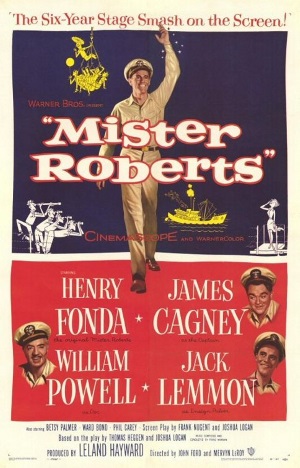
Mister Roberts (1955)

No One Can Succeed Like Mister Roberts

***This Review Contains Spoilers***

Fonda, Cagney, Powell, Lemon. What more could you ask for? Being a huge fan of all four actors, for me personally, Mister Roberts may be the greatest accumulation of actors ever; thus I will try my best to contain my inner fanboy. Not only do all four play interesting characters but they all share such interesting relationships between each other. Fonda and Cagney share a Bugs Bunny/ Yosemite Sam-like dynamic with Cagney being a frustrated old captain (possibly with a Napoleon complex) in a position of power but with no control over the taller Fonda stepping over everything he does.

Jack Lemon’s Ensign Pulver, on the other hand, hates the Captain but out of total shock, the captain likes the Ensign. I find this dynamic particular funny as I can relate to that situation of being admired by someone you dislike. However, I also relate to the character of Mister Roberts himself in his predicament of being stuck in a rut of which he is desperate to escape from; wanting to leave the navy cargo boat and be right in the action of the Second World War. The entire film effortlessly combines tragedy and comedy with no better example of this being the final scene itself in which the film transitions from the tragedy upon the characters discovering that Mr. Roberts has been killed in action to one more final pay off from a recurring gag; one of my favourite movie endings ever.

The claustrophobic intimacy of the ship, as well as the simply superb dialogue and performances, makes the dialogue-heavy scenes so engaging. Even with two directors on the project which could have spelled disaster, the film manages to come out perfectly fine rather than ending up like a Frankensteinian stitch up. The other scene which always stuck out to me was at the beginning of the film when the men are attempting to get a glimpse of women in a shower and going crazy as hell over it. Would men have the same reaction today because of the internet? Was the prospect of seeing a naked woman more thrilling back then?

Mister Roberts would be William Powell’s final film although one of Jack Lemon’s first, so I see the film as a passing of the torch between two generations of comedic actors. Originally Powell retired after appearing in How to Marry a Millionaire but decided to appear in Mister Roberts after reading the script. A much, much better choice of final film in which he shows that even in this stage of his career the man was still a master of words.

It’s Always Fair Weather (1955)

Stormy Weather Ahead

It’s Always Fair Weather will go down in history as the film musical which “could have been”. Had it been made a few years earlier it could have been in the same leagues as Singin’ In the Rain and On the Town but several shortcomings, some determined by the period the film was made prevent it from being so. Even the studio had that little faith in it they dumped it as a second feature alongside Bad Day At Black Rock.

It’s Always Fair Weather differs from other musicals of its time in its sombre tone with the tale of three war buddies who are reunited ten years later to find out they can’t stand each other upon discovering one is a hick, a snob and a goon. This is juxtaposed to a world of beautiful, bright colours and welcome artificiality with urban sets to die for. It’s Always Fair Weather was originally conceived as a sequel to On the Town, reuniting Gene Kelly with co-stars Frank Sinatra and Jules Munshin. However, by 1955, Munshin no longer had box office credibility while Sinatra was too big a star that the studio was unwilling to work with him. In their place, we get Dan Dailey and Michael Kidd, both of whom get the job done but lack the same electric chemistry Kelly’s On the Town co-stars possessed. Frank Sinatra in particular I find is sorely missed as I loved his three-picture partnership with Kelly in which they made an excellent comedic duo. None the less the roaster does get a big boost with the casting of the great Cyd Charisse, whom like Ann Miller in On the Town, plays a glamorous woman with contradictory personality and an encyclopedic knowledge of well, pretty much any topic.

However, I find It’s Always Fair Weather’s biggest drawback are the sections of the film which are uneventful and doesn’t have the lightning-fast pace of On The Town or Singin’ In The Rain. The film could definitely benefit from the trimming or removal of whole scenes; there is a faster-paced, snappier film in here. The film does help make up for this though in its musical numbers. It’s Always Fair Weather does showcase some of the best moments of any MGM musical with the soundtrack being one of the best in the MGM catalogue. The musical numbers and compositions are fantastic and all written for the film itself by the great Betty Comden and Adolph Green, while the majority of MGM musicals took their songs from their back catalogue as well as other stage musicals.

The five-minute Gershwin like dance number “The Binge” showcases the then-new cinemascope format by having three dancers occupy their own third of the screen as they dance and create percussion with trash can lids on their feet as they work together in great physical tandem of drunken joy. Once Upon a Time, on the other hand, is a heart aching number if there was one as the three men sing about their broken dreams while Music is Better Than Words couldn’t be more enchanting if you asked for it. The centrepiece of the film, however, is Gene Kelly’s number ‘I Like Myself’, featuring him tap dancing on roller skates, no trickery! Like Singin’ In the Rain, the number is an encapsulation of pure happiness (just look at the faces of the onlooking extras). This is of my favourite musical numbers of all time and is an unbelievable display of talent if I ever saw it. The film’s only crime in the song and dance department is the lack of a dance number between Gene Kelly and Cyd Charisse, despite one actually being filmed.

I feel widescreen technology came too late the MGM musicals which could have used it to great advantage but by 1955 musicals had already lost most of their economic viability due to the rise of television. It’s Always Fair Weather is Hollywood coming to terms with the existence of its rival television but relishes the opportunity to satirize the format as superficial and ridden with advertising.

The Harder They Fall (1956)

The Pen Is Mightier Than The Sword

***This Review Contains Spoilers***

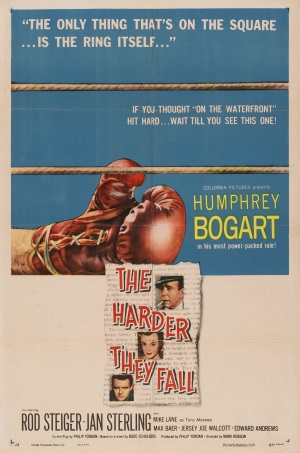
It’s unique to see Humphrey Bogart in a more contemporary, neo-realist 1950’s film in the form of The Harder They Fall. From the Saul Bass-inspired opening credits which help set up the plot (rather than just a series of static title cards) to the punchy music score, I imagine if Bogart lived longer and stared in movies for at least a few more years they would have been aesthetically in a similar vein to The Harder They Fall.

The Harder They Fall deals with corruption and fixing in boxing and how promoters exploit athletes regardless of their health or well being, providing an in-depth look at corruption in boxing as to who pulls the strings and how. The fight scenes themselves don’t suffer from the dilemma of old boxing films having dodgy looking bouts with sped-up footage or obviously fake punches, partially due to the fact that the fights within the film are staged and of poor quality fight tactics. Likewise, the grime and sweatiness of boxing arenas and training gyms never fail as effective subjects to capture on film, especially in black and white. Also, what’s the deal with that bus with the cardboard cutouts attached to it? It’s almost like a character in itself.

More so than any other Bogart film do we see such a striking generational clash with Bogart coming from the old school style of theatrical acting and Rod Steiger from the Marlon Brandon, method school style of acting. However, I’ve always found Bogart to be a very adaptable actor and he is able to seamlessly play of Steiger despite their acting styles being worlds apart. Bogart’s role as washed up columnist, Eddie Willis is one of the most interesting heroic performances of his career which combines Bogart’s trademarks of both world-weary cynicism but also, a sense of righteous morality as he deals with his moral and ethical conscience throughout the film. Eddie can draw up fake publicity for the not so talented, big lug Toro Moreno (Mike Lane), writing articles stating he is the heavyweight champion of South America, undefeated in 39 fights and largely get away with it – that’s the pre-internet world for you (“Nobody reads these west coast papers in the east”).

Eddie may take part in the world of boxing corruption but he never fully believes in what he is doing and tries to make the outfit as unscrupulous as possible. Not to mention he is the only person in the racket who genuinely cares about the gargantuan Toro, whereas the rest of the men couldn’t care less about him. Rod Steiger on the other hand as corrupt sports promoter Nick Benko is an impulsive, brash character who has no moral or ethical conscience – you have to ask does he actually believe in what he is doing is justified in his mind. Steiger chews the scenery throughout the film in a very shouty, loud-mouthed performance which has shades of DeNiro or Pacino coming through.

I had a sense of melancholy during the movie’s closing shots knowing this was the last time Bogart appeared on screen. Bogart was in poor health during the film’s production, suffering from lung cancer (although ironically it doesn’t stop him from lighting up during the movie). In the film’s conclusion, The Harder They Fall celebrates the power of writing as a force to fight wrong and enforce positive social change – proving once again the pen is mightier than the sword, or should I say boxing glove. In the powerful final shot, Eddie begins typing an article on boxing corruption and reformation for the sport, an aspiring sight for any budding non-fiction writers.

“The boxing business must rid itself of the evil influence of racketeers and crooked managers, even if it takes an Act of Congress to do it.”

Glen or Glenda (1953)

Misunderstood

Note: This is the earliest film review of mine which I still have. While my other early attempts make me cringe in how amateurish they are, this one I find has an appealing innocence to it, therefore I present it as I originally wrote it back in 2011.


I might sound insane, but I’m giving an Ed Wood movie a positive score from an artistic point of view. Glen or Glenda marked Wood’s first film, which he not only written and directed but also starred in. The film was originally slated to be a biopic on Christine Jorgensen, the propriety of the first publicly known sex change operation (in this case from male to female) Wood, however, took over production and instead turned it into a film about his own transvestism.

Whether you’re conservative or liberal on issue of cross-dressing and trans-sexuality, Glen Or Glenda manages to do something which I’ve seen many sacred cows fail to do, create emotional interest in its main characters, and succeeds to raise question on what it means to be normal, with an issue which is just as relevant today as it was in 1953.

The movie’s production values are surprisingly good for a film of this calibre. The surreal dream-like sequence in the 2nd half of the movie features some impressive filmmaking techniques and manages to engage you in the character’s descent into insanity. Even the film’s acting is decent, certainly better than in the likes of Plan 9 from Outer Space.

Lugosi’s character is widely regarded to be a scientist representing God. At first, I didn’t understand the character’s role in the movie (plus the use of the stock of footage is completely random). However, I was impressed with how his catchphrase which he utters throughout the course of the movie actually finds its way to having relevance with the plot.

I’m not the type of person who over analyzes movies looking for their deeper meaning, but in Glen or Glenda it really came through quite obviously and did leave an impression on me, as well as changing my opinions on Wood as a director. I can defiantly sense Ed Wood put a lot legitimate feeling into this movie, and certainly comes through in the finished product.

The Country Girl (1954)

Bing on a Binge

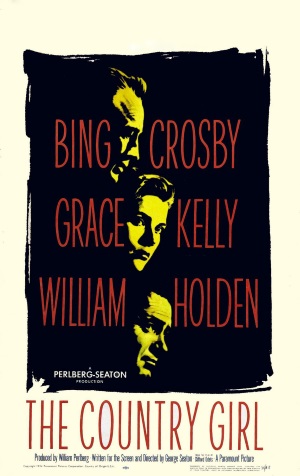
It’s good enough when a movie can impress me with an excellent performance delivered from an actor whom I didn’t think had the chops to do so, now multiply that by three and you’ve got The Country Girl.

I had only previously seen Bing Crosby in several musicals and comedies. He’s never struck me as an enigmatic screen presence but serviceable none the less. Thus surprise performance # 1 in The Country Girl. Why didn’t Crosby do more dramatic roles in his career? This is one of most powerful performances I’ve ever seen as a washed-up alcoholic performer who has hit rock bottom. Like Ray Milland in The Lost Weekend and Jack Lemon in Days of Wine and Roses, Crosby’s performance has helped convince me never to start drinking (or at least that would be the case since I’ve never had any intention of starting).

Yet I would still say he’s outdone by William Holden, surprise performance #2. I’ve found Holden to be very hit or miss as an actor, possibly relying on great directors to get a good performance out of him otherwise he comes off to me as forgettable. The jury is still out on his abilities as an actor but never less after watching The Country Girl again, I can say this is my favourite performance I’ve seen him deliver giving so much raw energy as a driven stage producer.

Finally in the triangle of surprise is Grace Kelly. Prior to watching The Country Girl, I was becoming increasingly anti-Grace Kelly, questioning if she was even a very good actress. Here in this dowdy, playing against type role, my opinion of her changed. I have a rule when it comes to reviewing not to talk about Oscars as I see complaining about awards to be futile and cliché. Yet this is one exception in which I’m forced to break it due to the controversy surrounding her win. Judy Garland’s role in A Star Is Born is one of my favourite film performances of all time and should have won her the Oscar that year however if The Country Girl had been released most other years I would have been more than happy to see Grace Kelly get the Oscar.

Without delving into a mindless praise fest I really was left flabbergasted by this trio of performers aided with the help of the film’s unforgettable sense of atmosphere as Grace Kelly puts best herself: “There’s nothing quite so mysterious and silent as a dark theatre, a night without a star.”

The Band Wagon (1953)

Fred Astaire 1953!

The Band Wagon is the film Fred Astaire’s career was culminating to: his best film in my view. Like Ninotchka with Greta Garbo or A Star Is Born with Judy Garland, this was the role he was born to play; one catered to his on-screen persona. Fred Astaire is Tony Hunter! An ageing hoofer who no longer is the star he once was. The Band Wagon contains little references to Astaire’s past: from Bill Bojangles Robinson to the opening credits feature an image of a top hat and cane, to the mentioning of a fictional movie “Swinging Down to Panama” perhaps a reference to Swing Time and Flying Down to Rio (although I do wish there could have been a little reference to Ginger Rogers herself in there).

The Band Wagon provides Astaire with some of the best musical numbers of his career. However, the film also allows him to showcase other avenues of his talent, such as his outburst scene over his dissatisfaction over rehearsals – a fine example of the acting prowess he possessed. While Ginger Rogers is obviously Astaire’s greatest partner Cyd Charisse is his most accomplished; could there be a more graceful figure?

Was I gullible that when I first watched The Band Wagon that the movie manipulated me into thinking the pretentious and egotistical stage director Jeffrey Cordova’s (Jack Buchanan) idea of a musical inspired by the Faust legend was a good idea? This isn’t the same old backstage musical plot; The Band Wagon is a thinking person’s musical. Likewise, Charisse’s Gabrielle Gerard has a mature subplot of her own involving her trying to deal with her dominating boyfriend and her feeling towards Tony; giving the film that extra mature edge.

Not only is there a great story, but there is also great comedy with a cast gels so well together. Oscar Levant and Nanette Fabray as a bickering couple and their hysterical fanboy reactions to meeting Tony Hunter, to Jack Buchanan’s over the top histrionics and his terrible ideas for a stage musical. My favourite moment in comedy in The Bandwagon is the scene in which Jeffrey Cordova manipulates Gabrielle’s boyfriend from being dead set against allowing her to be cast in his stage production to then begging him to allow her to be in the show. It’s like a Bugs Bunny-Yosemite Sam type moment but on a much more subtle level and made even more impressive by occurring in an uncut shot. Likewise, the sets in The Band Wagon have an astounding level of detail that scenes near the beginning of the film taking place on the street had me wondering where they sets or real-world locations.

Up until The Band Wagon, it was uncommon for a film musical to have a soundtrack entirely composed for it rather than having songs and compositions taken from other sources; which makes it all the more impressive that the entire soundtrack to The Bandwagon is superb. If I was to choose my three favourite musical numbers of all time, in terms of epic scope they would be The Broadway Melody Ballet from Singin’ In the Rain, The Lullaby of Broadway from Gold Diggers of 1935 and The Girl Hunt Ballet from The Band Wagon in all its 13-minute glory. Here noir meets musical, with Astaire at his most badass. His line delivery could be in an actual crime film itself, plus it inspired the music video for Michael Jackson’s Smooth Criminal. There’s also the Shine on Your Shoes number, one which I could watch again and again just to look at all those gizmos in the background and the genuine reactions on people’s faces at seeing Fred Astaire dance; while That’s Entertainment has become a semi-official anthem for Hollywood. Oh and there’s the Triplets number; one of the weirdest musical numbers ever filmed and they’re actually dancing on their knees!

The early to mid-1950’s where a phenomenal period for the musical genre. Hollywood produced some of its finest musicals in these years before television brought this era of film musicals to an end. Films like The Band Wagon elevated the genre to new heights. A Fred Astaire musical which has everything and more!

Auntie Mame (1958)

Live! Live! Live!

It’s hard for me not to be complete enamoured by a movie and a character like Auntie Mame. Two and half hours of zany histrionics with a central character who is a free-thinking, non-conformist and constantly has a joyous, optimistic outlook on life; oh, and did I mention she is a total screwball. Few other fictional characters seem to lead such an exciting life that I as the viewer am actually is jealous off (“Life is a banquet, and most poor suckers are just starving to death!”). If I ever amass a huge fortune then perhaps I can try to emulate the lifestyle of Mame. Ok even with a huge fortune that probably wouldn’t be possible in this mundane realm that is reality but I can at least try.

Auntie Mame is one of the most liberal movies to come out of the 1950’s. Mame’s carefree, flamboyant, free thinking and non-conformist lifestyle clashes with a decade which is thought of as being the most conformist of the 20th century. It should come as no surprise this movie has a huge gay following as the title character is essentially a drag queen. At the beginning of the movie, we see Mame throwing a party full of bohemians, intellectuals and champagne socialists (“Karl Marx, is he one of the Marx Brothers?”), essentially the predecessors to the modern day hipster. During the first 50 minutes of Auntie Mame the liberals are the ones having fun while the stuffy, puritan conservative Mr Babbock is being driven mad by Mame’s antics and instance that her nephew be sent to a be sent to a progressive school over a conservative prep school, a school with ancient Greek principles, has no uniforms and as the movies implies, teaches sex education in a very odd manner.

However, Auntie Mame isn’t a total demonisation of conservatives. In the middle portion of the movie she does end up getting married to a southern gentleman and an oil tycoon of whom lives on a plantation and goes fox hunting, which does show you that love can overcome ideology. Likewise, when Mame returns to her apartment after the death of her husband, the next few incarnations of her constantly redesigned apartment as well as her outfits are not as camp, possibly suggesting her husband’s influence on her. Well at least until the second last incarnation of her apartment which is very avant-garde.

With the movie’s references to sex and homosexuality among other things, Auntie Mame falls into the category of “how did they get away with that?”. Yet as liberal as the movie is for its time (and in many respects still is), the liberal of today is the conservative of tomorrow. Some of Mame’s actions wouldn’t rub with the modern left such as her desire to settle down with a man and her motherly instincts.

The Kaleidoscope opening credits set the stage for a film which is a feast for the eyes and ears. They really put effort into these early widescreen era title sequences in one of many attempts for a film to compete against television. Likewise, Mame’s lavish apartment is a masterpiece of set design as it evolves throughout the movie, with each incarnation being as impressive as the last. The movie doesn’t lose its stage roots which each act ending with the dimming of the lights with the spotlight on Mame before completely going to dark.

I am a huge Rosalind Russell fan and I know it’s a cliché expression but it usage couldn’t be any more adept here: this is the role she was born to play! How is it possible of a human being to talk at such a voracious rate? I do wonder how long the script for Auntie Mame must have been. There are probably more words in this movie than the Encyclopedia Britannica. Whenever there is a moment free of any dialogue I have little think to myself, “Oh yes, silence, I forgot what that feels like”.  When Roz’s motor mouth isn’t running, she’s pulling at my heartstrings; there are times when I wish I could just go into the screen and hug her. I can’t stress enough my love for the actress, the performance and the fictional character. Auntie Mame is an encapsulation of pure unmitigated joy. When I’m feeling down, I know what movie I’ll be turning to.

The African Queen (1951)

Steamboat Bogie

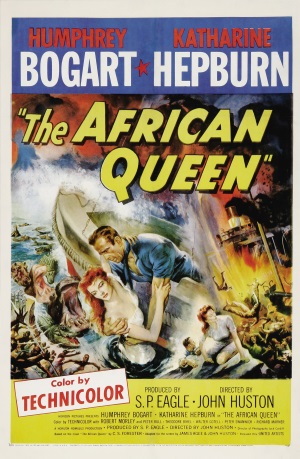
The African Queen is one of those perfect, anti-boring and instantly emotional engaging films that you never want to end. I never did I want to see Humphrey Bogart and Katharine Hepburn leave that tiny broken down old boat in an African rain forest – The African Queen is the film I measure all “man and woman who hate each other at the start but gradually fall in love” movies against. With the power of these actors, this transition comes off completely organically without a contrivance insight – even the point at which they fall in love can be pinpointed to an exact moment.

In showing how he was one of the most adaptable actors in cinema, Bogart leaves his usual urban dwellings and into the African jungle in the role of Charlie Allnut – the scruffy, carefree canuck of whom the recently commenced Great War in Europe means nothing to him nor does he appear to grasp its importance. It’s not until Rose (Katharine Hepburn) awakens a patriotic duty out of him does he perform his part to take out the German army. The scene in which Bogart goofs around with his intimation of various animals is surely the silliest moment of his career, but it’s all good fun – although I do have to ask am I the only one who gets some Bugs Bunny vibes with his performance here?

Katharine Hepburn’s Rose is one tough dame and does not appear to be a very likeable character during the first portion of the film. She doesn’t treat Charlie with any respect because he won’t agree with her demands, takes him granted and is interfering with what ain’t her property! But she’s Kate, she can do whatever she wants and get away with it, and we still love her for it (or at least that’s the case with me). Ultimately she makes more of a gentleman out of the scruffy, alcoholic slob – showing behind every great man is a great woman. Hepburn often played roles tailored towards her oddball personality, so I wonder if she held any hesitation portraying a Christian missionary and a more conservative, prudish woman (the film even features a recreation of the Walls of Jericho from It Happened One Night).

Jack Cardiff’s Technicolor cinematography has such striking vibrancy, a style distinctive from Hollywood Technicolor and one which captures Bogart and Hepburn’s rough, beat-up faces (devoid of any make-up) in such detail. Along with the sound effects of nature in the background and the occasional bit of wildlife, The African Queen is as close as a movie can get to make me feel like I’m a riverboat in East Africa. The African Queen was one of my earliest exposures to classic cinema, aeons before these movies took over my life and although I only saw the remaining 40 minutes, it stuck with me. In particular, the scene in which our duo starts getting eaten by insects; that scene always gives me the heebie-jeebies (even if it’s not a great special effect). The African Queen is within that rare category of films in which every viewing feels like a unique viewing experience, no matter how many times I watch it.