The Yakuza (1974)

Perhaps You’ve Heard of the Yakuza, the Poison Fists of the Pacific Rim. The Japanese Mafia!

***This Review Contains Spoilers***

At the heart of The Yakuza’s theme of the clash between eastern and western cultures, is that of the two’s opposing views on forgiveness. In Japanese culture, forgiveness is something you must earn. In western culture as preached though Christianity, any action can be forgiven regardless of how heinous; go to a confession box at a church and your sins will be wiped away. The Japanese don’t understand this; as a westerner don’t understand it either. Only towards the end of the film does Harry Kilmer (Robert Mitchum) become fully assimilated into another culture, and truly realise so much pain he has caused to Ken Tanaka (Ken Takakura), and performs the Yakuza ritual of Yubitsume, cutting off his little finger.

I can’t imagine a better choice for the role of Harry Kilmer than Robert Mitchum. I believe his acting experience and background is what brings a great level of sincerity to the role. Throughout his career, he appeared in a number of World War II films, including those about the war in the Pacific and featuring the use of the racial slur “Jap”. It can be an interesting experience seeing classic era actors in roles after the 1960’s that weren’t ensemble disaster movies; movies which contrast the attitudes of their ’golden age’ work. I’ve read Robert Redford was considered for the role but I believe the role was suited for an older, world-weary actor like Mitchum; plus it’s an apt choice casting one of the icons of film noir in this neo-noir. What I also love about the film is the touching love story between Harry and his Japanese love Eiko Tanaka (Keiko Kishi), a love of two people from different worlds made forbidden due to family ties, made all the more poignant with Mitchum being superb at portraying characters who are tough yet also tender.

Hollywood has had a long fascination with the Far East, producing movies which aren’t entirely very thoughtful or sensitive; The Yakuza is the more well-researched effort, to say the least. Yet I could still see the modern day PC patrol will still find something to the uproar about. Cultural appropriation is apparent throughout the film. Westerners Harry Kilmer and his friend Wheat (Herb Edelman) are so engaged with Japanese culture and customs to the point that it is second nature to them; while the Japanese display westernised trends such as the wearing of western clothes, or take the scene in the nightclub in which My Darling Clementine being sung.

The appropriation just doesn’t extend to the characters; the 1970’s Hollywood aesthetic and music is combined with Japanese iconography. Dave Grusin’s score is superb, creating a world alien to westerners and also contributing to one of the classiest films of the 1970’s. The violence is portrayed in a classy, arty tone and not coming of gratuitous with an effective combination of gunfire and katana duels. Also, can a gun still remain in a person’s hand and fire after their arm has been chopped off? Either way, it looks cool.

The Yakuza acts like a time capsule of 1970’s urban Japan, just take the scene in which Harry walks through the streets of Tokyo at night to meet his old love after 20 years. The filmmakers clearly took full advantage of the Japanese locations at their disposal; the Kyoto International Conference Centre in which Harry meets ken’s brother is an incredible piece of architecture and that public bathing room, dam, I want to go there!

Night Nurse (1931)

I’m Nick…the Chauffeur!

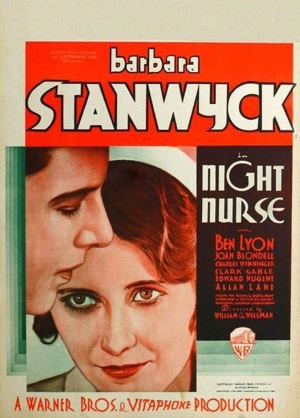
It doesn’t take long into Night Nurse to see the film isn’t a very positive portrayal of the health care service circa depression-era United States. Dr. Kildare this is not and even makes 1934’s Men In White come off as a more an idealised vision of the health care system in the 1930’s; Night Nurse is anything but. All within the picture’s first ten minutes Lora Hart (Barbara Stanwyck) is turned down for the job as a nurse but then gets it after catching the fancy from another doctor. Likewise one of the interns is a pervert and fellow nurse Maloney (Joan Blondell) recommends tricking patients into thinking you’ve saved their life in order to get money out of them. Blondell’s character, in particular, I really found myself loathing from an actress who normally played such likable characters. She clearly dislikes her profession and even recites the Florence Nightingale pledge while chewing gum – Night Nurse is a movie with a wide range of despicable human beings on display. There is even a scene which appears to show an actual baby in distress and another in which children talk about in graphic terms of the mental and physical abuse they and their dead sister have received – not very comfortable viewing.

Director William Wellman was one of the most interesting filmmakers during the pre-code era, whose film’s go against the conception of movies from the early 1930s being static and lacking camera movement or fluidity. Night Nurse is a perfect example of the kind of pictures Warner Bros produced during the 1930’s; a thought-provoking socially conscious melodrama. Whether or not it’s exaggerated, the plot of hospital corruption and the ineffectiveness of both the hospital and the authorities to prevent child abuse, the movie does succeed in packing a punch. What does it say when the intervention of gangsters, people working outside the law are required to save the lives of two children? Warner Bros was also known for featuring ethnic casts in their movies. At the beginning of the movie a shot focuses on a group of Chinese people sitting around a hospital bed speaking in their native language, helping to set the film’s gritty mood. There is also an emphasises later in the film that the shop which is broken into in order to steal milk for a bath in order to save the lives of malnourished children is from a Kosher delicatessen. Is there a particular reason for this? This was 1931 but history has made of this scene of the delicatessen windows being smashed unintentional creepy.

The other major reason to watch Night Nurse is to see Clark Gable in the pre-stardom role of Nick the Chauffeur in his glorious 5 minutes and 25 seconds (approx) of screen time (yes, I timed it). The film builds up to his reveal with the name of this unscrupulous “Nick” being thrown around. His character’s introduction with the use of a camera zoom and the uttering of “I’m Nick…the chauffeur” gives me chills in one of the most memorable moments in pre-code cinema. Gable is scary enough as a dominating brute who wants to murder children and isn’t afraid to punch women or the elderly but this is multiplied by the fact that he’s dressed like a Nazi. Ok not really, it’s a chauffeur’s uniform but when I first saw him wearing this, my instant reaction was “Why is he dressed like an SS officer?” (likewise, just as equally striking is his costume choice of a black kimono). The role of Nick is an odd duckling in the career of Gable which shown he had the knack for playing terrifying villains – such unrealised potential. As much as the man’s appearance in the background is enough to make you go, “oh s—t!”, and in a big way sister.

Dark Passage (1947)

The Man With Bogart’s Face

***This Review Contains Spoilers***

Dark Passage is one of the more experimental movies of Hollywood’s golden age with the majority of the film’s first third being filmed from the first person point of view of Humphrey Bogart’s character. I never thought a black & white movie from the 1940’s would remind me of a modern video game. I would like to see more films which experiment with this point of view style. MGM’s Lady In the Lake (also released in 1947) was filmed in POV for the entire film which the studio promoted by claiming the POV style was the most revolutionary style of film since the introduction of the talkies. Nope, it didn’t catch on. The use of POV took me off guard at first as I wanted to watch some Bogart but I did not get to see him on screen. Bogart’s distinctive voice alone though helps carry the picture, thanks in part to his many witty remarks. We’re then given a section of the movie in which Bogart doesn’t talk and is wrapped in bandages looking like a horror movie character (these scenes also make me squeamish). Considering we have to wait a whole hour until we finally see and hear Bogart in his entirely makes Dark Passage nothing short of a daring role.

For the plot, you do need to suspend your disbelief at the number of highly improbable coincidences. Irene (Bacall) just happens to be out painting near San Quentin on the day Vincent Parry (Bogart), the man she has an obsession with escapes and she knows where to find him. Oh, and she also happens to be friends with Madge (Agnes Moorehead) who gave false testimony in court against Parry that he murdered his wife.  I find it is easy however to just roll along with the ridiculous plot as the movie plays out like a dream, culminating in the satisfaction of seeing Bogart get his revenge on Agnes Moorehead (a useless old bag and a real love to hate character) and seeing these two characters getting their happily ever after together in South America. One minor complaint I have is the reveal of Frank Parry’s face on the newspaper, prior to getting plastic surgery; because the character doesn’t actually have Bogart’s face, I would have preferred the mystery of not knowing what he looks like. Also, a plastic surgeon who can give you the face of Humphrey Bogart? Someone should have told Woody Allen that in Play It Again Sam. Dark Passage in part sees the return of gangster Bogart but still has the romantic elements of his on-screen persona which he developed after achieving stardom. Right from the very beginning, we’re in classic gangster territory, a prisoner escaping from San Quentin, the type of setting not seen in a Bogart film since High Sierra. The on-location filming in San Francisco also really adds to the film, giving you a sense of the world the movie inhabits and Irene’s apartment with the two floors and the art deco designs – I want it!

I once said ‘All Through the Night’ was the most Hitchcockian film Bogart starred in but Dark Passage wouldn’t be far behind it. We get the innocent man falsely accused on the run while trying to prove his innocence. The focusing on landmarks (the Golden Gate Bridge), while the San Francisco setting has some Vertigo vibes. The trippy plastic surgery sequence feels reminiscent of the Salvador Dali dream sequence in Spellbound; while Madge’s death rings a bell of the character death shots in Vertigo in which someone falls from a great distance.

When attempting to review a movie, I can’t always predict how much I will have to say about it. Occasionally though you get movies like Dark Passage, which have layers and layers of fascinating details worth talking about. Dark Passage is my favourite Bogart & Bacall film, although to be honest, I was never a huge fan of their partnership. To Have and Have Not bored me and The Big Sleep was, well, a big sleep. Plus I never fully got the appeal of Lauren Bacall; she never struck me as a massively interesting screen presence.  I find Bacall plays a much more interesting character than in the previous two Bogie & Bacall pairings. Not a vamp but a lonely single woman who purses painting as a hobby.  During the first kiss between Bogart and Bacall, I had the reaction of “Ok, now I’m getting it”.

They Drive By Night (1940)

We’ve Got a Great Big Convoy Running Through the Night!

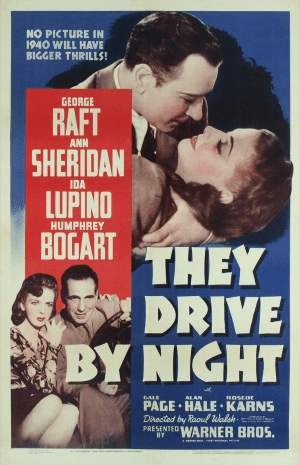
They Drive By Night captures the seedy and often dangerous world of the truck driver; the lack of sleep, the long distances to travel, the time missed with family, the comradery between truckers. The movie definitely highlights the dangers of trucking from the risk of falling asleep at the wheel, which in part lends itself to one very thrilling action sequence. With Warner Bros being the master of social commentary pictures, I enjoy movies like this which give you an insight into the lives of the lower class at the time; people trying to get by a day at a time with clearly little money to spare.

Thirty minutes into the picture we meet Ida Lupino, in my view possibly the epitome of the tough dame. Talk about a star-making performance, she owns the show as soon as she enters the picture. Every time she is in frame it’s hard to take your eyes off her as struts, poses and applies makeup to herself, even when her comedic foil of a husband Alan Hale is in frame acting like a buffoon. Her most notable scene in the film is one of the greatest, most gloriously over the top on-screen breakdowns ever committed to film. Charles Manson blamed The Beatles, Ida Lupino blamed the doors. Seeing Bogart as a family man is odd at first, the total opposite of his persona he would have in films such as those with Lauren Bacall. But he fits comfortably into the role, showing how adaptable an actor he was. George Raft is the weakest player out of the four stars, I’ve never seen Raft as much of an actor, but playing alongside these heavyweights manages to bring out the best in him.

What is the overall plot of They Drive By Night? There isn’t one; there’s no three-act structure. It’s almost like getting two movies for the price of one, with the first half focusing on trucking and the second half focusing on a murder. Comparing the two you wouldn’t think this is the same movie, but the odd combination works and makes for a unique viewing experience.

Larceny Inc. (1942)

Under Pressure

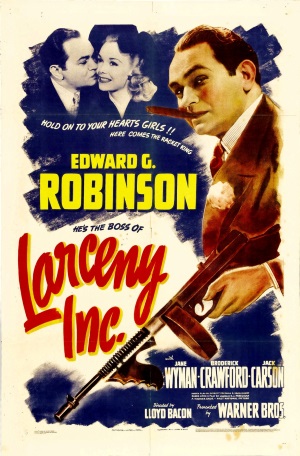
How can you resist a film like Larceny Inc once you’ve heard the plot? It’s one of those quirky film concepts I just love. A cocky criminal and his two buffoons buy a luggage store so they can dig their way into the bank next door. Perhaps the film’s greatest strength is how it plays out like a live action cartoon. Nothing ever goes beyond the scene in the moment; for example in one scene a set of oil pipes are burst during the digging process and the basement from which they are digging from is drenched in oil and yet this is never mentioned again. Even as one character who is not involved in the ban heist comes across the two drenched in the oil he bizarrely does not comment on their appearance; that’s the twisted cartoon world Larceny Inc incorporates. I’ve always thought actors from the 1930’s resembled cartoon characters with their exaggerated facial features and distinctive accents; very true with this cast including Edward G. Robinson, Jack Carson, and even a young Jackie Gleason; all live action caricatures.  Actors who emerged after the war generally didn’t have this and instead were actually more lifelike. You really get a sense of the world the movie takes place in with a street populated with such memorable and mostly ethnic characters giving the movie that Shop Around the Corner edge to it.

Maxwell aka Pressure’s gift wrapping has to be the comedic highlight of Robinson’s career; a comedy moment which couldn’t be timed more perfectly. His uttering of “$9:75”  is funny enough as it is but his pathetic attempt at gifting wrapping which follows had me in stitches. I also love Jack Carson’s attempt at hitting on Jane Wyman. This scene has nothing to do with the rest of the movie but has got to be the ultimate “skipping the pleasantries” monologue I’ve ever heard.

There are so many layers within Larceny Inc. Is the movie a celebration or an indictment on capitalism? The gangsters’ involvement in legitimate business is what makes them renounce their past ways but only after they’ve essentially been seduced and consumed by the capitalist system. Larceny Inc was released in 1942 just months after the US got involved in the war but the film’s production began prior to that with its themes of business and consumerism are completely counterproductive to the war effort, something I’ve noticed with many films released in 1942. There is also the irony that the gangster is the one who brings the community together and the authority figures in the movie are played as fools.

Larceny Inc can also join films like Rocky IV and Die Hard as Christmas movies which aren’t about Christmas, and Edward G Robinson dressed as Santa Claus? Sold!

White Heat (1949)

Get Up Stand Tall, Put Your Back Up Against the Wall

To date, White Heat remains the only instance in which my first encounter with an actor instantly turned me into a fan. Typically for me, I become a fan of a performer over a period of time and after seeing a number of their films. Not James Cagney though. The scene early during White Heat in which Cody Jarrett gets a headache and needs to be comforted by his mother, my instant reaction was, “I need to watch any movie with this guy I can get my hands on”. I have no hesitation putting Cagney’s performance as Cody Jarrett in my ten favourite movie performance of all time. At this point in my movie watching life I had never seen an actor so on fire, so electrifying. His twitchy mannerisms, machine gun way of speaking his violence against women and possibly above all, his mother complex, exposing an unsettling, adorable side. Like wow, you do not want to be stuck in an elevator with this guy. I would later discover White Heat came after the classic Warner Bros cycle of gangster movies, making White Heat a nostalgic revival of the genre, making Cody and his mother products of a different age. Margaret Wycherly as Ma Jarrett is the next great stand out performance for me, a character who appears as the stereotypical “aw shucks” mother common in classic Hollywood, but her attitude could not be more different.

Boy is this movie fast paced. White Heat is one of the few times my heart my beating so much out of how exciting the movie was. When the film was over I had the closest I could fell to that sense you get after coming off a rollercoaster, expect to get it from watching a movie. I feel that’s the best way, to sum up White Heat, a rollercoaster of violence and emotions. Even the scenes of police officers discussing Cody’s psychological tendencies and the examination of their late 1940’s tracking techniques are riveting, but they do save the best for last. The Warner gangster movies ended with incredible final scenes with brilliant closing lines, White Heat’s may be the best of them all. I question if I’ll ever experience such a high level of movie watching euphoria on a first time viewing again.

The Petrified Forest (1936)

This Is How The World Ends, Not With a Bang But With a Whimper

***This Review Contains Spoilers***

When I first watched The Petrified Forest I was at an unsure time in my life; fearful of the future and with my own sense of individualism and artistic ambitions. Watching Leslie Howard as Alan Squier, a failed artist who eventually takes his own life so a young girl could be the artist he never was made me fearful and depressed of what my own future held in store for me. I felt for this character to the point that it hurt because I was worried that someday I could become that character, perhaps not to that extreme but destined to a similar fate. Gabrielle (Bette Davis) on the other hand is stuck in a rut and dreams of going to France. No one in The Petrified Forest has much to look forward to; even the old man played by Charlie Grapewin gets very excited by the prospect of gangsters being nearby. Anything to create some excitement in the middle of the desert, excitement which doesn’t wain when he’s being held hostage by them. At the time when I watched this film and I was dealing with the uncertainty of if I would ever leave my hometown or would I always be stuck here. Few other films have ever had characters which spoke so directly to me.

The atmosphere in The Petrified Forest is intense enough that I can forgive the not so seamless transitions between real-life locations and the sets. With little to no use of non-diegetic music, the sound of a windstorm is more than enough to emphasize the prison of which the characters reside. I also highly recommend checking out Heat Lightning from 1934 which contains many similarities to The Petrified Forest in its setting and atmosphere as well as characters and plot points.

The Petrified Forest’s most notable contribution to cinema is the breakthrough role of Humphrey Bogart as Duke Mantee, a role in which he has never been more terrifying. I generally don’t think of Bogart as an actor who is scary but here he is a guy I would not want to be stuck in an elevator with, even with that distinct walk with his slouch and his arms bent in that manner as the dangle. – In most cases this would look ridiculous by Bogart makes it work. Bogart’s acting career had been marred with failure up until this point with this likely being his final chance to make it in Hollywood and no doubt must have fueled his performance. I know a film is good when I have to think and contemplate which actor (Howard or Bogart) gave the better performance.

How often do you get to see gangsters and intellectuals involved in such profound conversations? Howard and Bogart play characters whom are worlds apart yet develop a mutual respect for each other as they discover they share a bond with their individualism (also look out for Bogart’s head being framed over a moose head so it looks like he has antlers). Fascinating characters (all with such unique dynamics between each other) in a fascinating story is already one of the most important things I could ask for from a movie, even better when they affect me on a personal level.

Manhattan Melodrama (1934)

Melodrama’s so much fun, in black and white for everyone to see.

***This Review Contains Spoilers***

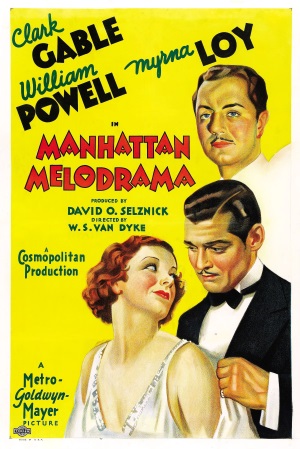
A gangster movie starring Clark Gable, William Powell and Myrna Loy, thankfully I was not disappointed. Watching these three titans of classic Hollywood in action (and sadly the only picture in which Gable and Powell appeared together), Manhattan Melodrama not only had me enthralled from beginning to end, it’s hypnotizingly good. Gangsters, dames, urbanites, class and sophistication, this movie encompasses elements of 1930’s cinema which I’m a sucker for – and yes, the film has the word melodrama in the title, something that would never happen in contemporary cinema.

The Angels With Dirty Faces style plot allows for poignant social commentary, with Powell as a district attorney trying to avoid corruption and not allowing his personal feelings to affect his decisions. William Powell’s performance as Jim Wade is the best I’ve seen him deliver; just listen to the emotional plea he gives during the movie’s courtroom scene. His character is essentially a fantasy, an elected member of government who’s entirely honest. When Wade goes against his ethics and engages in cronyism he tells the truth to the public and resigns from office rather than trying to desperately cling onto power. There’s doubt Powell had a real knack for playing lawyers and elected members of office.

Not to undo Gable as Blackie Gallagher, the manner in which he acts during the film’s final third is simply heartbreaking as he constantly jokes around despite being sentenced to the electric chair in the film’s finale. The ending of this movie just kills me as Wade’s friend since childhood is sentenced to death; it’s near the top of my list of all time tear-jerking scenes, pure cinematic tragedy. The lights of prison even dim as the switch is pulled, the ever classic cliché. In real life that doesn’t actually happen but in the film it is the final tug of the heartstrings. Also, it seems hard to believe now that Mickey Rooney would play a child version of Clark Gable but in 1934 audiences couldn’t have seen what he would turn out to be as an adult.

Does there exist an actress who doesn’t have great chemistry with Clark Gable or even any actor for that matter? Manhattan Melodrama is the first of fourteen screen pairings of Powell and Loy, and their first scene together couldn’t be more perfect, in which she falls into his lap in the back seat of a car as she starts to deliver exposition in the most adorable manner.

MGM is not generally associated with the gangster genre. Manhattan Melodrama doesn’t have the grit of Warner Gangster films but works in its own style of MGM’s glossy high production values and ranks as one of the best gangster films I’ve seen from the 1930’s. The movie seems to be more famous for being the last movie seen by gangster John Dillinger, who was shot by federal agents as he exited a Chicago movie theater. His reason for going to see the movie, apparently he was a Myrna Loy fan. The love of Loy killed John Dillinger, I guess I can’t blame him.

Jewel Robbery (1932)

Pre-Code Jewel

***This Review Contains Spoilers***

I remember people criticizing The Wolf of Wall Street as immoral, then I’d love to see their reaction to this 83-year-old gem.

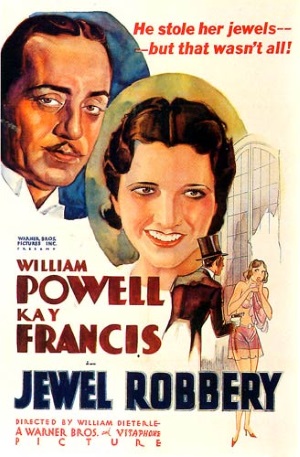
Kay Francis has one of my favourite character introductions ever, as an army of servants march to pamper her after getting up in the afternoon, lying in a bathtub, briefing showing off one leg shot up in the air then being pampered like a goddess ahead of her day of leisure. Jewel Robbery’s display of wealth would be explicit for any era, never mind the great depression. Francis’ reaction to being handed a box of jewels from Powell makes Lorelei Lee of Gentlemen Prefer Blondes look like less of a gold digger. Yes, these are shallow, superficial characters who never get punished for their actions, but that’s ok, only classic Hollywood actors could pull this off, making us enjoy rooting for characters like this. Although Francis’ character is at least self-aware of this, in one pivotal scene stating that she is shallow and weak as she leads a shallow and weak life and with a little courage she could run away from it.

William Powell is the coolest criminal ever; you would enjoy being held in a stick up by this guy. This being pre-code, a criminal is the hero of the story who deceives dim-witted guards. His methods of robbery, differentiating from what he calls “the stick ‘em up and shoot ‘em down school, no mess, no confusion” is so fascinating. Would his methods work in real life or is this just movie fantasy? He even gives his victims marijuana to calm them down. This movie waves the whole gauntlet of sex, drugs and rock ‘n’ roll. Ok, there’s no rock ‘n’ roll but there’s sex and drugs. The jewel robbery itself is so snappy and fast-paced. It takes up a large portion of the film (which at one point made me wonder if the film would be a sort of high-class version of Dog Day Afternoon) and it’s over in a jiffy.

Jewel Robbery is one of the most erotic and sexist films I’ve ever seen. Many of the scenes and dialogues are provoking in some way from Kay Francis wearing dress looks like it’s about to fall of her and exposes her backside to William Powell wrapping his arms around Francis to grab a ring of her finger; this is what you call a titillating movie. I also love Kay Francis and her girlfriend’s excited reaction to discovering a man infiltrated their house. Plus has there ever existed an actual dwelling that has an interior similar to that of William Powell’s hideout? If I ever win the lottery I am going to hand a copy of this movie to an interior decorator. Also, the newspaper which appears near the beginning of the movie is called “Weiner Journal”.

The High Sign (1921)

Keaton Komedy Klassic

The ‘High Sign’ has to be my favourite Buster Keaton short and it just so happens to be the first independent film Keaton produced, giving birth to his iconic unnamed character. However, Keaton was reportedly disappointed with the short and didn’t release it until the following year, instead making One Week his first solo short. I question why though as I feel the premise of The ‘High Sign’ is one of Keaton’s most inspired and even worthy of being used as the set-up for a feature – it’s true what they say, the artist is often wrong about their own work. The opening prologue of The High Sign states “Our hero came from Nowhere– he wasn’t going Anywhere and got kicked off Somewhere”; and considering his superhuman stunts, Keaton is like an alien who just landed on Earth. This opening prologue reminds me of a statement Roger Ebert made in his review of The General; “[Keaton] seems like a modern visitor to the world of silent clowns”.

The ‘High Sign’ packs in so much gags and material into its 21-minute runtime, chocked full of blink-and-you-miss-it moments in the story of a wannabe gangster who also becomes a bodyguard for the man he is assigned to kill. The gag involving Keaton’s set-up with the dog, the meat and the string (it’s hard to explain) is reminiscent of something Mr. Bean would conjure while the short also features the earliest example I’ve seen in a film of a recurring gag with the high sign itself, a secret signal between the members of a gang known as The Blinking Buzzards. Keaton even messes with the audience’s expectation for comic effect by walking past a banana peel on the ground only to not slip on it. Furthermore, the short’s finale is a real “How did they do that?” sequence. The house with its traps and secret hatches is an astounding piece of set design and when four rooms on duel levels appear in the frame at once in which Keaton jumps back and forth between them, it reminds me of a 2D platform video game. I was laughing, in awe and was even shocked (when the gangster’s neck is closed on the door) all at once. All of this takes place within a nostalgic, Coney Island-like setting (filmed at Venice Pier in Los Angeles) and even features the appearance of a man at the 11 minutes mark who bears quite a resemblance to that other great silent comic, Charlie Chaplin (intentional or not?). I’ll say it now and I’ll say it again; the genius of Buster Keaton will never cease to amaze me.