The High Sign (1921)

Keaton Komedy Klassic

The ‘High Sign’ has to be my favourite Buster Keaton short and it just so happens to be the first independent film Keaton produced, giving birth to his iconic unnamed character. However, Keaton was reportedly disappointed with the short and didn’t release it until the following year, instead making One Week his first solo short. I question why though as I feel the premise of The ‘High Sign’ is one of Keaton’s most inspired and even worthy of being used as the set-up for a feature – it’s true what they say, the artist is often wrong about their own work. The opening prologue of The High Sign states “Our hero came from Nowhere– he wasn’t going Anywhere and got kicked off Somewhere”; and considering his superhuman stunts, Keaton is like an alien who just landed on Earth. This opening prologue reminds me of a statement Roger Ebert made in his review of The General; “[Keaton] seems like a modern visitor to the world of silent clowns”.

The ‘High Sign’ packs in so much gags and material into its 21-minute runtime, chocked full of blink-and-you-miss-it moments in the story of a wannabe gangster who also becomes a bodyguard for the man he is assigned to kill. The gag involving Keaton’s set-up with the dog, the meat and the string (it’s hard to explain) is reminiscent of something Mr. Bean would conjure while the short also features the earliest example I’ve seen in a film of a recurring gag with the high sign itself, a secret signal between the members of a gang known as The Blinking Buzzards. Keaton even messes with the audience’s expectation for comic effect by walking past a banana peel on the ground only to not slip on it. Furthermore, the short’s finale is a real “How did they do that?” sequence. The house with its traps and secret hatches is an astounding piece of set design and when four rooms on duel levels appear in the frame at once in which Keaton jumps back and forth between them, it reminds me of a 2D platform video game. I was laughing, in awe and was even shocked (when the gangster’s neck is closed on the door) all at once. All of this takes place within a nostalgic, Coney Island-like setting (filmed at Venice Pier in Los Angeles) and even features the appearance of a man at the 11 minutes mark who bears quite a resemblance to that other great silent comic, Charlie Chaplin (intentional or not?). I’ll say it now and I’ll say it again; the genius of Buster Keaton will never cease to amaze me.
Angels with Dirty Faces (1938)

Angels With Filthy Souls

***This Review Contains Spoilers***

One of the things I love most about Angels with Dirty Faces is that proposes the age-old idea of a person’s entire destiny being defined by one single event. The fact that Jerry (Pat O’Brien) could run faster than his childhood friend Rocky (James Cagney) while being chased by the police for a petty crime would determine the paths they would take in life. If only Rocky could climb over that fence, things would have been so much different.

I’m a huge fan of the Warner Bros gangster movies of the 1930’s and Angels with Dirty Faces is probably the most classic of these movies In that it gets referenced and spoofed most in popular culture. These films deal with social issues, many of which are still relevant today. When I hear current news stories about crime and social issues, I often find myself thinking “They dealt with that in an old 30’s crime/gangster film”. Angels with Dirty Faces is no exception. Rocky Sullivan was never truly a criminal but his stay at a reformatory for his petty crime turned him into one. However, Pat O’Brien’s role of Father Jerry Connolly presents an incredibly stark contrast with today’s commonplace media reports of priests molesting boys. I find it fascinating to see a movie in which a member of the clergy is presented as someone who is treated with the utmost respect and entirely trustworthy, of course, this being an attempt to appease the Legion of Decency.

Even with the religious overtones, the movie still provides one of the most intriguing moral dilemmas ever presented in a movie; Rocky making the ultimate sacrifice. Before his execution, Father Connolly asks him to pretend going yellow and show people he was a coward by begging for mercy before being sent to the chair. The only thing Rocky has left is his reputation and he is being asked to throw that away so kids won’t look up to him and his lifestyle. Rocky does just this at the last moment, a complete rejection of the gangster way of life.

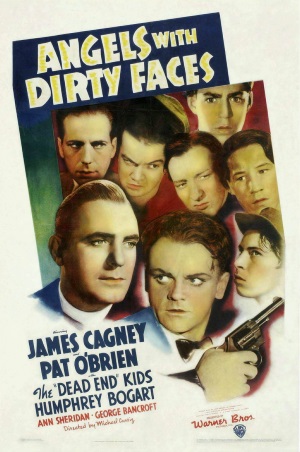
While nothing can top the pure electricity that is Cagey in White Heat, Angels With Dirty Faces gets my spot as the next most interesting performance in his career. The Dead End Kids give Cagney an element to his performance few other actors would rarely get the chance to express, likewise his real-life friendship with Pat O’Brien is easily apparent on screen with their interactions. Humphrey Bogart also appears in a pre-stardom supporting role. Despite only appearing in several scenes he nearly succeeds in upstages Cagney with his enigmatic screen presence. Plus that kid playing a young Cagney at the beginning of the film is very eerily like him.

Socially conscience pictures such as this which came from Warner Bros really give an insight into the lives of the common folk of the time. A moment which always stuck out to me in Angels With Dirty Faces is the basketball game because it’s the only classic-era film which comes to mind which features a basketball game thus showing an activity from the 1930’s which is still popular today. Likewise, the movie also acts as a historical document for the lingo among inner-city youths of the time. The performances given by The Dead End Kids feels like an early example of method acting; no surprise when watching this that it was once referred to as Italian street acting.

Michael Curtiz is undoubtedly one of the greatest craftsmen of Hollywood’s golden age (after all, in this same year he directed one of the most perfect things ever created, The Adventures of Robin Hood). The movie immediately flaunts it’s very handsome production values right from the opening shot. The execution finale of Angels with Dirty Faces alone is a masterpiece of cinematography with its prominent use of shadows, bright lighting and tilted camera angles. Here Curtiz creates a criminal underworld which is hard not to get sucked into. We might not want to emulate gangsters but we can’t help but be fascinated by them.