Häxan [Häxan: Witchcraft Through the Ages] (1922)

Get Witch or Die Tryin’

***This Review Contains Spoilers***

Witchcraft as a subject matter wouldn’t normally be my cup of brew, yet with its unique combination of documentary and scripted drama, Häxan (pronounced as “heck-sun”) presents itself as interesting even to non-adherents. Häxan is a film which on the surface level looks like it would appeal to new age mystics or that one edgy goth kid in every school, however, in contradiction to its arcane visual presentation, Häxan is a film of scientific rationalism as established from the beginning (“The belief in evil spirits and witchcraft is connected with childish perceptions from the world of mysticism”) and one from the God of the Gaps school of thought (“When primitive man is faced with something incomprehensible, the explanation is always the same: witchcraft and evil spirits”).
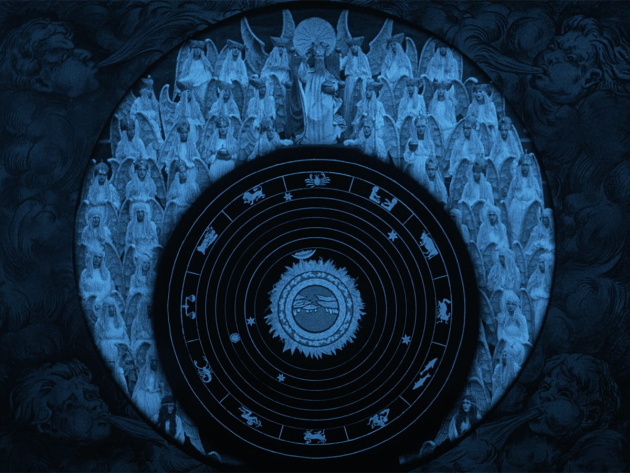
The film’s first of seven chapters provides an overview of witchcraft throughout the ages (primarily the Middle Ages), featuring an array of astronomical diagrams from antiquity, as well as historical depictions of devils and demons. Many of these images are frightening to look at and are presented alongside such gruesome captions as “One devil pours the sulphur-reeking contents of a horn down a man’s throat”, speaking deeply to the fear present in the human condition. One of the film’s later documentary segments features the ever-popular topic of Medieval instruments of torture, with one particularly standout moment involving (as the film claims) one of the actresses volunteering to use a medieval thumb screw, although she is seen laughing on screen when using it (make of that what you will). Many of these displays feature an on-screen pointer being held by someone off-screen, yet they still retain a cinematic quality. As a viewer, you feel like you are being imparted with clandestine, forbidden knowledge rather than feeling like the 1920’s equivalent of a PowerPoint presentation.
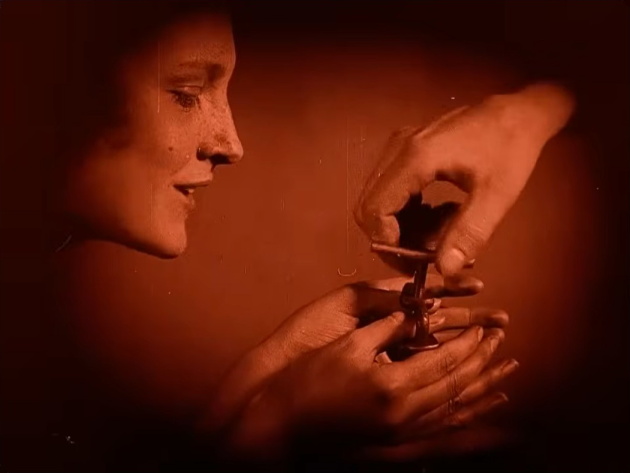
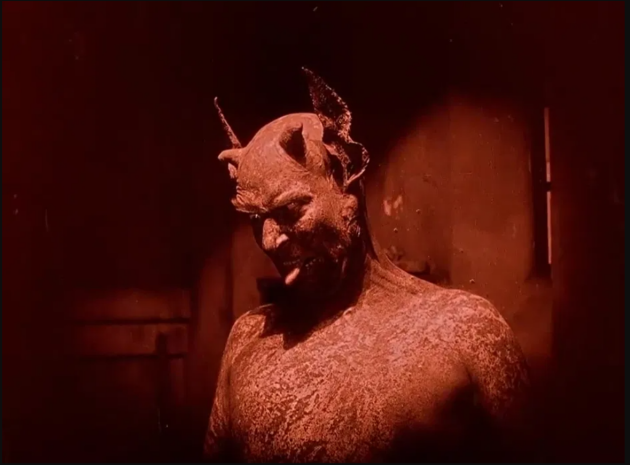
Häxan has all the ingredients you would want from a 100+ year old, arcane, European movie. The sepia tinting, eerie music, haunting choirs, the sight of animal skulls and skeletons in the witch’s dwelling and even the Swedish title cards make it feel all the more unnerving and atmospheric. Likewise, during the trial section of the film (chapters 3 and 4), the close-up shots of the old woman’s face as she is forced to deal with Church inquisitors feel reminiscent of what would later be accomplished in The Passion of Joan of Arc (1928). The lady in question during these scenes, Maren Pedersen (as Maria the Weaver), in her only screen credit, was born in the year 1842. It’s amazing, penetrating close-up into the face of a woman whose birth predates the existence of cinema by decades. Häxan also features scenes with Satan himself (played by the director, Benjamin Christensen), as he gleefully shows off his forked tongue. Over the years, I have kept seeing this as an image of ridicule and parody; thus, my instant reaction when seeing it is to laugh. Likewise, as far as the more immature 12-year-old in me goes, many viewers may also be humoured to see the end credits card.

Witch hunts (whether literal or figurative) have one major paradox, as stated in Häxan: ”those who oppose the arrest of a witch are of course themselves witches”. Or as The Simpsons memorably put it in the episode Treehouse Of Horror VIII, “If you’re innocent, you will fall to an honourable Christian death. If, however, you are the Bride of Satan, you will surely fly your broom to safety. At that point, you will report back here for torture and beheading”. During Häxan, we see a deception of the pious man of the church as a glutton, comically feasting on huge pieces of bread and meat, before chasing his maiden for some hanky-panky. Regardless of whether or not the film has a deliberate anti-clerical or anti-religious angle, it still uses the phraseology in one of its intertitles of “the year of our Lord 1488”.
The final chapter of Häxan circles back to the demystified with a medicalised conclusion, of which the picture presents its central argument that women accused of being witches in the past would be diagnosed with hysteria or other medical conditions in the present day. It is presented in a thought-provoking and articulate manner, although if I were to give one criticism, it would be with the title card stating: “We no longer sit and stare in fright at the devil’s paintings on the church wall”. For starters, it annoys me in a lot of media, the use of pronoun “we” as the media in question thinks it is speaking on behalf of viewers, but additionally, the film contradicts this only moments later by stating “But superstition – doesn’t it still flourish among us?”, as well as with an earlier claim by the director that the actress who plays Maria the Weaver, states that she herself has seen the devil at her own bedside. Häxan presents itself as a work of scientific demystification, yet it cannot resist the same lurid imagery and superstition it claims to transcend. One might say, the devil is in the details.

Contraband [Blackout] (1940)

Hello Darkness My Old Friend

***This Review Contains Spoilers***

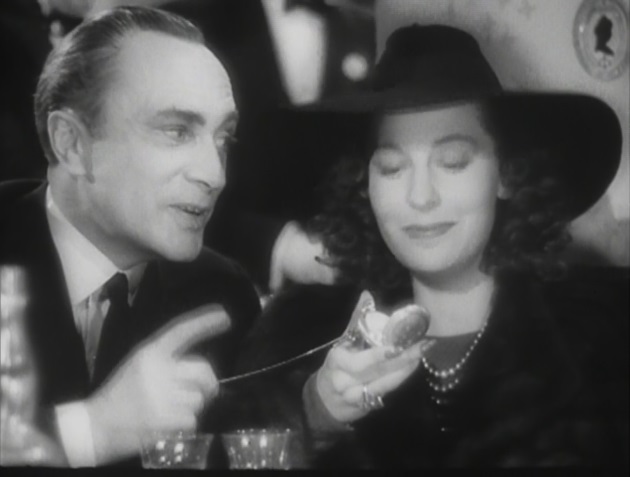
Contraband holds a number of similarities to All Through The Night (released by Warner Bros the following year). Both films are Hitchcockian thrillers and (as the title of the latter suggests) take place all through a single night in which a romantic hero inadvertently infiltrates a Nazi spy ring (even though the word “Nazi” is never used in ether film). On top of that, Conrad Veidt appears in both films, although he is cast as a villain in All Through The Night. I love films that effectively play out within a condensed time frame and Contraband is simply enormous fun to watch – one of those films which I felt like I had to tell someone about it afterwards I was left that thrilled. Contraband would be renamed Blackout for the US release, but I think Contraband is the cooler title.

Contraband would offer Conrad Veidt the rare role of a hero as Danish seaman, Captain Anderson. Veidt doesn’t have the looks matinee idol but he is very suave and pulls of the romantic hero with ease (sadly this great actor would pass away only three years following the release of Contraband from a heart attack aged 50). The bane to Captain Anderson, Mrs Sorensen (Valerie Hobson) is introduced defying the captain’s orders and not wearing a life jacket despite what the chattering gossips around her say. This defiance and Hepburn-esque, free-spirit attitude establishes Mrs Sorensen as a real badass.

The chemistry between Veidt and Hobson has shades of William Powell & Myrna Loy, with the two sharing moments reminiscent of screwball comedies. For example, the scene in which Sorensen calls for a taxi in a feminine voice after multiple taxis ignore Anderson is similar to the hitchhiking scene from It Happened One NightContraband makes reference to bondage on a number of occasions from Anderson’s early foreshadowing asking Sorensen “Have you ever been put in irons?” to the rather erotic, James Bond-style scene in which they attempt to break free after being tied up by their Nazi captors. All this sexual tension culminates by the film’s final scene in which Anderson directs Sorensen to drop her life jacket as it hits the floor and they go into a clinch, followed by phallic symbolism of a dripping wet anchor in the final shot – as steamy as a film from the 1940s can get.

Contraband is set in November 1939, the phoney stage of World War II. Like Powell & Pressburger would do in their subsequent film 49th Parallel, Contraband is clearly a rally call to other nations against neutrality in the war. Although a British film, Contrband is one which should ignite the patriotism in any Dane as Captain Anderson and his fellow Danish patriots from the Three Vikings restaurant in London work together to infiltrate the London based Nazis. Contraband offers an insight into life in London during the blackout as people try to go about their lives as normal, using torches to navigate their way in the street (they must be pointed down or else the blackout warden will call you out) and closing their eyes for ten seconds before going back outside. In one scene two wardens approach a man lighting up a cigarette in the street to which the man angrily responds “Why don’t you do something to earn your 3 quid a week and leave taxpayers alone”. With this portrayal of the restriction of liberties as well as the aforementioned refusal of Mrs Sorensen to be compelled to wear a life jacket, I can’t help for Contraband to directly remind me of recent world events as of writing this review. Due to the blackout setting, much of Contraband is visually dark and makes great use of chiaroscuro lighting and expressionist visuals – appropriate considering that the film stars the most notable cast member from the granddaddy of German Expressionist films, The Cabinet Of Dr Caligari. Unfortunately Contraband has yet to receive the special edition, 4K re-master treatment, with the film only being available in a scratchy print on an old Region 1, Kino DVD.

I do have to question if escapade off Captain Anderson’s ship and into London by Mrs Sorensen and her accomplice Mr Pidgeon (Esmond Knight) was part of a mission or a spur of the moment decision since we are lead to believe the British interception of the ship was unplanned.  It’s never made clear who or what Sorensen or Pidgeon are working for however it is reveled their aim is to find out under what neutral names, German vessels sail across the Atlantic, so in all likelihood, they’re probably British spies. Thus I do theorise that Sorensen and Pidgeon had a part to play on the British authorities stopping the ship and forcing it to dock overnight. This theory is backed up by the film’s ending in which one of the British authorities gives Anderson what he is told is a box containing painkillers to help him with his illness. Afterwards Mrs Sorensen tells him to look in the box only to find it contains the pocket watch which he lost in London, proving more or less she is working for the British authorities.

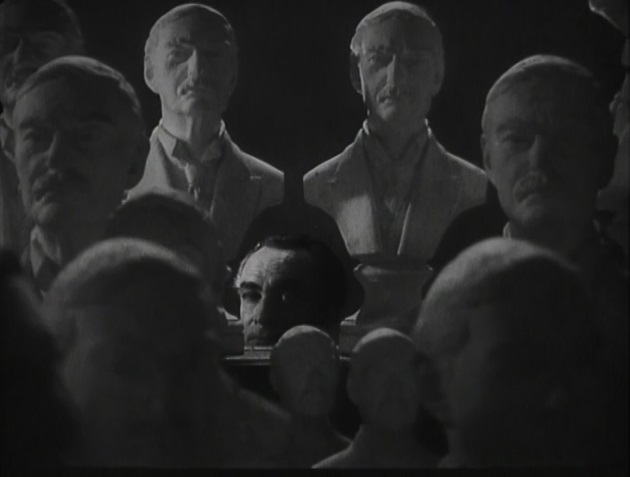
Adjoining the Nazi’s London layer is a warehouse full of busts of then British Prime Minister Neville Chamberlain by a company known as “Patriotic Plaster Products”. Why does a Nazi spy ring have a warehouse full of busts of Neville Chamberlain? Likewise, I can’t tell whether or not the film is trying to denigrate Chamberlain. After Anderson knocks out one of the Nazi ring leaders using one of the busts which simultaneously smashes it to pieces, Anderson responds “They always said he was tough”. Chamberlain left office on May 10th, 1940 and Winston Churchill became Prime Minister –Contraband was released in UK theatres the following day.