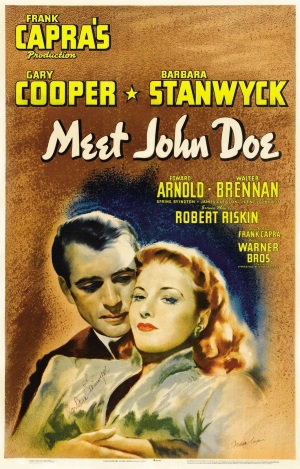
Meet John Doe (1941)

A Face In the Crowd

Sadly Meet John Doe appears to be an uncared about film falling into the public domain. I’ve previously wondered if this film could have the power to inspire real-life John Doe clubs, like Fight Club inspiring real-life fight clubs. Meet John Doe is the ancestor to film’s like A Face in the Crowd and Network, chronicling the rise and fall of a media built character. Meet John Doe is not thought of as a conspiracy/paranoia film but is a few actions scenes away from being a conspiracy thriller. After watching you’ll start feeling more like tin foil hat wearing conspiracy theorist untrusting of government and the establishment.

John Doe is a Christ-like figure; he preaches loving thy neighbour when he is disgraced a newspaper editor proclaims “chalk one up for the Pontius Pilates of the world” and even plans to sacrifice himself on Christmas day. On top of that, Barbara Stanwyck’s speech at the end in which she tells John he doesn’t have to die for the idea of the John Doe movement – that somebody else already did – the first John Doe and he has been keeping the idea alive for 2000 years, all while the Christmas bells ring. Classic Hollywood films sure love their hard-hitting symbolism and metaphors.

Barbara Stanwyck is a phenomenon here with so much life and energy she can make any bit of exposition entertaining. As for Gary Cooper and Walter Brennan in of their many film pairings; what is it makes them a great duo? Perhaps it’s just the humorous interactions of two folksy Americans. Cooper’s boyish charm is on full display here, such his baseball pitching in a hotel room to his curious on look at a naked statuette. Meet John Doe is one of the finest performances he ever gave with his outburst at the dinner meeting making the hairs on my neck stand up. Walter Brennan’s The Colonel, on the other hand, doesn’t trust any media, authority or society in general. He’s comically cynical in the extreme and probably be a conspiracy theorist if he had lived in later decades. Throughout the film he refers to others as “helots”; state-owned serfs of the ancient Spartans (“When you become a guy with a bank account, they got you, yes sir, they got you”).

Although the John Doe movement claims the John Does are inheriting the Earth, the movement is funded by a corporation; so did they not see someone like D.B Norton taking advantage of them? Edward Arnold as D.B Norton is one scary, menacing guy who is complete with his own personal army force, giving the full authoritarian dictator vibes. When he sees his servants listening to Doe’s speech on the radio and applauding, he realises the political power he can have if he can get John Doe on his side. Under a scheme to buy his way to power he uses the John Doe movement to further his own agenda, to create a political party of which he leads in order to become President of the United States. His description that he plans to create “a new order of things” and “the American people need an iron hand and discipline” sounds like he has the intent of turning the country into a fascist dictatorship. There’s no doubt that Meet John Doe among other things was an argument against American isolationism in the war.

Another striking moment of Meet John Doe is the monologue given by Bert Hanson, the soda jerker (Regis Toomey) on how little we know about our neighbours and how a failure to get the whole picture leads to misconceptions of other people. It’s true in real life, people you live next to for years and you never contact them: perhaps the guy next door isn’t a bad egg.

Many of Capra’s films showcase the people’s need for a leader (Mr. Deeds, Mr. Smith or George Bailey) and in turn, they appear to be clueless and misguided with one (think of Pottersvillie in It’s a Wonderful Life) in a showcase of Capra’s darker side. Here the public buying up what the media tells them such as when Norton exposes John Doe for being an apparent fraud in one of the movie’s most powerful scenes as the movie captures so vividly the destruction of a dream. As dark as the movie’s ending is, it still remains optimistic in which the fight goes on (“there you are Norton, the people!”).

Five Star Final (1931)

The Scum

***This Review Contains Spoilers***

Five Star Final is 85 years old yet nothing has changed in that the public still has an appetite to read about filth in newspapers. The themes here would be looked at in many newspaper comedies throughout the 1930’s, however, this is no screwball comedy – it’s deadly serious. I guess we can’t say “back in my day journalists had ethics”. The real-life inspiration for Five Star Final came from a New York tabloid called New York Evening Graphic. At the time of the film release, the Evening Graphic was losing circulation because its new editor was attempting to make it a more respectable paper, just like the character of Randall played by Edward G. Robinson the editor of the fictional tabloid newspaper The Gazette.

Randall is an editor who is not without ethics. Despite the objections of the paper’s management, “Randall won’t print pictures of girls in underwear in the pictures section” and prints cables from The League of Nations. The pressure is on him to stop printing “actual news” and more sensationalist stories and gossip. When Randall gives in we see the full sleaze of Edward G. Robinson; after all, nobody could do sleaze better than him.

The stealer of the show, however, is Boris Karloff as Isopod. This isn’t a horror movie but his performance feels like one straight from a horror picture with his distinctive, eerie voice. Isopod is a disgraced priest of whom Randall disguises as a practising priest to go undercover and do the paper’s dirty work; a creep who is full of crap and as Randall puts it “You’re the most blasphemous looking thing I’ve ever seen”. The name Isopod in Greek means ‘even footed’ but more commonly is the name an unpleasant looking order of crustacean parasites so I guess it works.

The Gazette has a number of shady practices; they bully retailers and vandalise their stalls for not putting their papers on top. Likewise they employee a pretty girl played by Ona Munson to do dirty work for the paper although the main reason they’re choosing her for the job is that she’s not flat chested, as evident by the shot in which Aline MacMahon is clearly looking at her rack (even Isopod enjoys checking her out).

In order, the increase the circulation of The Gazette, Randall unearths a 20-year-old murder case for the sake of a sensational story later titled, “Famous Killer’s Girl to Wed Society Man”. Today with this internet thing we’ve got going on it would be highly unlikely someone could hide the fact they were once tried for murder while Isopod could just get a photograph of the murder’s daughter on Facebook. But the fact remains the same: sensationalist news stories can affect the lives of innocent associates.

The film has a truly superb cast with everyone having their moment in the sun and this being a film set in the world of journalism, the dialogue flows at a rapid-fire rate; a form of acting which is truly a thing of the past. Marian Marsh’s breakdown at the end is hair-raising melodramatic brilliance, even if her husband just happens to walk in as she pulls out a gun in a delightfully improbable turn of events.

The production values are excellent, helmed under the great director Mervyn Le Roy (such an impressive back catalogue). The use of sound in the opening credits with boys shouting “extra!” and the noise of the printing press sets the atmosphere while it’s evident the studio strived for this production to have authentic sets. Many shots in Five Star Final have an impressive level of depth such as that of George E. Stone with his feet up in the foreground as he sits back while on the phone.

Five Star Final contains innovative use of split screen as Mrs Voorhes (Frances Starr) in the middle of the frame is trapped between paper employees who go about their business as usual and try to ignore her but also shows the paper as voyeuristic spies. Yes, the filmmakers sure love their symbolism here. Throughout the film, Randall is constantly washing his hands (“50 times a day” apparently) while the paper employees going to the bar and drink in order to deal with their conscience. Likewise, Randall’s closeted love interest Miss Taylor played by Aline MacMahon has feelings towards him but objects to his job and the paper; she is symbolic of his conscious. To top it all off, the film ends with an image of the paper lying in the gutter like the filthy rag it is; a final powerful image to stick in your mind.

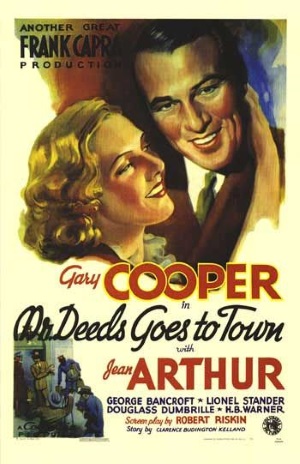
Mr Deeds Goes to Town (1936)

Meet Longfellow Deeds

***This Review Contains Spoilers***

I’ll admit that it took me a while for Gary Cooper to grow on me as an actor and to see his appeal under his minimalist, low key style of acting; but eventfully I got it. It’s been said Cooper’s face was the map of America; so why in under God did they cast Adam Sandler in a remake of Mr Deeds Goes to Town?

Mandrake Falls is a town full of oddballs, and the naive but not a total dunce Longfellow Deeds comes off as a weirdo to the city dwellers who are fascinated by his behaviour and start mocking him. Mr Deeds Goes to Town certainly highlights the divide between city slickers and small-town folk; this is particularly evident in the scene in which Deeds, himself a poet meets a group of distinguished poets in the restaurant and is appalled by their snobbery and elitism to the point that he beats them up.  Likewise, the film also features Charles Lane as a lawyer, the inspiration for The Simpsons’ blue haired lawyer.

In an example of the darker side of Capra’s films, Mr Deeds Goes to Town is a cynical look at society and the media as a whole (“Why do people seem to get pleasure out of hurting each other, why don’t they try helping each other once in a while?”). Multiple people are out to snag Deed’s fortune while the media is out constantly pursuing him due to his odd but ultimately harmless behaviour; the media manipulating how a person is seen by the public. Mr Deeds is a man who became famous for inheriting a fortune, in other words, he’s famous for being famous and the newspapers appear to have nothing better to do than report on his escapades such as feeding donuts to a horse; relevant to today’s celebrity culture.

With the scene in the park in which Babe plays a set of improvised drums and Deeds sings humoresque. Capra didn’t want to include it as he thought it was too sappy but Jean Arthur insisted it remain. Capra of all people thought it was too sappy?!  But ah Capra sentiment, it never fails to move me.

The sanity hearing at the end of the film is pure movie fantasy; I doubt in real life someone could be classified insane on such so-called evidence. In a demonstration of Cooper’s ability as one of the best actors when it comes to giving a rousing speech or monologue, he talks about the silly quirks we all have. Although the likes of “o” filling or knuckle cracking seems rather trivial, I’m always left with the impression that the movie is making a statement on society’s treatment of those who don’t fully “fit in” or adhere to conformity and asks the question; who is truly “normal”?

Rocky V (1990)

Back To Where It All Began

***This Review Contains Spoilers***

Few motion pictures seem to inspire as much intense dislike as Rocky V, even to the point in which Sylvester Stallone himself gave the film a score of “O” on a British talk show – yes, 0/10. Come on man, can you really say Rocky V has absolutely no merit to it what so ever? Even the sitcom The Vicar of Dibley bashes Rocky V in its pilot episode; “Four’s not bad is it? There were four gospels, four horsemen of the Apocalypse, four Rocky movies until they made Rocky V, very bad movie”. As a huge fan of the Rocky movies I’ll just come out and say it, I love Rocky V. Oh yeah, deal with it! Part V was designed the return the series back to its roots, not only by bringing Rocky back to his humble beginning on the streets of Philadelphia but also with the film being directed by John G. Avildsen, the director the first Rocky. In my eyes, the film succeeds in this aim.

The one big grip I do have with Rocky V is how it messes up the Rocky continuity. Just to give a brief recap of said continuity from Rocky III onwards: it isn’t made clear of the date in which Rocky III ends, but we are told the date of Mickey’s death as taking place in 1981 so we can assume Rocky’s second fight with Clubber Lang took place in 1981/82. Rocky IV picks up where Part III left off, but no dates are mentioned in the movie nor is it made clear on the passing of time. It seems most likely the events of Rocky IV take place somewhere from 1982 to 1985, the year in which the movie was released. Rocky V picks up where Rocky IV left off, and once Rocky returns to the United States from Russia and gets off the plane, he is greeted by his teenage son; however, at the end of Rocky IV he was still a child. There should have been a passing of time before the introduction of the teenage son. But on top of this, considering the early 90’s aesthetic of Rocky V, due in part of its soundtrack, it seems like Rocky really did travel through time when flying on that plane from the 80’s world of Rocky IV (perhaps some crazy fan theory explanation could solve the mystery such as Rocky staying in Russia for several years after his fight with Drago). While this plot hole does bother me to a degree, does it really interfere with my enjoyment of the overall movie? No, not really.

Once Rocky travels through time and is back in America, the family go home to a different mansion than that seen in Rocky III and IV, but I can accept perhaps they owned more than one property. Regardless, due to an issue involving taxes, the Balboa family lose their fortune and are forced to return to return to Paulie’s old place in Philadelphia. What was the tax issue? To quote IMDB’s FAQ section for Rocky V:

When Rocky was in Russia during Rocky IV, Paulie gave the power of attorney to Rocky’s accountant, because the accountant told Paulie he needed to authorize a tax extension. Given free access to Rocky’s accounts, the accountant used Rocky’s savings to finance a real estate investment, planning on having the money back in the account by the time Rocky returned from Russia. However, the real estate deal went bad and the money was never returned. Additionally, Rocky discovers that he has debt payments, mortgage payments ($400,000) and that the accountant hasn’t filed any of Rocky’s tax returns for over 6 years.

Ok, I’m not an expert on taxes, but the movie makes it sound convincing, so I’ll buy it.

Rocky’s return to his old stomping ground gives the film a welcome nostalgia factor, from Rocky wearing his clothes from the first movie to Adrian being dowdy once again and working in the pet shop, to the return of locations from the first movie such as the Atomic Hoagie Shop) at one point in the film, they even repeat the very first shot of the original Rocky). Likewise, the streets of Philly appear to be more graffiti and trash-laden than they had been in 1975/76. Rocky V also features Burgess Meredith’s final appearance as Mickey (even if he does look older than his last appearance in Rocky III), in a newly filmed flashback scene in which he gives one of the most powerful monologues in the series. his is ranks as one of my favourite scenes of the entire franchise, and I fail to see how anyone could deny its emotional impact.

Due to Rocky’s newly diagnosed brain damage, he is unable to return to the boxing ring and instead trains a new upcoming boxer Tommy Gunn (portrayed by real-life boxer Tommy Morrison); a predecessor to the plot of 2015’s Creed. Tommy Gunn is nowhere near as iconic or memorable as Apollo Creed, Clubber Lang or Ivan Drago, but I still enjoy his character and find him more interesting than Mason ‘The Line’ Dixon in Rocky Balboa. He’s an enthusiastic go-getter who eventually turns on his mentor and becomes seduced by the dark side of the boxing business. So yeah, it’s a better version of Star Wars Episode III: Revenge Of The Sith with Rocky as Obi-Wan, Tommy as Anakin and the boxing promoter George Washington Duke as Palatine. George Washington Duke is the main villain of the movie; a Don King-like boxing promoter. I love this guy; he’s such a stereotypical loud-mouthed salesman, continuing the tradition of over the top Rocky Villains. It is even implied by Duke himself that he is resentful of being the beneficiary of affirmative action (“Do people really think I’m a cheap carbon copy or a second-rate pretender who only got a shot because of my skin tone!”).

However, the real heart of Rocky V lies with its father-son story and the themes of neglect and abandonment between Rocky and his son Robert, played by Stallone’s real-life son, Sage Stallone; making the interactions between them feel more real and genuine. Not to mention the character of Robert has a frightening predicament of going from a sheltered life to living in a tough neighbourhood. It’s weird to think that both Sage Stallone and Tommy Morrison are now both dead; two young stars from a movie which is only 26 years old. Stallone already hates Rocky V as it is, but having the movie star his deceased son I’d imagine makes the movie even more unwatchable for him. In regards to the subplot involving Robert and the school bullies, I actually find this aspect of the story to be interesting itself. I feel it showcases how in order to make peace with the bullies he had to fight them back and win the battle, and that Adrian’s suggestion that she who would rather he solve his problems verbally would be a futile gesture. After Robert fights the bullies he then immediately makes peace with one of them and they become friends. Could this be a war parable, or am I just over-analysing?

Despite V being the black sheep of the franchise, Rocky V still ends on a fight, not in the ring but on the street. Having Rocky take part in a barbaric street fight makes for great entertainment, due in part to the fun of seeing Rocky engage in a fight in which there are no rules. I also love all the over the top crowd reactions (“Come on dad, he took my room!”,You’re losing everything!”). The film’s final pay off is immensely satisfying in which Rocky punches George Washington Duke right into the air and onto a car; what comeuppance!

Rocky V reintroduces Bill Conti’s music after being absent from Rocky IV. However, the soundtrack of Rocky V is mainly comprised of hip-hop and R ’n B. I’m not a fan of hip-hop, but I do like the songs included in the film. With Go For It I get the impression they were trying to create a new Eye of the Tiger; a song which is named after a phrase which is repeated throughout the film which is central to the plot. It could never be as iconic as Eye of the Tiger, but it still gets me jamming. I also love the new version of Take You Back which gives the song an early 90’s spin. All the films in the series reflect the periods in which they were made, and for Rocky V it’s the early 90’s. Likewise, continuing the series tradition of recapping the fight from the previous film, Rocky V presents a recap of the Rocky-Drago fight scored with the traditional Rocky music by Bill Conti rather than the Vince DiCola score from Rocky IV, which is a nice touch. The opening title with the faces of Rocky and Drago in the typography is also my favourite opening title in the series.

I’ve heard reviewers complain Rocky V is a depressing ending to the series. It becomes clear at the conclusion of the film that Rocky learns he doesn’t need wealth to be happy providing he’s still got his family and his health; and eventually he chooses his family over his career, pride, and ego. This is a theme which ties in with the end credits song The Measure of a Man sung by Elton John:

“You’ve come full circle, now you’re home, without the gold, without the chrome. And this is where you’ve always been, you had to lose so you could win. And rise above your troubles while you can.”

I did not find Rocky V in any way undermines the optimistic nature of the series. Initially, it was scripted for Rocky to die at the end, and there is even a deleted scene which shows the character of Marie from the first movie continued to hang out with the wrong crowd. These elements would make an interesting alternative version, but for my Rocky canon, I prefer the direction they took. Plus the reintroduction of Marie in Rocky Balboa was a better path for the character, more in tune with the series’ optimistic nature.

The end credits of Rocky V give a retrospective of the entire series which couldn’t be more perfect, plus I love the song The Measure of a Man. I don’t often talk about how great the end credits of a film are, yet with all the Rocky sequels I watch the credits in their entirety. Rocky V is the black sheep of the series in terms of plot structure. We already have four movies which end with Rocky fighting an opponent in the ring, it would have been tiresome to do that a fifth time. Instead, Stallone wrote a sequel which took a chance. So yes, I love Rocky V. Got a problem with that? Then my ring’s
Rocky IV (1985)

80’s: The Movie

***This Review Contains Spoilers***

Rocky IV is one of the most entertaining movies ever made. If there was ever a movie I can turn to for just 90 minutes of pure, immense, adrenaline filled, inspirational entertainment, it’s Rocky IV. The runtime is the shortest of the series, but those 90 minutes are perfect. The poster for Rocky IV is displayed proudly in my bedroom, and every now and then I look at it in all its majesty with Rocky sticking his glove up in the air while draped in the stars and stripes. I feel the Rocky movies had the ideal lifespan for a movie franchise; start off serious, goof out for some fun, but then end again on a serious note.

There’s no question about it, Rocky IV is the most 80’s movie ever. Case in point:

– Synthesized rock soundtrack.

-Cold war propaganda.

-Conservative, Reagan era values.

-MTV music video style montages.

-Larger than life villain.

-It’s a sequel of a long-running franchise.

-There’s a robot.

-Rocky drives a sports car.

-Display of decadence.

-Brigitte Nielsen, star of other very 80’s movies Red Sonja and Cobra.

-Action movie revenge plot.

-Full of cheesy/corny quotable lines (“If he dies, he dies”, “Whatever he hits, he destroys”).

Stallone’s inspiration for Rocky IV came from the two fights between Joe Louis and Max Schmeling in 1936 and 1938 respectively; two fights which embodied the political and social conflict of the time – an African American taking on a supposed representation of Aryan superiority. Thus in Rocky IV we get Ivan Drago, the terrifying Aryan superman Rocky must challenge to avenge the death of his friend (could that sound more 80’s?).  Ivan Drago is a terminator; the strongest opponent humanly possible; however is Drago an interesting villain? I say yes; one of my favourite screen villains of all time as a matter of fact. In a memorable Siskel & Ebert moment, Roger Ebert described Drago as a “moderately interesting villain” but complained “how come he never has a single scene alone with his wife” and “why does she have nine times more dialogue than he has?”. Drago doesn’t speak for himself as there is no individualism in communism. I feel Dolph Lundgren gives a great physical performance, playing a character who is the opposite of Clubber Lang in that he speaks few words; succeeding in being an intimidating monster with his physical presence alone. I also love Drago’s reaction to Apollo’s entrance at the exhibition fight; that of a Soviet being welcomed to America.

Ivan Drago is a product of a state that sponsors his training as exemplified in the movie’s two training montages. Drago’s music theme is cold, intimidating and mechanical, just like his training. He is given steroids by his trainers and at a press conference an American reporter says “There have been rumors of blood doping and widespread distribution of anabolic steroids in the Soviet Union”; feels like an eerie foreshadowing to the state-operated Russian doping scandal of 2016. Following the boycotts at the 1980 and 1984 Olympics, Rocky IV couldn’t have come at a better time when sports and politics were going hand in hand. Drago’s fit of rage near the end of the fight in which he proclaims “I fight to win. For me! For me!”, is clearly a jab at communism as he wants to work for himself and not for the glory of the country. Likewise, when he lifts up and throws the Russian official who criticises him, it’s a classic Frankenstein moment; the monster turning on its creator.

Apollo Creed’s entrance, on the other hand, is one of the most capitalistic things ever put on film, with James Brown singing Living In America among Belly Dancers and Creed himself dressed in stars and stripes; and to top it all off, it’s in Las Vegas. A stark contrast to the Russians who open the Rocky-Drago fight later in the movie to their national anthem (yet another awe-inspiring musical highlight in the film). Did Apollo’s ego untimely kill him? Apollo’s patriotic egotism clouded his better judgment and no idea just how strong Drago would be. The sheer power of Drago’s punches during the fight with Creed (if you could even call it that) are exemplified by the sound effects. Also, why does Drago receive no punishment for throwing the referee aside, but if I was going to point out every little thing in this movie which makes no sense I’d be here all day. There’s such brutality to Creed’s death; pure slow motion brutality. I’ll never forget my mum’s reaction the first time I watched Rocky IV, a gasping “oh my God!”.

When I was studying for my GCSE examinations, the Rocky IV soundtrack was one of my primary sources of music listening. Whenever I have a stressful day of work I listen to the Rocky IV soundtrack when I need that extra bit of adrenaline to make me go on. Feeling down? Rocky IV soundtrack! Need inspiration? Rocky IV soundtrack! Having a workout? Rocky IV soundtrack! 20% of the Rocky IV or 23 minutes is comprised montages with songs which can make anything look epic in one of the epitomes of the 1980’s soundtrack; everything you would expect from a score which won the Razzi for worst music score. The score by Vince diCola has been officially released but copies are not easy to come by. The actual Rocky IV soundtrack features different versions of War and Training Montage than those which appear in the film, although these variants are good in their own right.

If there is one word associated with Rocky IV, its montage. I can watch these montages over and over again and still be enthralled by them. The first training montage is heavy on its symbolism of nature vs. machine and showcases the beauty of the Russian wilderness. Ok, it’s actually Wyoming but I can buy into it being a vast frozen expanse of the Soviet Union. But it’s training montage number 2 which has to be my favourite training montage in film history. This is partly due to John Cafferty’s Hearts On Fire – a motivating, pumping anthem if there ever was one (that synth, God I love it!) In the spirit of everything in Rocky IV being larger than life, instead of running up the steps of the Philadelphia Museum of Art, the montage ends with Rocky climbing a mountain.

The editing of Rocky IV also contributes to the film’s bombastic nature. The transitional shots of magazine covers and newspaper articles make the film play out like more of a comic book than it already is. Likewise, shots such as that of Rocky’s Russian chaperone looking into binoculars gets repeated three times within a few seconds but zoomed in further each time and edited to the rhythm of the score; it’s just so cool. On the other hand, I even recall a review I heard for Star Wars: The Forces Awakens refer the final shot of that movie as a Rocky IV shot, in reference to the aerial shot of Rocky on top of the mountain. Is Rocky IV a more influential film than the history books let on?

Rocky IV is incredibly distant from the first movie but this is appropriate as Rocky is out of his element and in a foreign land. This is the only film in the series not to take place in Philadelphia unless you include the scene in the Balboa mansion although it’s never made clear where the mansion is located. The No Easy Way Out montage is comprised of clips from the first movie, so the film allows you to bask in the stark contrast between the movies; a man who used to be a not very intelligent nobody and made money from prizefighting and working for a loan shark is now at the center of international politics.

Even the sheer predictably of Rocky IV is wonderful, such as when Adrian shows up in Russia to support Rocky; it’s all cliché but in the best sense of the word. The build-up to the final fight and the atmosphere is so immense; there could never be a Rocky film more epic than this. By this point, I’m actually scared for Rocky and fearful for his life, and Paulie’s emotional outpour before the fight, it gets me every time. I don’t care what anyone says, this is the greatest fight in film history. Rules don’t apply and Rocky somehow lasts the 15 rounds and even wins over the crowd (“Suddenly Moscow is pro-Rocky!”). This isn’t just Rocky against another opponent, this is Rocky against a superhuman, a hostile crowd, a Mikhail Gorbachev lookalike and an entire world superpower. Keep your superhero movies with their city-destroying battles; this is what I call a duel! Rocky’s final speech is naive in the most wonderful way. The words of the speech are so juvenile, yet when I hear Stallone utter them in the movie; it brings a tear to my eye. Did Rocky IV really help end the cold war? Who knows? Oh, and the end credits provide us with yet another awesome montage!

Rocky IV embodies the essence of capitalism the American Dream; if you work hard, success is attainable. I know many would just look at the movie and scoff at it as a simplified look at the Cold War with an “us and them” mentality. But as a piece of propaganda does it work? Oh, you bet it does. Rocky IV, I salute you to your over the top, cheesy 80’s perfection.

Rocky IV > Citizen Kane

Rocky III (1982)

Rocky III: An American Tradition

After the recap of the fight from the previous movie, Rocky III opens with a montage which begins with fireworks and giant light up sign of Rocky as if to say “Welcome to the 80’s!”; a decade when everything was larger than life. The song of choice is Eye of Tiger, the montage is edited like an MTV music video and Rocky even appears on The Muppet Show; and all that merchandise, me want!

Rocky III is ridiculously entertaining while still managing to have thematic substance. Rocky is no longer struggling with fame. A man who couldn’t film a simple commercial in Rocky II is now making all sorts of endorsements. He could barely drive a car in Rocky II, now he can now drive with ease. Rocky has also become a more intelligent man instead of the dum dum he was in first two movies. Not to mention does he looks different, very handsome I might add and in such physical shape. I think Stallone looks like Al Pacino here, especially when wearing a suit.

Rocky III brought the series in a different direction, distant from the first two movies. But despite Rocky’s wealth and fame, Rocky III is not a movie which cheapens out. The primary theme of the movie is about Rocky’s fame making him soft or as Mickey puts it, “You got civilised”. Once Rocky discovers Mickey has been hand picking fighters his seemingly perfect bubble of a life is burst; “You wake up after a few years, thinking you’re a winner, but you’re not, you’re really a loser”. This continues the series theme of being semi-autobiographical of Stallone’s own life as the movie examines what fame and fortune can do to a person. Adrian’s role is smaller is time round although her character still sees an evolution as the famous lifestyle has taken away her shyness and made her more outspoken and pretty hot too I might add. Just listen to the words of motivation she gives Rocky on the beach; a far cry from the Adrian in the first movie.

Even when Rocky discovers Mickey has been hand picking fighters prior to his first fight with Clubber Lang, Rocky is training in the most superficial gym. It’s full of photographers and visitors, musicians are playing and merchandise is being sold.  Unsurprisingly he gets the worst beating of his life at the hands of Clubber Lang. The solution to Rocky getting his so-called “eye of the tiger” back; get away from the superficiality of his wealthy lifestyle and back to the nitty-gritty. As Apollo Creed puts it, “Man, when we fought, you had that eye of the tiger man, the edge! And the only way to get it back is to go back to the beginning; you know what I’m saying?”. I stick by these words as some of the wisest words I’ve heard uttered in a motion picture. Whenever you lose your mindset of determination whether physically or mentality, go back to where you first started in order to reclaim it. Rocky III humanises Apollo Creed with Rocky and Apollo becoming friends being a great spin on the story. I always think of his intense shouting of “There is no tomorrow!” whenever I need some motivation.

The hypnotic, uneasy music which plays when Rocky is training poorly under Apollo and stuck with the threat of living with failure reminds me of Bernard Herman’s score to Vertigo in possibly the most uneasy scenes in the series. Likewise, the scene of Paulie in the arcade has to be the most surreal scene in the entire series in which he throws a bottle pinball machine in slow motion complete with odd sound effects; it’s an image which doesn’t leave your head.

Mr. T as Clubber Lang, oh man! What a beast! A true larger than life villain with outbursts of immensely entertaining lightning fast dialogue; he sure has a way with words with such a violent temper and high levels of anger. You do not want to be stuck in an elevator with this guy. Which raises the question; is Clubber responsible for the death of Mickey by pushing him to the side? Yet even close to death Mickey can still inspire with scenery-chewing words of motivation; his death being one of the series most emotional moments. The boxer vs. wrestler charity fight on the other hand between Rocky and Thunderlips (Hulk Hogan) has nothing to do with the rest of the movie but dam is it entertaining. It’s so over the top with such intense pain on display. The referee and police officers are thrown to the side, the audience is assaulted and even Paulie gets in on the action (I do love those bits of humour Paulie provides).

The final fight in Rocky III is the only in ring fight in the series which takes place in real time until Creed.  Meanwhile, the final scene of the movie is such fun, with Rocky and Apollo playing off each other which along with the training montage gives off some homoerotic vibes along the way with sweaty, shirtless, muscular men in tank tops as well as men hugging and jumping in the sea.

Also, the film’s trailer refers to Rocky III as an “American tradition”. What’s the tradition? Hollywood sequels?

Rocky II (1979)

Rocky II: Electric Boogaloo

***This Review Contains Spoilers***

Rocky II picks right off where the first movie ended and with the characters are already established, we can get right into the story. Stallone writes and directs this time, and who knows his own creation better than him?

Rocky II has a much higher budget than the first film and thus doesn’t have the guerrilla filmmaking tactics of the first so while it loses something in that regard it’s still no less a beauty of a film. They can even afford to have a huge crowd of kids following him during the training montage and possibly the cheesiest moment in any Rocky movie. We now get two montages instead of one and the series obsession with them would grow from here. The final fight benefits the most from the higher budget. We actually get to see a large crowd of spectators instead of relying on stock footage and camera angels disguising the lack of extras; while the use of slow-motion captures the pain and barbaric nature of fighting in glorious detail. When Rocky and Apollo both fall to the ground at the end of the fight, the suspense is crazy! The final shot of Rocky’s beat up face as he slurs in classic Stallone fashion is so barbaric; a perfect shot to end the movie on.

In Rocky II we get to see what Rocky does now that he has lots of money for the first time in his life and you really get a sense of the character’s new found happiness. However, he becomes blinded by this happiness and it goes to his head such as when he buys a house without even checking the upstairs. Rocky struggles with his new found fame and can’t even film a simple commercial. Just like how the public turn their back on Rocky, the public turned their back on Stallone after his two follow up films to Rocky bombed; Paradise Alley and F.I.S.T. Like how Stallone had to do a sequel to Rocky in order to get by, Rocky has to fight Apollo again to get by and prove that he is not a fluke or a one hit wonder. Apollo’s trainer Duke also has a bigger role here and would continue to be more prevalent in Rocky III and IV; I love this guy and his intense words of inspiration.

Rocky II is easily the funniest movie in the series, from his poor driving skills to his mispronunciation of words when trying to film a commercial (“Smeel mainly”) but my favourite moment is when he tries to a catch a chicken as part of his training (“I feel like a Kentucky Fired Idiot”). I also find it funny the scene in which Apollo is being consumed by hate mail telling him to kill himself; it’s a good thing for him the web doesn’t yet exist. In terms of more twisted humour, Rocky takes Adrian to the zoo and even proposes to her there, because you know, retards like the zoo.

Rocky II was the first film in the series to use synthesizers in its score and the music feels very late 70’s and at times disco inspired (listen to the vocal version of All of My Life, it’s beautiful). Bill Conti’s ‘Redemption’ is by far the best piece of original music in the movie; it makes me want to climb a mountain.
Just a side note: In regards to the Rocky DVDs, only the first movie gets the special edition treatment and the rest are just bare bones releases. I know the first is considered the best but that doesn’t mean there’s no merit to the sequels that they’re just tossed aside on the home video releases.

Rocky II offers everything I could ask for in a sequel, a movie which stays true to the original but offers new elements along the way. It advances the story and adds an extra layer of depth to already complex characters. In 1979 the New Hollywood movement was coming to an end and the age of the blockbuster had begun. In 1976 Rocky lost the final fight but keeping with the newfound optimism in Hollywood movies, in 1979 Rocky wins the fight (although timeline wise its late 1976).

Rocky (1976)

The Philadelphia Story

I may sound like a bit of a fanboy when I talk about the Rocky franchise but I just legitimately love all these movies so much. This is a series which always inspires me and has aided me during my darkest days. Rocky was one of the first movies to have such a profound impact on me, making me appreciate cinema on a deeper level. I first saw Rocky on TV and week after week came back to watch the sequels; such joy I had and memories I never forget.

I don’t think there is a fictional character whom I’ve been more emotionally invested in than Rocky Balboa. Could there be a character who is more honest or down to Earth? A man who has next to nothing yet has such a positive outlook on life (“Naw I ain’t got no phone, I had to pull it you know because people calling me all the time, and who needs the aggravation, right?” – such profound wisdom). The character is also a mystery and an enigma; who are his parents and what about his early years? Apart from a few brief snippets of information, it’s up to the viewer’s imagination instead of giving us a pointless origin story which Hollywood is so keen on nowadays. The character is biographical of his creator Sylvester Stallone throughout the whole series; his fictional alter ego. Just like Rocky, Stallone had next to nothing before making it as a star. Just like how the character rises to the challenge against impossible odds, the movie also beat impossible odds by becoming one of the biggest sleeper hits of all time. Likewise what movie or character is more identified with a city or has such reverence for the location it was filmed.

All the films in the series reflect the periods in which they were made. It’s 1976, America’s Bicentennial year. Perhaps the country didn’t know it needed an injection of optimism after years of cynical and pessimistic film as well as political upheaval. Don’t get me wrong, there will always be a place for cynicism in movies but with such movies dominating the mainstream at the time it was clear that enough was enough. It seems like happy endings where against the law in the first half of the 70’s, but Rocky brought them back for better or worse, and film snobs will look down on it for that. But yes, I do blubber away at this ending and Adrian’s uttering of “I love you!” is the greatest “I love you!” in cinema history. The ending has that same feeling of joy and happiness as seen in the ending of many Frank Capra movies. Speaking of Capra, Rocky’s response to being asked if he wants to fight Apollo Creed for the world heavyweight championship is like Gary Cooper in Mr Deeds Goes to Town when he is told of the vast sum of money he has inherited.

As the filmmakers didn’t get permission to shot for many of the on locations, guerilla filmmaking techniques where employed in the making of Rocky; capturing the streets of Philadelphia in all their glory with that distinctive that gritty look of 70’s films while aided with the use of the then-new technology in the form of the steady cam. You’d be hard pressed to find a movie which is more naturalistic and unmanufactured as Rocky.

It’s astounding that such a low budget film could have had such a great soundtrack and score. Bill Conti’s score to Rocky always makes me feel melancholic; the Rocky soundtracks have given me hours upon hours of listening pleasure. I even watch the end credits of all the films for the music (well except the first one as the end credit music here is quite dreary). The Rocky movies are also responsible for my love of montages. I’ll never forget the feeling of exuberance I felt watching the film’s training montage for the first time and hearing Gonna Fly Now; we’re talking the goosiest of goosebumps.

Roger Ebert compared Stallone to Marlon Brando in his original review, and in 1976 no one could have seen this man being a future action movie star, but I maintain the man is more intelligent than people make him out to be. He’s made a respectable career out of what he is capable of doing. How many people can claim to have been able to write installments in a film series which has lasted four decades and still manage to keep the long-running story interesting? During the filming of Rocky, he had to do script rewrites on the spot such as upon discovering the ice rink for Rocky and Adrian’s was completely empty or the shorts on the giant poster of Rocky in the stadium where the wrong colour.

When I watched this film at a younger age, I never fully appreciated the romantic angle, yet watching it from a more mature perspective. Rocky and Adrian are like two misfits who don’t fully fit in with the rest of society. There is a goddess with Adrian, and only Rocky can see it. The scene in which Rocky invites Adrian to his apartment after their first date took my breath away like few other love scenes have ever done. The sexuality on display is immense with Stallone in a vest and the gradual build-up to their first kiss, and I’m sure they did it.

The world of Rocky is populated with such unforgettable characters. Rocky’s trainer Mickey Goldmill is one of the greatest mentors in film history (either him or Obi-Wan Kenobi in my book) with his grouchy and curmudgeon manner. I feel Burgess Meredith is an actor who got better with age, so no surprise his most famous role came to him at the age of 68. Paulie (Burt Young) is one pathetic hateful loser, abuses his sister, is violent and yet you can’t help but feel sorry for him. Apollo Creed (Carl Weathers) on the other hand, dam! What a showman with his charisma, confidence, cockiness, and ego; the archetype of a leading man from a blacksploitation film. Yet despite being a black man, he is surely one of the most patriotic characters ever put on screen who shuns any left wing mentality of victimhood; sounds like a dam monster movie!

One more recent viewings of Rocky I’ve also come to appreciate Tony Gazzo (Joe Spinell) more as a character. A charismatic loan shark who employs Rocky and has a real liking for him, giving him money for his date, attends his fight with Apollo and doesn’t try to take over his boxing career whereas many other mobsters would. Yet Rocky’s lenient collecting style by refusing to break the thumbs of clients who don’t pay up causes problems for Gazzo yet he treats Rocky almost like a brother. It shouldn’t come as a surprise then that in the original script for the film, Rocky and Gazzo where brothers.

When Rocky visits the empty arena before the fight you can feel the pressure and weight that bestows him. By the time the final fight comes around I’m so emotionally invested in this character that I’m rooting for him like it’s a real fight. During the fight itself, the punches look real and there’s no sped up footage like boxing films of the past; while Bill Conti’s score ups the intensity and suspense for some serious emotional impact.

It’s a Wonderful Life (1946)

It Happened One Christmas

***This Review Contains Spoilers***

Why yes I do cry like a baby over it’s a Wonderful Life: every time. That ending is such a huge release after such as a dark and depressing alternative reality. I’m always left shaken up by it and need a break before I can watch another movie as well as making me want to make amends with loved ones. I’m sure everyone who watched It’s a Wonderful Life thinks to themselves what the world would be like if they were never born. The struggle of George Bailey is relatable to a wide spectrum, and I know for myself it really hits home. Being stuck in a dead-end town and feeling you will bust if you don’t get away from it; having your life not going the way you intended it to while your siblings appear to be doing so much better than you. But in at the end George Bailey realises what he’s got when it’s all gone, above it all, God’s greatest gift. It’s a Wonderful Life takes placed in a world in which God exists (and can focus his time on this one person over the rest of the world, but I digress). I’ve never felt however for It’s a Wonderful Life to have a religious agenda, it’s merely just a plot device for the film’s fantasy elements.

Lionel Barrymore’s performance as Henry F. Potter I feel is a tie between his brother John’s roles in Twentieth Century as the best performance from the Barrymore clan. Potter is one of the biggest douche bags in movie history; the archetype evil business mogul and ripe for comparisons with real-life figures. Not only has he no charitable side, he directly steals money in order to destroy his competition. Unlike other screen villains, Potter does not get any comeuppance at the end of the film, although you could say he’s destiny as a sick, frustrated and lonely man who hates anyone that has anything he can’t have is punishment enough. Potter isn’t a total caricature though, he is more three dimensional than that. He’s a man who knows how to conduct and run a business and understands that high ideals without common sense could ruin a town. But George Bailey is no fool, he is a natural born leader, even if he doesn’t realise it. He stands up to Potter without giving it a second thought, runs a building and loan which is a real estate empire itself; even his father states to him that he was born older than his brother.

Moments like the makeshift honeymoon suite in the broken down house which they later make their own or the recurring gag with the mantle at the end of the stairway represents the kind of writing which elevates It’s a Wonderful Life above the majority of other movies. Like the greatest of films, you notice something new on every viewing. Likewise, nobody can do moments of intimacy like Frank Capra, the movie is full of scenes in which it is simply two actors talking with no background music, yet creates raw human emotions like no other. Take a scene such as George and Mary walking through a neighbourhood at night while George talks about his ambitions for the future, the rest of the world ceases to exist. Many will be quick to put down Capra’s work as so-called “Capracorn” or as Potter puts it, “sentimental hogwash”. Get off your high horse and stop thinking you’re above such emotion – cinema is about the manipulation of emotions.

It’s hard not to feel sentimental for the representation of small-town America on display. Bedford Falls itself is a town full of interesting and unique characters. It actually reminds me of The Simpsons. Potter himself is essentially the town’s own Mr. Burns in The Simpsons – the people of Springfield hate Burns but are dependent on him for their energy needs. Likewise, the people of Bedford Falls hate Potter and would be dependent on him for their housing if it wasn’t for the competition of the Bailey Building & Loan.

Due to its public domain status, the film was shown on some TV networks in 24-hour marathons. I’d happily watch one of those networks as I can’t stop watching It’s a Wonderful Life no matter what point in the movie I begin. Could you get a more perfect marriage between actor and director than James Stewart and Frank Capra? Collaborating on a perfect trilogy of films, with each one better than the last. It’s a Wonderful Life? It sure is.

Dances with Wolves (1990)

Writes With a Keyboard

It’s more than apparent that Kevin Costner has such love and reverence for the Hollywood western, as he resurrects the genre one decade on from the infamous flop that was Heaven’s Gate and continuing the long tradition of epic Hollywood filmmaking in Dances With Wolves. I find it refreshing to see westerns which include the Indian point of view and the insight Dances With Wolves provides into the culture and lifestyle of the Sioux as well as hearing a language not often heard is fascinating. The Indians in Dances With Wolves are humanised with moments such as when John Dunbar (Kevin Costner) endures a relatable awkward moment as he sees Kicking Bird (Graham Greene) having sex in the tipi they are sharing, to moments in the film in which the Indian children of the tribe have the desire to be grown up and act older than they are. The Indians, however, are not sanctified either and the film avoids the noble savage stereotype; some members of the tribe are vicious killers and openly express their prejudice. The white man on the other hand is shown killing mass amounts of Buffalo only for their horns, throwing their trash on the ground and polluting the water. More significantly the film shows the Sioux’s rival tribe The Pawnee working in co-operation with the US military to take out the Sioux, presenting the conflict between settlers and natives as not a simple good/bad dichotomy – Dances With Wolves presents both villainy and nobility on both sides.

Although not many people share the fondness I have for Kevin Costner and dismissing him as a dull, monotone actor, I point to Dances With Wolves as a showcase that the man is a great screen presence as he carries a four-hour-long movie on his shoulders with no dialogue for long stretches of time while exuberating his commanding narration voice. The passage of time in which John Dunbar very slowly over the course of a four-hour runtime becomes assimilated into the Sioux culture, learns their language and becomes more emotive and open from his previously quiet, stoic self represents an astounding piece of storytelling. Unfortunately, certain individuals will look upon a movie like Dances With Wolves and decry it as offensive for its display of so-called “cultural appropriation” because apparently, the embracing of other cultures doesn’t represent unity between races but thievery of one culture’s ways by another. Dances With Wolves is a film that speaks to our humanity and shows how race can transcend culture. The scene in which Dunbar is being held by the US soldiers as they assault him, denying him to return to his newfound way of life as well as killing his wolf companion Two Socks and using his diary as toilet paper is beyond painful to watch. I’ve become so attached to the character at this point that I can’t bear to watch everything he has worked towards being destroyed.

I can’t say if Dances with Wolves is a movie intended to carry an environmental message but that is an impression I get from it from the film’s contrast between the resourceful Native Americans to the more polluting white men (Costner would go on to later produce and star in the eco-thriller Waterworld). John Dunbar’s desire to see the western frontier before it disappears is comparable to the last great frontiers today which are apparently at risk of eventually disappearing if modern climate change accounts are anything to go by. John Dunbar is a man who doesn’t want to take advantage of the land but to simply admire and bask in it – who needs CGI when there’s a world of scenic and natural beauty out there begging to be captured on film? Simply look at the film’s majestic landscapes of the badlands accompanied by John Barry’s score which evokes a real sense of wonder. “Why go out to a location when you can just create it on a computer. Isn’t that so much easier?” – sigh. Likewise, the famous buffalo hunt scene is the real deal. How do you recreate a buffalo hunt? Why get huge herds of buffalo of course. Like the chariot race in Ben-Hur, history is brought back to life with herds buffalo as far as the eye can see with stuntmen on horseback right in the middle of it all; pulling off something as huge as this and retaining continuity is astounding. Dances With Wolves doesn’t come off as cold, callous Oscar bait but sadly it is another movie in which its Best Picture win has hurt its reputation; “Dances With Wolves is just that movie which beat Goodfellas”.